


Eriksen, Clarkston Finish 'Dream' Run
November 30, 2013
By Bill Khan
Special to Second Half
DETROIT — Ian Eriksen's senior season was slipping away.
And so was his lifelong dream.
Eriksen and his football-playing buddies in Clarkston talked about earning an MHSAA championship back when they were in elementary school and winning the Super Bowl of the Northern Youth Football League in Oakland County.
But after rushing for 2,167 yards and 33 touchdowns as a junior, Eriksen came into his senior year with Achilles and ankle injuries, then underwent arthroscopic surgery for a partially torn meniscus in his right knee on Sept. 19.
Four Friday nights passed with Eriksen in street clothes, unsure of when — or if — he'd ever rejoin his teammates in pursuit of their shared dream.
"That was really tough, because I've never been injured that seriously," Eriksen said. "It could've been a lot worse. I tried to be positive. All you can do is be positive rather than mope over it."
One positive out of the situation may be that Eriksen was fresh enough by the end of the playoffs to take on a heavy workload and help carry the Wolves to their first MHSAA football title.
Eriksen ran 32 times for 237 yards and three touchdowns in Clarkston's 32-14 victory over perennial power Detroit Catholic Central in the MHSAA Division 1 championship game Saturday at Ford Field.
He also had a 30-yard catch to extend Clarkston's first touchdown drive, and a sack. In Clarkston's last two games, Eriksen ran 76 times for 592 yards and nine touchdowns.
"He gave us a lot of problems," said veteran Catholic Central coach Tom Mach, who has built a dynasty with the power-running game. "He was a very good running back. He would be a good running back in our program. We would've loved to have him. We had a lot of trouble tackling him. He got the extra yard and put in the extra effort.
“They kept the ball away from us, getting those first downs, getting those first downs, getting those first downs. That's frustrating on a team, especially when you do get the ball when you're a ball-control offense like us."
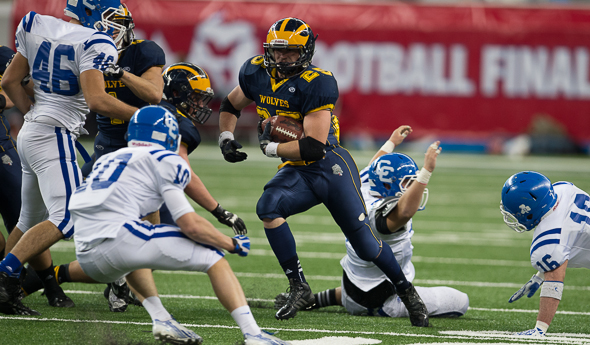 Bringing Clarkston its first MHSAA championship was the fulfillment of a dream for Eriksen and his teammates after the program reached three Semifinals and made the postseason 16 times under 27-year coach Kurt Richardson.
"In Little League, there's a Super Bowl," Eriksen said. "We won the Super Bowl together in 2006 when we were in fourth and fifth grade. The next thing we started talking about was winning a high school championship if we could do it. We knew we could."
Eriksen and some of the players who delivered that championship were in the stands at Troy Athens four years ago when Clarkston lost by two points in a Semifinal to Sterling Heights Stevenson.
"I remember when that happened," Eriksen said. "Everyone in the community was just so upset about that. Me and the other guys were like, 'That's not going to happen to us when we get there.'"
Clarkston made Catholic Central settle for a third straight runner-up finish by stealing a page from the Shamrocks' script.
Led by Eriksen and an outstanding offensive line, the Wolves ground out 288 yards on 45 carries. They had a 27:58 to 20:02 advantage in time of possession.
"The offensive line doesn't get enough credit," Richardson said. "They deserve it for this one."
After a punt and interception ended Clarkston's first two drives, the Wolves scored touchdowns on their next five possessions.
Both teams had promising drives end with interceptions deep in the opponent's territory before Clarkston broke through for the game's first score with 13 seconds left in the first half.
Converting three times on third down and once on fourth, Clarkston moved 91 yards in 17 plays, taking 6:36 off the clock, before D.J. Zezula hit Shane Holler with a 15-yard touchdown pass on a post route. The extra point failed.
The key play on the drive was a 30-yard pass to Eriksen on third-and-12 from Clarkston's 15-yard line.
"We knew we had to score, because we got the ball to start the second half," Zezula said. "It was 0-0 and we knew we had to get up on CC. They brought in an extra (defensive back). The play-action with Ian helps me out a lot with time and the O-line helps me a lot with time. We knew the play-action would work."
Catholic Central's best drive of the first half came following the opening kickoff. The Shamrocks marched to the Clarkston 24 before Tim Cason intercepted a pass, only the second pick thrown by Catholic Central all season.
Jack Van Acker made two big plays to keep Clarkston out of the end zone on the Wolves' second possession. First, he made a touchdown-saving tackle on a 35-yard run by Eriksen to the Shamrocks' 10-yard line. Then, two plays later, he picked off a pass in the end zone after Clarkston moved to the 6.
A 63-yard punt by Zach Bock pinned Clarkston at its own 9-yard line with 6:49 left in the second quarter before the Wolves drove for the only touchdown of the first half. Clarkston's average starting field position on three first-half possessions was its own 10.
Armed with a lead and momentum, Clarkston took the opening kickoff of the second half and marched 80 yards in eight plays, taking a 12-0 lead on a 37-yard run by Eriksen with 8:18 left in the third quarter.
The lead reached 18-0 on a 1-yard run by Eriksen with 3:59 left in the third.
Catholic Central got on the board when Dylan Roney scored on a 2-yard run with 45 seconds left in the third quarter, cutting Clarkston's lead to 18-7.
The Wolves responded with a seven-play, 71-yard drive that ended on a 47-yard pass from Zezula to Caine Watlington with 8:35 left in the game.
The Shamrocks scored again on a 48-yard pass from Sean Birney to Alexander Bock with 5:46 left, but Clarkston again had an answer, with Eriksen scoring on a 12-yard run to cap the scoring with 4:06 left.
Zezula was 10 for 15 for 154 yards, two touchdowns and one interception. Birney was 13 for 23 for 166 yards, one touchdown and one interception.
Clarkston won its final 13 games after a season-opening loss to Rochester Adams, a loss the Wolves avenged in the playoffs.
"A lot of these kids have been playing together since fifth grade," Richardson said. "They've played Chiefs together, so they've come up through the junior ranks. We all felt this could be a special season. We had some issues at the start. We talked to the kids at the time about turning a negative into a positive. You're going to get slapped in the face in life. We got slapped in the face in the first game. They learned from it. It was a huge coming-together point for us as a team."
Catholic Central (11-3) became the third team to finish runner-up three straight years. Utica Eisenhower was the Division 1 runner-up from 1999-2001 and Crystal Falls Forest Park was the Division 8 runner-up from 2004-06.
The Shamrocks' 2012 runner-up team was led defensively by sophomore middle linebacker David Widzinski, who had a game-high 15 tackles. Less than two weeks later, he died in his sleep.
Tributes to Widzinski were visible at Ford Field. Catholic Central's uniforms had a patch with his No. 33 inside a shamrock. In the student section, some students wore white and formed a 33 within a field of blue shirts worn by the others. Widzinski's jersey hung on the wall on the Catholic Central sideline.
"We brought up David a lot," Mach said. "He was a force behind our team all year long. Every day after practice, we would say a prayer for him and the people in our community who are suffering. It was a real learning experience for our kids to put something bigger than themselves in place of winning and losing."
PHOTOS: (Top) Clarkston players trade high fives with fans as they march off the Ford Field turf with their first MHSAA championship trophy. (Middle) Clarkston running back Ian Eriksen runs through the reaching arms of Detroit Catholic Central defenders Saturday. (Click to see more from Terry McNamara Photography.)
Drive for Detroit: Week 3 in Review
September 10, 2018
By Geoff Kimmerly
Second Half editor
Just like that, we're three weeks into another Michigan high school football season.
 And just like that, the picture of what we might expect this fall is beginning to get a little bit clearer.
There are 128 undefeated teams setting the pace. Some we're used to seeing at the top, and a number of others are enjoying encouraging turnarounds early this fall.
Below we offer glances at 45 games that popped from the page this past weekend, and we're just beginning to tell the story.
“Drive for Detroit” is powered by MI Student Aid.
Bay & Thumb
HEADLINER: Davison 36, Flint Carman-Ainsworth 29 These Flint-area powers haven’t been in the same league since 2013, but Davison (3-0) ran its winning streak over Carman-Ainsworth (2-1) to three straight with a late score and win in the Saginaw Valley League Blue opener. Click for more from the Flint Journal and see below for highlights from WJRT.
.@DavCardFootball rallies late to beat @CarmanAinsworth, remain perfect @DavisonMade @CACavaliers https://t.co/ZgDnRqOiNC
— ABC12WJRT (@ABC12WJRT) September 8, 2018
Also of note: Flint Hamady 24, Flint Beecher 18 With the other three Genesee Area Blue teams starting out a combined 2-7, Hamady might be in nice shape already to win its first league title since 2007. The rival Buccaneers (1-2), however, are hoping to turn things around quickly as they seek to get back to the playoffs for the first time since 2015.
Remember this one: Sandusky 28, Ubly 22 These two and Harbor Beach have been in the mix for most of the Greater Thumb Conference East titles this decade; Sandusky (3-0) has an early upper hand this time, but Ubly (2-1) will be waiting for a trip-up.
Other shoutouts: Saginaw Swan Valley 41, Freeland 3 The Vikings (3-0) have looked unstoppable early, this time winning big against the rival Falcons (2-1). Cass City 40, Marlette 14 The Red Hawks (2-1) have bounced back from a Week 1 loss with two big wins including this one over a Marlette team that beat Harbor Beach in Week 2.
Greater Detroit
HEADLINER: Oak Park 23, Farmington Hills Harrison 15 In successive weeks, Oak Park (3-0) has defeated Birmingham Groves and now Harrison (2-1), the teams with which it shared the Oakland Activities Association White championship a year ago. The Knights are impressing especially on defense, giving up just under 12 points per game. Click for more from the Oakland Press and see highlights below from State Champs! Sports Network.
??VIDEO: Check out the highlights of the Oak Park (@OakParkHighMI) vs. Farmington Hills Harrison (@FHHarrisonFB) game from Friday night pic.twitter.com/sn9HAbEiqx
— STATE CHAMPS! (@statechampsnet) September 8, 2018
Also of note: Clinton Township Chippewa Valley 45, Utica Eisenhower 24 The Big Reds (3-0) are the team to chase in the prestigious Macomb Area Conference Red after this win over last season’s champion Eisenhower (1-2) – which edged Chippewa Valley 49-42 a year ago in the game that eventually decided the title.
Remember this one: Lake Orion 28, Rochester Adams 24 The Dragons (1-2) had a tough 2017, which included a 39-8 defeat to Adams (2-1). But they got their first win this fall by handing a first loss to the reigning OAA Red co-champ.
More shoutouts: Canton 47, Plymouth 26 The Chiefs (2-1) handed the neighboring Wildcats (2-1) their first loss as the rivalry started a new chapter with both teams boasting new coaches. Dearborn Heights Crestwood 22, Romulus 20 Crestwood last was 3-0 in 1991, according to michigan-football.com, and equaled last season’s overall win total by downing a reigning league champion in the Eagles (0-3).
Mid-Michigan
HEADLINER: East Lansing 31, Grand Ledge 28 This one told a lot about one of mid-Michigan football’s premier leagues. East Lansing, last season’s Capital Area Activities Conference Blue runner-up, now looks most likely to provide newcomer DeWitt the biggest challenge in this fall’s league race. But Friday also showed reigning champion Grand Ledge has the opportunity to make an impact despite graduating much of last year’s team. Click for more from the Lansing State Journal.
??VIDEO: Check out the highlights of the East Lansing (@eltrojans) vs. Grand Ledge (@GL_football) game from last night pic.twitter.com/nBEJvIMTxD
— STATE CHAMPS! (@statechampsnet) September 9, 2018
Also of note: Greenville 41, Lowell 35 (OT) The Red Arrows (0-3) are having rare struggles to open this fall, but beating them is still a huge accomplishment – and Greenville (1-2) had dropped three games to Lowell over the last two seasons, including once in the playoffs.
Remember this one: Williamston 21, Fowlerville 14 These two are main reasons the CAAC Red has a new look this fall, and Williamston (3-0) has an early advantage on contending for the league title – although much-improved Fowlerville (2-1) showed it can’t be counted out.
More shoutouts: Clare 42, Harrison 18 Harrison (1-2) remains the last team to beat Clare (3-0) in the Jack Pine Conference – back in Week 9 of 2015. Holt 14, Traverse City West 7 Downing a 2017 playoff team like West (1-2) is a great sign for Holt (1-2), especially after the Rams opened with losses to two more tough nonleague foes.
Northern Lower Peninsula
HEADLINER: Lake City 14, McBain 12 Recall that the Trojans (3-0) stormed back from 2-7 in 2016 to 12-1 last fall, and that they earned the Highland Conference title because of a 28-8 win over eventual runner-up McBain in Week 3. The Ramblers (1-2) made this one closer, but Lake City’s 12-game regular-season winning streak lives on. Click for more from the Cadillac News and see highlights below from MI Sports Now.
.@LCTROJANFOOTBAL turns back McBain in thrilling 'Overtime on the Road' matchup https://t.co/djRZ8IJevh pic.twitter.com/Gce55ca4SV
— MISportsNow (@MISportsNow) September 8, 2018
Also of note: Manton 28, Beal City 22 The Rangers (3-0) were last 3-0 in their most recent playoff season, 2014, and hadn’t beaten Highland Conference foe Beal City (0-3) since joining the league in 2007.
Remember this one: Cheboygan 22, Boyne City 6 The Northern Michigan Football League Legends division could be shifting as Cheboygan (1-2) handed the reigning champion Ramblers (1-2) their first league defeat after a perfect run a year ago.
More shoutouts: West Branch Ogemaw Heights 18, Wyoming Kelloggsville 14 Kelloggsville (1-2) is struggling after last season’s 10-1 finish, but regardless this is big for Ogemaw Heights (1-2) as it equaled its win total for the last three seasons combined. Manistee 33, Ludington 14 The Chippewas (3-0) have bounced back from last season’s 2-7 finish and handed Ludington (2-1) its first defeat to start Lakes 8 Conference play.
Southeast & Border
HEADLINER: Monroe St. Mary Catholic Central 20, Riverview 6 St. Mary (2-1) has played three 2017 playoff teams to open this fall, including reigning Huron League champion Riverview (2-1). The Falcons are chasing in the league after falling to Milan last week, but now will cheer for Riverview to take down Milan this week and open the league race all the way back up. Click for more from the Southgate News-Herald.
Also of note: Dundee 33, Hudson 6 The Vikings (3-0) equaled last season’s win total by defeating the reigning Lenawee County Athletic Association champion Tigers (2-1), a big step as Dundee seeks its first playoff berth since 2012.
Remember this one: Brooklyn Columbia Central 21, Ida 20 These are two more contenders in the LCAA, with Ida (2-1) last season’s runner-up and Columbia Central (3-0) one of the new favorites.
More shoutouts: Jackson 27, Monroe 20 The Southeastern Conference is treating Jackson (3-0) well. Although this was just a crossover, the win over Monroe (2-1) was impressive and with two league victories to begin the fall gave the Vikings their best start since 2003. Dexter 37, Ann Arbor Huron 14 A week after breaking a 42-game losing streak, Dexter (2-1) guaranteed its best finish since 2011.
Southwest Corridor
HEADLINER: Hartford 26, Mendon 24 (OT) Mendon does not lose often during the regular season; in fact, the Hornets were riding a 21-game regular-season winning streak before Hartford pulled off this headline grabber. Mendon had won last year’s meeting 41-14 on the way to claiming the first Southwest 10 Conference title. Click for more from the St. Joseph Herald-Palladium and see below for highlights from FOX 17.
Hartford 26, Mendon 24 @HartfordFB https://t.co/WuSHoQLKdr
— FOX 17 Blitz (@FOX17Blitz) September 8, 2018
Also of note: Portage Central 21, Portage Northern 20 Central (2-1) scored the go-head touchdowns during the final minutes to bounce back from a Week 2 loss and make it five straight over the rival Huskies (2-1).
Remember this one: Berrien Springs 41, Schoolcraft 28 The Shamrocks (2-1) opened this season with a loss but have bounced back with two solid wins including this one over a Schoolcraft team that has made the playoffs nine straight seasons and also sits 2-1.
More shoutouts: Delton Kellogg 28, Fennville 7 The Panthers are 3-0 for the first time since 2009 after handing Fennville (2-1) its lone defeat. Battle Creek Central 30, Battle Creek Lakeview 15 Central’s second straight win over Lakeview (0-3) put the Bearcats at 3-0 after they won three games total both of the last two seasons.
Upper Peninsula
HEADLINER: Calumet 14, Ishpeming Westwood 12 A few late defensive stops could end up being the difference in the Western Peninsula Athletic Conference large-school title race as Calumet (3-0) hung on to deal Westwood (2-1) its first defeat. The Copper Kings have playoff-caliber Iron River West Iron County and Norway next, but both are in the league’s other division. Click for more from the Houghton Daily Mining Gazette.
Also of note: Ishpeming 46, Norway 19 The West PAC small-school division is loaded, but with this win it looks like Ishpeming (3-0) and West Iron might be favorites with Norway (2-1) on the chase.
Remember this one: Gladstone 14, Menominee 0 The Braves (2-1) didn’t play Menominee (0-3) last season, but before that hadn’t beaten the Maroons during their yearly series since 2008. Menominee shares the longest active playoff streak of 22 seasons with Rockford, but must win out to guarantee pushing it to 23.
More shoutouts: Escanaba 27, Detroit Loyola 24 After a Week 1 loss, Escanaba (2-1) has won two games by four points combined, with this one over rejuvenated Loyola (2-1). Negaunee 30, Hancock 29 The Miners (1-2) needed this after a tough start, and got past a Hancock team that’s also 2-1 and coming off its best season since 2006.
West Michigan
HEADLINER: Holland West Ottawa 45, Rockford 40 The Ottawa-Kent Conference Red season is one week old, but West Ottawa (3-0) made quite an opening statement with its third straight win over the perennially powerful Rams (1-2) – coincidentally all three have been decided by five points. This time quarterback Isaac VanDyke scored with 20 seconds to play to extend the streak. Click for more from the Holland Sentinel and see highlights below from WZZM.
Late score lifts West Ottawa over Rockford https://t.co/Zd7YlzSMU0 pic.twitter.com/glVHkW9EdE
— 13 On Your Sidelines (@13OYSL) September 8, 2018
Also of note: Muskegon Orchard View 32, Muskegon Catholic Central 14 The Cardinals (1-2) didn’t have the greatest start with two 20+ point losses, but beating MCC (1-2) for the first time since 1966 could be the beginning of a turnaround.
Remember this one: Muskegon 49, East Grand Rapids 21 The Big Reds (3-0) were the state’s biggest story after two huge wins to open this season, but they trailed East Grand Rapids (1-2) by 14 in this game before scoring 42 unanswered points.
More shoutouts: Grandville 37, Grand Rapids Forest Hills Central 36 The Bulldogs (1-2) are on the board after losses to two reigning MHSAA champions to start the season, but the Rangers (1-2) might also be one of the state’s best 1-2 teams after falling by just a point two straight weeks. Wayland 19, Grand Rapids South Christian 14 Wayland (3-0) has equaled its win total of both the last two seasons thanks to its first victory over the Sailors (2-1) since 2007.
8-Player
HEADLINER: Mount Pleasant Sacred Heart 22, Deckerville 12 The Irish brought a tradition of success from 11-player this fall, and the transition appears to be going smoothly as they moved to 2-1 with this win over the reigning 8-player Division 1 runner-up. The Eagles (1-2) have lost two straight but to teams that are a combined 5-1. Click for more from the Mount Pleasant Morning Sun.
.@SacredHeartMtP1 doubles up Deckerville https://t.co/sPCIXISxkC pic.twitter.com/4NI1V2NoRU
— MISportsNow (@MISportsNow) September 7, 2018
Also of note: Pickford 38, Crystal Falls Forest Park 20 The Panthers (3-0) avenged last season’s 8-Player Division 2 Semifinal loss to the eventual champion Trojans (1-2).
Remember this one: Brethren 42, Marion 20 Brethren (2-1) sits alone atop the West Michigan D League standings with this win over the reigning champion Eagles, a 54-0 winner in last year’s meeting.
More shoutouts: Genesee 8, New Haven Merritt 6 In its first season of 8-player, Genesee is 3-0 – after winning a combined three games over the last three seasons. Merritt (1-2), meanwhile, has two losses by a combined eight points. Camden-Frontier 44, Portland St. Patrick 0 The Redskins (3-0) have outscored their opponents by a combined 169-6 and handed the reigning 8-player Division 2 runner-up Shamrocks (2-1) their first shutout since 2014.
Second Half’s weekly “Drive for Detroit” previews and reviews are powered by MI Student Aid, a part of the Student Financial Services Bureau located within the Michigan Department of Treasury. MI Student Aid encourages students to pursue postsecondary education by providing access to student financial resources and information, including various student financial assistance programs to help make college more affordable for Michigan students. MI Student Aid administers the state’s 529 savings programs (MET/MESP) and eight additional aid programs within its Student Scholarships and Grants division. Click for more information and connect with MI Student Aid on Facebook and Twitter @mistudentaid.
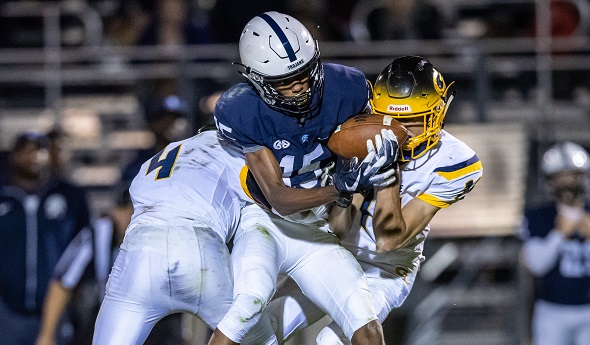
PHOTO: East Lansing and Grand Ledge players work to secure the ball during Friday's Trojans win. (Click to see more from HighSchoolSportsScene.com.)