

Farewell Silverdome; Our Memories Live On
By
Ron Pesch
MHSAA historian
November 28, 2017
Farewell Pontiac Silverdome.
In early December, more than 15 years after the Detroit Lions played their last game beneath its air-supported Teflon-paneled roof, the “Dome” will take a last breath and then depart.
Finally.
The last few years have been cruel to the stadium that was once a gem and the home of dreams.
The Lions arrived at the newly opened “Pontiac Metropolitan Stadium” (or “Ponmet” as it was called by enthusiasts of the new structure) in August 1975. It was renamed “Pontiac Stadium” later in the year by the city council, and in October of 1976 the Pontiac council again re-christened the building as the “Pontiac Silverdome.”
“We feel the new name better conveys the image of our facility,” said Charles McSwigan, Jr., stadium executive director, at the time. “It certainly lets everyone around the country know we have a modern year-round domed stadium.”
The move was primarily marketing motivated. “The other three giants, Super, Astro and King, get all the publicity,” added McSwigan, further explaining the change. “Promoters call them, but they don’t even come near us.”
Launched in 1975, the MHSAA football championship games were played outdoors at college stadiums that first year on the Saturday before Thanksgiving. While deemed a success, the games were played at two different sites. That had presented challenges.
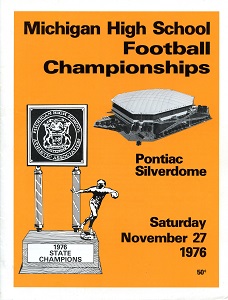 Following that first year, consideration was given to the new structure in Pontiac.
“There are some problems,” remarked Al Bush, MHSAA executive director, explaining the logistics of a possible move to the NFL stadium. “For instance, it would be difficult to play four games on the same day. We would have to start early in the morning, and the last game would have to start late at night.”
Competition for attendance with various events, including deer hunting season, and college football – especially the televised University of Michigan-Ohio State game – were factors to be considered. The high school football playoffs were still a new product without a tradition. Finances also were an area of worry. It was estimated that a crowd of between 20,000 and 25,000 would be needed to make the jump economically feasible.
So, it was with great caution and trepidation that the move was made indoors to Pontiac. Initially, the contract was for a single year. The games would be played on the Saturday following Thanksgiving. By all measures, to the delight of all involved, the 1976 championships were a huge success.
“The four state championship games, which were played in the Silverdome in two sessions on Saturday, drew a paid attendance of 29,423 fans,” said Associated Press writer Harry Atkins in a follow-up piece following the games, “bringing smiles of relief and joy to MHSAA Executive Director Al Bush and his assistant, Vern Norris. The attendance figure was almost double the number of fans who turned out last year in ice box-like weather at two sites – Western Michigan University and Central Michigan University.”
With that, a new contract was signed, and for 29 years the city of Pontiac served as home to the MHSAA 11-player football championships. “Goin’ to the Dome” soon became the goal of every high school in Michigan that offered the sport.
Following a 15-10 victory over the Dallas Cowboys in early January 2002, the Lions departed the Silverdome for Ford Field, located in downtown Detroit. The high school Finals stayed put for three more years before moving to Ford Field.
Twelve seasons after following the Lions from Pontiac to Detroit, countless memories and several MHSAA championship game records still stand from those years under the Dome.
Four championship games were played at the Silverdome to close each season from 1976-90. In 1991, the playoffs were expanded to eight classifications and the Finals expanded to eight games over a two-day showcase.
For many across Michigan, those 176 high school state title games were their first live exposure to the building many had only seen on television. For football fans, the MHSAA Finals provided an affordable and unique chance to visit the stadium and watch the game between the 20-yard-lines at ground level. An NFL game, concert, or in later years a Pistons basketball game at the Silverdome was far from an intimate experience for most. Seating 80,311, it was the largest stadium in the NFL until 1997.
For thousands of athletes and coaches, the playing surface was their first exposure to artificial turf. It was an honor to set foot on the field. After all, who didn’t want to run on the same canvas on which Lions legend Barry Sanders painted?
 Who can forget the Mill Colemen-led comeback drive to title glory in the final minutes as Farmington Hills Harrison downed DeWitt for the Class B title in 1989, or “The Catch” by Muskegon Reeths-Puffer’s Stacy Starr that broke the hearts of Walled Lake Western players and fans in the final seconds in Class A in 1992? Who remembers the wild 91 points (and 883 yards in total offense) posted in Belding’s 50-41 victory over Detroit Country Day in Class B in 1994, when Belding trailed by 19 points at the half? The combined final score remains the record for most points tallied in a title game by two teams.
Farmington Hills Harrison and coach John Herrington won five consecutive finals in Pontiac (1997, 1998, 1999, 2000, 2001), and 12 of their 13 MHSAA Finals titles at the Silverdome. A total of 12 of Detroit Catholic Central’s 17 trips to the Finals meant a bus ride to Pontiac.
One record performance set in the opening game of the 1976 championships still stands in the MHSAA championship record book. With the evolution of the game, it may never fall.
Despite the climate-controlled environment afforded by moving indoors, Crystal Falls Forest Park threw only three passes against Flint Holy Rosary in the Class D title game, completing one for a net -3 yards. By default, that total established a record for pass defense in a title game. It remains the zenith.
Forest Park had little need for the pass that day. The Trojans rolled up 234 rushing yards on 48 carries, including a 74-yard touchdown run off left tackle by all-state running back Marty Ball with 4:36 to play in the first quarter. Less than two minutes later, a fumble recovery by Forest Park’s Charlie Davis was returned 25 yards for a score, and the Trojans led, 14-0. Holy Rosary passed for 204 yards including an 18-yard pass from Ron Fray to Dan Lehoux in the second quarter, but couldn’t overcome that first quarter deficit, falling 14-6. A crowd of 14,879 attended the day’s first session, comprised of the Class D and Class A games.
Other long-standing record performances at the Dome still can be spotted in the record book.
Josh Wuerfel’s 46-yard field goal in the second quarter gave Traverse City a 10-0 halftime lead and aided the second-ranked Trojans’ 24-14 defeat of top-ranked Detroit Catholic Central in the 1988 Class A contest. The kick stood for 28 years as the title game record before finally being exceeded (twice!) at the 2016 championships played at Ford Field. Liam Putz of Grand Rapids West Catholic shattered the mark with a 47-yarder against Menominee in the Division 5 title game, before Ben Fee of Orchard Lake St. Mary’s topped the kick in the eighth game of the weekend. Fee’s 49-yard field goal late in the fourth quarter helped St. Mary’s down Muskegon 29-28 in the Division 3 thriller. The boot was his third field goal of the game. Combined with two extra points, he finished as the Eaglets’ top scorer.
Paul Gross of Jackson Lumen Christi established a new mark for extra points against Livonia Clarenceville in the 2001 Division 5 game, connecting accurately on all seven of his attempts. The record has been matched twice since the move to downtown Detroit.
Nick Williams’ 90-yard touchdown dash on Farmington Hills Harrison’s first play from scrimmage in the 1994 Class A game, a 17-13 victory over Grand Rapids Forest Hills Central, still tops the record book category for longest run play in a title game. An 89-yard TD run by Constantine’s Jim Schragg sits directly behind the Williams’ mark. Schragg rolled up 307 yards in a 34-13 win over Suttons Bay in the 2004 Division 6 game, during the final year at the Silverdome. His total established the pinnacle for rushing yards in a game.
Ravenna’s Benny Clark carried the ball 49 times (including 29 rushes in the second half) for 212 yards as the Bulldogs topped Morenci 30-14 in the 1996 Class C contest. The total, which exceeded the previous mark of 40 set by Dan Lato of Crystal Falls Forest Park in 1977, has yet to be matched or exceeded.
The fastest championship game passing touchdown came 15 seconds into the 2003 Division 5 Final, when Jackson Lumen Christi‘s Tyler Aldridge found wide-open Matt Russell on a reverse pass on the second play from scrimmage. The Titans defeated Muskegon Oakridge 23-0 for the title.
 Quarterback Tony Koshar tossed a short pass to Jim Steinman, “who shed a tackler and managed to stay in bounds as he took off for the end zone on a 96-yard scoring play,” as Gobles grabbed a 31-22 upset victory over top-ranked Crystal Falls Forest Park in the 1984 Class D title game. The reception for the longest pass play lasted 24 years before it was finally topped in 2008.
Kirk Williams’ 15 pass receptions for DeWitt against East Grand Rapids in the 2002 Division 3 contest still stand the test of time, as does Brad Johnson’s 87-yard punt return for a touchdown for Schoolcraft against Frankfort in the 1988 Class D championship game.
The 1991 title games saw two defensive marks set, both on the same day. On Saturday, November 30, Rick Marcotte of Lake Linden-Hubbell scooped up a fumble and dashed 79 yards for a touchdown and a new Finals record versus Mendon in Class DD. Less than 16 hours earlier Nate Cierlak of Muskegon Catholic Central had set the mark with a 56-yard return for a TD against Harbor Beach. In that year’s Class CC Final against Negaunee, Jason Livengood of Battle Creek Pennfield set the one mark that statistically can never be topped when he returned a pick-six for 100 yards.
Eight punts by Muskegon’s Jason Crago in the Big Reds’ 16-13 victory over Detroit Martin Luther King in the 1989 Class A title game was unmatched until 2007, when Aaron Hudson of Blissfield equaled the total. On Saturday, Clarkston’s Jermaine Roemer also tied the record in the Division 1 Final.
Between 1976 and 2004, more than 1.5 million fans attended the games in Pontiac, with a peak of attendance of 71,156 in 1995.
Soon the site will be cleared, with plans for redevelopment. Not far down the road, The Palace of Auburn Hills, once home to the MHSAA Basketball Finals and longtime home to the MHSAA Individual Wrestling Finals, will be scrubbed from the earth. Along with them, the structural evidence of the home of countless accomplishments will disappear.
Change is constant, and time moves on. Still those achievements, and several others, live on in the pages of the MHSAA record book, in the memories of those who competed and the recollections of those who played witness.
 Ron Pesch has taken an active role in researching the history of MHSAA events since 1985 and began writing for MHSAA Finals programs in 1986, adding additional features and "flashbacks" in 1992. He inherited the title of MHSAA historian from the late Dick Kishpaugh following the 1993-94 school year, and resides in Muskegon. Contact him at [email protected] with ideas for historical articles.
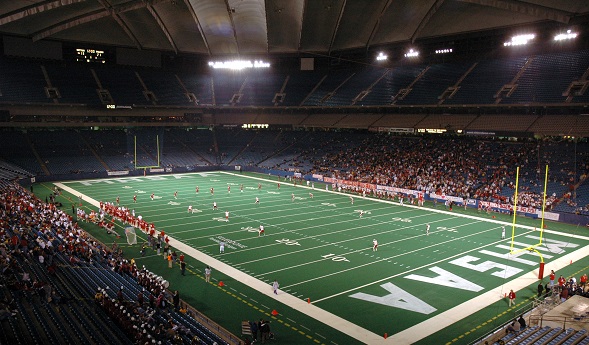
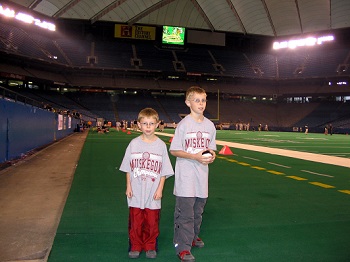
PHOTOS: (Top) Constantine and Suttons Bay played in the Division 6 Final at the Silverdome as part of the last weekend of MHSAA games in the building in 2004. (Top middle) The 1976 program welcomed Finals fans to the Dome for the first time. (Bottom middle) The author's children during a trip to the Silverdome before the Finals moved to Ford Field. (Below) The 1986 Finals ticket got fans into two games at the Silverdome for $4. (Photos courtesy of Ron Pesch and MHSAA files.)
Working Together, with Neighbor's Help, Schoolcraft Teams Making Selves at 'Home'
By
Pam Shebest
Special for MHSAA.com
September 19, 2023
SCHOOLCRAFT — If it is a home game for the Schoolcraft football team, head over to Vicksburg.
 If it is soccer, go to Schoolcraft’s baseball field.
Things are a bit jumbled in the sports world for the Eagles this season.
With a new football field under construction and a new elementary school built on the site of the former practice fields, the two teams have been a bit displaced.
“Along with our football field, we had three practice fields that were utilized by a lot of our youth programs, Rocket football, youth soccer and our soccer and football programs,” Schoolcraft athletic director Bryan Applin said. “It’s taken a lot of understanding and flexibility from our coaches, players and our community to make it work out, and it has.”
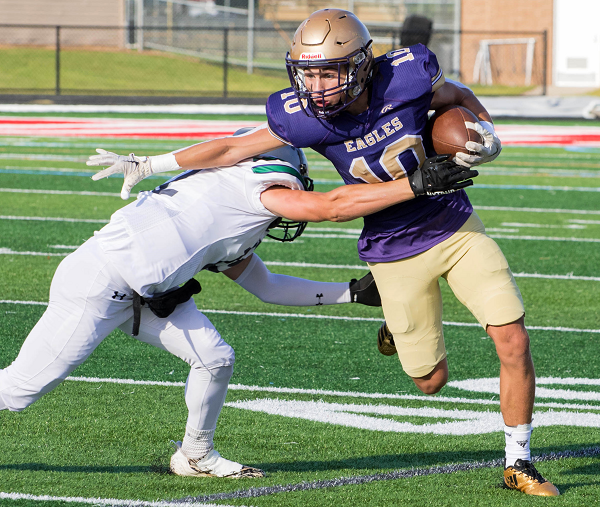
Meanwhile, all four Eagles home football games will be played at Vicksburg High School.
If Vicksburg is home on a Friday, then the Eagles will play Saturday, including their Homecoming game this Saturday against Galesburg-Augusta.
The Eagles won their only “home” game so far, 33-14 against Kalamazoo United, and take a 3-1 record into Saturday’s contest.
The soccer team gave up its field to the football team for practices and has been practicing and playing their matches in the outfield of the baseball stadium.
For the soccer team, “It’s kind of an upgrade,” Applin said. “The soccer field they traditionally play on, they don’t have a scoreboard, they don’t have a bathroom facility, so we’ve been able to use the (baseball) scoreboard, the PA system, open up the bathroom building.
 “The goal at some point is to give soccer a home, and we’re very, very excited about that.”
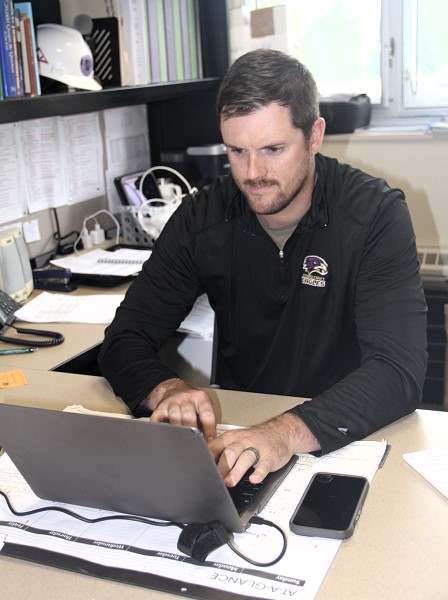
This year definitely has been challenging for the first-year AD, who credits Vicksburg athletic director Mike Roy with being a tremendous help.
“Mike Roy has been nothing but accommodating to us,” Applin said. “He’s been super helpful to me stepping in and assuming this scenario.
“The communities are so close, it almost feels like home for us.”
Roy said Jeff Clark, former Schoolcraft AD, reached out once the bond was passed for the new stadium last year.
“We had to make small accommodations as did Schoolcraft to make the schedules work,” Roy said. “By moving (Schoolcraft’s) games to Saturday, Vicksburg had to work with our Rocket football organization to make sure games were completed” before the Eagles varsity games.
Schoolcraft football coach Nathan Ferency said his team has been “rolling with the punches.
“These guys don’t care where it’s at; they just want to play football. We’re all taking care of each other. What a great place to be when everybody works together.”
When Jake Bailey heard the team would be playing at Vicksburg, “That got me excited,” the junior offensive tackle said. “They’ve got a really nice facility. I know the school will come out to support us no matter where we are, but it’s definitely different.
“Good thing we don’t play Vicksburg, although it would be fun because it would be both our home fields. The new facilities and being back at our home field at Roy Davis (Field next year) will be really fun.”
Vicksburg is Division 4, while Schoolcraft is Division 7.
 The soccer team was “just being a team player” in giving up its own field for football practice, second-year head coach Jeremy Mutchler said.
“For the soccer team to be a team player and get behind the football team will help the community get behind the soccer team as well,” he added.
The biggest drawback is that part of the current field includes a piece of the baseball infield.
“The only odd thing is it is a smaller field, still regulation size, but smaller,” Mutchler said. “Part of the field is in the diamond, so we have to play in the dirt and it gets tricky, especially when you’re trying to throw it in or just play down the line.”
The move has cost the team a few home games.
“At the beginning of the year, we allowed schools, if they didn’t want to play here, we would go to their house,” Mutchler said. “We had to go to a few schools we would have played at home.”
Maintenance supervisor Eric McGehee was instrumental in preparing the field.
“He laid out exactly the parameters, so I was able to send that to all the ADs that were going to visit to give them an opportunity to decide whether that’s something they wanted to help us out for our home games,” Applin said. “A lot of schools were more than willing to come and play us to give our boys some home games. A couple wanted to be cautious and play on a more traditional surface, and we were able to make those arrangements as well.”
In only its second year as a varsity sport, the boys soccer team is still finding its identity, posting a 2-5 record so far.
 “We’re a very young team,” Mutchler said. “All juniors and freshmen. This is the juniors' second regular season. It’s all been a learning phase with maturity and sportsmanship.”
Junior captain Jack Curtis said he was a bit “bummed out” when he heard the team would move to the baseball field.
“The first practice, I drove over to our practice field,” he said. “No one was there.
“I drove over to the high school and saw everyone practicing (at the baseball field). I didn’t think a soccer field could fit on a baseball field.”
Curtis said in spite of the temporary move, “I’m just glad we can have some home games this year on Schoolcraft soil.”
As for Applin, he spent much of his career coaching basketball at both the high school and college levels and most recently worked as a salesman for Zeigler. His wife, Meredith, is an assistant coach for Western Michigan University’s women’s basketball team.
Ferency is appreciative of the work Clark and Applin have done to make this season’s changes relatively seamless.
“I’d like to highlight how great our athletic department is,” he said. “It takes a lot of moving pieces and parts to move people around and have a space for everybody.
“I’m really proud of our athletic department and all our coaches and kids for just rolling with the punches.”
 Pam Shebest served as a sportswriter at the Kalamazoo Gazette from 1985-2009 after 11 years part-time with the Gazette while teaching French and English at White Pigeon High School. She can be reached at [email protected] with story ideas for Calhoun, Kalamazoo and Van Buren counties.
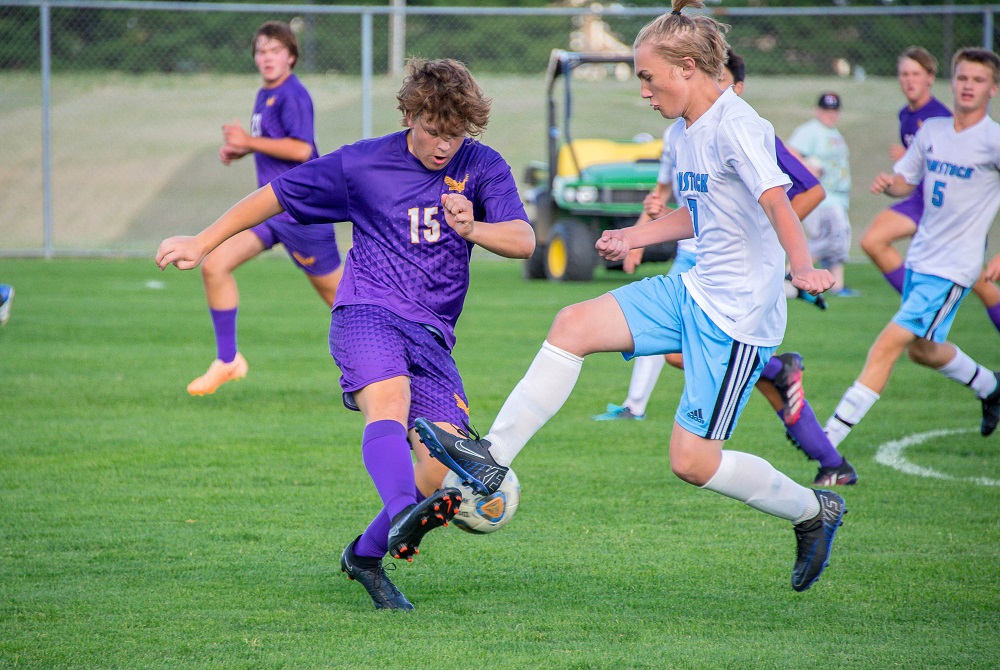
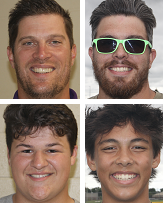
PHOTOS (Top) Schoolcraft’s varsity boys soccer team, including Nyan Wonders (15), faces Comstock this season on its field in the outfield of the baseball stadium. (2) Schoolcraft’s Kolby Lloyd (10) works to break away from a tackler during a “home” game played at Vicksburg this fall. (3) Clockwise, from top left: Schoolcraft football coach Nathan Ferency, Schoolcraft boys soccer coach Jeremy Mutchler, soccer player Jack Curtis and football player Jake Bailey. (4) Schoolcraft athletic director Bryan Applin has taken over the maneuvering of the teams’ home sites during his first year on the job. (Action photos by Stephanie Blentlinger/Lingering Memories Photography. Headshots and Applin photo by Pam Shebest.)