

Five for 50: Record Remains Golden
By
Geoff Kimmerly
MHSAA.com senior editor
September 20, 2012
By Geoff Kimmerly
Second Half editor
Tom Essenburg remembers one night 50 years ago like it was just last Friday.
Rain had been falling steadily on Sept. 21, 1962, as the Holland and Muskegon Heights football teams took the field at Holland's Riverview Park for their Week 2 game.
 Heights was coached by the already-legendary Okie Johnson, and at his disposal were a handful of speedsters who could potentially make for a long night for Essenburg, a senior defensive back – although he had a hopeful hunch the wet weather might hinder the Tigers' passing game.
“I’m thinking to myself, what’s going to go on today?” Essenburg remembered this week. “They threw six passes the whole ballgame, because it was so wet.
“They didn’t complete one to a Muskegon Heights player,” he added. “But they completed five to me.”
Friday marks the 50th anniversary of Essenburg grabbing five interceptions, an MHSAA record for one game that twice has been tied but still stands half a century later.
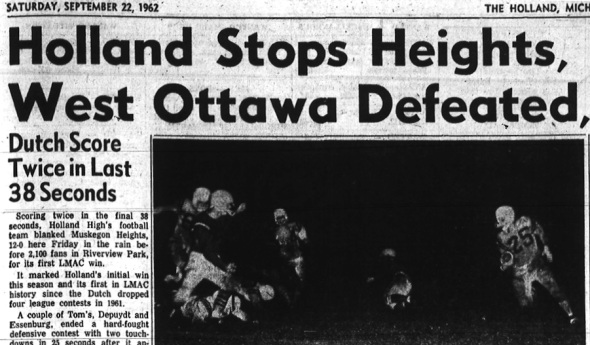
The next day's Holland Evening Sentinel first told of Essenburg's final interception, which he returned for a touchdown with 13 seconds to play in the 12-0 victory. The report's seventh paragraph explained that Essenburg “had quite a night with enemy aerials."
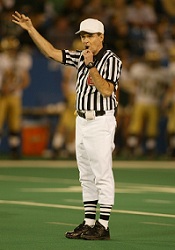
Essenburg, by his own estimation, was good but “not anything exceptional” at football. But he'd go on to captain the Western Michigan University men’s tennis team and officiate five MHSAA Football Finals during a 41-year career wearing the stripes. He's reffing still – he will be in the white hat Friday at Zeeland East – and owns and operates a fitness club in Grand Rapids.
It is more for those reasons that Essenburg is known well in the west Michigan athletic community. But the times have come, every few years or so, when someone runs across his name in the MHSAA record book, or recognizes his name from the record board at Holland High.
 Doing his job
“I had a job to do. I was a defensive back. My job was to make sure people didn’t get behind me,” Essenburg said this week. “I don’t think I counted (the interceptions) during the game. Not until I got the paper the next day did I think that (five) must have been right.”
When his family headed to Holland to see relatives, Kristin Callis remembers her dad asking her and her siblings if they’d like to stop by the field to see where he had his history-making moments.
“Of course we would groan and act like it would be the end of the world to make the stop. I only recall seeing the field once,” said Callis, the eldest of Essenburg’s three children. “It was really just a funny thing my Dad would say to us. He was proud yet humble when it came to his accomplishment.”
Essenburg also played baseball, basketball, and ran track at points during his high school years. After a standout tennis career with the Broncos, he became a teacher and later athletic director at Allegan High – and as a coach he started a boys tennis program that became one of the state’s elite under successor Gary Ellis.
Essenburg does most of his officiating these days for football and softball, and also has worked at the collegiate level. This spring, Essenburg received his 40-year service award from the MHSAA for his work between the lines.
“Excelling in high school sports charted the course for the rest of my Dad's life,” Callis said.
Essenburg owns Endurance Fitness in Grand Rapids. Previously, he started the Ramblewood Raquet Club in Grandville and managed the East Hills athletic club for nearly two decades. All three of his children got their first jobs at his club, and he taught them to play as many sports as they had interest. Essenburg's tennis skills no doubt passed down to Callis, who played at Hillsdale College. And, of course, the children have a pretty good idea what's happening on the football field – when they were kids, Essenburg would quiz Kristin, Heidi and Ryan on football officiating signals.
 History lives on
Essenburg's listing is the oldest for a defensive statistic in the MHSAA football record book. (Temperance Bedford's Tony Gill in 1990 and Concord's Zach Brigham in 2010 also grabbed five interceptions in one game to tie the record.)
But in a final ironic twist, recognition didn't come right away. Back then, a local service club sponsored a Player of the Week award for Holland's football team, with the best player each game honored the following Thursday. For the Heights game, Essenburg had to be a shoe-in.
The award that week went to a defensive lineman.
"I was just heartbroken. I said, 'What more could I do?'" Essenburg said. "But that was fine. Later in the year I got it."
“It’s a good thing I’m a referee,” he then joked. “If I was (a back judge), I might be really lenient with pass interference.”
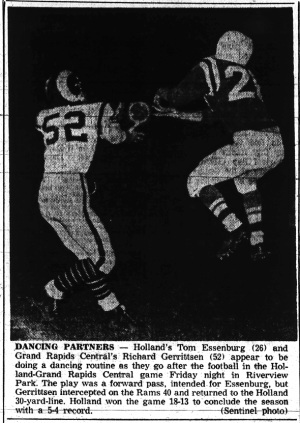
PHOTOS: (Top) Tom Essenburg was mentioned prevalently in the Sept. 22, 1962 Holland Evening Sentinel for his five interceptions the night before against Muskegon Heights. (Middle) Later that season, the Sentinel also ran a photo of Essenburg attempting to haul in a pass. (Bottom) Essenburg has officiated in five MHSAA Football Finals, the most recent in 2004 at the Pontiac Silverdome.
Drive for Detroit: Week 6 in Review
October 2, 2012
In coachspeak, it's referred to as "sense of urgency."
And the numbers back up why that phrase is thrown around frequently when the calendar turns to October.
After Week 6, there are 57 teams qualified for the MHSAA football playoffs – out of 73 total that had opportunities last weekend to earn automatic berths. And 101 can join that fortunate group with victories Friday or Saturday.
Those totals together would make up more than half of this season's playoff field, and with chances running out for teams sitting on the edge. Here's a look at how some of those teams kept their destinies in their own hands, with only three games to play before the postseason begins.
Greater Detroit
Orchard Lake St. Mary 24, Birmingham Brother Rice 14
Make that wins the last two weeks over the reigning Division 1 (Detroit Cass Tech) and Division 2 (Brother Rice) champions by the reigning MHSAA Division 3 champ Eaglets. Running back Grant Niemiec continues to build on that strong championship performance, and ran for three scores in this Detroit Catholic League Central clash. Click to read more from the Detroit Free Press.
Also noted:
Ann Arbor Pioneer 14, Temperance Bedford 13 – The Pioneers took a solid step toward repeating as Southeastern Conference Red champions with their second one-point win in league play.
Saline 20, Monroe 13 – Saline had lost all three games against Monroe since they both moved into the SEC Red, and looks good for its best season since 2008.
Brownstown Woodhaven 64, Wyandotte Roosevelt 36 – Although not massive, call this an upset nonetheless as the Warriors had lost six straight to their Downriver League foes, who were 5-0.
Romeo 21, Port Huron 20 – Romeo stayed alive for an automatic playoff berth at 3-3 by beating the Macomb Area Conference White co-leader.
Thumb and Bay
Flint Powers 42, Davison 28
The Chargers won a big one in the wake of retired coach Jack Pratt’s recent death; his funeral was Friday morning. These two and Carman-Ainsworth were all undefeated in the Saginaw Valley Association South heading into the night, and Powers’ win set up this week’s game against FCA as the league title decider. Click to read more from the Flint Journal.
Also noted:
Lake Fenton 34, Goodrich 7 – The Blue Devils continue to roll in the Genesee Area Conference Red, outscoring league opponents 190-21.
Bay City Western 28, Midland Dow 20 – The Warriors needed this one to keep pace with that other Midland team, the Chemics, with whom Western is tied atop the SVA North.
Lapeer West 27, Holly 21 (OT) – Lapeer West moved to 4-1, just barely, and remains a game behind Swartz Creek in the Flint Metro League standings.
Hemlock 19, Saginaw Swan Valley 7 – The Huskies have emerged as tops in the Tri-Valley Conference Central, just in time to play second-place Freeland this week to decide the title.
Mid-Michigan
Hartland 35, Brighton 14
The Eagles are quickly becoming one of the best stories in the state this fall, and are off to a 6-0 start for the first time since, well, potentially ever (at least since 1950, the start of the team’s records at Michigan-football.com). They are tied for first in the Kensington Lakes Activities Association West, with co-leader Grand Blanc up next. Click to read more from the Livingston County Daily Press & Argus.
Also noted:
Ithaca 33, Carrollton 21 – Make it 34 straight wins for the Yellowjackets, tied for sixth in MHSAA football history, and with no one else likely to slow them during the regular season.
Lansing Everett 6, East Lansing 0 – The Vikings are one game through a tough three-game string that will determine if they go 9-0 and win the Capital Area Activities Conference Blue.
Lansing Sexton 21, Holt 7 – Sexton’s playoff hopes appeared done and Holt’s revived, but both are now 3-3 although still facing tough must-win games down the stretch.
Beal City 43, Lake City 8 – Both were undefeated coming into the weekend, but it appears the Aggies will cruise to the Highland Conference title.
West Michigan
Lowell 42, Grand Rapids Forest Hills Central 24
Forest Hills Central carried a lead into the fourth quarter, but Lowell intercepted four passes during the final period to remain tied for first atop the O-K White. Circle the Week 9 game against Grand Rapids Christian as the likely decider of this league’s title. Click to read more from the Grand Rapids Press.
Also noted:
Hopkins 34, Grandville Calvin Christian 21 – The Vikings are 6-0 and clinched a share of the O-K Silver by beating the second-place Squires.
Montague 22, Shelby 15 (OT) – Shelby had the highest playoff point average among likely Division 6 teams, and Montague was 13th; this should change that up dramatically.
Fruitport 21, Grant 14 – The Trojans also are 6-0 and now owners of a share of the Lakes Eight Conference title thanks to this win over second-place Grant.
Rockford 24, Holland West Ottawa 14 – The Rams have seemingly laid low after a 1-2 start, but of course you shouldn't forget about them; Rockford is 4-2 and tied for first in the O-K Red.
Lower Up North
Traverse City Central 42, Traverse City West 28
Central took one more giant step toward winning its first league title since these schools were still one, in 1996. The Trojans now sit atop the Big North Conference, needing only a victory over winless Gaylord in Week 8 to clinch a share of the title. This win also earned Central the Nowak-Olson Memorial Trophy. Click to read more from the Traverse City Record-Eagle.
Also noted:
Grayling 41, Elk Rapids 22 – This helped sort out the top of the Lake Michigan Conference, with Grayling moving to 6-0 to stay tied for first with Boyne City.
Mancelona 36, Pickford 8 – These teams were both 5-0 entering this nonconference matchup, but Mancelona’s defense kept to its eight-points-given-up per-game average.
Maple City Glen Lake 29, Kingsley 7 – Glen Lake is in line for its first league title since 2001 after knocking off the proposed favorite in 4-2 Kingsley.
West Branch Ogemaw Heights 24, Cadillac 21 – Ogemaw Heights needed a win to get to 3-3 and stay alive for an automatic playoff bid, and for all intents and purposes knocked Cadillac (4-2) out of contention for a possible share of the Big North Conference title.
Southwest and Border
Schoolcraft 19, Battle Creek Pennfield 16
Schoolcraft’s first win over Pennfield since 2009 possibly lines it up for a first 9-0 regular season since 2001, and nearly assures the Eagles will win the Kalamazoo Valley Association title as they’ve now beaten all three teams tied for second place. Schoolcraft didn’t take the lead in this one until 1:34 remained in the fourth quarter. Click to read more in the Kalamazoo Gazette.
Also noted:
Buchanan 28, Niles Brandywine 22 – The Bucks look good to finish first in the Lakeland Conference with one league game to play.
Hartford 27, Lawton 24 – Not much has cleared up in the Southwestern Athletic Conference South, where these two are among four tied for second in a league that has five teams 5-1 or better overall.
Climax-Scotts 7, Pittsford 6 – These two are the best in the Southern Central Athletic Association, with Climax-Scotts just one point better in this game that should eventually decide the champion.
Mattawan 49, St. Joseph 14 – The Wildcats moved to 6-0 and kept pace with Stevensville Lakeshore atop the Southwest Michigan Athletic Conference West; circle Oct. 12, the night they meet.
Upper Peninsula
Cedarville 72, Rapid River 12
For the second straight week, Cedarville downed in a big way another contender in the Bridge Alliance 8-Man Conference, this time reigning MHSAA 8-Player runner-up Rapid River. Todd Hecht scored on two runs, two catches and a fumble return. Click to read more from the Escanaba Daily Press.
Also noted:
Iron Mountain North Dickinson 55, Crystal Falls Forest Park 27 – No league standing was at stake as they play in difference conferences, but North Dickinson did end an eight-game losing streak against the Trojans.
L’Anse 36, Ironwood 28 (OT) – Only 2-7 a year ago, the Purple Hornets are 6-0 and contending for the Western Peninsula Athletic Conference title with Eagle River Northland Pines (Wis.).
Iron Mountain 12, Manistique 7 – Both are still alive for the playoffs, but this was key; Iron Mountain moved to 4-2 while Manistique fell to 3-3.
Kingsford 21, Marquette 14 – The Flivvers have won both of their first two Great Northern Upper Peninsula Conference games by seven or fewer points, but look like the favorites with two to go.
Trophy Games
Every week, the MHSAA highlights Trophy Games from around the state. Here are a few more to join the Traverse City West/Central matchup above:
Friendship Trophy: This replaced the Oil Can, which originated in 1930, as the award played for annually by Sparta and Coopersville. Final: Coopersville 35, Sparta 14.
Bobcat-Bulldog Award: Petersburg-Summerfield had claimed this the last four seasons against rival Ottawa Lake Whiteford. Final: Whiteford 40, Petersburg-Summerfield 26.
Hinker Bell: Menominee has now held onto this trophy against Escanaba for 14 straight seasons. Final: Menominee 42, Escanaba 17.
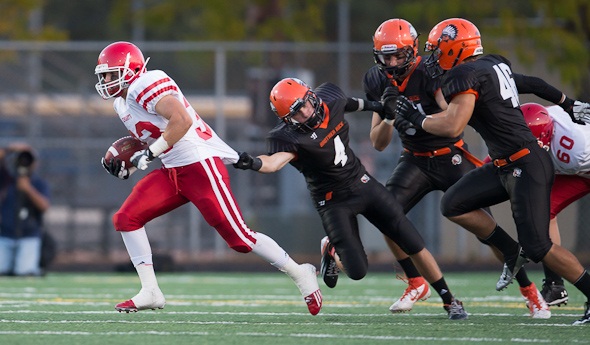
PHOTO: Orchard Lake St. Mary running back Parker McInnis pulls away from Brother Rice defenders Jason Alessi (4) and Lucas Cherocci (46) during this weekend's 24-14 Eaglets win. (Click to see more at Terry McNamara Photography.)