

Five for 50: Record Remains Golden
By
Geoff Kimmerly
MHSAA.com senior editor
September 20, 2012
By Geoff Kimmerly
Second Half editor
Tom Essenburg remembers one night 50 years ago like it was just last Friday.
Rain had been falling steadily on Sept. 21, 1962, as the Holland and Muskegon Heights football teams took the field at Holland's Riverview Park for their Week 2 game.
 Heights was coached by the already-legendary Okie Johnson, and at his disposal were a handful of speedsters who could potentially make for a long night for Essenburg, a senior defensive back – although he had a hopeful hunch the wet weather might hinder the Tigers' passing game.
“I’m thinking to myself, what’s going to go on today?” Essenburg remembered this week. “They threw six passes the whole ballgame, because it was so wet.
“They didn’t complete one to a Muskegon Heights player,” he added. “But they completed five to me.”
Friday marks the 50th anniversary of Essenburg grabbing five interceptions, an MHSAA record for one game that twice has been tied but still stands half a century later.
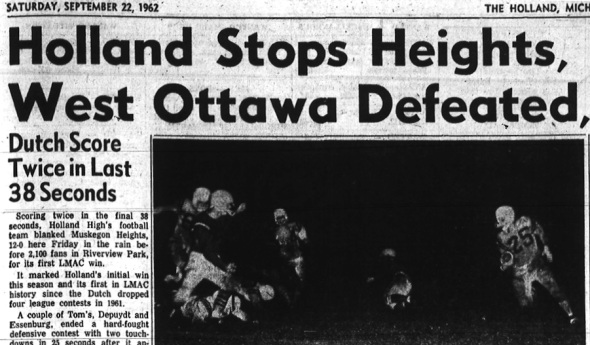
The next day's Holland Evening Sentinel first told of Essenburg's final interception, which he returned for a touchdown with 13 seconds to play in the 12-0 victory. The report's seventh paragraph explained that Essenburg “had quite a night with enemy aerials."
Essenburg, by his own estimation, was good but “not anything exceptional” at football. But he'd go on to captain the Western Michigan University men’s tennis team and officiate five MHSAA Football Finals during a 41-year career wearing the stripes. He's reffing still – he will be in the white hat Friday at Zeeland East – and owns and operates a fitness club in Grand Rapids.
It is more for those reasons that Essenburg is known well in the west Michigan athletic community. But the times have come, every few years or so, when someone runs across his name in the MHSAA record book, or recognizes his name from the record board at Holland High.
 Doing his job
“I had a job to do. I was a defensive back. My job was to make sure people didn’t get behind me,” Essenburg said this week. “I don’t think I counted (the interceptions) during the game. Not until I got the paper the next day did I think that (five) must have been right.”
When his family headed to Holland to see relatives, Kristin Callis remembers her dad asking her and her siblings if they’d like to stop by the field to see where he had his history-making moments.
“Of course we would groan and act like it would be the end of the world to make the stop. I only recall seeing the field once,” said Callis, the eldest of Essenburg’s three children. “It was really just a funny thing my Dad would say to us. He was proud yet humble when it came to his accomplishment.”
Essenburg also played baseball, basketball, and ran track at points during his high school years. After a standout tennis career with the Broncos, he became a teacher and later athletic director at Allegan High – and as a coach he started a boys tennis program that became one of the state’s elite under successor Gary Ellis.
Essenburg does most of his officiating these days for football and softball, and also has worked at the collegiate level. This spring, Essenburg received his 40-year service award from the MHSAA for his work between the lines.
“Excelling in high school sports charted the course for the rest of my Dad's life,” Callis said.
Essenburg owns Endurance Fitness in Grand Rapids. Previously, he started the Ramblewood Raquet Club in Grandville and managed the East Hills athletic club for nearly two decades. All three of his children got their first jobs at his club, and he taught them to play as many sports as they had interest. Essenburg's tennis skills no doubt passed down to Callis, who played at Hillsdale College. And, of course, the children have a pretty good idea what's happening on the football field – when they were kids, Essenburg would quiz Kristin, Heidi and Ryan on football officiating signals.
 History lives on
Essenburg's listing is the oldest for a defensive statistic in the MHSAA football record book. (Temperance Bedford's Tony Gill in 1990 and Concord's Zach Brigham in 2010 also grabbed five interceptions in one game to tie the record.)
But in a final ironic twist, recognition didn't come right away. Back then, a local service club sponsored a Player of the Week award for Holland's football team, with the best player each game honored the following Thursday. For the Heights game, Essenburg had to be a shoe-in.
The award that week went to a defensive lineman.
"I was just heartbroken. I said, 'What more could I do?'" Essenburg said. "But that was fine. Later in the year I got it."
“It’s a good thing I’m a referee,” he then joked. “If I was (a back judge), I might be really lenient with pass interference.”
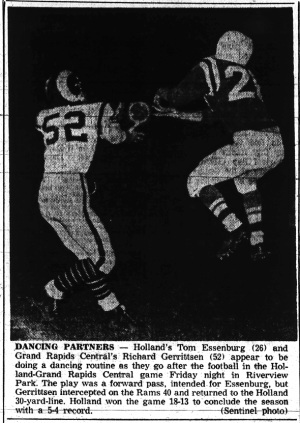
PHOTOS: (Top) Tom Essenburg was mentioned prevalently in the Sept. 22, 1962 Holland Evening Sentinel for his five interceptions the night before against Muskegon Heights. (Middle) Later that season, the Sentinel also ran a photo of Essenburg attempting to haul in a pass. (Bottom) Essenburg has officiated in five MHSAA Football Finals, the most recent in 2004 at the Pontiac Silverdome.
St. Patrick Immediately Sets Tone On Way to Claiming 1st Title Since 1992
By
Jason Juno
Special for MHSAA.com
November 22, 2025
MARQUETTE — Portland St. Patrick has been no stranger to the MHSAA Finals since moving to 8-player football, but the Shamrocks had come up short of a title in three appearances since 2017.
They were back in the Division 2 championship game Saturday, and again facing a team from the Upper Peninsula, just like the other three times. But this time, St. Patrick made it clear from the opening kick it had no intention of going back below the Mackinac Bridge without the championship trophy.
The Shamrocks rode the momentum from a fast start and blanked Felch North Dickinson 53-0 at the Superior Dome.
“It means a lot,” St. Patrick senior back Brady Leonard said with the trophy in his hand. “Having a couple classes before us come here and not be able to finish the job, it was not just for our team, but it was for everyone that came and wasn’t able to finish it.”
Aiden Fandel set the tone when he took the opening kick to the Nordics’ 3-yard line. Jerryd Scheurer ran three yards on the first play from scrimmage, and Leonard ran in the conversion for an 8-0 lead just 20 seconds into the game.
 “It was huge, just to flip the field position right away was a big deal,” St. Patrick coach Patrick Russman said.
The Shamrocks scored two more times during the first quarter, taking advantage of excellent field position.
St. Patrick’s Tyler Thelen blocked a punt to set up its next score. The Shamrocks took over at the North Dickinson 9, and Charlie Thelen caught a four-yard pass from Scheurer on the second play of the drive for a 14-0 lead.
The Nordics went for it on fourth-and-1 at their own 29 on the ensuing possession, but they were stuffed for no gain, giving St. Patrick the ball not far from the red zone.
Leonard ran eight yards for the touchdown and a 20-0 lead with 5:34 still left in the first quarter.
What a start.
"It was very important," Leonard said. "We knew if we came off hot, we knew that we'd be able to punch them in the mouth and we'd get off to the start that we normally have.”
The Shamrocks scored two more times in the first half, both on runs by Hudson King, who led with 120 yards on 10 carries. His 30-yarder came just seven seconds into the second quarter, and his 21-yard rush gave them a 33-0 lead that held until halftime.
The Nordics drove into St. Patrick territory twice in the period. The first stalled at the 44 when the game was still within reach at 26-0. The second got all the way to the 24, but incomplete passes on third and fourth downs gave St. Patrick the ball back with four seconds on the first-half clock.
North Dickinson just couldn’t overcome that start, or the talent level of the Shamrocks.
“We’ve been punched in the mouth before, but they’re way better,” Nordics coach Mike Christian said. “They were just so much better than us today. They’re bigger, faster, stronger. We just couldn’t get anything going.”
 The second half proved to be more of the same. St. Patrick reached the end zone three more times, on short runs by Caleb Pline and two players listed as linemen, Logan Krieger and Nick Pung.
St. Patrick finished a perfect 13-0, and went unbeaten even with a tough schedule. Russman said the Shamrocks started off with tough Mid-State Activities Conference foes Merrill and Morrice. They ended the regular season with a win over eventual Division 1 runner-up Blanchard Montabella. Their playoff run included wins over Mendon, ranked No. 1 in the final media poll of the season, and last year’s Division 1 champion, Deckerville.
“We didn’t have any time to not be ready this year,” Russman said. “We’ve had a pretty good run of some very quality football teams throughout the stretch of the year. They didn’t give us any rest, so the kids did a good job of getting ready each week. Sometimes you slip, and these guys didn’t slip.”
He credited the team’s chemistry for the special season. The practices were superb all year. And they of course had some really good players.
“Our line has been working hard and they just continued to grind it out today, and our backs finished plays on the offensive end,” Russman said. “We’ve been trying to get a faster and faster defense each week, and I think they’ve really done that and accepted that challenge.”
St. Patrick’s last Finals win came when it was playing 11-player football in 1992, in Class D. North Dickinson was seeking its first championship but had to settle for its second runner-up finish (11-player, Class D, 1998).
The Nordics’ 17-game winning streak came to an end. They finished at 12-1 this year after winning their final five games last season.
North Dickinson canceled its varsity season in 2023, announcing at the time that it would play a JV schedule with only four upperclassmen on the roster. Two years later, the Nordics made it to the final game.
“My seniors would have been sophomores then,” Christian said. “I didn’t want to throw them into that right away. This is kind of what we were aiming for when we did that.”
It all worked out. Missing the playoffs last year proved to be a good motivator as well.
“They really put the extra work in,” he said. “They’re such great kids, and they worked their tails off all summer and I’m just so proud of them.”
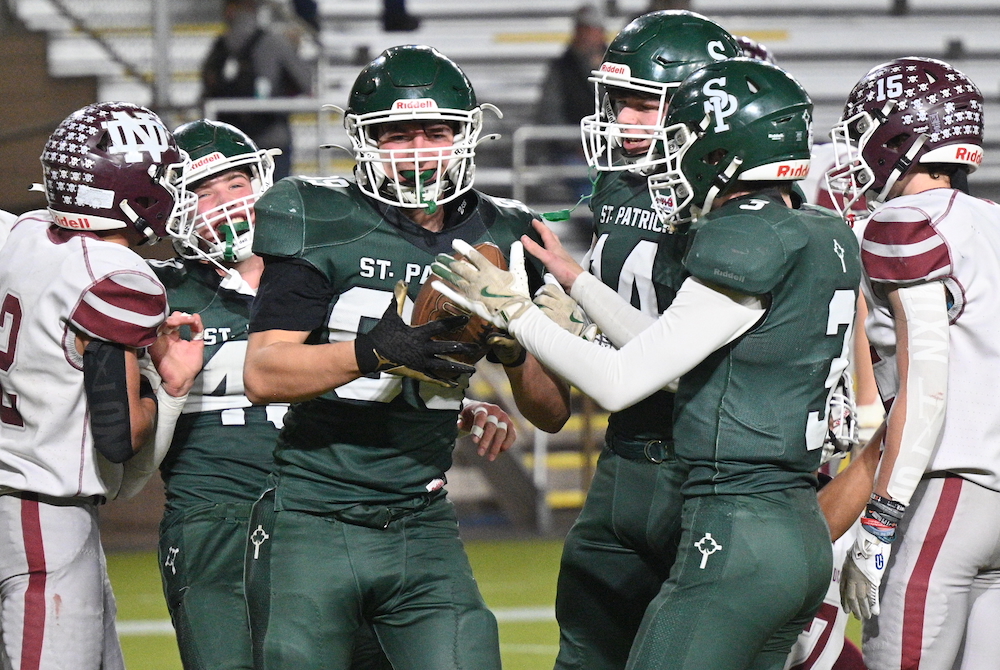
PHOTOS (Top) Portland St. Patrick players celebrate a touchdown Saturday at Superior Dome. (Middle) North Dickinson quarterback Brady Jungwirth (15) works to pull away from a tackler. (Below) The Shamrocks’ Charlie Thelen (12) goes high to pull in a pass. (Click for more from Cara Kamps.)