

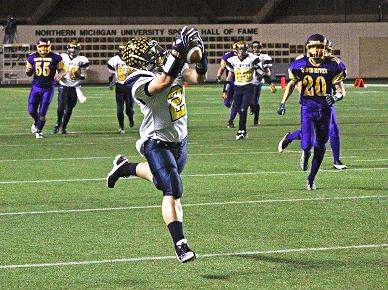
Football: Carsonville-Port Sanilac Wins Inaugural 8-Player Championship
By
Geoff Kimmerly
MHSAA.com senior editor
November 18, 2011
MARQUETTE – Carsonville-Port Sanilac sophomore Dan Rickett emerged from his team’s final huddle of this season, pulled close to an assistant coach and said, “This one says MHSAA this time.”
His Tigers also celebrated a championship last season – a perfect season in fact, but unofficial title because the MHSAA has not yet instituted playoffs for the now 3-year-old sport.
This year, the first playoffs were held. And that made Friday’s 59-20 win over Rapid River at the Superior Dome – and the trophy C-PS then received – mean so much more.
The Tigers are the first MHSAA 8-player football champions.
“All the people saying last year was nothing, this will shut them up,” C-PS senior quarterback Hayden Adams said. “It means a lot more because we actually had to make a run in the playoffs. It’s that much harder, and we had to play that much better every game.
“I think we topped it off at the end of the season.”
A total of 1,433 fans – most wearing Rapid River’s purple and yellow – cheered on the teams in the inaugural game. C-PS finished 12-1 overall to move to 21-1 in coach Tim Brabant’s two seasons. The Rockets finished 11-2 in their first season of 8-player.
The sport was added by the MHSAA in 2009 to provide another option for schools with enrollments so small they had difficulty fielding an 11-player squad. Playoffs were added this season after the necessary 20 schools announced they’d be sponsoring 8-player teams.
That was not lost on either team, even for Rapid River in the loss. The Rockets had won one game each of the last two seasons playing 11-player teams.
“We had never played in the postseason at all since I’ve been here,” Rapid River senior running back Jacob Berglund said. “To make it this far, it’s awesome.”
Offense has reigned in the early stages of the MHSAA 8-player game. The Final kept to that standard.
The teams combined for 901 yards. Adams completed 12 of 17 passes for 324 yards and five touchdowns, and ran for 130 more yards and two scores. Two of his scoring passes were to his brother Trevor Adams, also a senior, including a 43-yarder on the second play of the game. Rickett ran for 78 yards and a touchdown on five carries, and also caught six passes for 133 yards and two scores.
The Tigers jumped out to a 19-0 lead and pushed it to 27-6 by the end of the first quarter. But in 8-player football, a 21-point advantage generally is not a safe one.
Rapid River outscored C-PS in the second quarter to get within 39-20 by halftime. After completing just one pass during the first quarter, Rockets sophomore quarterback Jake Pearson threw for 144 yards and two scores during the second.
But then something somewhat unimaginable happened. The Tigers held the Rockets scoreless the rest of the game.
“At halftime we made some adjustments on what we should do when they motioned. We picked it up real fast,” said C-PS senior linebacker Steven Koehler, who finished with a game-high 20 tackles, including 12 solos.
“I think that the fact they had 10 seniors, and the speed. They’re a year older, two years older in some cases,” Rapid River coach Steve Ostrenga listed as reasons his team had difficulties. “You get two more years of development in that respect as far as strength, and their speed was noticeable. I think that was the big key, their speed.”
Half of C-PS’s players were seniors who had served large roles on this and last season’s teams.
“It’s very fun to watch when we have a group of kids who are that athletic, hard working, and very polite. It’s hard for me to send these guys off,” Brabant said. “I get emotional just thinking about it. But … I know they’re going to be very successful in life.”
The Rockets, meanwhile, graduate just seven players, and also had seven freshmen and three sophomores this fall. Said Pearson, “It was a great learning experience. We know what we have to do for next year now.”
“Now all the teams are going to see what we do,” Adams said. “And they’re going to start doing all the things we do.”
Menominee's Man Among Maroons
June 28, 2012
Ken Hofer walked high school football sidelines as a head coach for nearly a half-century. That, in itself, is an incredible accomplishment.
But Menominee's recently-retired and legendary coach packed plenty of success into his 48 seasons, a tenure that began in his hometown of Stephenson.
- Hofer is retiring with a record of 342-136-3 and after three straight nine-win seasons.
- His teams have made the MHSAA playoffs at the ends of the last 16.
- The Maroons won 29 straight games from 2006-2008, with back-to-back 14-0 finishes in 2006 and 2007.
- His teams won three MHSAA championships, in those two perfect seasons and in 1998.
- In three of the last six seasons, his offense scored more than 500 points.
"His impact has been felt for generations, and his legacy will continue to inspire students into the future," Menominee superintendent Erik Bergh wrote when Hofer made his announcement.
Click to read our Q&A with the longtime Maroons coach, who stepped down earlier this month.
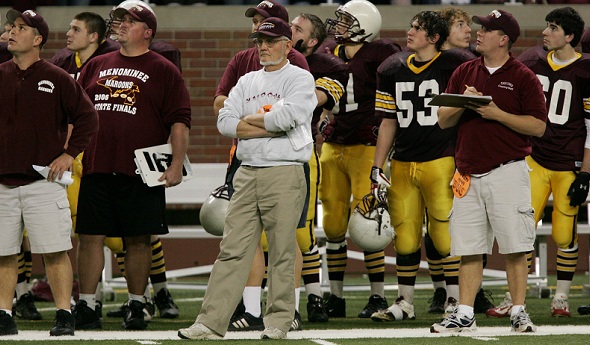
PHOTO: Ken Hofer, center in gray sweatshirt, coached Menominee to a 41-6 win over Madison Heights Madison in the 2006 Division 5 Final at Ford Field.