

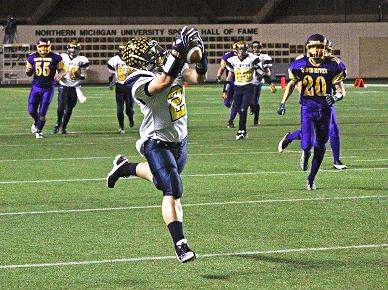
Football: Carsonville-Port Sanilac Wins Inaugural 8-Player Championship
By
Geoff Kimmerly
MHSAA.com senior editor
November 18, 2011
MARQUETTE – Carsonville-Port Sanilac sophomore Dan Rickett emerged from his team’s final huddle of this season, pulled close to an assistant coach and said, “This one says MHSAA this time.”
His Tigers also celebrated a championship last season – a perfect season in fact, but unofficial title because the MHSAA has not yet instituted playoffs for the now 3-year-old sport.
This year, the first playoffs were held. And that made Friday’s 59-20 win over Rapid River at the Superior Dome – and the trophy C-PS then received – mean so much more.
The Tigers are the first MHSAA 8-player football champions.
“All the people saying last year was nothing, this will shut them up,” C-PS senior quarterback Hayden Adams said. “It means a lot more because we actually had to make a run in the playoffs. It’s that much harder, and we had to play that much better every game.
“I think we topped it off at the end of the season.”
A total of 1,433 fans – most wearing Rapid River’s purple and yellow – cheered on the teams in the inaugural game. C-PS finished 12-1 overall to move to 21-1 in coach Tim Brabant’s two seasons. The Rockets finished 11-2 in their first season of 8-player.
The sport was added by the MHSAA in 2009 to provide another option for schools with enrollments so small they had difficulty fielding an 11-player squad. Playoffs were added this season after the necessary 20 schools announced they’d be sponsoring 8-player teams.
That was not lost on either team, even for Rapid River in the loss. The Rockets had won one game each of the last two seasons playing 11-player teams.
“We had never played in the postseason at all since I’ve been here,” Rapid River senior running back Jacob Berglund said. “To make it this far, it’s awesome.”
Offense has reigned in the early stages of the MHSAA 8-player game. The Final kept to that standard.
The teams combined for 901 yards. Adams completed 12 of 17 passes for 324 yards and five touchdowns, and ran for 130 more yards and two scores. Two of his scoring passes were to his brother Trevor Adams, also a senior, including a 43-yarder on the second play of the game. Rickett ran for 78 yards and a touchdown on five carries, and also caught six passes for 133 yards and two scores.
The Tigers jumped out to a 19-0 lead and pushed it to 27-6 by the end of the first quarter. But in 8-player football, a 21-point advantage generally is not a safe one.
Rapid River outscored C-PS in the second quarter to get within 39-20 by halftime. After completing just one pass during the first quarter, Rockets sophomore quarterback Jake Pearson threw for 144 yards and two scores during the second.
But then something somewhat unimaginable happened. The Tigers held the Rockets scoreless the rest of the game.
“At halftime we made some adjustments on what we should do when they motioned. We picked it up real fast,” said C-PS senior linebacker Steven Koehler, who finished with a game-high 20 tackles, including 12 solos.
“I think that the fact they had 10 seniors, and the speed. They’re a year older, two years older in some cases,” Rapid River coach Steve Ostrenga listed as reasons his team had difficulties. “You get two more years of development in that respect as far as strength, and their speed was noticeable. I think that was the big key, their speed.”
Half of C-PS’s players were seniors who had served large roles on this and last season’s teams.
“It’s very fun to watch when we have a group of kids who are that athletic, hard working, and very polite. It’s hard for me to send these guys off,” Brabant said. “I get emotional just thinking about it. But … I know they’re going to be very successful in life.”
The Rockets, meanwhile, graduate just seven players, and also had seven freshmen and three sophomores this fall. Said Pearson, “It was a great learning experience. We know what we have to do for next year now.”
“Now all the teams are going to see what we do,” Adams said. “And they’re going to start doing all the things we do.”

Parking, Entrance Protocols Announced for 2025 11-Player Football Finals
By
Geoff Kimmerly
MHSAA.com senior editor
November 24, 2025
To provide for the convenience and safety of spectators attending the Michigan High School Athletic Association 11-Player Football Finals on Nov. 28 and 30 at Ford Field in Detroit, attendees are being advised of a variety of items related to transportation and security – including policies regarding parking, seating and types of bags allowed into the stadium.
Parking will be available in Ford Field facilities and lots to the east and north of the stadium and costs $8. A map identifying the designated Ford Field lots (4, 5 and 6) and parking deck can be found on the Football page under “2025 Road to the Finals.” (There also are a number of privately-operated parking facilities close to Ford Field, but their pricing may differ.)
Fans also are advised that the consumption of alcohol is prohibited in Ford Field parking facilities and lots, and smoking – including use of electronic cigarettes and vaporizers – is prohibited inside the stadium. Tailgating, including the setting up and use of grilling equipment, also is not allowed.
Tickets are priced at $20 and allow a fan to see all four games in a single day. Tickets are available for purchase at the door (cash or credit accepted), or online from Ford Field via Ticketmaster – links to order tickets both days also are on the MHSAA Website football page. Spectators leaving the stadium will be required to purchase another ticket for re-entry. Babes in arms will be admitted without charge for this event.
Spectators may enter Ford Field at Gates A, D & G. Upon arrival in the building, fans will find their designated seating areas on the South side of the field if their team is the designated home team for their contest and on the North side for the designated visiting team. Home teams this weekend are Detroit Catholic Central, Dexter, DeWitt, Hudsonville Unity Christian, Pontiac Notre Dame Prep, Jackson Lumen Christi, Menominee and Hudson. Brightly-lit video boards above the seating areas will display the names of the participating teams each day, and fans should sit on the side of the stadium where they see their school’s name. For general fans, the entire lower bowl of Ford Field will be open for the event.
Security measures also will be in place to help assure spectator safety. Fans will be subject to metal detector screening, and Ford Field personnel reserve the right to request patrons open their coats, bags and other item-carrying vessels for visual inspection and deny entrance to individuals who do not cooperate. Spectators should remove cell phones, cameras, keys and other large metal objects before passing through the metal detectors.
Items which fans will be prohibited from bringing into the building include, but are not limited to, the following:
* Purses larger than a clutch bag, coolers, briefcases, backpacks, book bags, diaper bags, fanny packs, cinch bags, grocery & paper bags; duffle bags, computer bags or luggage of any kind.
* Aerosol cans (hairspray, mace, pepper spray, etc.)
* Animals (except service animals to aid guests with disabilities)
* Balloons (air or helium)
* Balls (beach balls, footballs, etc.)
* Banners or large flags
* Cameras with lenses longer than five inches or any detachable lens. Selfie Sticks also are prohibited.
* Chairs including folding chairs or stools
* Decals, stickers, confetti or glitter
* Drones and/or remote-controlled aircraft
* Electronic equipment including laptop computers, video recorders (hand-held video cameras are allowed), tripods and wearable video cameras including Go Pros.
* Fireworks
* Flashlights
* Food, beverages – including water – or liquids (cans, bottles, boxes, flasks, etc.)
* Illegal substances
* Knives, pocketknives, box cutters, scissors, etc.
* Laser pointers
* Marijuana including medically prescribed electronic accessories or paraphernalia associated with marijuana or illegal narcotics use.
* Markers (permanent) and/or paint
* Noisemaking devices (bells, horns, kazoos, whistles, etc.)
* Objects that can be used as missiles or projectiles (sticks, poles, bats, clubs, Frisbees, etc.)
* Strollers and infant car seats or carriers
* Umbrellas (large size)
* Weapons
* Wrapped gifts
The following items may be permitted after inspection:
* Bags that are clear plastic, vinyl or PVC and do not exceed 12 inches by 6 inches by 12 inches, or a one-gallon clear plastic freezer bag (Ziploc or similar). An exception will be made for medically necessary items after proper inspection at the Gate.
* Infant items in a clear bag (bottles and formula) only if accompanied by a child
* Binoculars and binoculars cases not exceeding 4½ inches by 6½ inches may be brought in via one of the clear plastic bag options.
* Cameras (lenses may not measure longer than five inches or be detachable, and no tripods or extension cords)
* Small radios (no larger than the size of a football and used with an earpiece)
* Small, compact umbrellas (must be placed securely under seat)
* Posters and signs without poles or sticks, or larger than what one person can hold.
* Tablets (iPads, Kindles, etc.)
* Seat cushions not exceeding 15 inches by 15 inches. Seat cushions also must not contain arm rests, zippers, pockets, flaps or metal backs.
The complete list of prohibited items can be found on the Detroit Lions Website. Prohibited items that are discovered during security inspections at stadium entrances must be returned to the owner's vehicle or discarded. Items will not be held for later pickup.
Fans are reminded that all image taking (still and video) may be only for personal, non-commercial use.