

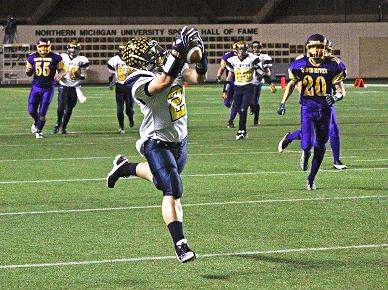
Football: Carsonville-Port Sanilac Wins Inaugural 8-Player Championship
By
Geoff Kimmerly
MHSAA.com senior editor
November 18, 2011
MARQUETTE – Carsonville-Port Sanilac sophomore Dan Rickett emerged from his team’s final huddle of this season, pulled close to an assistant coach and said, “This one says MHSAA this time.”
His Tigers also celebrated a championship last season – a perfect season in fact, but unofficial title because the MHSAA has not yet instituted playoffs for the now 3-year-old sport.
This year, the first playoffs were held. And that made Friday’s 59-20 win over Rapid River at the Superior Dome – and the trophy C-PS then received – mean so much more.
The Tigers are the first MHSAA 8-player football champions.
“All the people saying last year was nothing, this will shut them up,” C-PS senior quarterback Hayden Adams said. “It means a lot more because we actually had to make a run in the playoffs. It’s that much harder, and we had to play that much better every game.
“I think we topped it off at the end of the season.”
A total of 1,433 fans – most wearing Rapid River’s purple and yellow – cheered on the teams in the inaugural game. C-PS finished 12-1 overall to move to 21-1 in coach Tim Brabant’s two seasons. The Rockets finished 11-2 in their first season of 8-player.
The sport was added by the MHSAA in 2009 to provide another option for schools with enrollments so small they had difficulty fielding an 11-player squad. Playoffs were added this season after the necessary 20 schools announced they’d be sponsoring 8-player teams.
That was not lost on either team, even for Rapid River in the loss. The Rockets had won one game each of the last two seasons playing 11-player teams.
“We had never played in the postseason at all since I’ve been here,” Rapid River senior running back Jacob Berglund said. “To make it this far, it’s awesome.”
Offense has reigned in the early stages of the MHSAA 8-player game. The Final kept to that standard.
The teams combined for 901 yards. Adams completed 12 of 17 passes for 324 yards and five touchdowns, and ran for 130 more yards and two scores. Two of his scoring passes were to his brother Trevor Adams, also a senior, including a 43-yarder on the second play of the game. Rickett ran for 78 yards and a touchdown on five carries, and also caught six passes for 133 yards and two scores.
The Tigers jumped out to a 19-0 lead and pushed it to 27-6 by the end of the first quarter. But in 8-player football, a 21-point advantage generally is not a safe one.
Rapid River outscored C-PS in the second quarter to get within 39-20 by halftime. After completing just one pass during the first quarter, Rockets sophomore quarterback Jake Pearson threw for 144 yards and two scores during the second.
But then something somewhat unimaginable happened. The Tigers held the Rockets scoreless the rest of the game.
“At halftime we made some adjustments on what we should do when they motioned. We picked it up real fast,” said C-PS senior linebacker Steven Koehler, who finished with a game-high 20 tackles, including 12 solos.
“I think that the fact they had 10 seniors, and the speed. They’re a year older, two years older in some cases,” Rapid River coach Steve Ostrenga listed as reasons his team had difficulties. “You get two more years of development in that respect as far as strength, and their speed was noticeable. I think that was the big key, their speed.”
Half of C-PS’s players were seniors who had served large roles on this and last season’s teams.
“It’s very fun to watch when we have a group of kids who are that athletic, hard working, and very polite. It’s hard for me to send these guys off,” Brabant said. “I get emotional just thinking about it. But … I know they’re going to be very successful in life.”
The Rockets, meanwhile, graduate just seven players, and also had seven freshmen and three sophomores this fall. Said Pearson, “It was a great learning experience. We know what we have to do for next year now.”
“Now all the teams are going to see what we do,” Adams said. “And they’re going to start doing all the things we do.”
Off to Fast Start, Gunsells Aspiring to Assemble Lasting Ludington Legacy
By
Tom Kendra
Special for MHSAA.com
September 11, 2025
Cameron Gunsell has been building things at Ludington High School his entire life.
 “One of my earliest memories is making forts with the blocking dummies with my older brother during football practices,” recalled Gunsell of his and older brother Wilson’s adventures.
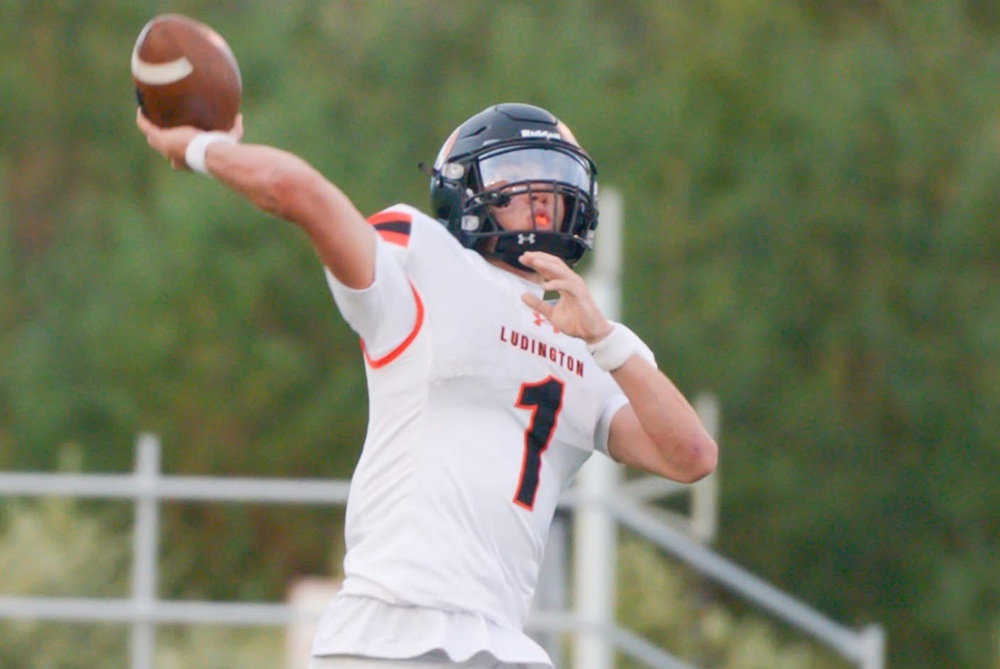
The Gunsells are now building something much bigger and more permanent at Ludington – with dad, Charlie Gunsell, in his 22nd and final year as the Orioles’ head football coach, Wilson an assistant coach and Cameron the team’s unquestioned leader and senior quarterback.
Cameron has rushed for nine touchdowns and thrown for three more over the first two weeks, leading Ludington to lopsided road wins over Coopersville and rival Mason County Central and heading into Friday’s home and West Michigan Conference Lakes opener against Fremont.
There is a buzz in this small town, best known for its Lake Michigan car ferries, which hasn’t won a football conference title since 1999 and has only one playoff victory in school history, which came during the COVID year of 2020.
“We definitely feel like this is our time,” said Cameron, 18, who is three years younger than his only sibling, Wilson. “Our motto this year is ‘Wake People Up.’ We brought back a ton of playmakers and had the best offseason in the weight room getting ready.”
The Orioles started making noise right away at Coopersville, where Cameron carried the ball 34 times for 246 yards and five touchdowns while completing 8-of-11 passes for 116 yards and a TD. He also made a team-high six tackles from his free safety position.
Last week, he was back at it against rival MCC in the Lumberman’s Cup, this time doing more damage through the air completing 8-of-15 passes for 245 yards and two scores while rushing 16 times for 161 yards and four TDs. He again led the team with eight tackles.
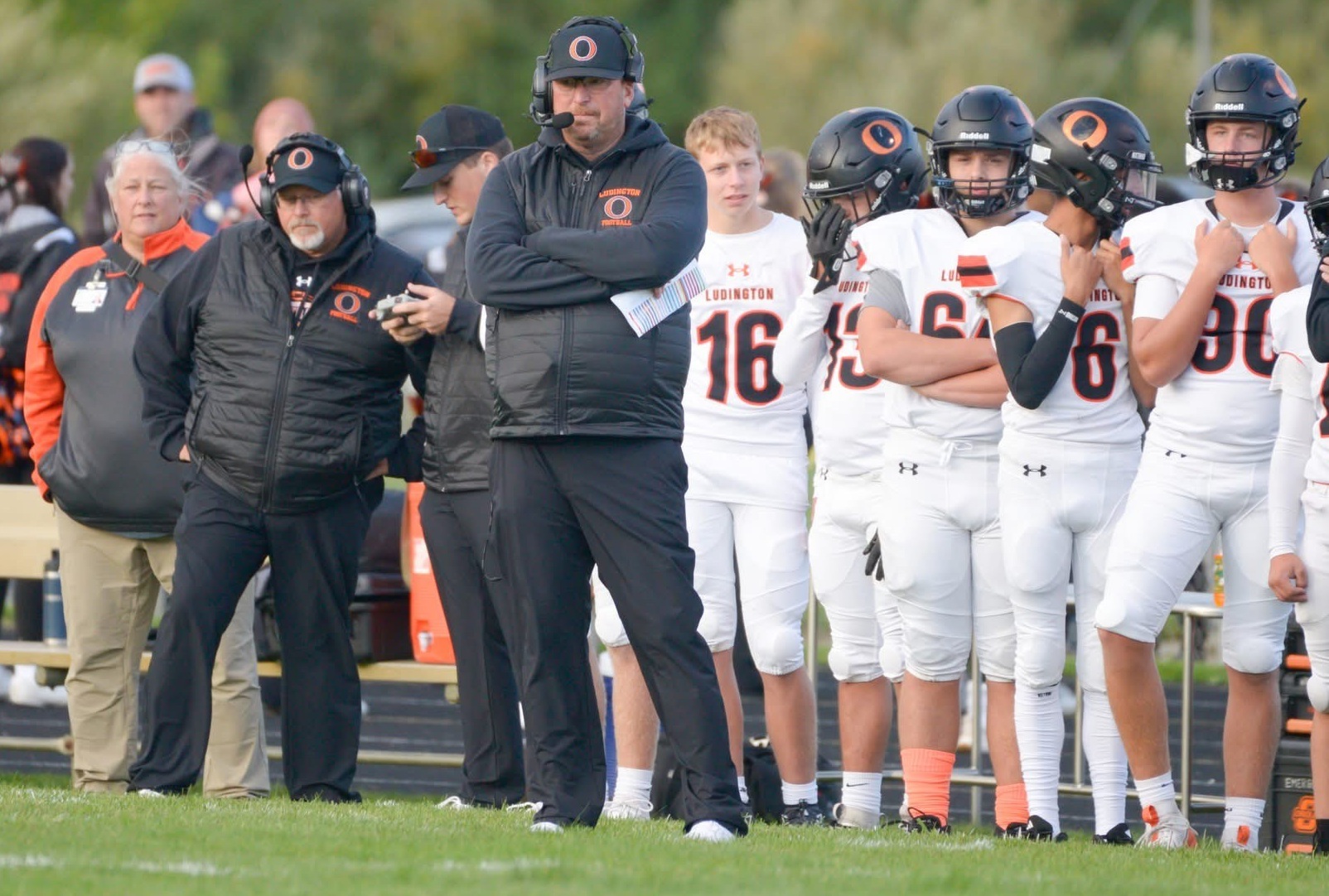
“It’s uncomfortable for me as the head coach talking about my son, but he is really good,” said Charlie Gunsell, a Caro native who was the starting quarterback at Ferris State in 1997. “Cam is so stinking competitive, and 80 percent of what we do offensively is a read through him. He is the guy who makes us click on both sides of the ball.”
 Cameron (6-foor-3, 190 pounds), in his third year as the starting quarterback, is closing in on 4,000 passing yards and 3,000 rushing yards for his career. His play caught the attention of college scouts, drawing scholarship offers from Grand Valley State, Davenport and reigning Division II national champion Ferris.
Gunsell announced last month that he would be following in his dad’s footsteps at Ferris, which he said was not an easy decision.
“I honestly was really close to choosing Grand Valley,” said Cameron, who completed 70 percent of his passes last season. “But, in the end, I have always wanted to be a Bulldog. Just like here at Ludington, I grew up going to football games at Ferris.”
With that choice behind him, Cameron is focused on the immediate goal of helping his team unseat Whitehall, which has won three straight WMC Lakes titles, and then making a run in the Division 4 playoffs.
He knows that defenses are going to be keying on him and stacking the box after his fast start.
“If they want to focus on me, that’s great for us,” explained Cameron, who lines up in the shotgun every play and distributes the ball to the Orioles’ four-wide skill players. “We have a lot of other weapons this year.”
The leading receiver is junior Taj Williams with seven catches for 142 yards over two games, while sophomore Kyle Himes has three catches for 122 yards.
Ludington actually features three Himes brothers, with freshman Mikie Himes the team’s second-leading rusher through two games with 88 yards. Junior Messiah Himes is a dangerous running and receiving threat from his slot position.
“We have a lot of kids who deserve touches, and they will get them as we get into our conference games and everyone tries to take Cam away,” said Gunsell, who is assisted by offensive coordinator Brent Gillett and defensive coordinator JP Deines.
Coach Gunsell points to conference foes like Oakridge, Montague, Orchard View and Whitehall as teams that have had the type of playoff success his team wants to emulate.
In order to make a run, he said the team must get the job done up front, where they are led by seniors Walt Autrey (6-4, 298), Colin Shelton and Connor Chaney.
“We have had talented players before, but our biggest thing up here is, are we tough enough?” said Gunsell. “These kids have worked so hard in the weight room to get stronger and to make that toughness our calling card.”
 Tom Kendra worked 23 years at The Muskegon Chronicle, including five as assistant sports editor and the final six as sports editor through 2011. E-mail him at [email protected] with story ideas for Muskegon, Oceana, Mason, Lake, Oceola, Mecosta and Newaygo counties.
PHOTOS (Top) Ludington quarterback Cameron Gunsell launches a pass during his team’s win over Mason County Central last week. (Middle) Gunsell’s father and head coach, Charlie Gunsell (in headset) monitors the action from the sideline. (Photos by Jason Goorman/Local Sports Journal.)