

Football Families Carry on Tradition
By
Tom Markowski
Special for Second Half
November 12, 2015
WATERFORD – Football always has been a family affair at Waterford Our Lady of the Lakes.
 It started with longtime coach Mike Boyd and continues on with Josh Sawicki, who’s in his third season as Lakes’ football coach.
Boyd retired after 2012 with 361 career victories, third most in MHSAA history. His sons, Mike, Jr., and Andy, played for him and contributed significantly to the Lakers’ success.
Mike Boyd played for his cousin, Leo “Smokey” Boyd, at Saginaw St. Peter & Paul.
And Boyd coached a number of siblings in his 48 seasons at Lakes. Josh and Jake Sawicki were two. Josh played linebacker and guard for four seasons, three times selected to all-state teams. Jake was a running back.
Sawicki took over for Boyd and has continued the winning tradition. Lakes was 8-3 his first season, 9-2 last season, and the Lakers are 11-0 heading into Saturday’s 1 p.m. Division 8 Regional Final against Saginaw Michigan Lutheran Seminary (10-1).
Those family ties continue as well. Quarterback Clay Senerius and receiver Devin Senerius are fraternal twins.
Clay is a three-year starter and is one of the top quarterbacks in Division 8. He’s 6-foot-3, 185 pounds and has been offered a scholarship by Avila University, an NAIA school in Kansas City (Mo.). Kalamazoo College, Hope College and St. Francis, located in Fort Wayne (Ind.) have also shown interest.
Senerius threw a school-record seven touchdown passes in a game as a junior. During his career he’s thrown at least five touchdown passes in a game five times. Through 10 games this season, he’s completed 107 of 171 attempts for 2,226 yards, 26 touchdowns and five interceptions.
And if Lakes wasn’t such a well-balanced team, those statistics would be even more impressive.
 “He’s a drop-back passer,” Sawicki said. “He has some athletic ability. What I like about him is he’s coachable. He throws a pretty pass. When he’s locked in, it’s like a video game.
“We throw it, but we don’t throw it that much.”
To the point, Lakes – Senerius, that is – threw for 2,900 yards last season and rushed for 1,200. This year the Lakers have gained half of their yards on the ground.
This team is primed to make a long playoff run. It’s dominated by seniors, and for a small school, the linemen are big. The offensive linemen average 235 pounds, the defensive linemen 260.
The best on offense is left guard Liam Sutton (6-0, 280), one of four seniors on the line. Sawicki will often run plays to Sutton’s side or use him as a pulling guard.
At nose guard is senior Anthony Clark (6-1, 310). Clark started playing football last season and is still developing. A state champion powerlifter, Clark is used just on defense.
Sawicki said a family member discouraged Clark from playing football.
“It took a while for his mom to allow him to play,” Sawicki said. “She was afraid he was going to get hurt. I assured her that Clark wasn’t going to be the one getting hurt.”
But what makes Lakes a team to be reckoned with is its offense, led by the Senerius twins and their other playmakers like Ryan Kostich, a 6-1, 215-pound linebacker and slot receiver, and running back-receiver Chris Cartier. Devin Senerius has 12 touchdown receptions and Cartier is averaging 13 yards every time he touches the ball, rushing and receiving.
“We have some really good receivers,” Clay Senerius said. “The last few weeks we’ve run the ball well, too. The offensive line is excelling.
“It’s great playing with my brother. I know typically what he’s going to do. I know where he’s going to be."
 Tom Markowski is a columnist and directs website coverage for the State Champs! Sports Network. He previously covered primarily high school sports for the The Detroit News from 1984-2014, focusing on the Detroit area and contributing to statewide coverage of football and basketball. Contact him at [email protected] with story ideas for Oakland, Macomb and Wayne counties.
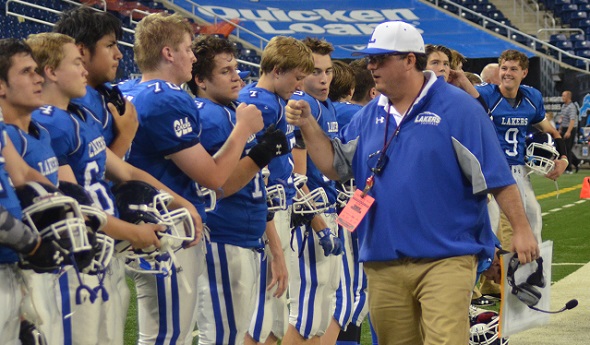
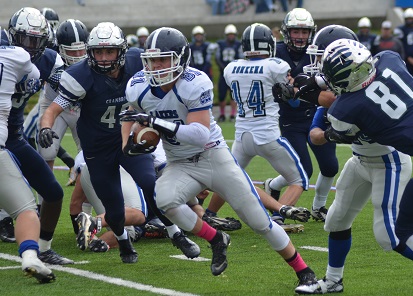
PHOTOS: (Top) Waterford Our Lady of the Lakes football coach Josh Sawicki fist-bumps his players during a Prep Bowl appearance at Ford Field. (Middle) Receiver Ryan Kostich (81) races through an opening during a 36-10 win over Bloomfield Hills Cranbrook Kingswood. (Photos by Paula Imboden.)
Five for 50: Record Remains Golden
By
Geoff Kimmerly
MHSAA.com senior editor
September 20, 2012
By Geoff Kimmerly
Second Half editor
Tom Essenburg remembers one night 50 years ago like it was just last Friday.
Rain had been falling steadily on Sept. 21, 1962, as the Holland and Muskegon Heights football teams took the field at Holland's Riverview Park for their Week 2 game.
 Heights was coached by the already-legendary Okie Johnson, and at his disposal were a handful of speedsters who could potentially make for a long night for Essenburg, a senior defensive back – although he had a hopeful hunch the wet weather might hinder the Tigers' passing game.
“I’m thinking to myself, what’s going to go on today?” Essenburg remembered this week. “They threw six passes the whole ballgame, because it was so wet.
“They didn’t complete one to a Muskegon Heights player,” he added. “But they completed five to me.”
Friday marks the 50th anniversary of Essenburg grabbing five interceptions, an MHSAA record for one game that twice has been tied but still stands half a century later.
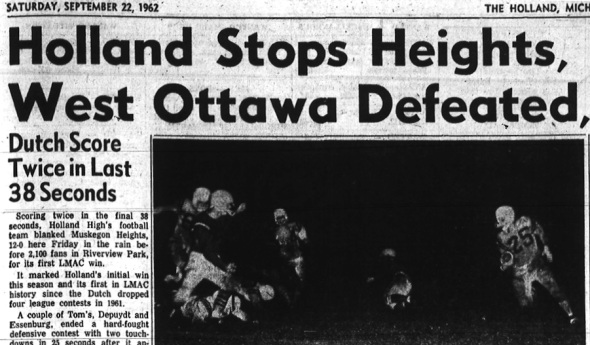
The next day's Holland Evening Sentinel first told of Essenburg's final interception, which he returned for a touchdown with 13 seconds to play in the 12-0 victory. The report's seventh paragraph explained that Essenburg “had quite a night with enemy aerials."
Essenburg, by his own estimation, was good but “not anything exceptional” at football. But he'd go on to captain the Western Michigan University men’s tennis team and officiate five MHSAA Football Finals during a 41-year career wearing the stripes. He's reffing still – he will be in the white hat Friday at Zeeland East – and owns and operates a fitness club in Grand Rapids.
It is more for those reasons that Essenburg is known well in the west Michigan athletic community. But the times have come, every few years or so, when someone runs across his name in the MHSAA record book, or recognizes his name from the record board at Holland High.
 Doing his job
“I had a job to do. I was a defensive back. My job was to make sure people didn’t get behind me,” Essenburg said this week. “I don’t think I counted (the interceptions) during the game. Not until I got the paper the next day did I think that (five) must have been right.”
When his family headed to Holland to see relatives, Kristin Callis remembers her dad asking her and her siblings if they’d like to stop by the field to see where he had his history-making moments.
“Of course we would groan and act like it would be the end of the world to make the stop. I only recall seeing the field once,” said Callis, the eldest of Essenburg’s three children. “It was really just a funny thing my Dad would say to us. He was proud yet humble when it came to his accomplishment.”
Essenburg also played baseball, basketball, and ran track at points during his high school years. After a standout tennis career with the Broncos, he became a teacher and later athletic director at Allegan High – and as a coach he started a boys tennis program that became one of the state’s elite under successor Gary Ellis.
Essenburg does most of his officiating these days for football and softball, and also has worked at the collegiate level. This spring, Essenburg received his 40-year service award from the MHSAA for his work between the lines.
“Excelling in high school sports charted the course for the rest of my Dad's life,” Callis said.
Essenburg owns Endurance Fitness in Grand Rapids. Previously, he started the Ramblewood Raquet Club in Grandville and managed the East Hills athletic club for nearly two decades. All three of his children got their first jobs at his club, and he taught them to play as many sports as they had interest. Essenburg's tennis skills no doubt passed down to Callis, who played at Hillsdale College. And, of course, the children have a pretty good idea what's happening on the football field – when they were kids, Essenburg would quiz Kristin, Heidi and Ryan on football officiating signals.
 History lives on
Essenburg's listing is the oldest for a defensive statistic in the MHSAA football record book. (Temperance Bedford's Tony Gill in 1990 and Concord's Zach Brigham in 2010 also grabbed five interceptions in one game to tie the record.)
But in a final ironic twist, recognition didn't come right away. Back then, a local service club sponsored a Player of the Week award for Holland's football team, with the best player each game honored the following Thursday. For the Heights game, Essenburg had to be a shoe-in.
The award that week went to a defensive lineman.
"I was just heartbroken. I said, 'What more could I do?'" Essenburg said. "But that was fine. Later in the year I got it."
“It’s a good thing I’m a referee,” he then joked. “If I was (a back judge), I might be really lenient with pass interference.”
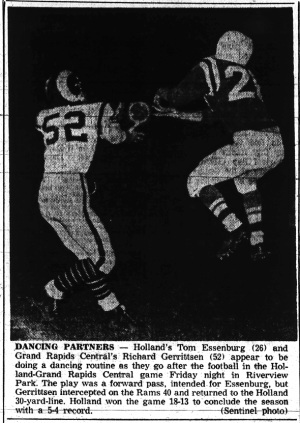
PHOTOS: (Top) Tom Essenburg was mentioned prevalently in the Sept. 22, 1962 Holland Evening Sentinel for his five interceptions the night before against Muskegon Heights. (Middle) Later that season, the Sentinel also ran a photo of Essenburg attempting to haul in a pass. (Bottom) Essenburg has officiated in five MHSAA Football Finals, the most recent in 2004 at the Pontiac Silverdome.