

Football Families Carry on Tradition
By
Tom Markowski
Special for Second Half
November 12, 2015
WATERFORD – Football always has been a family affair at Waterford Our Lady of the Lakes.
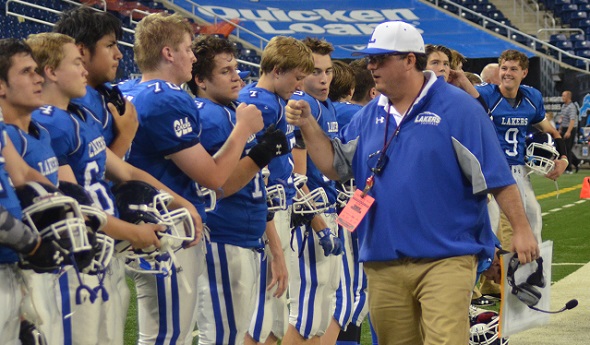
 It started with longtime coach Mike Boyd and continues on with Josh Sawicki, who’s in his third season as Lakes’ football coach.
Boyd retired after 2012 with 361 career victories, third most in MHSAA history. His sons, Mike, Jr., and Andy, played for him and contributed significantly to the Lakers’ success.
Mike Boyd played for his cousin, Leo “Smokey” Boyd, at Saginaw St. Peter & Paul.
And Boyd coached a number of siblings in his 48 seasons at Lakes. Josh and Jake Sawicki were two. Josh played linebacker and guard for four seasons, three times selected to all-state teams. Jake was a running back.
Sawicki took over for Boyd and has continued the winning tradition. Lakes was 8-3 his first season, 9-2 last season, and the Lakers are 11-0 heading into Saturday’s 1 p.m. Division 8 Regional Final against Saginaw Michigan Lutheran Seminary (10-1).
Those family ties continue as well. Quarterback Clay Senerius and receiver Devin Senerius are fraternal twins.
Clay is a three-year starter and is one of the top quarterbacks in Division 8. He’s 6-foot-3, 185 pounds and has been offered a scholarship by Avila University, an NAIA school in Kansas City (Mo.). Kalamazoo College, Hope College and St. Francis, located in Fort Wayne (Ind.) have also shown interest.
Senerius threw a school-record seven touchdown passes in a game as a junior. During his career he’s thrown at least five touchdown passes in a game five times. Through 10 games this season, he’s completed 107 of 171 attempts for 2,226 yards, 26 touchdowns and five interceptions.
And if Lakes wasn’t such a well-balanced team, those statistics would be even more impressive.
 “He’s a drop-back passer,” Sawicki said. “He has some athletic ability. What I like about him is he’s coachable. He throws a pretty pass. When he’s locked in, it’s like a video game.
“We throw it, but we don’t throw it that much.”
To the point, Lakes – Senerius, that is – threw for 2,900 yards last season and rushed for 1,200. This year the Lakers have gained half of their yards on the ground.
This team is primed to make a long playoff run. It’s dominated by seniors, and for a small school, the linemen are big. The offensive linemen average 235 pounds, the defensive linemen 260.
The best on offense is left guard Liam Sutton (6-0, 280), one of four seniors on the line. Sawicki will often run plays to Sutton’s side or use him as a pulling guard.
At nose guard is senior Anthony Clark (6-1, 310). Clark started playing football last season and is still developing. A state champion powerlifter, Clark is used just on defense.
Sawicki said a family member discouraged Clark from playing football.
“It took a while for his mom to allow him to play,” Sawicki said. “She was afraid he was going to get hurt. I assured her that Clark wasn’t going to be the one getting hurt.”
But what makes Lakes a team to be reckoned with is its offense, led by the Senerius twins and their other playmakers like Ryan Kostich, a 6-1, 215-pound linebacker and slot receiver, and running back-receiver Chris Cartier. Devin Senerius has 12 touchdown receptions and Cartier is averaging 13 yards every time he touches the ball, rushing and receiving.
“We have some really good receivers,” Clay Senerius said. “The last few weeks we’ve run the ball well, too. The offensive line is excelling.
“It’s great playing with my brother. I know typically what he’s going to do. I know where he’s going to be."
 Tom Markowski is a columnist and directs website coverage for the State Champs! Sports Network. He previously covered primarily high school sports for the The Detroit News from 1984-2014, focusing on the Detroit area and contributing to statewide coverage of football and basketball. Contact him at [email protected] with story ideas for Oakland, Macomb and Wayne counties.
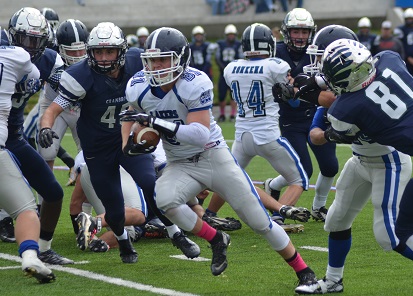
PHOTOS: (Top) Waterford Our Lady of the Lakes football coach Josh Sawicki fist-bumps his players during a Prep Bowl appearance at Ford Field. (Middle) Receiver Ryan Kostich (81) races through an opening during a 36-10 win over Bloomfield Hills Cranbrook Kingswood. (Photos by Paula Imboden.)
Dock Putting Dad's Coaching Lessons to Work as Middleville TK Continues Climb
By
Steve Vedder
Special for MHSAA.com
November 3, 2025
MIDDLEVILLE – Denny Dock can't pinpoint the exact moment he thought his football-loving son would follow him into coaching, but the signs were there all along.
 For starters, there were the countless hours spent tossing a football around the backyard. Or when his young son, Jeff – not even old enough for middle school at the time – eagerly joined other Stevensville Lakeshore coaches watching film on weekends.
Maybe it was all those Friday nights spent trekking along the sideline as a ball boy for Lancers teams. Another clue might have been the Saturday afternoons the two spent together watching college football, or taking in the NFL on Sundays.
When Jeff got older, it may have been how he readily absorbed tips that helped him become a better quarterback in high school and then at Grand Valley State. It could have even been an early, uncanny ability to grasp the importance of fundamentals.
Put it all together, and it seemed inevitable coaching football loomed in Jeff Dock's future.
"That's very fair to say," said Denny Dock, who is 19th on the state's list of all-time winningest football coaches while also the winningest high school softball coach in the country. "The younger years in football were really positive for Jeff, and that doesn't happen all the time. There are negative things that can happen."
While there might have been multiple signs the younger Dock would one day join the coaching ranks, he admits it was far from a done deal. There were thoughts of becoming a biology teacher, a pastor or maybe even an orthopedic surgeon.
But coaching? Even with his father as a classic example of the positive impact a good coach could spread, Dock said it took years for him to eventually land in coaching.
"It dawned on me that there were a lot of all three of those things in being a coach," he said. "Growing up in sports is what I knew, and I ended up developing a passion for it."
That passion is actually the highest it's been in years as his Middleville Thornapple Kellogg football team this past weekend improved to 7-3, continuing the program's first winning season since 2020 and the best fall since the Trojans went 7-3 in 2018. The Trojans defeated Hastings 28-20 in a Division 2 playoff opener, and a win this Friday at Lowell would give Middleville its first District championship since 2001.
Denny Dock coached football at Hartford from 1981-83, Dowagiac from 1984-87, and then Lakeshore from 1988-2013, returning to lead the Lancers for one more season in 2020 and all together totaling a 270-79 career record, 15 league titles and five runner-up MHSAA Finals finishes.
He has kept his hand in football in aiding his son's Trojans program. He's at all the games to add support, critique, advice, strategy, tips on how practices can best be organized and long talks discussing how continual improvement can be furthered.
It's a two-way street as an old football coach who never had a losing season, and is a member of the Michigan High School Football Coaches Association Hall of Fame, can remain invested in the game while his son benefits from three decades worth of experience.
Jeff Dock said his father's real value is his ability to spot from the stands the little things that less experienced coaches may miss.
 "Play calling, how players are used, maybe a little bit about strategy," Dock said.
After playing for his father, Dock said there's no doubt he's transferred the best of what he learned into his own coaching. The older Dock was not only a highly successful football coach, he's compiled a 1,319-345-2 record in softball with eight Finals titles.
Whether it's about football or the philosophy Dock stresses in his softball program, the advice accepted from his father – who still attends softball clinics for tips on improving the Lakeshore program – is virtually across the board. It begins, however, with how a coach should treat his players.
"I was a manager growing up, and I saw his intensity and a love of his players," Dock said. "He never pushed me in any direction, but he told me about education. He always let me figure it out. One of the coolest things my parents did in raising me was to allow me to figure things out."
As far as the Xs and Os of coaching, Dock said his father prizes an organized practice. In fact, it could even be argued that both Docks enjoy a spirited and productive practice session over the microscope of Friday Night Lights.
"He never had a losing season, and it was ingrained in us just to go back to work and that that work never stops," he said. "He loves practices and being organized. Rule No. 1 with him was to make sure the players are prepared, and that you have to communicate with them. Dad would never belittle us or cuss us out.
"I saw the work he put in, how he'd wake up every Saturday thinking about the game. I saw the nitty gritty of coaching and how it was going to take work."
It was that seemingly endless work, in fact, that Denny Dock made sure his young son understood. Denny had no illusions over the pitfalls of coaching, and the pros and the cons. But before he could teach that to his son the coach, he made sure his son the quarterback understood how athletics worked.
There were challenges as a player and now for his son as a coach.
"He was always a quarterback because I think he liked the ball in his hands," Denny Dock said. "I think he liked the leadership part of the game, understanding the team part, and knowing what he had to do. That always challenged him."
While the challenge of playing is long gone for the younger Dock, the next challenge is building a program which is annually competitive. To do that, Jeff Dock said he accepts what his father knew 30 years ago.
"I'm willing to learn anything from anyone at any time," he said. "I know my dad has always thought about what he can do to become a little better every year. I'm always looking for ways to communicate and do things better. It can always be done better, but how can you get there? How can we do the little things better. That's what I learned."
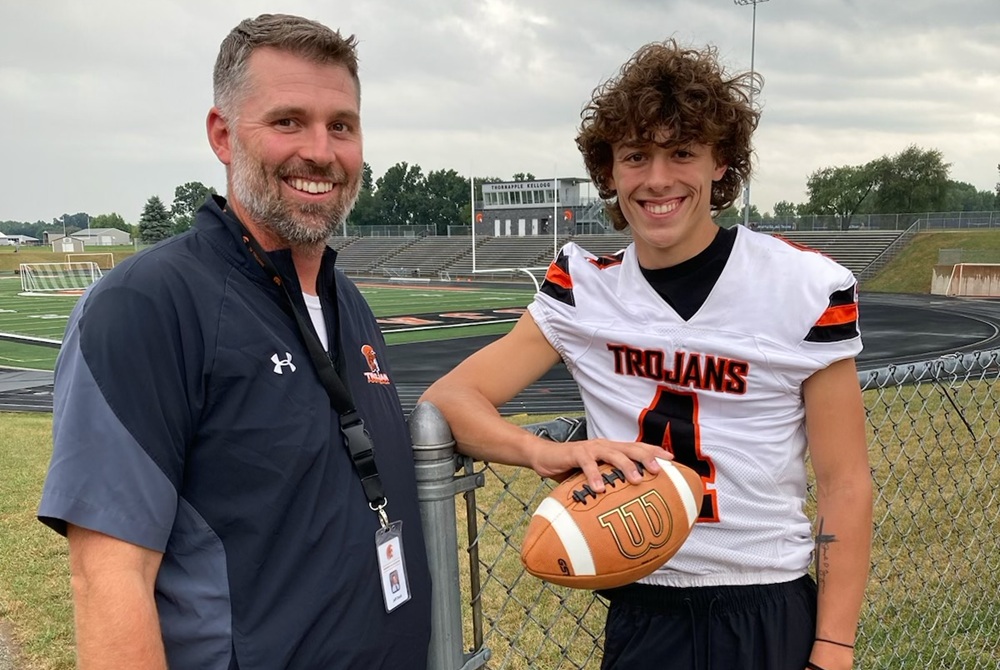
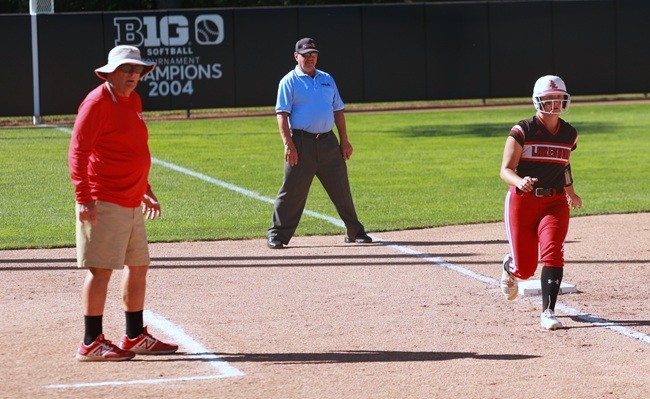
PHOTOS (Top) Jeff Dock, left, and son Micah – Middleville Thornapple Kellogg’s quarterback this season – stand for a photo at their home field. (Middle) Denny Dock, far left, coaches a base runner during Stevensville Lakeshore’s 2022 Semifinal win. (Top photo by Steve Vedder.)