

Football Kicks Off Again, 129 Years Later
By
Ron Pesch
MHSAA historian
August 25, 2017
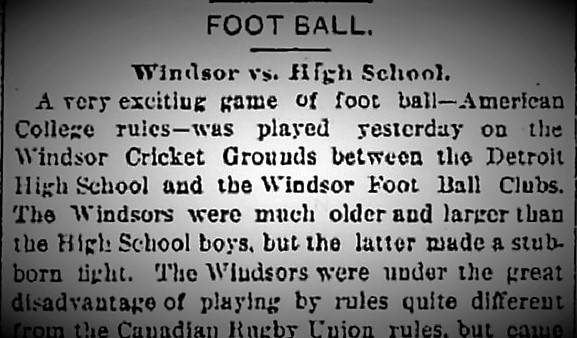
Buried in the text on the fourth page of the Saturday, October 27, 1888, Detroit Free Press is a single, concise sentence bearing a minimum amount of detail.
“The Windsor foot ball team will play the Detroit High School team this afternoon at 3.”
To date, this is the earliest account of a Michigan high school playing the game of “foot ball.”
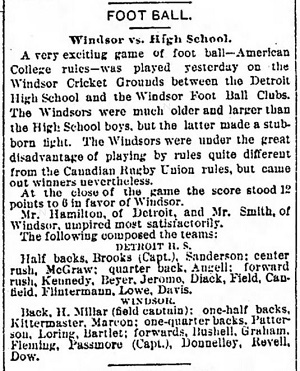
The following day’s paper provides only a few more details. The game was played on the Windsor Cricket Grounds. Despite the great disadvantage of playing under “American Football rules … quite different from the Canadian Rugby Union rules …” the “older and larger” Windsors won the contest, 12-6. Rosters for each squad were provided.
 Under American rules of the time, a touchdown was worth four points, with a conversion kick following a touchdown worth two additional points. At the time, a field goal counted for five points and a safety was worth two. The teams, however, may have agreed to a different scoring system before the contest.
Was this the first football game for a Michigan high school? That’s unlikely, but it is certainly among the earliest published accounts involving a prep game in the state.
It’s a fair assumption that foot ball, or some version of the game, was being played in neighborhoods before that time, at least based on the following statement found in the Jackson Citizen Patriot, dated June 18, 1867. Only days before, Dorrance & Goodwin’s, a store on Main Street in Jackson, had placed advertisements in the newspaper’s classifieds noting the pending arrival of this new product.
“Foot Ball – The pastime was inaugurated on our streets yesterday. Three or four balls were kept in motion all day on Main street alone. It affords no little amusement to the little boys, and is certainly a healthy exercise for the larger ones. It’s all right as long as no windows are broken or horses scared. Both calamities were barely escaped scores of times during the day.”
Rutgers and Princeton are credited with playing the first college football game in 1869. A decade later, in 1879, the University of Michigan established a football team.
Detroit High School played a number of games in 1888, besides the Windsor match, including a contest with the Tappen School from the Corktown area of Detroit. Played at the Detroit Athletic Club grounds on the afternoon of Thursday November 15, a final score was not mentioned in the following day’s Free Press.
For those unfamiliar with the sport, an account of the University of Michigan versus Detroit Athletic Club contest that appeared in the November 18 Free Press served as a fine introduction to the game, and the determination behind securing “possession of a leather-covered foot ball.”
“It was very interesting to see one speedy young man, after a desperate struggle in which the spectators fully expected to see him lose an arm or a leg, get away from his captors and start like a deer, with eight or ten of the opposite side in full pursuit. He is overtaken and the leader of the pursuing party springs upon the back of the man with the inflated trophy, bearing him to the ground with a dull thud … It is also an inspiring sight to see a fleet-footed player seize the ball and run at full speed in the direction of the goal of his opponents. Then a wing-footed opponent cuts across to intercept him, makes a flying leap, grasps the fugitive around the neck or waist and both go to grass with a suddenness and velocity that transforms them into human wheels …
 “While one unaccustomed to foot ball will naturally be startled by some of the acrobatic feats, still it is impossible to watch the game for any length of time without a tingling of the blood and holding of the breath. It is most intensely exciting, continuous in action and replete with fine points of play.
“It may be explained that the goals in a foot ball game are set at a distance of 330 feet from each other. The goal is made by placing two pieces of scantling twenty feet long upright in the ground, eighteen and one-half feet apart. Another piece runs midway horizontally between the uprights, and the ball must go over the horizontal piece and between the uprights to count a goal. There are eleven men on each side and the object is, of course, to get the ball through the goal of the other. The time of game is an hour and a half each side playing forty-five minutes from each goal, with an intermission of ten minutes between halves.”
A player who ran over an opponent’s goal line, “with the ball and touched it down” was then entitled to “bring the ball in front of the goal and attempt to kick it through”…
Among those playing for the Athletic Club squad that day was “little Hugh Brooks (captain) of the high school team.” Eligibility rules for players would evolve over time.
On Saturday, November 24, Detroit High School squared off for the first of two contests with Ann Arbor High School, this one at the Detroit Athletic Club grounds. Admission to the 2:45 p.m. contests was 25 cents. A crowd of around 300 watched “an exciting illustration of how Rugby foot ball is played. The exhibition by the Ann Arbor boys was considerably better than that of the Detroiters,” noted the Free Press, “the result of that being that Detroit’s banners have been kicked into the dust.”
Ann Arbor returned home with a 12-0 victory.
A second game with Ann Arbor was quickly scheduled.
In between, on Thursday, November 29, the Detroit High School squad played the Athletic Club before a crowd of about 200.
 “While the Athletics won by 12 to 0, still their playing was very loose, probably the result of over confidence. The Athletics will have to rid themselves of this by Saturday or the Albions will make short work of them.”
A large crowd gathered in the drizzling rain in Ann Arbor on Saturday, December 8, for what appears to be the final contest of the 1888 season for the high school teams of Detroit and Ann Arbor.
“It was a fine game. (Captain) Brooks, McGraw and Wisner, for Detroit, and Jewett, Diggert, Dupont, and Rathbone for Ann Arbor, made fine plays for their respective sides.” The result was an 8 to 2 win, and redemption, for the Detroit squad.
Today, 129 years later, “football” has seen wild expansion, numerous rule changes, and huge advancement in equipment worn when compared to those pioneer days of the sport. In 2017, more than 1 million individuals will suit up for high school teams across the United States. In Michigan alone, more than 36,000 participate in prep football.
And our state’s original programs live on. On Friday, Detroit Central opened its season with a win over Detroit Loyola. Ann Arbor High School, renamed Ann Arbor Pioneer in the late 1960s, fell in its Friday opener to Muskegon.
Welcome to another season of America’s favorite pastime.
 Ron Pesch has taken an active role in researching the history of MHSAA events since 1985 and began writing for MHSAA Finals programs in 1986, adding additional features and "flashbacks" in 1992. He inherited the title of MHSAA historian from the late Dick Kishpaugh following the 1993-94 school year, and resides in Muskegon. Contact him at [email protected] with ideas for historical articles.
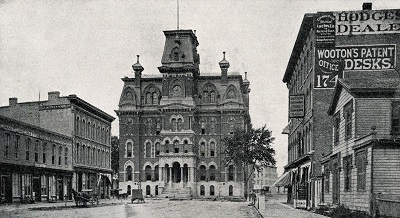
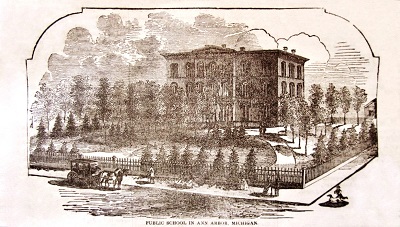
PHOTOS: (Top) The Detroit Free Press included brief coverage of the first "reported" game on Oct. 28, 1888. (Middle) When Michigan’s state government moved from Detroit to Lansing in 1847, the old Capitol building was re-opened as the Detroit’s first city high school in 1863. To better accommodate Detroit’s growing population, the old two-story structure was remodeled into a four-story building, unrecognizable to most. The school served the city well until January 1893, when it burned to the ground. (Below) Erected in 1856 at the cost of $27,000, Ann Arbor High School at State and Huron (now site of the North Quad of the University of Michigan) was destroyed by fire in 1904. (Photos courtesy of Ron Pesch.)
Youngest Brother Bryan Closing Convertini Family's Memorable 13-Year Run at MCC
By
Tom Kendra
Special for MHSAA.com
May 8, 2025
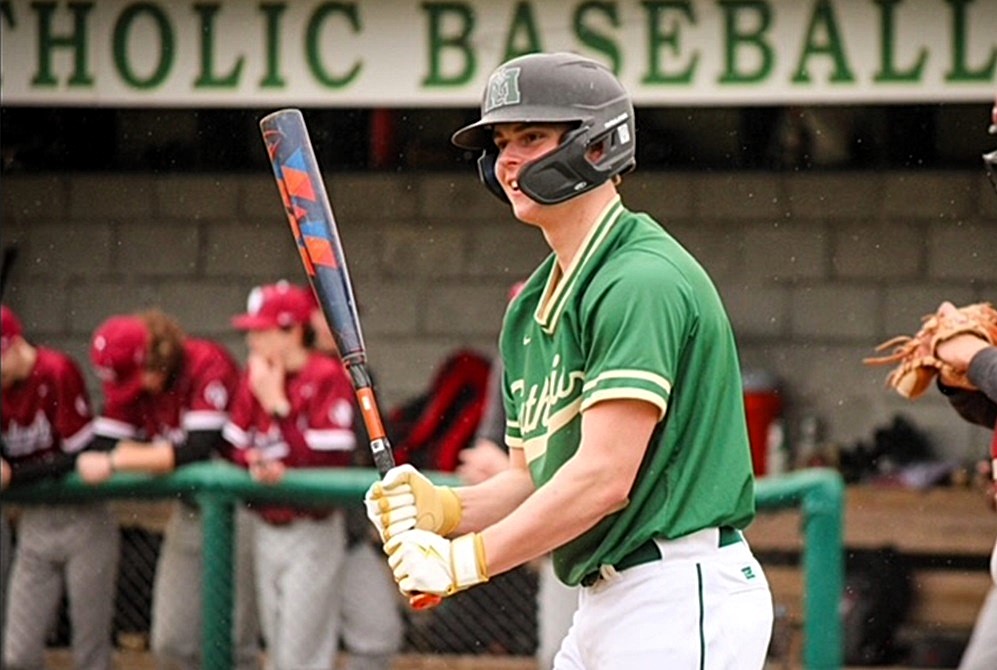
Bryan Convertini is nearing the end of an amazing four-year athletic career for Muskegon Catholic Central, but this swan song is not just about him.
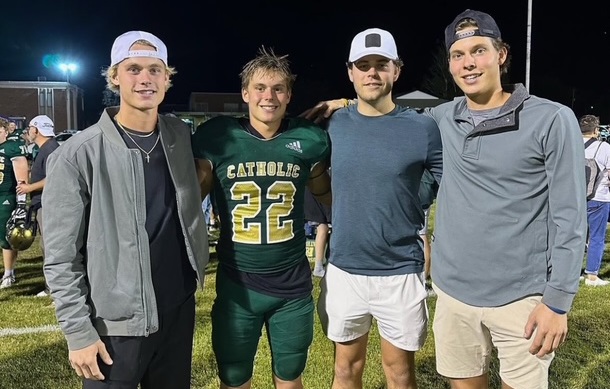
 Bryan is the last of the four “Convertini boys” at MCC, who collectively have provided Crusaders fans with plenty of big plays and thrilling wins – doing it all with their humble, no-nonsense leadership style – over the past 13 years.
“The Convertinis have really become the first family of Muskegon Catholic Central,” said MCC baseball coach Steve Schuitema, noting their father, Kolin, is an assistant varsity football coach and their mother, Jene, has served as the team mom for baseball and football for years.
“It will be different and a little sad to not have a Convertini out there for MCC anymore. All of them were leaders and a coach’s dream and really an extension of the coach on the field.”
Mason, 26, graduated in 2017 and set the sports tone for his three brothers, playing football, hockey as part of MCC’s cooperative team with Muskegon Reeths-Puffer, and baseball.
Nolan, 23, graduated in 2020 and, at 6-foot-2, is the tallest of the brothers. He played the same three sports as Mason, and was the most versatile of the boys, playing almost every position in football, including starting two games at quarterback.
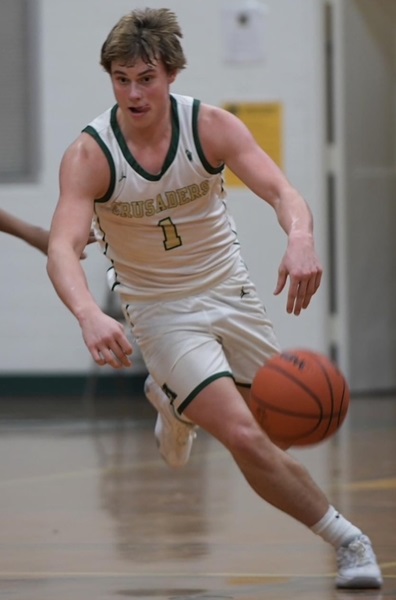
Sam, 21, graduated in 2022, and also played football, hockey and baseball, but he opted to play basketball his senior year so he could play with his younger brother, Bryan.
Bryan, 18, will graduate June 1 after a standout, three-sport career, including the past three years as the starting varsity quarterback, before beginning college this fall at Grand Valley State.
“My memories at MCC go way back to when I was like 6 or 7 and the waterboy in football and the batboy in baseball,” said Bryan with a smile.
“The first word that comes to mind when I think about it is family. The whole school is like a big family that pushes and supports each other.”
Grandpa’s boys
The Convertini boys come from good stock, starting with their grandfathers.
On their mother’s side is Grandpa Bryan McLay who, at the age of 87, is still considered “Mr. Hockey” in Muskegon.
 McLay, a Kenora, Ontario, native who first came to Muskegon in 1960 (the same year that the downtown hockey arena opened), tallied more than 1,000 points over his 13 seasons with the Muskegon Zephyrs and later, the Mohawks.
McLay moved in with the family after his wife, Peggy, died four years ago, and regularly regales his grandsons with his “old-time hockey” stories.
Jene picked up her father’s passion for sports and has been a natural in the Crusaders’ “team mom” role – organizing meals, carpools, fundraisers and sending out emails for game and schedule changes, among other things.
On their father’s side is Grandpa Fred Convertini, a California native who played in the 1966 Rose Bowl as an offensive lineman at Michigan State – as part of what is considered the top offensive line in MSU history.
Kolin certainly inherited his father’s athletic ability, making first-team all-state in football (running back), wrestling and track & field (pole vault) during his senior year of 1989-1990. He went on to play defensive back at Eastern Michigan University.
He also picked up his father’s humility and toughness, the latter which was put to the test in 2014 when he was diagnosed with cancer.
“Kolin’s cancer really brought us together as a family,” explained Jene. “We didn’t know how long we had, and we decided we weren’t going to do travel sports any more. I didn’t want to be in Chicago and Kolin in Detroit for the weekend and then we say hi on the way out the door to work on Monday morning. We decided to spend more time together.”
Like their grandfathers and father, all four of the Convertini boys were known for their dependability, rarely if ever missing games due to sickness or injury.
In fact, Bryan suffered an injury in the opening football game of his junior season, then played the remaining 10 games on what was later determined to be a broken left ankle – and, by the way, he earned first-team all-state as a defensive back with five interceptions.
“It hurt so bad,” Bryan said, shaking his head. “But I needed to be out there. My team needed me to be out there.”
Home cooking
The Convertini house in Norton Shores has been a gathering place for MCC athletes for years.
It all started when the boys were little, wrestling between the couches and shooting pucks at the walls in the basement.
 Later on, that basement became the annual meeting spot for the MCC football team for “Selection Sunday,” when the team would learn its draw for the postseason playoffs.
Mason and Nolan, the two older boys, certainly enjoyed the most team success. Mason was part of three straight Division 8 championship football teams from 2014 to 2016. Nolan, meanwhile, played in three national championship games (with two titles) as a member of the Hope College men’s club hockey team.
The two younger boys had less team success, in large part because MCC really started struggling with numbers, but Sam and Bryan certainly did all they could and were rewarded with individual accolades.
Sam was the first of the brothers to make first-team all-state, earning the honor as a tight end in 2021. Bryan did one better, making all-state twice – after his junior year as a defensive back and his senior year as an “athlete” for his contributions all over the field.
Bryan also made first-team all-state last year in baseball, batting .478 as an outfielder.
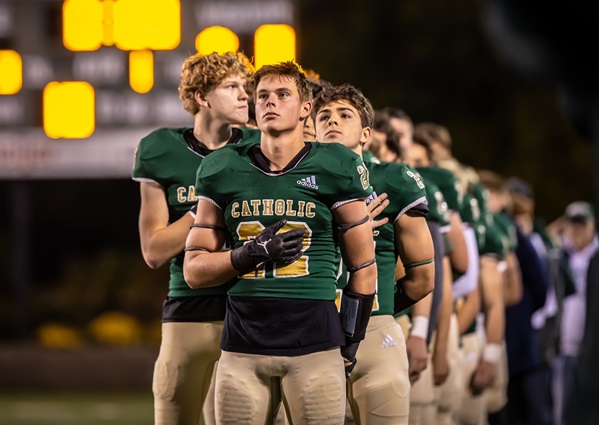
In football, he rose above his broken ankle as a junior to rush for more than 800 yards and 11 touchdowns. In a win over Benton Harbor, he had a rushing TD, a passing TD, a receiving TD and returned an interception for yet another TD. This past fall as a senior, he threw for 880 yards and rushed for 621, while making a team-high 81 tackles in his first year at linebacker.
But when asked about the individual highlight of his football career, he doesn’t hesitate.
“That would have to be my freshman year, when I threw a halfback pass to my brother (Sam) for a touchdown,” recalled Bryan, noting a play that occurred in a victory over Muskegon Heights Academy during what ended as the 500th win in MCC football history.
Going out with a bang
Bryan hopes to tack on some additional highlights over the next month of baseball season, effectively writing a happy ending to the Convertini novel.
The Crusaders’ baseball team is off to an 11-4 start after a home sweep of Byron Center Zion Christian on Tuesday, during which MCC pitchers allowed just one run over two games.
 Bryan is currently batting .375 while playing the critical position of shortstop, out of need, since he is a natural outfielder.
He would love to have a repeat of his freshman year, when he batted leadoff and helped the Crusaders to District and Regional championships. MCC had won 11 straight Districts before falling short last spring, so he said avenging that District loss is a major priority.
That would also be an appropriate ending after an uncharacteristic football season when the young Crusaders (who started three 14-year-old freshmen on the offensive line) finished 1-7.
Things went much better in basketball, as Bryan teamed with all-stater Bradley Richards to help MCC to an 11-10 record, its first winning season in six years.
Through winning or losing, MCC football coach Steve Czerwon said the strong Catholic faith of the Convertini family is always front and center.
The family will gather to celebrate in early September, when Mason and his fiancée, Sophie, get married at St. Michael’s Church in Muskegon. That is about the same time that Bryan will be off to Grand Valley, and Czerwon and the MCC football program will begin the post-Convertini era.
“Bryan and all of his brothers have an inner strength which sets them apart,” said Czerwon, who took over as MCC’s head coach in 2013, which was Mason’s freshman year. “All of them respect authority and they want to learn and get better, which is all that you can ask.
“It’s been a pleasure working with their family. We are all going to miss them.”
 Tom Kendra worked 23 years at The Muskegon Chronicle, including five as assistant sports editor and the final six as sports editor through 2011. E-mail him at [email protected] with story ideas for Muskegon, Oceana, Mason, Lake, Oceola, Mecosta and Newaygo counties.
PHOTOS (Top) Muskegon Catholic Central’s Bryan Convertini takes a look down the third-base line during a baseball at bat. (2) The four Convertini boys take a photo together after one of Bryan’s football games in 2023. From left: Sam, Bryan, Mason and Nolan. (3) Convertini brings the ball upcourt during basketball season. (4) Convertini (22), stands for the national anthem this past fall. (Baseball and basketball photos by Michael Banka. Football photo by Tim Reilly. Family photo courtesy of Jene Convertini.)