

Football Kicks Off Again, 129 Years Later
By
Ron Pesch
MHSAA historian
August 25, 2017
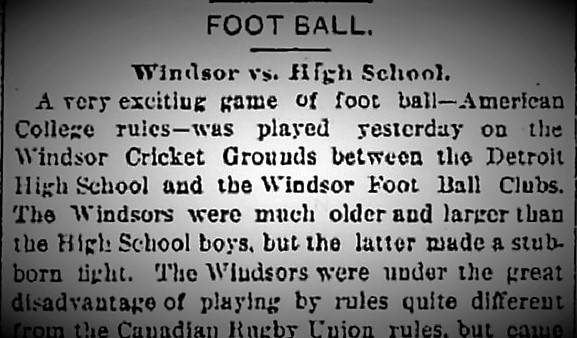
Buried in the text on the fourth page of the Saturday, October 27, 1888, Detroit Free Press is a single, concise sentence bearing a minimum amount of detail.
“The Windsor foot ball team will play the Detroit High School team this afternoon at 3.”
To date, this is the earliest account of a Michigan high school playing the game of “foot ball.”
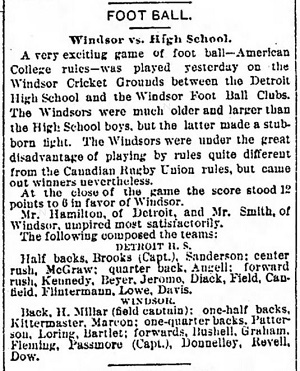
The following day’s paper provides only a few more details. The game was played on the Windsor Cricket Grounds. Despite the great disadvantage of playing under “American Football rules … quite different from the Canadian Rugby Union rules …” the “older and larger” Windsors won the contest, 12-6. Rosters for each squad were provided.
 Under American rules of the time, a touchdown was worth four points, with a conversion kick following a touchdown worth two additional points. At the time, a field goal counted for five points and a safety was worth two. The teams, however, may have agreed to a different scoring system before the contest.
Was this the first football game for a Michigan high school? That’s unlikely, but it is certainly among the earliest published accounts involving a prep game in the state.
It’s a fair assumption that foot ball, or some version of the game, was being played in neighborhoods before that time, at least based on the following statement found in the Jackson Citizen Patriot, dated June 18, 1867. Only days before, Dorrance & Goodwin’s, a store on Main Street in Jackson, had placed advertisements in the newspaper’s classifieds noting the pending arrival of this new product.
“Foot Ball – The pastime was inaugurated on our streets yesterday. Three or four balls were kept in motion all day on Main street alone. It affords no little amusement to the little boys, and is certainly a healthy exercise for the larger ones. It’s all right as long as no windows are broken or horses scared. Both calamities were barely escaped scores of times during the day.”
Rutgers and Princeton are credited with playing the first college football game in 1869. A decade later, in 1879, the University of Michigan established a football team.
Detroit High School played a number of games in 1888, besides the Windsor match, including a contest with the Tappen School from the Corktown area of Detroit. Played at the Detroit Athletic Club grounds on the afternoon of Thursday November 15, a final score was not mentioned in the following day’s Free Press.
For those unfamiliar with the sport, an account of the University of Michigan versus Detroit Athletic Club contest that appeared in the November 18 Free Press served as a fine introduction to the game, and the determination behind securing “possession of a leather-covered foot ball.”
“It was very interesting to see one speedy young man, after a desperate struggle in which the spectators fully expected to see him lose an arm or a leg, get away from his captors and start like a deer, with eight or ten of the opposite side in full pursuit. He is overtaken and the leader of the pursuing party springs upon the back of the man with the inflated trophy, bearing him to the ground with a dull thud … It is also an inspiring sight to see a fleet-footed player seize the ball and run at full speed in the direction of the goal of his opponents. Then a wing-footed opponent cuts across to intercept him, makes a flying leap, grasps the fugitive around the neck or waist and both go to grass with a suddenness and velocity that transforms them into human wheels …
 “While one unaccustomed to foot ball will naturally be startled by some of the acrobatic feats, still it is impossible to watch the game for any length of time without a tingling of the blood and holding of the breath. It is most intensely exciting, continuous in action and replete with fine points of play.
“It may be explained that the goals in a foot ball game are set at a distance of 330 feet from each other. The goal is made by placing two pieces of scantling twenty feet long upright in the ground, eighteen and one-half feet apart. Another piece runs midway horizontally between the uprights, and the ball must go over the horizontal piece and between the uprights to count a goal. There are eleven men on each side and the object is, of course, to get the ball through the goal of the other. The time of game is an hour and a half each side playing forty-five minutes from each goal, with an intermission of ten minutes between halves.”
A player who ran over an opponent’s goal line, “with the ball and touched it down” was then entitled to “bring the ball in front of the goal and attempt to kick it through”…
Among those playing for the Athletic Club squad that day was “little Hugh Brooks (captain) of the high school team.” Eligibility rules for players would evolve over time.
On Saturday, November 24, Detroit High School squared off for the first of two contests with Ann Arbor High School, this one at the Detroit Athletic Club grounds. Admission to the 2:45 p.m. contests was 25 cents. A crowd of around 300 watched “an exciting illustration of how Rugby foot ball is played. The exhibition by the Ann Arbor boys was considerably better than that of the Detroiters,” noted the Free Press, “the result of that being that Detroit’s banners have been kicked into the dust.”
Ann Arbor returned home with a 12-0 victory.
A second game with Ann Arbor was quickly scheduled.
In between, on Thursday, November 29, the Detroit High School squad played the Athletic Club before a crowd of about 200.
 “While the Athletics won by 12 to 0, still their playing was very loose, probably the result of over confidence. The Athletics will have to rid themselves of this by Saturday or the Albions will make short work of them.”
A large crowd gathered in the drizzling rain in Ann Arbor on Saturday, December 8, for what appears to be the final contest of the 1888 season for the high school teams of Detroit and Ann Arbor.
“It was a fine game. (Captain) Brooks, McGraw and Wisner, for Detroit, and Jewett, Diggert, Dupont, and Rathbone for Ann Arbor, made fine plays for their respective sides.” The result was an 8 to 2 win, and redemption, for the Detroit squad.
Today, 129 years later, “football” has seen wild expansion, numerous rule changes, and huge advancement in equipment worn when compared to those pioneer days of the sport. In 2017, more than 1 million individuals will suit up for high school teams across the United States. In Michigan alone, more than 36,000 participate in prep football.
And our state’s original programs live on. On Friday, Detroit Central opened its season with a win over Detroit Loyola. Ann Arbor High School, renamed Ann Arbor Pioneer in the late 1960s, fell in its Friday opener to Muskegon.
Welcome to another season of America’s favorite pastime.
 Ron Pesch has taken an active role in researching the history of MHSAA events since 1985 and began writing for MHSAA Finals programs in 1986, adding additional features and "flashbacks" in 1992. He inherited the title of MHSAA historian from the late Dick Kishpaugh following the 1993-94 school year, and resides in Muskegon. Contact him at [email protected] with ideas for historical articles.
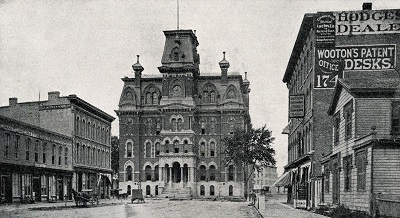
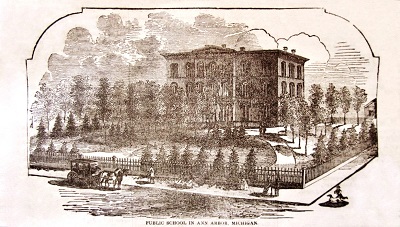
PHOTOS: (Top) The Detroit Free Press included brief coverage of the first "reported" game on Oct. 28, 1888. (Middle) When Michigan’s state government moved from Detroit to Lansing in 1847, the old Capitol building was re-opened as the Detroit’s first city high school in 1863. To better accommodate Detroit’s growing population, the old two-story structure was remodeled into a four-story building, unrecognizable to most. The school served the city well until January 1893, when it burned to the ground. (Below) Erected in 1856 at the cost of $27,000, Ann Arbor High School at State and Huron (now site of the North Quad of the University of Michigan) was destroyed by fire in 1904. (Photos courtesy of Ron Pesch.)
Performance: River Rouge's Mareyohn Hrabowski
December 6, 2019
 Mareyohn Hrabowski
River Rouge junior – Football
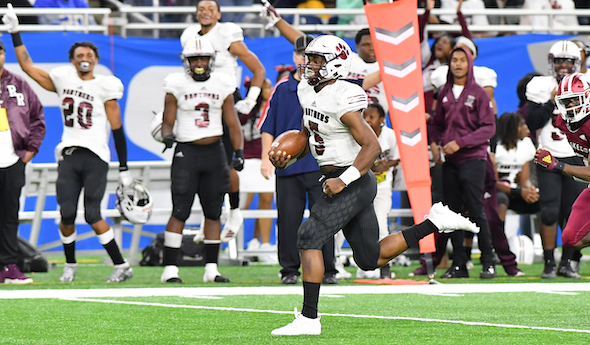
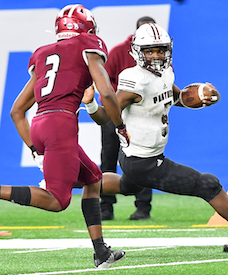
The Panthers’ multi-talented quarterback has become the state’s most-discussed emerging star from last weekend’s MHSAA 11-Player Football Finals after leading River Rouge to an arguably unexpected 30-7 win over Muskegon in the Division 3 championship game. Hrabowski ran 15 times for 175 yards and three touchdowns and completed 6-of-12 passes for 45 yards more in leading the Panthers to their first Finals title in the sport, earning the MHSAA “Performance of the Week.”
For the season, Hrabowski ran 115 times for 1,175 yards (10.2 per carry) and 14 touchdowns and completed 78 of 108 passes for 1,045 yards and 11 scores with only two interceptions. In making its second trip to the Finals, River Rouge set a program wins record finishing 13-1 with its only loss in Week 1, by three, to eventual Division 4 champion Grand Rapids Catholic Central. The Panthers also outscored their five playoff opponents by an average score of 37-7. But the crowning achievement certainly was defeating Muskegon – the Big Reds were last season’s Division 3 runners-up and the top-ranked team entering this fall’s playoffs, and had received national recognition this fall while quarterbacked by Ohio State recruit Cameron Martinez. After the Big Reds took a 7-0 lead with a score during the final minute of the first quarter Saturday, Hrabowski scored on runs of 1, 40 and 35 yards to put the Panthers up 21-7 less than a minute into the third quarter.
The 6-foot-3, 205-pound signal caller had showed his skills well all fall, but the attention likely will grow substantially after his Ford Field performance. He announced earlier this week he’d received a scholarship offer from Bowling Green, and he’ll surely be one of the most anticipated players to watch heading into next fall. Hrabowski also will play basketball for River Rouge, last season’s Division 2 runner-up in that sport, and run track next spring. He carries a 3.5 grade-point average with algebra and environmental science his favorite classes, and he enjoys building and fixing things – mechanical engineering is a field of study he’s considering after high school.
Coach Corey Parker said: “Mareyohn is a great kid, he plays the game hard, he plays the game smart, he plays the game the right way, he’s always focused and is very coachable. He’s a great leader and works hard to get the most out of his teammates. He’s hard on his offensive line on the field, yet maintains a great relationship with all of them off the field – that speaks to his character. … We were not shocked by his state championship performance at all; we knew he had a chance of having a big game if he could get through the emotional roller coaster the state championship throws at you. Mareyohn was your prototype dual threat QB at Ford Field Saturday. He ran the ball exceptionally well and completed several passes for first downs during crucial points in the game. I’m very proud of him and our QB coach, Larry Johnson. (Mareyohn) developed as the season went on and peaked at the right time.”
Performance Point: “After the game, just enjoying the moment after beating the No. 1 team in the state, and letting it soak in – the crowd, everybody was really happy. We won our first state championship in school history, so it was really big for the city, and it means a lot for everyone. It was a really big night for us, the whole team and the city.”
 Taking the spotlight: “Before the game a lot of people were talking about Muskegon. A lot of people thought they were going to win. When we won the game, people started talking about River Rouge, and it put us on the map. We were looking forward to playing a game like that. We knew that the championship, that it was going to be a good team. We like playing against competition. Those big games get us hype.”
Finals formula: “To make it this far, it definitely takes teamwork, and trust, and believing in your coaches. And never giving up. It’s not easy making it to the state championship. It takes a lot of hard work. You’ve got to be consistent. Team bonding in camps, and getting to know each other and hanging out together really builds a lot of trust and believing in each other.”
Big plays, big-time player: “I was really looking forward to the opportunity. I like playing against competition. I worked as hard as I could to get to this point, and I knew I wasn’t going to give up. … I think every time I ran the ball, passed the ball, I did it like it was going to be my last. Every touchdown that I ran, I ran as hard as I could. And playing against Muskegon, it built my confidence every single time we got a big play – and that played a big role in how I played the game that night.”
More to come: “I watch (Baltimore Ravens’ QB) Lamar Jackson a lot. I like some of my game being like his a little bit. (I’m planning on) getting a little bit faster in the offseason and getting more tools for my box for next season. ... I want to show that I can pass the ball, not only run the ball, and hopefully next year will be fortunate enough to make the state championship again and win. And just keep on showing people I’m one of the best quarterbacks in Michigan.”
– Geoff Kimmerly, Second Half editor
Past honorees
Nov. 28: Kathryn Ackerman, Grand Haven swimming - Report
Nov. 21: Emily Van Dyke, Southfield Christian volleyball - Report
Nov. 14: Taylor Wegener, Ida volleyball - Report
Nov. 7: Carter Solomon, Plymouth cross country - Report
Oct. 31: Jameson Goorman, Muskegon Western Michigan Christian soccer - Report
Oct. 24: Austin Plotkin, Brimley cross country - Report
Oct. 17: Jack Spamer, Brighton cross country - Report
Oct. 10: Kaylee Maat, Hudsonville volleyball - Report
Oct. 3: Emily Paupore, Negaunee cross country - Report
Sept. 26: Josh Mason, South Lyon soccer - Report
Sept. 19: Ariel Chang, Utica Eisenhower golf - Report
Sept. 12: Jordyn Shipps, DeWitt swimming - Report
PHOTOS: (Top) River Rouge's Mareyohn Hrabowski (5) breaks away for one of his three touchdown runs Saturday while his teammates cheer him on. (Middle) Hrabowski works to evade a defender.