

Football Kicks Off Again, 129 Years Later
By
Ron Pesch
MHSAA historian
August 25, 2017
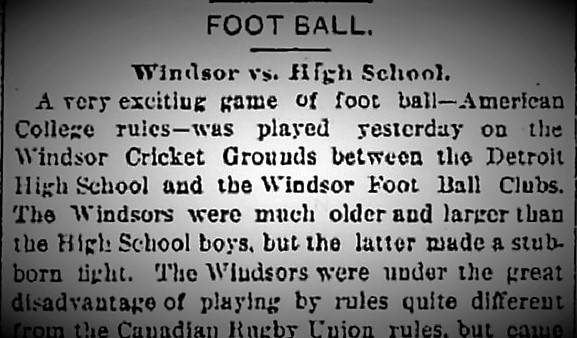
Buried in the text on the fourth page of the Saturday, October 27, 1888, Detroit Free Press is a single, concise sentence bearing a minimum amount of detail.
“The Windsor foot ball team will play the Detroit High School team this afternoon at 3.”
To date, this is the earliest account of a Michigan high school playing the game of “foot ball.”
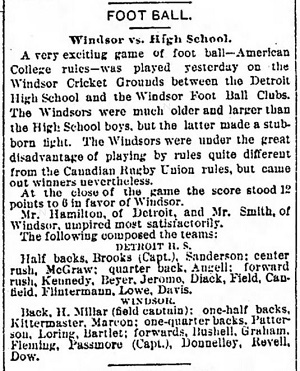
The following day’s paper provides only a few more details. The game was played on the Windsor Cricket Grounds. Despite the great disadvantage of playing under “American Football rules … quite different from the Canadian Rugby Union rules …” the “older and larger” Windsors won the contest, 12-6. Rosters for each squad were provided.
 Under American rules of the time, a touchdown was worth four points, with a conversion kick following a touchdown worth two additional points. At the time, a field goal counted for five points and a safety was worth two. The teams, however, may have agreed to a different scoring system before the contest.
Was this the first football game for a Michigan high school? That’s unlikely, but it is certainly among the earliest published accounts involving a prep game in the state.
It’s a fair assumption that foot ball, or some version of the game, was being played in neighborhoods before that time, at least based on the following statement found in the Jackson Citizen Patriot, dated June 18, 1867. Only days before, Dorrance & Goodwin’s, a store on Main Street in Jackson, had placed advertisements in the newspaper’s classifieds noting the pending arrival of this new product.
“Foot Ball – The pastime was inaugurated on our streets yesterday. Three or four balls were kept in motion all day on Main street alone. It affords no little amusement to the little boys, and is certainly a healthy exercise for the larger ones. It’s all right as long as no windows are broken or horses scared. Both calamities were barely escaped scores of times during the day.”
Rutgers and Princeton are credited with playing the first college football game in 1869. A decade later, in 1879, the University of Michigan established a football team.
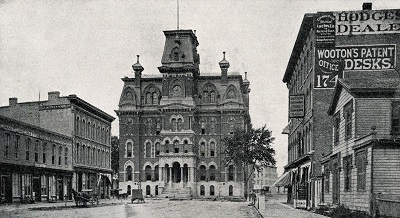
Detroit High School played a number of games in 1888, besides the Windsor match, including a contest with the Tappen School from the Corktown area of Detroit. Played at the Detroit Athletic Club grounds on the afternoon of Thursday November 15, a final score was not mentioned in the following day’s Free Press.
For those unfamiliar with the sport, an account of the University of Michigan versus Detroit Athletic Club contest that appeared in the November 18 Free Press served as a fine introduction to the game, and the determination behind securing “possession of a leather-covered foot ball.”
“It was very interesting to see one speedy young man, after a desperate struggle in which the spectators fully expected to see him lose an arm or a leg, get away from his captors and start like a deer, with eight or ten of the opposite side in full pursuit. He is overtaken and the leader of the pursuing party springs upon the back of the man with the inflated trophy, bearing him to the ground with a dull thud … It is also an inspiring sight to see a fleet-footed player seize the ball and run at full speed in the direction of the goal of his opponents. Then a wing-footed opponent cuts across to intercept him, makes a flying leap, grasps the fugitive around the neck or waist and both go to grass with a suddenness and velocity that transforms them into human wheels …
 “While one unaccustomed to foot ball will naturally be startled by some of the acrobatic feats, still it is impossible to watch the game for any length of time without a tingling of the blood and holding of the breath. It is most intensely exciting, continuous in action and replete with fine points of play.
“It may be explained that the goals in a foot ball game are set at a distance of 330 feet from each other. The goal is made by placing two pieces of scantling twenty feet long upright in the ground, eighteen and one-half feet apart. Another piece runs midway horizontally between the uprights, and the ball must go over the horizontal piece and between the uprights to count a goal. There are eleven men on each side and the object is, of course, to get the ball through the goal of the other. The time of game is an hour and a half each side playing forty-five minutes from each goal, with an intermission of ten minutes between halves.”
A player who ran over an opponent’s goal line, “with the ball and touched it down” was then entitled to “bring the ball in front of the goal and attempt to kick it through”…
Among those playing for the Athletic Club squad that day was “little Hugh Brooks (captain) of the high school team.” Eligibility rules for players would evolve over time.
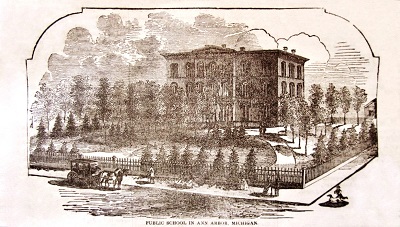
On Saturday, November 24, Detroit High School squared off for the first of two contests with Ann Arbor High School, this one at the Detroit Athletic Club grounds. Admission to the 2:45 p.m. contests was 25 cents. A crowd of around 300 watched “an exciting illustration of how Rugby foot ball is played. The exhibition by the Ann Arbor boys was considerably better than that of the Detroiters,” noted the Free Press, “the result of that being that Detroit’s banners have been kicked into the dust.”
Ann Arbor returned home with a 12-0 victory.
A second game with Ann Arbor was quickly scheduled.
In between, on Thursday, November 29, the Detroit High School squad played the Athletic Club before a crowd of about 200.
 “While the Athletics won by 12 to 0, still their playing was very loose, probably the result of over confidence. The Athletics will have to rid themselves of this by Saturday or the Albions will make short work of them.”
A large crowd gathered in the drizzling rain in Ann Arbor on Saturday, December 8, for what appears to be the final contest of the 1888 season for the high school teams of Detroit and Ann Arbor.
“It was a fine game. (Captain) Brooks, McGraw and Wisner, for Detroit, and Jewett, Diggert, Dupont, and Rathbone for Ann Arbor, made fine plays for their respective sides.” The result was an 8 to 2 win, and redemption, for the Detroit squad.
Today, 129 years later, “football” has seen wild expansion, numerous rule changes, and huge advancement in equipment worn when compared to those pioneer days of the sport. In 2017, more than 1 million individuals will suit up for high school teams across the United States. In Michigan alone, more than 36,000 participate in prep football.
And our state’s original programs live on. On Friday, Detroit Central opened its season with a win over Detroit Loyola. Ann Arbor High School, renamed Ann Arbor Pioneer in the late 1960s, fell in its Friday opener to Muskegon.
Welcome to another season of America’s favorite pastime.
 Ron Pesch has taken an active role in researching the history of MHSAA events since 1985 and began writing for MHSAA Finals programs in 1986, adding additional features and "flashbacks" in 1992. He inherited the title of MHSAA historian from the late Dick Kishpaugh following the 1993-94 school year, and resides in Muskegon. Contact him at [email protected] with ideas for historical articles.
PHOTOS: (Top) The Detroit Free Press included brief coverage of the first "reported" game on Oct. 28, 1888. (Middle) When Michigan’s state government moved from Detroit to Lansing in 1847, the old Capitol building was re-opened as the Detroit’s first city high school in 1863. To better accommodate Detroit’s growing population, the old two-story structure was remodeled into a four-story building, unrecognizable to most. The school served the city well until January 1893, when it burned to the ground. (Below) Erected in 1856 at the cost of $27,000, Ann Arbor High School at State and Huron (now site of the North Quad of the University of Michigan) was destroyed by fire in 1904. (Photos courtesy of Ron Pesch.)
Drive for Detroit: Week 1 Preview
August 28, 2019
By Geoff Kimmerly
Second Half editor
By the end of this opening weekend of Michigan high school football, some fans will say of their successful teams "it's just like last year," while others will boast "this looks nothing like last year, and it's going to be special."
 That's perhaps the greatness of high school football above all other levels – more than at any other, the beginning of the season provides such a fresh slate that last year's winless team could become this year's league champion.
Total, 608 teams will start down that road, with the great majority of the weekend's 306 varsity openers to be played Thursday, followed by games Friday and Saturday as well.
As we'll do every week, below we've broken out some of the games of particular interest from every corner of the state. (Records shown below are from 2018.) Check out your local game, but also take advantage of the opportunity to watch any of 25 games being broadcast this weekend on MHSAA.tv, including all six from the Xenith Prep Football Kickoff Classic at Wayne State University and both from the Vehicle City Gridiron Classic at Flint's Atwood Stadium. Click for the full schedule.
"Drive for Detroit" is sponsored by MI Student Aid, which works to make college more accessible, affordable and attainable for Michigan students.
Bay & Thumb
Fenton (7-3) at Davison (7-3), Thursday
These have been two of the Flint area's powers during the 2000s, Davison riding a four-season playoff streak after bouncing back from a brief rough patch and Fenton coming off its 11th consecutive postseason appearance. They split a pair of openers in 2014 and 2015 before taking three years off, and they're both hoping to ride a strong start in this nonleague game into league title contention. Both finished a win shy of claiming a conference title a year ago.
Keep an eye on these: THURSDAY Traverse City West (7-3) at Midland (9-4), Montrose (10-3) at Cass City (8-3), Detroit Country Day (7-3) at Flushing (7-3), Marshall (3-6) at Freeland (7-4).
Greater Detroit
Detroit Martin Luther King (12-2) vs. Detroit Catholic Central (7-4) at Wayne State University, Saturday
This year's Xenith Classic is loaded with great matchups, with this one holding a slight edge at the top of the list. Last we saw King, the Crusaders were stunning at least some of the state with a Division 3 championship game win over Muskegon. DCC is a Ford Field regular as well and looking to climb back to that level after falling in its Division 1 District Final a year ago. This will be these teams' first matchup since a District Final in 2001.
Keep an eye on these: THURSDAY Saline (11-2) vs. Clinton Township Chippewa Valley (14-0) at Wayne State FRIDAY Oak Park (9-2) at West Bloomfield (9-3), Grand Rapids Catholic Central (11-2) at River Rouge (8-2), Muskegon (13-1) vs. Warren De La Salle Collegiate (12-2) at Wayne State.
Mid-Michigan
Reading (14-0) vs. Pewamo-Westphalia (11-1) at Olivet College, Thursday
Reading didn't just go undefeated on the way to the Division 8 title last year. The Rangers scored 678 points, 10th most in MHSAA 11-player history. Pewamo-Westphalia will provide one of Reading's most formidable challenges of the last few seasons, however. The Pirates missed Ford Field last fall for the first time since 2014, falling to eventual Division 7 champion New Lothrop in a Regional Final.
Keep an eye on these: THURSDAY Clare (9-2) at Alma (9-2), Hudson (4-5) at Ithaca (8-2), Muskegon Oakridge (9-2) at Belding (7-3), Mason (5-4) at Okemos (7-4).
Northern Lower Peninsula
New Lothrop (13-1) at Lake City (12-1), Thursday
This carries as much intrigue as just about any opener in the state, large schools or small. As noted above, the Hornets are the reigning Division 7 champions, finishing 13-1 last fall and reaching the Final with a 51-22 Semifinal win over Lake City. That was the Trojans' only loss of the season, repeating 2017 when its only defeat came in a Semifinal against eventual Division 7 champion P-W.
Keep an eye on these: THURSDAY DeWitt (12-1) at Traverse City Central (7-3), McBain (8-3) at Kingsley (10-2), Millington (7-4) at Maple City Glen Lake (5-5), FRIDAY Manton (4-5) at Johannesburg-Lewiston (9-2).
Southeast & Border
Chelsea (10-4) at Dexter (6-4), Friday
Dexter football was one of the state's best stories of the 2019-20 school year, posting its first winning record since 2010 and earning the first playoff berth in program history. That gives this annual Southeastern Conference White matchup more buzz than ever before. Chelsea did win last season's meeting 34-20 on the way to finishing 10-4 and Division 4 runner-up.
Keep an eye on these: THURSDAY Madison Heights Madison (13-1) at Monroe St. Mary Catholic Central (9-3), Ottawa Lake Whiteford (10-1) at Blissfield (7-5), Napoleon (5-5) at Brooklyn Columbia Central (9-2), Carleton Airport (4-5) at Ida (8-3).
Southwest Corridor
Jackson Lumen Christi (13-0) at Kalamazoo United (11-1), Friday
Storylines are everywhere. Lumen Christi has won three straight Division 6 championships and at 23 games carries the state's longest active winning streak. United, made up of students from Hackett Catholic Prep and Kalamazoo Christian, tied the best record for either school together or apart by finishing 11-1 a year ago. However, United graduated one of the state's most prolific quarterbacks ever in Eric Wenzel, now at Western Michigan University, and coach Jesse Brown is now the Lumen Christi athletic director.
Keep an eye on these: THURSDAY St. Joseph (5-5) at Battle Creek Central (7-4), Holland West Ottawa (6-4) at Stevensville Lakeshore (5-5), Grand Rapids West Catholic (5-5) at Berrien Springs (7-3), Decatur (6-5) at Mendon (7-5).
Upper Peninsula
Negaunee (5-4) at Iron Mountain (8-3), Thursday
After a rare sub-.500 season in 2017, Negaunee got back to 5-4 a year ago but missed making the playoffs by a win. The Miners' closest defeat came on opening night, 12-9 to Iron Mountain, which went on to post one of the state's best turnarounds of 2018 at 8-3 after going 1-8 the season before. These two should be in the mix for the Western Peninsula Athletic Conference Copper title once again.
Keep an eye on these: THURSDAY Gladstone (4-5) at St. Ignace (5-4), Bark River-Harris (2-7) at Gwinn (6-4) FRIDAY West Iron County (8-3) at Munising (4-5), Marinette (Wis.) (4-5) at Menominee (2-7).
West Michigan
Reed City (11-1) at Montague (11-3), Friday
This will be the third straight opening-night meeting between these two playoff regulars, and the first two were decided by at least three touchdowns. But last year's came with a twist; Reed City won 34-13, but Montague went on to finish 11-3 and Division 6 runner-up. The Coyotes, meanwhile, suffered their only loss in the playoffs for the third time in four seasons and sixth time in eight, falling in a Division 5 Regional Final.
Keep an eye on these: THURSDAY Rockford (7-5) at Grand Rapids Christian (8-3), Saginaw Swan Valley (12-1) at Cedar Springs (10-2), Zeeland West (8-3) at East Grand Rapids (6-4), Hudsonville Unity Christian (12-2) at Allendale (5-5).
8-Player
Wyoming Tri-unity Christian (10-1) at Climax-Scotts (4-5 in 11-player), Friday
Another handful of teams switched to 8-player from 11 this fall, and Climax-Scotts might be the most anticipated mover over the last few seasons. Last fall was the first since 2002 that the Panthers didn't win at least eight games. They'll be greeted by Tri-unity, which has established itself as an 8-player power and posted double-digit wins last season for the second time in three years.
Keep an eye on these: THURSDAY Morrice (13-0) at Kingston (8-2), Bellevue (9-2) at Martin (6-4 in 11-player), Powers North Central (8-2) at Cedarville (7-5) at DeTour FRIDAY Crystal Falls Forest Park (6-5) at Pickford (12-1).
Second Half’s weekly “Drive for Detroit” previews are powered by MI Student Aid, a part of the Office of Postsecondary Financial Planning located within the Michigan Department of Treasury. MI Student Aid encourages students to pursue postsecondary education by providing access to student financial resources and information. MI Student Aid administers the state’s 529 college savings programs (MET/MESP), as well as scholarship and grant programs that help make college Accessible, Affordable and Attainable for you. Connect with MI Student Aid at www.michigan.gov/mistudentaid and find more information on Facebook and Twitter @mistudentaid.
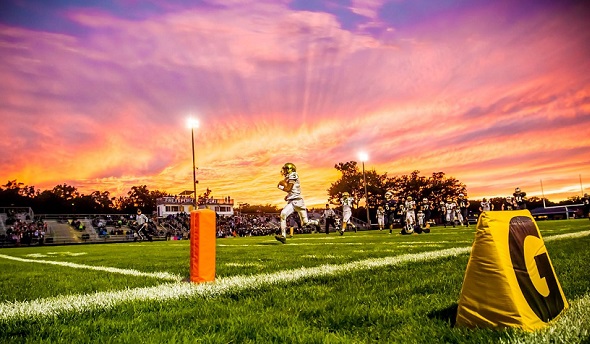
PHOTO: Friday (and this week Thursday) night lights return to football fields all over the state this weekend. (Photo by Tim Reilly.)