

Football Kicks Off Again, 129 Years Later
By
Ron Pesch
MHSAA historian
August 25, 2017
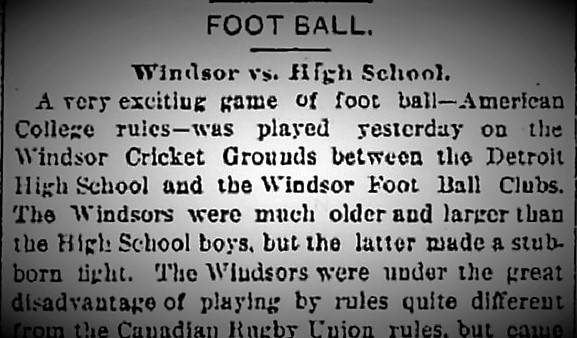
Buried in the text on the fourth page of the Saturday, October 27, 1888, Detroit Free Press is a single, concise sentence bearing a minimum amount of detail.
“The Windsor foot ball team will play the Detroit High School team this afternoon at 3.”
To date, this is the earliest account of a Michigan high school playing the game of “foot ball.”
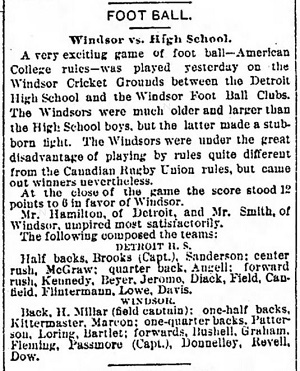
The following day’s paper provides only a few more details. The game was played on the Windsor Cricket Grounds. Despite the great disadvantage of playing under “American Football rules … quite different from the Canadian Rugby Union rules …” the “older and larger” Windsors won the contest, 12-6. Rosters for each squad were provided.
 Under American rules of the time, a touchdown was worth four points, with a conversion kick following a touchdown worth two additional points. At the time, a field goal counted for five points and a safety was worth two. The teams, however, may have agreed to a different scoring system before the contest.
Was this the first football game for a Michigan high school? That’s unlikely, but it is certainly among the earliest published accounts involving a prep game in the state.
It’s a fair assumption that foot ball, or some version of the game, was being played in neighborhoods before that time, at least based on the following statement found in the Jackson Citizen Patriot, dated June 18, 1867. Only days before, Dorrance & Goodwin’s, a store on Main Street in Jackson, had placed advertisements in the newspaper’s classifieds noting the pending arrival of this new product.
“Foot Ball – The pastime was inaugurated on our streets yesterday. Three or four balls were kept in motion all day on Main street alone. It affords no little amusement to the little boys, and is certainly a healthy exercise for the larger ones. It’s all right as long as no windows are broken or horses scared. Both calamities were barely escaped scores of times during the day.”
Rutgers and Princeton are credited with playing the first college football game in 1869. A decade later, in 1879, the University of Michigan established a football team.
Detroit High School played a number of games in 1888, besides the Windsor match, including a contest with the Tappen School from the Corktown area of Detroit. Played at the Detroit Athletic Club grounds on the afternoon of Thursday November 15, a final score was not mentioned in the following day’s Free Press.
For those unfamiliar with the sport, an account of the University of Michigan versus Detroit Athletic Club contest that appeared in the November 18 Free Press served as a fine introduction to the game, and the determination behind securing “possession of a leather-covered foot ball.”
“It was very interesting to see one speedy young man, after a desperate struggle in which the spectators fully expected to see him lose an arm or a leg, get away from his captors and start like a deer, with eight or ten of the opposite side in full pursuit. He is overtaken and the leader of the pursuing party springs upon the back of the man with the inflated trophy, bearing him to the ground with a dull thud … It is also an inspiring sight to see a fleet-footed player seize the ball and run at full speed in the direction of the goal of his opponents. Then a wing-footed opponent cuts across to intercept him, makes a flying leap, grasps the fugitive around the neck or waist and both go to grass with a suddenness and velocity that transforms them into human wheels …
 “While one unaccustomed to foot ball will naturally be startled by some of the acrobatic feats, still it is impossible to watch the game for any length of time without a tingling of the blood and holding of the breath. It is most intensely exciting, continuous in action and replete with fine points of play.
“It may be explained that the goals in a foot ball game are set at a distance of 330 feet from each other. The goal is made by placing two pieces of scantling twenty feet long upright in the ground, eighteen and one-half feet apart. Another piece runs midway horizontally between the uprights, and the ball must go over the horizontal piece and between the uprights to count a goal. There are eleven men on each side and the object is, of course, to get the ball through the goal of the other. The time of game is an hour and a half each side playing forty-five minutes from each goal, with an intermission of ten minutes between halves.”
A player who ran over an opponent’s goal line, “with the ball and touched it down” was then entitled to “bring the ball in front of the goal and attempt to kick it through”…
Among those playing for the Athletic Club squad that day was “little Hugh Brooks (captain) of the high school team.” Eligibility rules for players would evolve over time.
On Saturday, November 24, Detroit High School squared off for the first of two contests with Ann Arbor High School, this one at the Detroit Athletic Club grounds. Admission to the 2:45 p.m. contests was 25 cents. A crowd of around 300 watched “an exciting illustration of how Rugby foot ball is played. The exhibition by the Ann Arbor boys was considerably better than that of the Detroiters,” noted the Free Press, “the result of that being that Detroit’s banners have been kicked into the dust.”
Ann Arbor returned home with a 12-0 victory.
A second game with Ann Arbor was quickly scheduled.
In between, on Thursday, November 29, the Detroit High School squad played the Athletic Club before a crowd of about 200.
 “While the Athletics won by 12 to 0, still their playing was very loose, probably the result of over confidence. The Athletics will have to rid themselves of this by Saturday or the Albions will make short work of them.”
A large crowd gathered in the drizzling rain in Ann Arbor on Saturday, December 8, for what appears to be the final contest of the 1888 season for the high school teams of Detroit and Ann Arbor.
“It was a fine game. (Captain) Brooks, McGraw and Wisner, for Detroit, and Jewett, Diggert, Dupont, and Rathbone for Ann Arbor, made fine plays for their respective sides.” The result was an 8 to 2 win, and redemption, for the Detroit squad.
Today, 129 years later, “football” has seen wild expansion, numerous rule changes, and huge advancement in equipment worn when compared to those pioneer days of the sport. In 2017, more than 1 million individuals will suit up for high school teams across the United States. In Michigan alone, more than 36,000 participate in prep football.
And our state’s original programs live on. On Friday, Detroit Central opened its season with a win over Detroit Loyola. Ann Arbor High School, renamed Ann Arbor Pioneer in the late 1960s, fell in its Friday opener to Muskegon.
Welcome to another season of America’s favorite pastime.
 Ron Pesch has taken an active role in researching the history of MHSAA events since 1985 and began writing for MHSAA Finals programs in 1986, adding additional features and "flashbacks" in 1992. He inherited the title of MHSAA historian from the late Dick Kishpaugh following the 1993-94 school year, and resides in Muskegon. Contact him at [email protected] with ideas for historical articles.
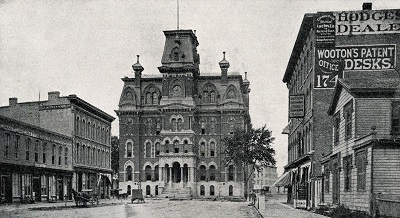
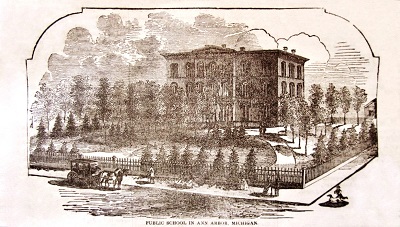
PHOTOS: (Top) The Detroit Free Press included brief coverage of the first "reported" game on Oct. 28, 1888. (Middle) When Michigan’s state government moved from Detroit to Lansing in 1847, the old Capitol building was re-opened as the Detroit’s first city high school in 1863. To better accommodate Detroit’s growing population, the old two-story structure was remodeled into a four-story building, unrecognizable to most. The school served the city well until January 1893, when it burned to the ground. (Below) Erected in 1856 at the cost of $27,000, Ann Arbor High School at State and Huron (now site of the North Quad of the University of Michigan) was destroyed by fire in 1904. (Photos courtesy of Ron Pesch.)
Drive for Detroit: Week 2 in Review
September 5, 2017
By Geoff Kimmerly
Second Half editor
We're only two weeks into this football season, and of course there has been plenty to talk about.
But our 8-player football divisions experienced a season's worth of highlights over this Labor Day weekend.
See below for Week 2's most significant results from every region of the state in 11-player football, but also check out the 8-player highlights – which include the first win ever for one team and the first loss in forever for another.
Bay & Thumb
Bay City Central 22, Midland Dow 21 (OT)
After falling a score short in its opener against Frankenmuth, Bay City Central (1-1) blocked an extra point and then got the game-winner from kicker Austin Welter to beat Dow (1-1) for the first time since 2011 – and after falling to the Chargers both during the regular season and playoffs in 2016. Those two losses last year were by 20 and then 31 points, respectively. Click for more from the Bay City Times.
Also noted:
Algonac 28, Almont 7 – After opening with a big loss to Marine City, the Muskrats (1-1) got a needed bounce-back against another of the Port Huron area’s elite in Almont (1-1).
Freeland 34, Chesaning 25 – The Falcons (2-0) kept their regular-season winning streak intact at 23 straight against an Indians that team opened with a shutout but fell to 1-1.
Flint Powers Catholic 37, Saginaw Heritage 34 (2 OT) – Andrew Simon was another kicking hero as Powers (2-0) won a second straight close game and sent the Hawks to 1-1.
Lake Fenton 21, Montrose 0 – This Genesee Area Conference Red opener was a big one to get out of the way for the reigning champ Blue Devils (1-1), with Montrose (1-1) always in the league title mix as well.
Greater Detroit
Bloomfield Hills 28, West Bloomfield 24
The “new” Bloomfield Hills burst on the scene with its first winning campaign in 2016, starting 9-0 before falling to West Bloomfield 31-14 in a Division 1 playoff opener. To finish off this avenging, however, the Black Hawks needed to drive nearly the entire field over the final two minutes. Bloomfield Hills now sits 2-0 with both wins by four points or fewer, while West Bloomfield fell to 0-2 with two losses by five points or fewer. Click for more from the Oakland Press.
Also noted:
Warren DeLaSalle 31, Grandville 0 – The Pilots (1-1) traveled to face a second straight Ottawa-Kent Conference reigning champion, landing a stunning defeat on last season’s Red co-leading Bulldogs (1-1) after falling to Lowell in Week 1.
Clarkston 17, Southfield Arts & Technology 7 – The Wolves (2-0) have given up 14 points total in two impressive wins, while Southfield A&T might be the best 0-2 team in Michigan after another close loss to a power.
Utica Eisenhower 42, Macomb Dakota 16 – Eisenhower (2-0) ran its streak in this rivalry to three straight after also ending last season for Dakota (1-1) in a District Final.
Gibraltar Carlson 42, Trenton 14 – A week after taking a giant step forward in the Downriver League race with a win over Allen Park, Trenton (1-1) fell for the second straight season to Carlson (2-0), which is coming off a 4-5 finish but won three of its final four games last fall.
Mid-Michigan
DeWitt 14, Grand Ledge 7
The combination of Grand Ledge’s sizable Week 1 win over Hudsonville, DeWitt’s loss to Grand Rapids Christian and the Comets’ victory in the first game of this quickly-building rivalry last fall makes the Panthers victory all the more impressive. DeWitt held Grand Ledge scoreless until late in the fourth quarter – and to its fewest points in a regular-season game since 2013. Click for more from the Lansing State Journal.
Also noted:
St. Johns 56, Cadillac 43 – The Redwings (1-1) especially on offense bounced back after scoring 20 in a one-point loss Week 1 to East Lansing; Cadillac (1-1) also put up its highest tally since midway through 2015.
Ionia 35, Hillsdale 14 – This could eventually come into play as Hillsdale (1-1) tries to get back to the playoffs after seeing its 15-year streak end last fall and Ionia (1-1) tries to get in for the first time since 2013.
Lansing Sexton 20, Portland 14 – This provided an exciting preview of Capital Area Activities Conference White matchups to come, as the Big Reds (2-0) are set to join annual favorite Portland (1-1) in that division next year.
Saranac 27, Fowler 21 – The Redskins are 2-0 for the first time since 2011 with a win over Fowler (1-1) also for the first time since that fall.
Northern Lower Peninsula
Traverse City St. Francis 35, Maple City Glen Lake 9
St. Francis enjoyed the debut of Glen Lake’s new artificial turf field by handing the Lakers their sixth straight loss in this rivalry. The Gladiators (2-0) ran their regular-season winning streak to 24 after also beating Glen Lake 35-9 last fall. But Glen Lake would love to repeat history – in 2016 it rebounded and won 10 of its next 11 to reach the Division 6 championship game. Click for more from the Traverse City Record-Eagle.
Also noted:
Rogers City 14, Indian River Inland Lakes 7 – Inland Lakes (1-1) got to celebrate last week its first win since 2015, but Rogers City (1-1) ended the fun with its first victory since Week 6 a year ago.
Alpena 27, Sault Ste. Marie 26 – The Wildcats (1-1) stopped a two-point conversion to get a win for the second straight season over the Blue Devils (1-1).
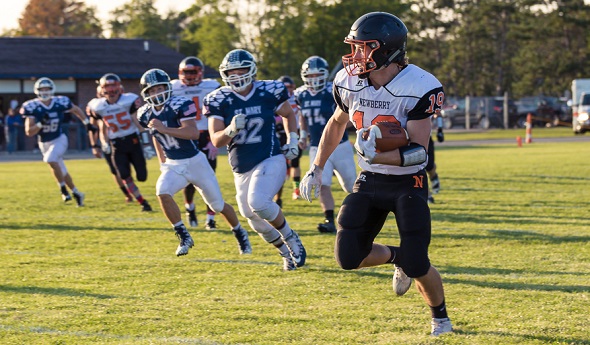
Gaylord St. Mary 28, Newberry 21 (OT) – The Snowbirds are off to a 2-0 start for the second straight season but this time with wins over two teams that made the playoffs the year before; Newberry is 1-1 coming off an 8-3 finish.
Petoskey 14, Escanaba 7 – The Northmen (1-1) got their first win, both equaling last year’s total and avenging last season’s 39-0 defeat to the Eskymos (1-1).
Southeast & Border
Milan 41, Monroe St. Mary Catholic Central 18
The Big Reds (1-1) didn’t enjoy a great start falling by 20 two weeks ago to Chelsea, but made up for it by avenging last season’s only regular-season loss. That 2016 10-point defeat to St. Mary cost Milan an outright Huron League championship, but this win broke a three-year losing streak against the Falcons (1-1). Click for more from the Monroe Evening News.
Also noted:
Parma Western 32, Battle Creek Pennfield 20 – The Panthers are enjoying their third 2-0 start in four seasons but also went 0-2 a year ago; the Panthers, a playoff team in 2016, now must battle back from a winless start.
Homer 52, Concord 12 – These two and Springport shared the Big 8 Conference title last season, but this big win by Homer (2-0) means Concord (0-2) will need to catch up quickly to stay in the mix.
Reading 34, Springport 7 – Staying in the Big 8, Reading made a statement to move to 1-1 after two straight 3-6 finishes, while Springport (1-1) also finds itself now a win back in its title defense.
Chelsea 10, Pinckney 7 – Chelsea (2-0) scored all of its points over the final few minutes to stun Pinckney (1-1) in the latter’s second game in the Southeastern Conference White.
Southwest Corridor
Berrien Springs 27, Schoolcraft 14
Defense has been Berrien Springs’ strength in three straight playoff seasons, and the Shamrocks (2-0) earned one of their most impressive regular-season wins in some time by holding Schoolcraft (1-1) to its fewest points since Week 8 of 2014. The Eagles also hadn’t lost a regular-season game in more than two years. Click for more from the St. Joseph Herald-Palladium.
Also noted:
Climax-Scotts 52, Sand Creek 21 – A week after seeing their 19-game regular-season winning streak end, the Panthers (1-1) started anew by handing a first loss to a Sand Creek team that went 9-2 a year ago.
Delton Kellogg 34, Lawton 21 – Despite starting 1-1, Delton has put up 72 points over two games, with 34 the second-most Lawton (0-2) has given up during the regular season since 2014.
Coldwater 28, Marshall 7 – After losing to Marshall (1-1) by 10 last year and losing out on a share of the Interstate 8 Athletic Conference title because of that defeat, Coldwater (2-0) has jumped the first obstacle a tough league road.
Richland Gull Lake 10, Portage Northern 9 – The Blue Devils (1-1) have won two games in each of the last two seasons, but now own their first of this fall over a 2016 playoff team in the Huskies (0-2).
Upper Peninsula
L'Anse 32, Lake Linden-Hubbell 12
Lake Linden-Hubbell (1-1) hadn’t fallen during the regular season since 2014 and hadn’t lost to L’Anse since a 2013 District opener. But the Purple Hornets – 2-0 coming of a 2-7 run last fall – appear to have turned things around as they look to break a three-season playoff drought. Click for more from the Houghton Daily Mining Gazette.
Also noted:
Gwinn 30, Iron Mountain 24 – The Modeltowners (1-1) bounced back from a rough Week 1 defeat to Gladstone to quickly put Iron Mountain down 0-2 after the latter finished 8-3 a year ago.
Calumet 28, Negaunee 21 – This was a nonleague game but a great confidence builder for Calumet (2-0), which went 10-2 last season despite splitting with the Miners (0-2).
Norway 35, Ishpeming 22 – The Hematites (1-1) came out on a roll with a big Week 1 victory, but Norway (2-0) took that momentum away with a second straight win in the series.
Munising 20, St. Ignace 8 – The Mustangs (1-1) struggled to only two wins last season, but handed 2016 Division 8 semifinalist St. Ignace a rare early second loss.
West Michigan
Lowell 14, Rockford 0
Lowell handed the Rams (1-1) their first shutout since Week 5 of 2014 and scored all the points it needed during the first half to extend its regular-season winning streak to 19. The Red Arrows (2-0) didn’t have a penalty or a turnover in holding an opponent scoreless for the first time since Week 5 of 2015. Click for more from the Grand Rapids Press.
Also noted:
Muskegon Catholic Central 31, Frankfort 6 – The Crusaders (1-0) won this rematch of last season’s Division 8 Regional Final by a nearly identical score and remains the only team to have beaten Frankfort (1-1) since 2015.
East Kentwood 21, Orchard Lake St. Mary's 0 – The Falcons (2-0) put themselves into the thick of O-K Red talk with a surprising shutout of the reigning Division 3 champion Eaglets (0-2).
Muskegon Mona Shores 42, Zeeland West 20 – The Sailors moved to 2-0 by avenging last season’s four-point loss to West (1-1), which hasn’t won its first two games for the first time since 2013.
Muskegon 28, Lincolnshire Stevenson (Ill.) 7 – Muskegon traveled to Illinois to avenge its only regular-season loss of 2016, a three-pointer to Stevenson on the way to finishing Division 3 runner-up.
8-Player
Crystal Falls Forest Park 66, Powers North Central 58 (OT)
The Trojans (1-1) can argue they were the second-best 8-player team in the state last year, losing twice to North Central while giving the Jets their toughest games. Forest Park now also can boast that it handed North Central (1-1) its first 8-player loss, ending the Jets’ winning streak at 27 since making the switch in 2015. Click for more from the Escanaba Daily Press.
Also noted:
Deckerville 52, Lawrence 0 – The Eagles (2-0) have outscored their first two opponents by a combined 94-6, with this especially impressive against a Lawrence program that is 37-8 since moving to 8-player in 2013.
Atlanta 28, Fife Lake Forest Area 18 – Two weeks ago, Atlanta won its first game since 2014; on Thursday it moved to 2-0 for the first time since 1992 against a Forest Area team that is 1-1 but was 7-3 in 2016.
Rapid River 50, Eben Junction Superior Central 42 (2OT) – Combined with Forest Park’s win over North Central, Rapid River (2-0) looks like the team to beat in the Western Eight Conference after surviving Superior Central (0-2) and beating the Trojans in Week 1.
Bear Lake 44, Baldwin 28 – The Lakers (1-1) earned their first win ever in handing Baldwin (1-1) its first loss since moving from 11-player before this season.
PHOTO: A Newberry ball carrier is chased by Gaylord St. Mary defenders during the Snowbirds' overtime win Friday. (Photo by Jeff Rochefort.)