


Football Playoffs: Finals in Review (with videos)
November 28, 2011
Game over. But what a way to finish.
How should we end a four-month MHSAA football season? With 26 hours worth of Finals over the course of two days, viewable from the comfy confines of Detroit's Ford Field.
Following are my final takes from our Finals weekend. Click on the headers below to see our coverage from each game, and check out the videos for a taste of some of the weekend's hoopla.
The first video was done by Potterville grad and MHSAA Scholar-Athlete award winner Sam Davis, and has at least a couple of us ready to put our helmets back on and hit the field. The other is a slice from one of the most raucous student sections from the weekend.
1st and 10
5 and 4 to No. 1: Bloomfield Hills Brother Rice and Flint Powers Catholic weren’t the first teams to reach Finals with a 5-4 record entering the postseason. But both doing so and winning speaks loudly not just of their respective talents, but also on the gains each made by playing tough opponents. Both came out of tough leagues – Brother Rice was one of three finalists from the Detroit Catholic League Central, and Powers played much larger schools in the Big Nine. Both also played and lost to eventual MHSAA champions during the regular season – Brother Rice against Division 3 winner Orchard Lake St. Mary, and Powers against Division 7 champ Saginaw Nouvel.
Like a rock – or Stone: Detroit Cass Tech linebacker/fullback Royce Jenkins-Stone might’ve been the most impressive all-around player from the weekend. The 6-foot-1, 215-pound Michigan prospect ran for 65 yards and had seven tackles – numbers that don’t stick out. But he scored on a 32-yard run, a three-yard pass and a 36-yard interception return.
Just the beginning: Technicians freshman quarterback Jayru Campbell will be in the statewide lens for the next three seasons after throwing for 240 yards and five touchdowns in the Final. He’s 6-3 and 170 pounds, and easily blended in among his star-studded teammates in just his first year of high school. He’ll also have junior Jordan Lewis (four catches, 89 yards, TD) to throw to for another year.
Good company: Brother Rice’s Devin Church was the other individual performer who seemed to wow the media crowd most with his Finals performance. He capped a 900-yard playoffs with 244 and three touchdowns – and drew comparisons from Lowell coach Noel Dean to past star backs like Kevin Grady and T.J. Duckett. Church will sign with Northern Illinois this winter.
Making tracks: Talk about a running attack, Orchard Lake St. Mary’s came within eight yards of putting three backs over 100 each in its Final. The Eaglets ran for 479 yards total – falling just 53 short of the MHSAA Finals record book minimum. Spencer McInnis ran for 214 yards and three scores, while Grant Niemiec and Parker McInnis both ran for 96 yards and a touchdown.
Rough and rumble: Zeeland West’s physicality in the Division 4 game was simply stifling. Keep in mind the Dux were without all-state linebacker Josh Blanton because of an injury. Then note that the team had just eight players weighing 200 pounds or more – and only three between 250-275. Zeeland West ran for 288 yards, but more impressively held Marine City to 79.
Charging forward: The weekend’s biggest stunner had to be Flint Powers over Lansing Catholic, for a number of reasons. Powers entered the postseason 5-4 (see above), Lansing Catholic was 9-0. The Cougars had beaten the Chargers 37-17 in Week 2. Lansing Catholic was ranked No. 1 by The Associated Press, while Powers was unranked.
Just the beginning, part II: Ithaca sophomore quarterback Travis Smith is another who will be watched closely after a big-time Ford Field debut. He threw for 299 yards and a touchdown and ran for another score in the Yellowjackets’ Division 6 win. Ithaca will graduate a lot in the spring. But the 6-1, 180-pound Smith provides the base needed for a quick rebuild.
Backing it up: Saginaw Nouvel’s Bennett Lewis was another player as good as advertised to those who hadn’t seen him play this season. He ran for 200 yards and five touchdowns in a half in Division 7, using both speed and muscle to make his way. At 5-foot-9 and 181 pounds, the Division 7-8 AP Player of the Year is getting some Division I looks and is at least a high Division II prospect.
Consistently contending: Here’s an idea why Mendon’s is such an impressive machine – eight of John Schwartz’s assistant coaches also played for him. The ninth, Bob Critz, has been at Schwartz’s side since the latter took over the program in 1989. During the post-championship press conference, Schwartz revealed that he’d had cancer surgery in June and his assistants ran the program through all of the summer prep.
Numbers game
55,360 – Number of fans who attended the 2011 Finals. The total was slightly higher Friday than Saturday.
5 – Number of touchdown passes by Cass Tech’s Campbell and number of rushing scores by Nouvel’s Lewis. Both tied MHSAA Finals records.
56 – Number of points scored by both Saginaw Nouvel (Division 7) and Flint Powers (Division 5) to set the Finals record for most in a championship game. Nouvel scored all of its points in the first half. Both games ended with scores of 56-26 -- and oddly, no other MHSAA game ended with that score this season.
413 – Total yards by Powers junior quarterback Garrett Pougnet, just 13 shy of the MHSAA Finals record set by Holland Christian quarterback A.J. Westendorp in the 2008 Division 4 Final.
97 – Distance in yards of Zeeland West senior Brad Mesbergen’s Finals record kickoff return in the Division 4 Final.
Link up
MHSAA.tv: See full postgame press conferences (and field interviews after the Divisions 3 and 4 Finals).
Fox Sports Detroit: Dan Dickerson and John Wangler wrap the two days of finals.
1st & Goal: 2025 11-Player Semifinals Review
By
Geoff Kimmerly
MHSAA.com senior editor
November 24, 2025
The pairings are set for the MHSAA 11-Player Football Finals at Ford Field, with seven teams earning opportunities Saturday to finish this fall without a loss – although three of next weekend’s championship games will feature matchups of undefeated contenders.
 The weekend’s Semifinals also saw four reigning champions earn chances at repeat titles, and Dexter earn its first trip to the final weekend of the season for the first time.
It’s a short week because of Thanksgiving, but we’ll be back Wednesday with game-by-game previews of all eight upcoming contests. For now, see below for a glance at all 16 games that got us here.
(Note: Highlights from Saturday's 8-Player Finals will be included in a final football championship "Review" next week.)
Division 1
Detroit Catholic Central 46, East Kentwood 6
The Shamrocks (13-0) will play in their first Final since 2016 after shutting down an East Kentwood offense that had scored fewer than 35 points only one other time this season. The Falcons (10-3) had reached the Semifinals for the first time since 2014. Click for more from the Detroit Free Press.
GIDEON JOINS THE GASH RETURN PARTY
Gideon Gash takes the opening kickoff of the second half to the 🏠
CC up 32-0 over EK
Delivered by @hungryhowies pic.twitter.com/EDf40zmFFP— STATE CHAMPS! Michigan (@statechampsmich) November 22, 2025
Detroit Cass Tech 48, Rochester Adams 22
The reigning Division 1 champion Technicians (13-0) will have the opportunity to play for a first Finals repeat since winning in 2011 and 2012 after continuing a playoff streak of scoring at least 42 points in all four wins. Adams (10-3) finished its season in the Semifinals for the second straight. Click for more from the Detroit News.
Detroit Cass Tech punched its ticket to Ford Field with a 48-22 win over Rochester Adams in the Division 1 Semifinal. The Technicians delivered a dominant performance on both sides of the ball to secure their spot in the state championship game. Check out all the highlights, big… pic.twitter.com/VglljhxROj
— STATE CHAMPS! Michigan (@statechampsmich) November 23, 2025
Division 2
Orchard Lake St. Mary’s 42, Portage Central 7
St. Mary’s (10-2) will play for a chance to repeat as Division 2 champion after finding its way against a Portage Central defense that otherwise gave up only 64 points this season. The Mustangs finished 12-1, tying their 2013 team for most wins in program history. Click for more from the Oakland Press.
LORENZO BARBER HAVE A DAY!💪
Barber helped lead the Eaglets early in their 42-7 victory over Portage Central!
Delivered by @hungryhowies pic.twitter.com/tpZCj50Xpc— STATE CHAMPS! Michigan (@statechampsmich) November 23, 2025
Dexter 41, Birmingham Groves 6
The Dreadnaughts’ Cooper Arendt and Cole Novara continued two of the most incredible statistical seasons in MHSAA history in lifting Dexter (12-1) into its first championship game. The pair connected on four touchdowns in ending Groves’ second-straight Semifinal run at 9-4. Click for more from the Ann Arbor News.
THIS KID IS UNREAL😮
Cole Novara has his 4th TD of the day to put his Dexter boys up 41-6
Delivered by @hungryhowies pic.twitter.com/fCsF3UVCUj— STATE CHAMPS! Michigan (@statechampsmich) November 22, 2025
Division 3
Mount Pleasant 41, Lowell 21
Mount Pleasant (13-0) turned in one of its highest-scoring offensive days this season to earn its first trip to the Finals since 2011. Lowell concluded its longest run since 2016 at 10-3. Click for more from the Mount Pleasant Morning Sun.
If you missed it last night on @WNEMTV5news, no problem!
The @MtpOilers defeated Lowell 41-21 to advance to the state finals for the first time in 14 years!
Mt. Pleasant dominated from the opening kickoff.
See the highlights and hear from the Oilers👇 pic.twitter.com/9oKdNZrRFp— Mark Pearson (@MarkPearsonTV) November 23, 2025
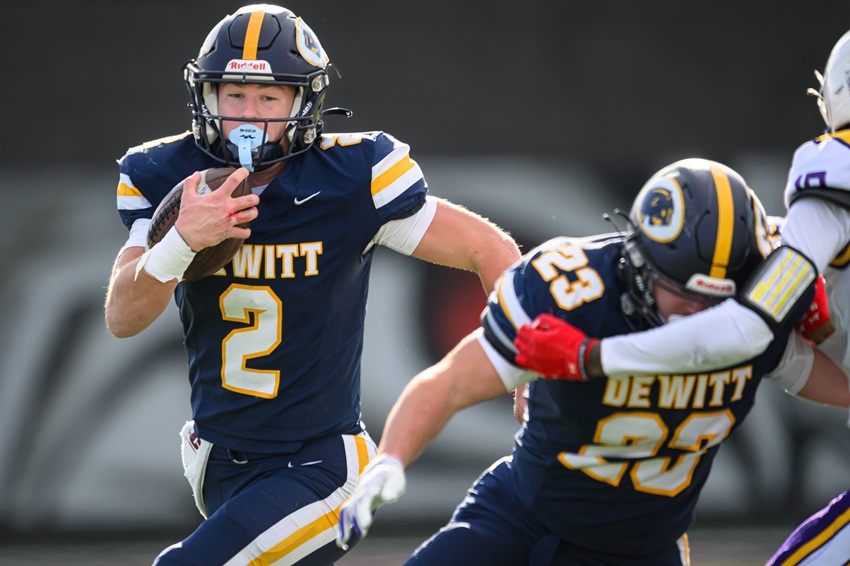
DeWitt 41, Warren De La Salle Collegiate 20
Traverse Moore scored four touchdowns to help bring DeWitt (13-0) back from a 13-7 halftime deficit and return to the Finals for the first time since 2021. De La Salle (6-7) turned a 1-4 start this season into its fifth Semifinal trip over the last six and after missing a year ago. Click for more from the Lansing State Journal.
TRAVERSE MOORE WAS IN A DIFFERENT MODE🔥
Moore's 3 touchdowns on the day continued helped one of the State's most electric offense's make a trip back to Ford Field!
Delivered by @hungryhowies pic.twitter.com/dp1TmIRACE— STATE CHAMPS! Michigan (@statechampsmich) November 23, 2025
Division 4
Hudsonville Unity Christian 45, Vicksburg 17
Unity Christian (12-1) again cleared its playoff opponent by double digits and will return to the Finals after last making the trip in 2021. Vicksburg finished its longest playoff run at 8-5 for the season. Click for more from the Grand Rapids Press.
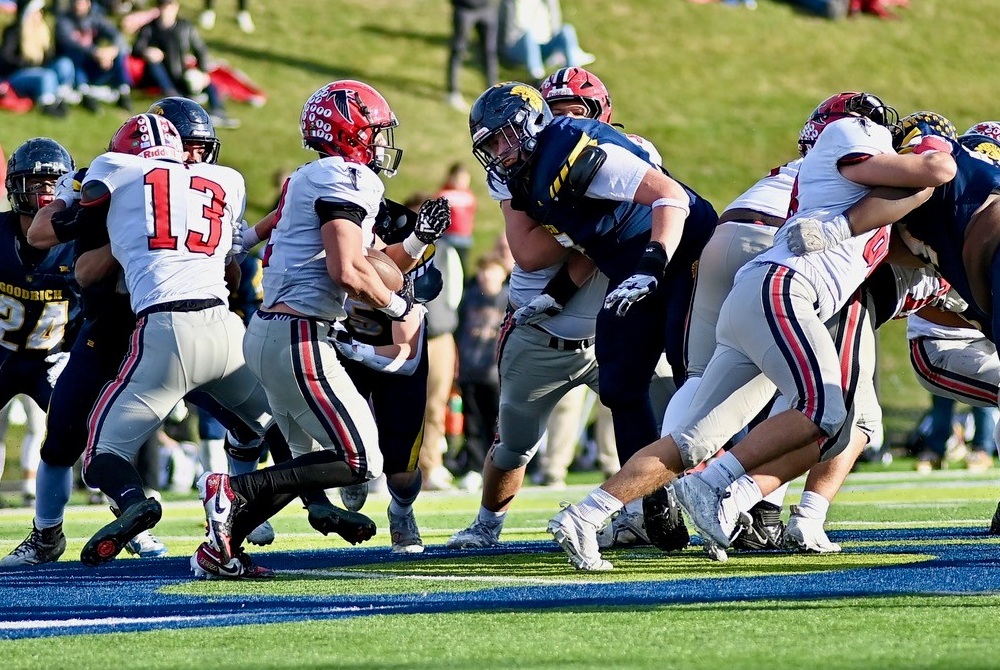
Dearborn Divine Child 10, Goodrich 7
Divine Child (12-1) put an end both to reigning champ Goodrich’s repeat hopes and 25-game winning streak, handing the lone defeat to an opponent for the second-straight week after downing Harper Woods 10-6 in a Regional Final. The Martians ended 12-1, while the Falcons advanced to their first Final since 1985. Click for more from MLIVE-Detroit.
Division 5
Grand Rapids West Catholic 34, Ogemaw Heights 24
West Catholic (12-1) had slightly fewer yards than Ogemaw Heights, but made them count a little bit more taking a 13-12 halftime lead all the way to earning its first Finals trip since 2022. Collin Abram (two touchdowns) on offense and Jael Djouguem (12 tackles) on defense led the Falcons. Ogemaw finished 11-1 while making its first Semifinal appearance since 2009. Click for more from the Bay City Times.
Pontiac Notre Dame Prep 51, Monroe Jefferson 21
Reigning champion Notre Dame Prep (11-2) will get the chance to win it all again after doing so for the first time a year ago. Several Fighting Irish found the end zone to earn that opportunity, with quarterback Sam Stowe throwing three scoring passes and running for a TD as well. Jefferson finished its first Semifinal season since 1999 at 11-2. Click for more from the Oakland Press.
Division 6
Kingsley 14, Kent City 0
Kingsley (11-2) is headed to Ford Field for the second time in three years after handing Kent City (12-1) its only loss of its winningest season. The teams were tied at halftime, but the Stags’ defense was just slightly more successful during the final two quarters in posting its first shutout this fall. Click for more from the Traverse City Record-Eagle.
Jackson Lumen Christi 25, Almont 19 (3OT)
This came down to the most dramatic ending of the weekend, as both contenders went scoreless during the first overtime and couldn’t convert after touchdowns during the second before Lumen (10-3) scored in the third and kept Almont (12-1) out of the end zone. Click for more from the Jackson Citizen Patriot.
BENNY GASTON IS THE DEFINITION OF CLUTCH‼️
As a Freshman Gaston sent the Lumen Christi baseball team to the State Championship with a walkoff single, now as a Junior he sends the Titans football team to Ford Field and puts his head coach Herb Brogan second overall in wins… pic.twitter.com/q7MtEHZPMH— STATE CHAMPS! Michigan (@statechampsmich) November 22, 2025
Division 7
Menominee 32, Pewamo-Westphalia 28
The Maroons (13-0) came back from a 21-6 halftime deficit and scored the game-winner with 24 seconds to play to earn a second trip in three seasons to Ford Field. The Pirates (11-1) were held to their fewest points this season and had given up only 86 over their first 11 games before Menominee broke through. Click for more from Upper Michigan’s Source.
Schoolcraft 43, Clinton 14
Schoolcraft will play in its first championship game since 2001 after scoring this game’s first 37 points. The Eagles (11-2) put up their third-most points in a game this season and held Clinton (10-3) to its fewest since opening weekend. Click for more from the Kalamazoo Gazette.
Division 8
Harbor Beach 40, Bark River-Harris 0
Harbor Beach (13-0) earned its second shutout of a season during which the Pirates are giving up only eight points per game, this one to earn a first trip to Ford Field since 2012. Bark River-Harris completed its first Semifinal season since 2003 at 10-2. Click for more from the Huron Daily Tribune.
Hudson 67, Allen Park Cabrini 14
Hudson will return to the Finals for the second time in five years with a chance for a second undefeated championship run this decade. The Tigers (13-0) topped 60 points for the fifth time this season but second week in a row in ending Allen Park Cabrini’s longest tournament run and winningest season at 11-2. Click for more from the Adrian Daily Telegram.
MHSAA.com's weekly “1st & Goal” previews and reviews are powered by MI Student Aid, a division within the Department of Lifelong Education, Advancement, and Potential (MiLEAP). MI Student Aid encourages students to pursue postsecondary education by providing access to student financial resources and information. MI Student Aid administers the state’s scholarship and grant programs that help make college Accessible, Affordable and Attainable for you. Click to connect with MI Student Aid and find more information on Facebook and Twitter @mistudentaid.
PHOTOS (Top) Dearborn Divine Child running back Marcello Vitti (2) takes a handoff into the line during his team's Division 4 Semifinal win over Goodrich. (Middle) DeWitt's Traverse Moore (2) follows a blocker during the Panthers' Division 3 win over Warren De La Salle Collegiate. (Divine Child/Goodrich photo by Terry Lyons. DeWitt/De La Salle photo by Kolleth Photo.)