

Football Playoffs: Semifinals in Review
November 21, 2011
It’s always hard to wave good-bye to another high school football season.
But stories of this fall’s playoffs will no doubt be retold a few times this winter -- especially after one of the most memorable Semifinals weekends in recent memory,
Nine of Saturday’s 16 games were decided by eight points or fewer. Two games were decided by three points, and three more games by just one. Twice, overtime was necessary to decide which team would advance to this weekend’s MHSAA Finals at Detroit’s Ford Field.
We’ll kick off Finals week with our regular round-up of the previous weekend’s playoff action – including the first 8-Player Final in MHSAA history. Later this week, we’ll take a brief look at every team hoping to finish by hoisting a championship trophy.
All eight games will be broadcast on Fox Sports Plus. Click for a full schedule and playoff scoreboard. And click here for a list of Fox Sports Plus channels in your area.
(Rankings are by The Associated Press’ panel of media voters.)
1st and 10
Division 1: Detroit Catholic Central 23, Rockford 20 (OT) – Rockford kicked a field goal for a three-point lead to begin overtime, but No. 2 beat No. 1 when DCC running back Anthony Darkangelo ran in the game-winner from seven yards out. Read more in the Novi News.
Division 1: Detroit Cass Tech 6, Utica Eisenhower 3 – Here’s why they play the games. Unranked Cass Tech continued an impressive defensive stand (see lower in this post for more) in knocking off the No. 3 Eagles. Read more in the Detroit Free Press.
Division 2: Lowell 42, Walled Lake Western 35 (OT) – Walled Lake Western came back from 14 down in the third quarter and then took a lead, but couldn’t keep the Red Arrows from booking a third-straight trip to the Finals. Read more in the Grand Rapids Press.
Division 2: Birmingham Brother Rice 27, Detroit Martin Luther King 26 – The Crusaders fought back from an early 21-0 deficit, and Brother Rice scored all of its points during the first half. But the Warriors held on twice at the end – once on a two-point conversion try that would’ve given King the lead, and then once more on the Crusaders’ final possession. Read more from the Oakland Press.
Division 3: Mount Pleasant 38, East Grand Rapids 37 – The Oilers were probably thinking less about EGR’s 28-game playoff winning streak and more about how the Pioneers had knocked them out of the playoffs two of the last three seasons. Now, Mount Pleasant can focus on playing in its first MHSAA Final. Read more in the Mount Pleasant Morning Sun.
Division 5: Lansing Catholic 42, Grand Rapids West Catholic 35 – The teams exchanged shots until just about the end, with this season’s No. 1 taking down the reigning champion despite trailing twice during the first half. Read more in the Lansing State Journal.
Division 6: Constantine 45, Ecorse 44 – The Falcons have shown they are tough to stop when it matters most, winning their third playoff game by seven or fewer points to advance to their first Final since 2004. Read more in the Sturgis Journal.
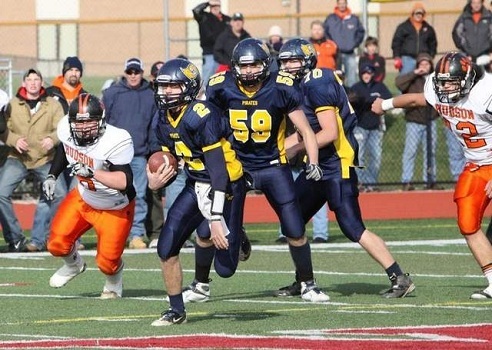
Division 7: Pewamo-Westphalia 22, Hudson 14 – The Pirates, making their second Semifinal appearance ever, earned their first Finals berth by ending the 26-game winning streak of the reigning champion Tigers. Read more from the Lansing State Journal.
Division 8: Mendon 34, New Lothrop 13 – The No. 3 Hornets had given up 47 points over their first 12 games, but top-ranked Mendon nearly doubled that while holding a New Lothrop offense averaging 52 points to just a pair of touchdowns. Read more in the Sturgis Journal.
8-Player Final: Carsonville-Port Sanilac 59, Rapid River 20 – It’s arguable what was more impressive – the Tigers’ offensive might, or that its defense held Rapid River scoreless in the second half of the first-ever MHSAA 8-player Final. Read more in the “First Pitch” at MHSAA.com.
Numbers Game
16 – Number of points Detroit Cass Tech has given up during the postseason, including three to Utica Eisenhower in Saturday’ 6-3 victory. The Technicians have held opponents to seven or fewer points in nine of 13 games this fall.
34 – Number of minutes Constantine held onto the ball – and kept Ecorse’s offense off the field – in a 45-44 Division 6 win.
901 – Number of yards, combined, put up by Carsonville-Port Sanilac and Rapid River in the inaugural 8-player Football Final.
324 – Passing yards by Carsonville-Port Sanilac quarterback Hayden Adams, who likely will be remembered as this state’s first 8-player star. Five of his 12 completions went for touchdowns, and he also ran for 130 yards and two scores.
More Fantastic Finishes
Division 3: Orchard Lake St. Mary 14, Battle Creek Harper Creek 10 – They were tied going into the fourth quarter. Harper Creek added a go-ahead field goal – and then St. Mary’s Grant Niemiec scored on an 11-yard run with 49 seconds left to take the final lead.
Division 4: Zeeland West 30, Comstock Park 6 – The Dux moved to 13-0 to tie the school record for wins and make a second MHSAA Final – in just seven seasons of existence.
Division 4: Marine City 45, Grosse Ile 6 – The Mariners shut down Grosse Ile until the final five minutes of the game to earn their second Finals berth in five seasons.
Division 5: Flint Powers Catholic 27, Almont 10 – Why they play the games, Part II. Powers is the latest to make the rare trek from 5-4 qualifier to potential MHSAA champion after taking out Nos. 2 and, most recently, 4 from the final AP regular-season poll.
Division 6: Ithaca 28, Iron Mountain 0 – The Yellowjackets returned to the Superior Dome and beat Iron Mountain for the second straight season to advance to Detroit.
Division 7: Saginaw Nouvel 14, Traverse City St. Francis 3 – The Panthers’ defense also has been awesome during this postseason, giving up just 23 points over four games.
Division 8: Fowler 45, St. Ignace La Salle 8 – The Eagles have gone from losing their coach the weekend before practice began in 2010 to making their first Final since winning Class D in 1998.
Up Next: MHSAA 11-player Finals
FRIDAY
Division 8: Mendon (13-0) vs. Fowler (11-2), 10 a.m. – These are two of the most storied small-school programs in state history, both ranking among the top 14 in the state in winning percentage since 1950 according to Michigan-football.com. Mendon was expected to be here, but surprise Fowler has been to this point plenty of times as well.
Division 2: Birmingham Brother Rice (9-4) vs. Lowell (12-1), 1 p.m. – Brother Rice’s tough schedule always gives it a decent shot of making the playoff field even at 5-4, but getting to the Final after coming in with that record is new ground for the Warriors (they made the Semifinals in 2009 after entering 5-4). Lowell was just about everyone’s pick to get this far – and will try to make it two titles in three seasons after losing in the 2010 championship game.
Division 6: Constantine (11-2) vs. Ithaca (13-0), 4:30 p.m. – Constantine’s 1-2 start is a distant memory as the Falcons go for their first championship in seven seasons. Ithaca made its first Final just a year ago, but can further its reputation as an elite power but claiming two titles in a row and extending its winning streak to 28.
Division 4: Marine City (13-0) vs. Zeeland West (13-0), 7:30 p.m. – It’s rare for the combination of bracket assignments and rankings to play out like this, but Marine City entered the postseason No. 1 and Zeeland West No. 2. The Mariners last won a championship in 2007, but have the chance to also finish 14-0 this time. Same story as the Dux try to improve just that little bit on their 2006 title run.
SATURDAY
Division 7: Pewamo-Westphalia (13-0) vs. Saginaw Nouvel (12-0), 10 a.m. – The Panthers are going for their third MHSAA championship in six seasons and have no problem raising their game; not counting two against Canadian teams, Nouvel played 10 games this season against teams that qualified for the playoffs. P-W joins Fowler as finalists from the Central Michigan Athletic Conference, and is led by a senior class that might be one of the best in the program’s successful history.
Division 1: Detroit Cass Tech (10-3) vs. Detroit Catholic Central (12-1), 1 p.m. – The Technicians seemingly have been building toward this weekend after making their first Semifinal appearance in 2010, and after losing by three in that game before going on to win by three in last week’s semi. Now they get the Shamrocks, who can move into a third-place tie with 11 MHSAA football championships.
Division 5: Flint Powers Catholic (9-4) vs. Lansing Catholic (13-0), 4:30 p.m. – The Cougars defeated Powers 37-17 in Week 2, but it’s fair to say much has changed. The Chargers haven’t given up that many points in a game since – but Lansing Catholic also hasn’t scored that few.
Division 3: Mount Pleasant (13-0) vs. Orchard Lake St. Mary (11-2), 7:30 p.m. – The Eaglets lost the last two Finals to East Grand Rapids by eight and three points, respectively. No matter what happens in this finale, there will be a new Division 3 champion for the first time in five seasons.
(Photo courtesy of Sharon Weber via the Lansing State Journal.)
Three Rivers Takes Run at District Together
October 31, 2017
By Wes Morgan
Special for Second Half
J.J. Wagner is economical with his words, stoic on the sideline, and not preoccupied with statistical trends. All he really asks of his Three Rivers football players is to play and sacrifice for one another.
 It’s been a pretty good recipe throughout his 13-year tenure as the head varsity coach of the Wildcats, at least in the years when the players truly held up their end of the bargain. With an 82-50 career record since 2005, Wagner has seen what can happen when everyone is pulling in the same direction, like a 13-0 run that ended with a loss in the 2009 Division 4 Final.
He’s also witnessed how complacency can cut a program right back down, as was the case in 2010 when an experienced Three Rivers squad went 4-5 and missed the postseason.
The Wildcats have been noticeably hungrier the last two years, with a 7-3 mark in 2016 and an 8-2 record this year as they prepare for Friday’s Division 4 District championship game against Edwardsburg.
Eleven games into the year, Three Rivers has been unable to break out of a Wolverine Conference bubble. The Wildcats went 7-2 in the league, with losses to Dowagiac (Week 2) and Vicksburg (Week 9). Revenge was sweet last Friday as Three Rivers beat Vicksburg in the Pre-District game (20-10).
Now, the difficult task of beating the league’s most dominant team for the second time in one year is what’s required to move on in the playoffs. If Three Rivers can beat the Eddies (after also doing so 21-18 in Week 7), there’s a chance they’ll face Wolverine Conference member Plainwell in the Regional Round.
“You get through the Wolverine (schedule) and then you’re suddenly in a mini Wolverine tournament,” Wagner joked.
There are no secrets in terms of playoff prep against such familiar foes, so it’s all about the basics.
“Our offense has been moving the sticks, our defense has been playing well, our special teams have played well and we play well when we don’t turn the ball over,” he said.
Having played for perennial power Mendon, where he registered 253 tackles as an outside linebacker during the 1987-89 seasons, Wagners’ emphasis on that side of the ball has been a hallmark of the 2017 campaign. Three Rivers has only allowed 11.7 points and 203 yards per game. The Wildcats have stopped opponents on third down 79.8 percent of the time.
A lot of that has to do with big and athletic senior defensive end Tirrell Hausmanis (6-foot-4, 245 pounds), senior defensive tackle Tyler Moore (5-11, 235) and the linebacker duo of senior Chris Morrill (5-10, 160) and Traven Van Oss (6-1, 165). That group alone has accounted for 34.5 tackles for loss this season. Morrill and Van Oss are tied for a team-best 61 tackles.
“Anytime you’re playing good defense, you can take a few more chances on offense,” Wagner said. “I don’t know how many times we’ve gone for it on fourth down this year, but it’s probably more than most (years). You can take a chance at midfield or the 40 that maybe you wouldn’t normally.”
Perhaps no player has embraced Wagner’s rule of doing what’s best for the team more than Hausmanis, who likely would have garnered a lot more attention from college coaches had he stayed at tight end. Instead, he’s anchored both lines the past two seasons.
“We all just do our jobs,” he said. “This happened and we weren’t big enough (on the offensive line) for me to play tight end. They needed me at tackle. At first I didn’t really like it, but I had to get used to it because it was what was best for the team. It helped us succeed and win, so I had to do it.”
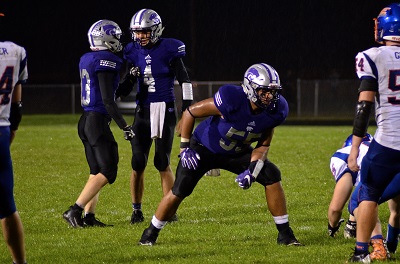 His defensive stats might not seem that impressive — 30 tackles with two sacks — but it’s what he’s capable of that impacts the game so severely.
“It helps when you know people are going to run away from (Hausmanis), so you can stunt and play games on the other side that can mess with their protections and blocking schemes,” Wagner said.
Wagner admitted he’s not big on stats, but for those who were wondering about how many times the offense has felt comfortable gambling on fourth down because of a belief in the defense, it’s 27. The Wildcats have converted 15 times (55.6 percent).
Other than knowing the defense could likely bail it out if needed, there’s been plenty of confidence in the offense under the leadership of junior quarterback Jalen Heivilin.
With a 22-6 touchdown-to-interception ratio, an average of 214.6 passing yards per game and a completion rate of 61 percent, the first-year starter has settled in nicely. Classmate Gavin Charvat has been Heivilin’s favorite target as the two have connected 42 times for 562 yards and six touchdowns. Bryce Morlan was next in line with 32 receptions for 549 yards and a team-high 11 TDs, but the senior went down in Week 9 with a torn anterior cruciate ligament. Fortunately for the Wildcats they also have reliable receivers in Jett Haifley and Zac Meyer; each has hauled in 23 passes for around 400 yards.
“When we play mistake-free, which is what we harp on, and eliminate pre- and post-snap penalties, you can win a lot of games,” Wagner said. “That’s what we focus on every week. If you can do that, you’re going to keep yourself in a lot of games.”
That was exactly the difference in Three Rivers’ home win against Edwardsburg on Oct. 6, which snapped a 34-game Wolverine Conference winning streak by the Eddies.
“We have to play with that same energy and effort (against Edwardsburg),” Wagner added. “In both of our losses, we came out kind of flat. If I knew why, we wouldn’t do it. We think we can go in there (at Edwardsburg) and play them tough again. It boiled down to mistakes in that (first meeting). We made our extra points, and we held them on all theirs. If we go in there with the same discipline, there’s no reason we can’t beat them again.”
 Wes Morgan has reported for the Kalamazoo Gazette, ESPN and ESPNChicago.com, 247Sports and Blue & Gold Illustrated over the last 12 years and is the publisher of JoeInsider.com. He can be reached at [email protected] with story ideas for Berrien, Cass, St. Joseph and Branch counties.
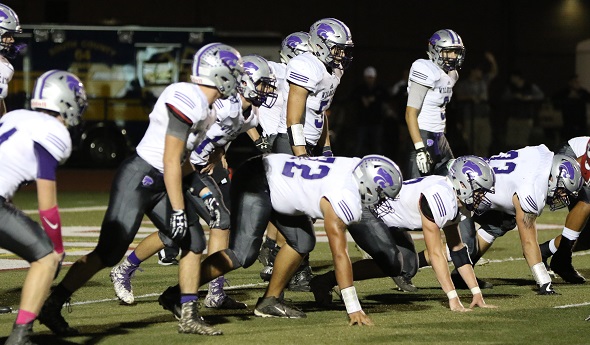
PHOTOS: (Top) Three Rivers’ defense lines up for a play; it’s been stifling this season giving up only 11.7 points per game. (Middle) Receiver Nolan Mark and quarterback Jalen Heivilin (4) talk things over against Edwardsburg. (Photos courtesy of JoeInsider.com.)