


Football Scheduling
December 23, 2014
The major complaint about the MHSAA Football Playoffs is not that too few teams qualify or too many, or that a five-week playoff is too long or should become six weeks, or that some worthy teams miss out while some less worthy teams get in. No; most people find a five-week, 11-player tournament after a nine-game regular season is the best that our late start to fall classes and our early start to winter weather will allow us in Michigan.
Many people appreciate being able to complete our 14-week season in the warmth of Ford Field on the Friday and Saturday of Thanksgiving weekend. Most people think that nearly 45 percent of 11-player schools is a sufficient tournament field. Many people like the excitement that the six-win threshold creates for teams that had been eliminated earlier from league championships.
The most serious and legitimate complaint about the season-ending playoffs is the stress it has placed on conferences and the struggles many schools have in building nine-game regular-season schedules. Some critics want to mess with the Football Playoffs because of the mess they believe it makes for regular-season schedulers.
Having the MHSAA provide every school a nine-game regular season schedule of the most nearby teams of the most nearly equal enrollments would shift scheduling headaches from the local level to the MHSAA.
I’m not suggesting that this solution to local problems doesn’t create new, large headaches for the MHSAA. But in fact, that is the tradition of school sports: when an issue is large enough in scope and common enough among member schools, the state high school association is asked to be the problem-solver. That’s how we got transfer rules, defined sports seasons and competitive cheer tournaments, for example. Just about every policy and procedure and program of the MHSAA arises from a common local problem looking for a statewide solution.
The 2014 Update Meeting Opinion Poll indicates that 70 percent of responding administrators do not favor the solution of the MHSAA making all schools’ regular-season varsity football schedules. Maybe the question should be narrowed to having the MHSAA complete member schools’ non-conference scheduling.
Meanwhile, we will keep watching as high school associations in other states move to statewide scheduling. For if scheduling is the problem, then scheduling itself needs to be the focus of the solution.
Drive for Detroit: Playoff Week 2 Review
November 11, 2019
By Geoff Kimmerly
Second Half editor
You can stop trying to predict what’s going to happen in the MHSAA Football Playoffs this month.
 The first two weeks have showed us that’s pretty much a futile endeavor – and that’s what could make these playoffs some of the most memorable of this decade soon to end.
A couple of observations quickly can be pulled from this weekend’s results. For starters, 12 teams ended their seasons with their first and only loss. Also, there were 16 rematches from the regular season – and 10 teams that lost the first meeting won this time around.
Sure, many of the heavy pre-playoff favorites are still around. But they might now be faced with stopping a few surprise contenders that have found their strides at the right time.
Below is a glance at some of the most notable District Final results from every division of 11-player, plus a thought on all eight 8-player Regional Finals. "Drive for Detroit" is sponsored by MI Student Aid.
11-Player
Division 1
HEADLINER Davison 42, Lapeer 21 Although Lapeer (9-2) did defeat Davison two weeks ago to win the Saginaw Valley League Blue title, the Lightning won that meeting only 24-21 – and the Cardinals more than flipped that result two weeks later. Davison (9-2) locked up its first District title since 2008 by overcoming a Lapeer defense that was giving up only 10.8 points per game and hadn’t surrendered more than 21 (also against Davison) this season. Click for more from the Flint Journal and see highlights below from State Champs Sports Network.
VIDEO: Check out the highlights of the Davison (@DavCardFootball) vs. Lapeer football game from last night. #MHSAA
Brought to you by @hungryhowies pic.twitter.com/wqyjq2PFS0— STATE CHAMPS! Michigan (@statechampsnet) November 9, 2019
District Digest Utica Eisenhower 27, Lake Orion 20 The Eagles (9-2) have won eight straight and their third District title in four seasons, while Lake Orion (9-2) ended its most successful season since 2012 and with both defeats this fall by just seven points apiece. Belleville 67 Brownstown Woodhaven 14 The Warriors (10-1) led into the second quarter before Belleville (11-0) scored 61 straight points over the final three to repeat as a District champion. Sterling Heights Stevenson 38, Macomb Dakota 35 A week after Dakota shocked reigning Division 1 champion Clinton Township Chippewa Valley, Stevenson (7-4) avenged its 40-14 Week 4 loss to the Cougars (6-5) to win its first District title since 2009.
Division 2
HEADLINER Birmingham Seaholm 42, Birmingham Groves 7 While Groves (8-3) has become a playoff regular and made the Division 2 Semifinals last season and in 2016, Seaholm is two seasons removed from a 1-8 finish and had lost seven straight to the rival Falcons – including in last year’s playoff opener. This season’s defeat was only three weeks ago, 35-14, but the Maples (8-3) avenged by holding a Groves offense averaging 30 points per game to its lowest output of the fall. The District title was Seaholm’s first since 2001. Click for more from the Oakland Press.
VIDEO: Check out the highlights of the Seaholm (@SeaholmFootball) vs. Groves district final from last night. @TheMapleForest #MHSAA
Brought to you by @hungryhowies pic.twitter.com/5R8GNNRgjF— STATE CHAMPS! Michigan (@statechampsnet) November 9, 2019
District Digest Muskegon Mona Shores 35, Midland Dow 12 The Sailors (9-2) finished their sweep of SVL Red co-champions by holding Dow (7-4) to its second-fewest points and scoring the second-most the Chargers gave up this fall. Detroit U-D Jesuit 11, Farmington 10 The Cubs (8-3) added a first District title since 2013 to their league championship, ending the Falcons’ season at 8-2 and with both losses by a combined five points. Walled Lake Western 49, Fenton 21 The Warriors (10-1) clinched their fourth District title in five seasons by handing the Tigers (9-2) their first loss since opening night.
Division 3
HEADLINER Edwardsburg 16, Zeeland West 2 – The Eddies – last year’s Division 4 champs – passed a major Division 3 test, and did so holding West (9-2) to its fewest points since the 2014 Semifinals. Granted, Edwardsburg (11-0) also scored way under its usual output, but put up enough while bringing down its defensive average half a point to giving up just 6.9 per game this season. The District title was the Eddies’ fourth straight, continuing a streak that began in Division 3 in 2016 before the team played in Division 4 the last two seasons. Click for more from the Edwardsburg Argus.
VIDEO: Check out the highlights of the Edwardsburg (@EddiesAthletics) vs. Zeeland West football game from last night. #MHSAA
Brought to you by @MHSAA pic.twitter.com/2XR9rtL0BC— STATE CHAMPS! Michigan (@statechampsnet) November 9, 2019
District Digest East Grand Rapids 41, Byron Center 14 The Pioneers (8-3) locked up their first District title since 2015 by handing Byron Center (10-1) its only loss during a rebound season that saw the Bulldogs bounce back from two straight sub-.500 finishes. Chelsea 28, Coldwater 21 The Bulldogs (11-0) won their fifth District title in six seasons with their second seven-point victory in two weeks. Coldwater finished 9-2 after going 3-6 a year ago. Allen Park 42, Riverview 26 The Jaguars (9-2) won their fourth District title in five seasons by eliminating Riverview (8-3) for the second straight.
Division 4
HEADLINER Pontiac Notre Dame Prep 54, Ortonville Brandon 40 As an independent during the regular season, Notre Dame Prep (10-1) faced a variety of opponents from a variety of leagues. So it’s gone a little unnoticed that the Fighting Irish are enjoying what has now tied their most successful season ever (with the 2011 team that finished 10-1). This District title was the program’s first since 2004. Brandon (8-3) ended its third season in four with at least eight wins. Click for more from the Oakland Press.
VIDEO: Check out the highlights of the Notre Dame Prep (@NDPrep_Football) vs. Ortonville Brandon football game from Friday night. #MHSAA @NDPMA_Athletics @NDPMA
Brought to you by @hungryhowies pic.twitter.com/ITSXXy9SW9— STATE CHAMPS! Michigan (@statechampsnet) November 10, 2019
District Digest Cadillac 21, Sault Ste. Marie 6 The Vikings (7-4) keep adding highlights to their first winning season since 2016, with this their first District title since 2013. The Blue Devils (7-4), meanwhile, concluded their winningest season since 2013. Grand Rapids Catholic Central 33, Sparta 7 The Cougars (10-1) reached double-digit wins for their fourth-straight season by winning their fourth-straight District title, this time ending the winningest season for Sparta (9-2) since the start of the playoff era in 1975. Milan 56, Romulus Summit Academy North 22 Both of these teams set program records for wins this season, Milan (11-0) reaching 11 for the first time and the Dragons in finishing 8-3.
Division 5
HEADLINER Kingsley 51, Muskegon Oakridge 34 The Stags have been charging since the return of coach Tim Wooer before the 2018 season, and they’re up to a combined 21-2 with two District titles over the last two years after handing Oakridge (10-1) its lone loss of the fall. The Eagles hadn’t given up more than 20 points in a game this season and not 50 since a Semifinal loss in 2013. Kingsley’s offensive performance raised its scoring average this fall to just under 46 points per game. Click for more from the Traverse City Record-Eagle and see highlights below from MI Sports Now.
. @KASAthletics Rolls Past Top-Ranked Oakridge For District Title https://t.co/EeAfd2Mtxb pic.twitter.com/PC6Bk7qI2U
— MISportsNow (@MISportsNow) November 10, 2019
District Digest Almont 22, Marine City 20 The Raiders (11-0) have put together arguably the most impressive playoff runs so far with two wins over rivals on the road, and with the Mariners (10-1) also unbeaten entering the night. A Marine City offense averaging nearly 44 points per game was stopped just enough by an Almont defense still giving up just 9.9 per contest. Lansing Catholic 21, Portland 0 The Cougars (10-1) won their first District title since 2015 by ending a six-game losing streak to the rival Raiders (8-3), the only team that had beaten Lansing Catholic over the last two seasons. Saginaw Swan Valley 21, Frankenmuth 7 The closest win of the Eagles’ perfect league title run was a three-pointer over Swan Valley in Week 5, and the Vikings (8-3) clinched their third-straight District title by taking the rematch. Frankenmuth finished 9-2.
Division 6
HEADLINER Montague 20, Ravenna 13 (OT) Another rematch reversal was as close as anticipated, with Montague avenging its 17-7 Week 6 loss. Ravenna (8-3) scored all of its points during the fourth quarter to send this game to overtime, but the Wildcats (9-2) scored the only points of the extra period. The District title was the third straight for the reigning Division 6 runner-up. Click for more from the Muskegon Chronicle.
VIDEO: Check out the highlights of the Montague (@Gue_Football) vs. Ravenna football game from last night. #MHSAA
Brought to you by @hungryhowies pic.twitter.com/5QKpvmaLQc— STATE CHAMPS! Michigan (@statechampsnet) November 9, 2019
District Digest Onsted 35, Grass Lake 21 The Wildcats (9-2) extended their first playoff season since 2014 with their first District title since 2007, while ending Grass Lake’s season also at 9-2. Calumet 39, Menominee 14 The Copper Kings (10-1) have 10 wins for the third time and a District title for the second in four seasons, and earned another home game as they seek their first Regional title. Menominee finished 7-4 after going 2-7 a year ago. Hillsdale 20, Constantine 14 League champion Hillsdale (11-0) joined Onsted as District champs from the Lenawee County Athletic Association, and now they will meet again. Constantine (8-3) ended its season with three defeats all by six points or fewer.
Division 7
HEADLINER New Lothrop 42, Beaverton 7 The legend of New Lothrop continues to grow. The Hornets (11-0) ran their winning streak to 16 going back to last year’s playoff run by handing Beaverton (10-1) its only loss – and scoring nearly half of the 100 points the Beavers gave up all season. New Lothrop has scored at least 40 points in 13 straight games dating back to last year’s Semifinals (and not counting a Week 8 forfeit this fall). Click for more from the Flint Journal.
VIDEO: Check out the highlights of the New Lothrop (@NLAPS) vs. Beaverton football game from last night. #MHSAA
Brought to you by @hungryhowies pic.twitter.com/Yt4lHxtURS— STATE CHAMPS! Michigan (@statechampsnet) November 9, 2019
District Digest Schoolcraft 47, Lawton 10 The Eagles (10-1) repeated as District champs and have now outscored two playoff opponents by a combined 104-16. Lawton (10-1) concluded a great turnaround after two straight 3-6 seasons. Cass City 28, Elkton-Pigeon-Bay Port Laker 2 Playing in its third-straight District Final, Cass City (10-1) made history winning its first championship during the opening round and getting to double-digit victories for the first time. Laker ended its sixth playoff season in seven years at 7-4. Traverse City St. Francis 14, McBain 6 The Gladiators (8-3) have played in four games decided by eight or fewer points, and this win pushed their record to 3-1 in those games as they got past McBain (6-5) for a sixth-straight District title.
Division 8
HEADLINER Reading 28, Cassopolis 6 A rematch of their 2017 Division 7 District Final – won by Cassopolis – was played out two years later, with Reading adding to its contender status as it looks to return to Ford Field after winning Division 8 last year. Cassopolis had given up more than 16 points only two other times over the last three seasons – and the last team to score 16 was Reading when Cassopolis won the 2017 matchup. Reading’s defense also did its part in this meeting, slowing way down a Cassopolis offense that was averaging 40 points per game. Click for more from the Hillsdale Daily News.
VIDEO: Check out the highlights of the Reading vs. Cassopolis football game from last night. #MHSAA
Brought to you by @MHSAA pic.twitter.com/7jKbu5fFnB— STATE CHAMPS! Michigan (@statechampsnet) November 9, 2019
District Digest Ubly 34, Harbor Beach 20 The Bearcats (9-2) had lost to Harbor Beach five times over the last three seasons including 29-14 in Week 5 and in District games the last two years. The Pirates finished 10-1 and were a combined 21-3 over the last two seasons. Saginaw Nouvel 46, Breckenridge 28 The Panthers (7-4) clinched their second District title in three seasons by handing reigning Division 8 runner-up Breckenridge (9-2) its first loss since the season opener. Beal City 33, Johannesburg-Lewiston 20 The Aggies (10-1) are another team extending a great turnaround season after they finished 2-7 a year ago. The District title was their first since 2014 and ended another great run for Johannesburg-Lewiston (10-1), which hadn’t given up more than 21 points in a game this fall.
8-Player
Division 1
HEADLINER Morrice 50, Deckerville 24 The reigning Division 1 champion Orioles (10-1) hadn’t been discussed much since seeing a 20-game winning streak end in Week 8 against Crystal Falls Forest Park. But they’re a big part of the conversation again after handing Deckerville (10-1) its only loss, scoring 50 of the 134 points the Eagles gave up this season and stopping an offense that was averaging 46 points per contest. Click for more from the Owosso Argus-Press.
VIDEO: Check out the highlights of the Morrice vs. Deckerville 8-Player @MHSAA Regional Final from Friday night.
Presented by @hungryhowies pic.twitter.com/h4liwMJ4Dw— STATE CHAMPS! Michigan (@statechampsnet) November 10, 2019
Regional Roundup Suttons Bay 36, Gaylord St. Mary 30 The Norsemen (11-0) ended up with a Week 6 win over Gaylord St. Mary after the Snowbirds (5-6) had to forfeit that 48-47 victory. But Suttons Bay will play in the Semifinals for the first time since 2006 after holding off a late St. Mary’s comeback attempt in this rematch. Kingston 50, Mio 48 The Cardinals (9-2) are headed to the Semifinals for the first time since 1996 after finally overtaking Mio (9-2) late in the fourth quarter. Colon 56, Martin 12 The Magi (11-0) actually saw their average margin of victory fall in defeating the previously unbeaten Clippers (10-1). Colon is winning by 48 points per game with no opponent getting closer than 34.
Division 2
HEADLINER Pickford 22, Powers North Central 14 The Panthers (10-1) avenged their only loss, a 20-14 defeat to the Jets (10-1) in Week 3, to earn a spot in the Semifinals for the fourth straight year and fourth in five seasons playing 8-player. Pickford, last season’s Division 1 runner-up, scored the go-ahead points during the final minute and held off the Jets’ final attempt to pull even. Click for more from the Sault Ste. Marie Evening News.
VIDEO: Check out the highlights of the Pickford at Powers North Central 8-Player regional final from this afternoon. @upfootball #MHSAA
Brought to you by @hungryhowies pic.twitter.com/DntlAHdcfv— STATE CHAMPS! Michigan (@statechampsnet) November 10, 2019
Regional Roundup Hillman 48, Cedarville 44 Playing in its 14th straight playoffs, Hillman (10-1) has advanced to its first Semifinal by avenging last season’s 44-6 first-round loss to the Trojans (6-5). The Tigers also reached double-digit wins for the first time. Climax-Scotts 34, Onekama 22 The Panthers (9-2) will play in their first Semifinal since 2007 after eliminating last season’s Division 2 runner-up Portagers (7-4), whose four losses all came to teams still alive in the playoffs. Portland St. Patrick 51, Kinde North Huron 16 The Shamrocks (11-0) are headed back to the Semifinals for the third straight season after denying the Warriors (7-4) an opportunity to get back for the second time in three years.
Second Half’s weekly “Drive for Detroit” previews are powered by MI Student Aid, a part of the Office of Postsecondary Financial Planning located within the Michigan Department of Treasury. MI Student Aid encourages students to pursue postsecondary education by providing access to student financial resources and information. MI Student Aid administers the state’s 529 college savings programs (MET/MESP), as well as scholarship and grant programs that help make college Accessible, Affordable and Attainable for you. Connect with MI Student Aid at www.michigan.gov/mistudentaid and find more information on Facebook and Twitter @mistudentaid.
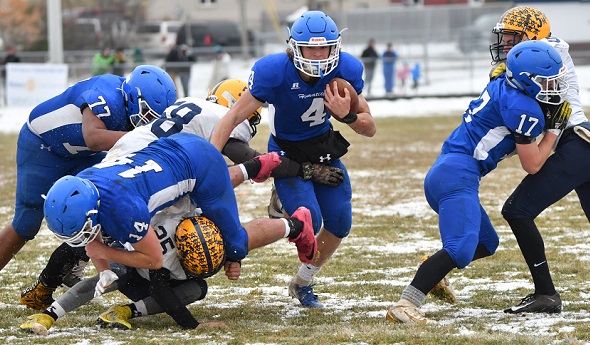
PHOTO: Ishpeming offensive linemen Victavian Hansen (77), Ben Pruett (14), and Dawson Delongchamp (17) make a hole for quarterback John Corkin (40), who gains several yards. (Photo by Cara Kamps.)