

Football Teams Mourn, Regroup, Remember
By
Tom Markowski
Special for Second Half
September 2, 2015
CLINTON TOWNSHIP – A rash of deaths of high school football players in Macomb County and elsewhere in the Detroit area has shaken those communities and the football programs within them.
Three football players at Clinton Township Chippewa Valley have died in the past 16 months. This past May, two players from Sterling Heights Stevenson and one from Utica Ford died in a horrific automobile crash at Stoney Creek Metro Park. Another football player at Southfield High drowned in a swimming pool shortly before the start of practice last month.
 One player at Chippewa Valley died of cancer, another died from injuries suffered as the result of an accident that took place in a home and the third died Aug. 5, five days before the first official day of practice, in an all-terrain vehicle crash that took place in the northeast region of the Lower Peninsula.
Chippewa Valley coach Scott Merchant played for coach Al Fracassa at Birmingham Brother Rice and then went on to play at Albion College before becoming a coach. Merchant remains shaken by the tragic events that have befallen his program.
In addition to the deaths of his players, two parents of former players, one only 46 years old, died during this time frame.
“They don’t give out manuals for this,” Merchant said. “It’s taken a lot out of me, personally. I don’t know. I’ve spent so much time away from my family, going to hospitals, going to funeral homes. You’re talking about young people’s lives here.
”I don’t know. I go to church. I believe in God. He has a plan. It’s hard to look a 16- or 17-year-old in their eyes and make sense of it all.”
Coaches coach, but there is so much more they are asked to do. They are expected to be mentors. They are often expected to be father figures. Sometimes they act as counselors, even if it isn’t in their job description. Perhaps most importantly they are leaders. They instruct their coaches and give them responsibilities. Players follow their directives and look to them for guidance.
On top of this, coaches are expected to be successful on the field. And a vast majority accept these responsibilities and a modest financial reward with a smile.
But when one of their players dies while still in high school, coaches must also remain emotionally strong for those who are too young to comprehend the finality.
Words of encouragement and a strong embrace can go a long way in times of trouble.
“We tell them, we’re here for you,” Merchant said. “We love you. We’re all hurting. We tell them there are two options. You can quit and be miserable. Or you can get off the ground and keep their memory alive.”
Nick Ureel was a senior at Chippewa Valley when he died of cancer in April 2014. Ureel played football his first two years but the cancer, which began in his testicles, prevented him from playing his junior and senior years.
Alex Mackmin was 16 years old when he died this May. He played on the junior varsity as a sophomore last season.
Merchant held workouts on Aug. 3 and 4 before letting his players go and enjoy the final few days before the start of practice Aug. 10. Duncan Blair, a senior who would compete for a starting position at linebacker, travelled north on vacation. He died while riding a four-wheel off-road vehicle that struck a tree.
 Coincidentally the Mackmin and Blair families attended the same church in Utica. Both funerals were held at that church.
Blair’s parents rode the fan bus to Wayne State University for Chippewa Valley’s opener against Lake Orion. Rhys Blair runs the concession stand at Chippewa Valley.
The circumstances were much different for the players who died in the crash in early May in northern Macomb County – but it was no less tragic.
Jonathan Manolios and Emanuel Malaj from Stevenson and Michael Wells from Utica Ford were killed in a car crash. All three played varsity football as juniors in 2014. Two other high school students were injured in the crash and both survived. All five were 17 years old at the time of the crash.
Last season was Kevin Frederick’s first as head coach at Stevenson. He was the former head coach at Whittemore-Prescott.
Frederick had never dealt with anything like this before.
“It was devastating,” he said. “We had a meeting with the kids at school and discussed why it happened. There were grief counselors available. I did meet with some of the parents. Some reached out and said their son wasn’t handling it well.
“We warned our kids not to go on social media after. People forget (the students) were very young. There were some very unkind things said on social media. Alcohol was involved. Their mistake cost them their lives. We tell them to think before you get into a car. Think before you take a drink.
“Scott’s circumstances were different. Kids act in a way … it costs them dearly. Some walk away and grow. This time they didn’t walk away.”
Chippewa Valley and Stevenson are members of the Macomb Area Conference Red, and the teams will play Sept. 11 at Stevenson. Both coaches say they will do something to remember those who died.
Chippewa Valley opens its home season a week later against Warren Cousino. Merchant said his players will wear black jerseys instead of their traditional red to remember those who died.
“Football isn’t an escape,” Merchant said. “It’s a distraction. It takes your mind off of it, but it really doesn’t. We have pictures of all three (students) in our locker room. They are there to remind us.”
 Tom Markowski is a columnist and directs website coverage for the State Champs! Sports Network. He previously covered primarily high school sports for the The Detroit News from 1984-2014, focusing on the Detroit area but also contributing to statewide coverage of football and basketball. Contact him at [email protected] with story ideas for Oakland, Macomb and Wayne counties.
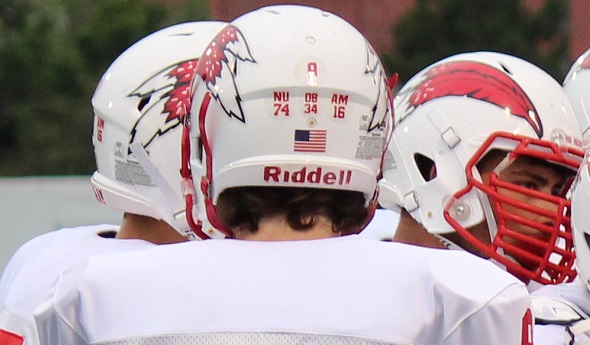
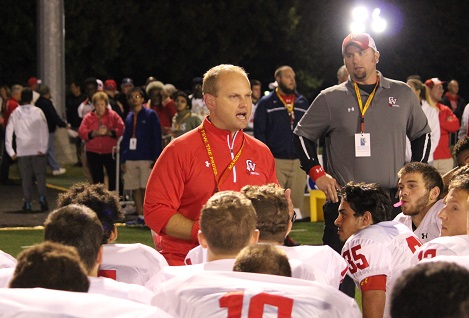
PHOTOS: (Top) Chippewa Valley players are wearing the numbers of three deceased teammates on the backs of their helmets this season. (Middle) Coach Scott Merchant addresses his players after last week's win against Lake Orion at Wayne State University.
Moore Making Case as Best of Martin Luther King's QB Greats
By
Tom Markowski
Special for Second Half
October 7, 2021
It might come as no surprise to many, but we could be watching the best quarterback that's ever been a part of the rich football history at Detroit Martin Luther King.
Let's begin with Darnell Dickerson, an `86 King graduate. Dickerson was the Detroit News' No. 1 Blue Chip prospect and went on to play at Pittsburgh. More recently there's Dequan Finn, who led King to the 2016 Division 2 title. Finn is currently the back-up quarterback at Toledo.
Now there's Dante Moore. Moore (6-foot-3, 200 pounds) is still a junior, so there's still much for him to accomplish, and for us to witness, at King.
As a freshman, Moore led the Crusaders to the Division 2 title game before they lost to Muskegon Mona Shores, 35-26. Last season, King lost to River Rouge, 33-30, in a Division 3 Regional Final. This season, King is 5-1 and one of the favorites to win the Division 3 title. Its only loss was Carmel High, 42-40. Carmel (6-1) is one of the top teams in Indiana.
Tyrone Spencer is in his sixth season as King's head coach and he realizes, with Moore, he has a special player.
“He's very poised, mature for his age,” Spencer said. “He's a class act on and off the field. He's got a great arm and great accuracy.”
Moore, 16, attended a number of camps throughout the country this past summer including many in the South including at Auburn, Clemson, Florida State and Georgia. At the Elite 11 camp in California, Moore was able to gauge how he measures up to a number of the top quarterbacks in the country, many of whom are a year older, and he more than held his own.
In only four games on the field (two wins came by forfeit), Moore has completed 67 of 95 pass attempts, for 1,280 yards and 17 touchdowns. He's received 27 scholarship offers including from Michigan and Michigan State.
Despite all of the hype Moore has received, he remains grounded. He's a quiet leader, but a leader nonetheless. As a sophomore he was elected captain, a rarity for any program but especially one as successful as King.
 “I remember my first snap (as a freshman) against Detroit Catholic Central at Wayne State,” he said. “It was crazy. Now I'm a junior, and I'm just thankful being with my teammates at a school like King.”
Moore was King's starter from day one, and he remembers well that first game against DCC – a 24-22 defeat against the Shamrocks, who went on to share the Detroit Catholic League Central title.
“It was crazy, taking my first snap,” Moore said. “Now I'm a junior. It goes so fast.”
Life has its twists and turns, and Moore has had his share. Born in East Cleveland, Ohio, Moore and his family moved to Detroit when he was 5. His father grew up in the Detroit area and went to Southfield High, where he competed in basketball, football and track, and job opportunities brought Otha Moore and his family back to Detroit.
But before all that took place, Moore and his family had moved to Lorain, located just west of Cleveland, then they went to live with his grandmother on a farm in Lancaster, located just southeast of Columbus. Too young to be responsible for chores such as milking cows and such, Moore did get a taste of farm life and the early-to-bed, early-to-rise lifestyle.
In addition to football, Moore began playing soccer at an early age. From second grade through eighth Moore was on the pitch either as a goalkeeper or a striker. He credits that sport for improving his footwork. When asked if he'd play soccer if King sponsored the sport, Moore quickly replied yes and admits he misses the game. He does get a few opportunities to show those foot skills; Moore is King's punter and has handled the place-kicking duties at times.
There was a transitionary period, country life to the big city, but Moore said because he's the out-going type, it didn't take him long to make new friends. It was this type of personality that years later would lead to a relationship that would not only grow into a strong friendship, but one that would have a lasting effect on his development as a quarterback.
While working out at a Southfield health club, Moore recognized Devin Gardner – the former Inkster star and Michigan quarterback/receiver – going through his workout. Moore wasn't going miss out on this chance meeting. He introduced himself, and they almost instantly became friends. For the past three years or so, Gardner has worked with Moore, mostly during the offseason. But rarely does a week go by when the two don’t talk about football, school, you name it.
“We talk about anything,” Moore said. “We tell each other jokes. We go to fairs together. He gives me advice on how to be a better man in my life. He's making an impact. He gets me mentally prepared.”
Moore first acknowledges his father as the one who's had the greatest impact in his life – athletically, emotionally and socially. After that, it's his other family – the King coaching staff – who has played such an important part in his development.
First there's Spencer, then there's quarterback coach Jerrell Noland – a former King quarterback (2007 graduate) who played at Kentucky State – and Terel Patrick, King's offensive coordinator. Both Spencer and Patrick coached under one of the icons in Detroit's coaching history, James Reynolds, and Patrick like Noland also played for Reynolds.
“I lean on (Patrick's) shoulder,” Moore said. “He helps me break down film and be prepared. It's not all about football at King. It's family.”
As for college, Moore has placed those decisions on hold until after the season.
“I'm just thankful I have the opportunity to play at a school like King,” he said. “I'm concentrating on the season and winning a state title. At the end of the season, I'll narrow down my choices.”
Tom Markowski primarily covered high school sports for the The Detroit News from 1984-2014, focusing on the Detroit area and contributing to statewide coverage of football and basketball. He also is a former correspondent and web content director for State Champs! Sports Network. Contact him at [email protected] with story ideas for Oakland, Macomb and Wayne counties.
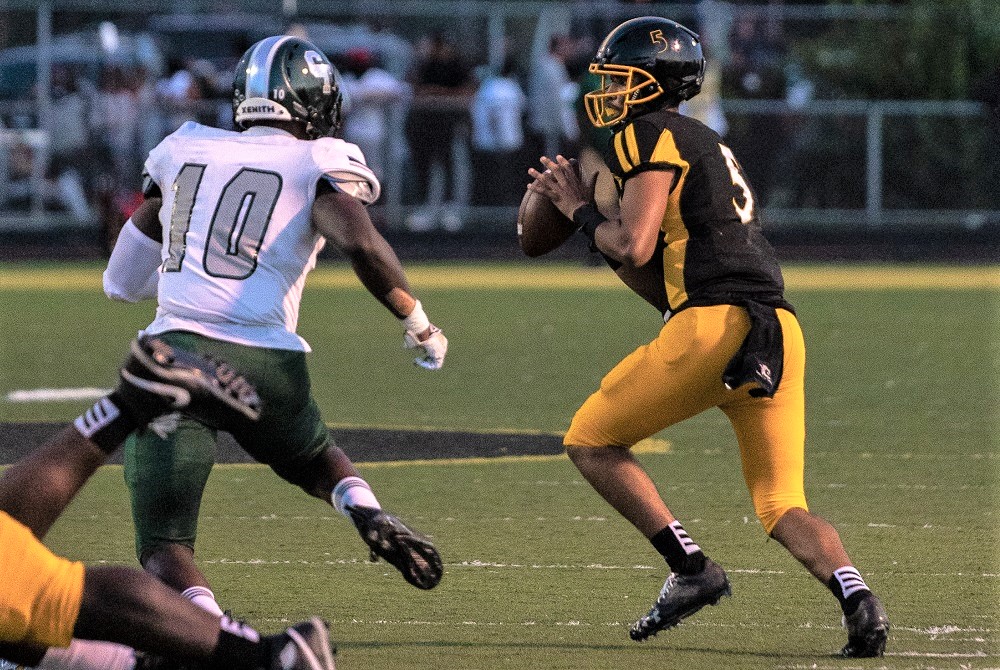
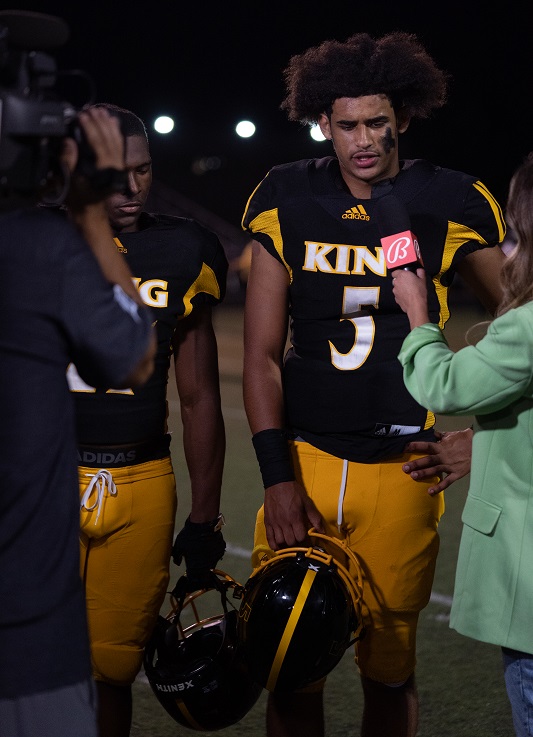
PHOTOS (Top) King quarterback Dante Moore (5) avoids the pressure during a 41-34 Week 3 win over Detroit Cass Tech. (Middle) Moore interviews after the game with Bally Sports Detroit. (Photos by Quintin Love Jr.)