

Football Teams Mourn, Regroup, Remember
By
Tom Markowski
Special for Second Half
September 2, 2015
CLINTON TOWNSHIP – A rash of deaths of high school football players in Macomb County and elsewhere in the Detroit area has shaken those communities and the football programs within them.
Three football players at Clinton Township Chippewa Valley have died in the past 16 months. This past May, two players from Sterling Heights Stevenson and one from Utica Ford died in a horrific automobile crash at Stoney Creek Metro Park. Another football player at Southfield High drowned in a swimming pool shortly before the start of practice last month.
 One player at Chippewa Valley died of cancer, another died from injuries suffered as the result of an accident that took place in a home and the third died Aug. 5, five days before the first official day of practice, in an all-terrain vehicle crash that took place in the northeast region of the Lower Peninsula.
Chippewa Valley coach Scott Merchant played for coach Al Fracassa at Birmingham Brother Rice and then went on to play at Albion College before becoming a coach. Merchant remains shaken by the tragic events that have befallen his program.
In addition to the deaths of his players, two parents of former players, one only 46 years old, died during this time frame.
“They don’t give out manuals for this,” Merchant said. “It’s taken a lot out of me, personally. I don’t know. I’ve spent so much time away from my family, going to hospitals, going to funeral homes. You’re talking about young people’s lives here.
”I don’t know. I go to church. I believe in God. He has a plan. It’s hard to look a 16- or 17-year-old in their eyes and make sense of it all.”
Coaches coach, but there is so much more they are asked to do. They are expected to be mentors. They are often expected to be father figures. Sometimes they act as counselors, even if it isn’t in their job description. Perhaps most importantly they are leaders. They instruct their coaches and give them responsibilities. Players follow their directives and look to them for guidance.
On top of this, coaches are expected to be successful on the field. And a vast majority accept these responsibilities and a modest financial reward with a smile.
But when one of their players dies while still in high school, coaches must also remain emotionally strong for those who are too young to comprehend the finality.
Words of encouragement and a strong embrace can go a long way in times of trouble.
“We tell them, we’re here for you,” Merchant said. “We love you. We’re all hurting. We tell them there are two options. You can quit and be miserable. Or you can get off the ground and keep their memory alive.”
Nick Ureel was a senior at Chippewa Valley when he died of cancer in April 2014. Ureel played football his first two years but the cancer, which began in his testicles, prevented him from playing his junior and senior years.
Alex Mackmin was 16 years old when he died this May. He played on the junior varsity as a sophomore last season.
Merchant held workouts on Aug. 3 and 4 before letting his players go and enjoy the final few days before the start of practice Aug. 10. Duncan Blair, a senior who would compete for a starting position at linebacker, travelled north on vacation. He died while riding a four-wheel off-road vehicle that struck a tree.
 Coincidentally the Mackmin and Blair families attended the same church in Utica. Both funerals were held at that church.
Blair’s parents rode the fan bus to Wayne State University for Chippewa Valley’s opener against Lake Orion. Rhys Blair runs the concession stand at Chippewa Valley.
The circumstances were much different for the players who died in the crash in early May in northern Macomb County – but it was no less tragic.
Jonathan Manolios and Emanuel Malaj from Stevenson and Michael Wells from Utica Ford were killed in a car crash. All three played varsity football as juniors in 2014. Two other high school students were injured in the crash and both survived. All five were 17 years old at the time of the crash.
Last season was Kevin Frederick’s first as head coach at Stevenson. He was the former head coach at Whittemore-Prescott.
Frederick had never dealt with anything like this before.
“It was devastating,” he said. “We had a meeting with the kids at school and discussed why it happened. There were grief counselors available. I did meet with some of the parents. Some reached out and said their son wasn’t handling it well.
“We warned our kids not to go on social media after. People forget (the students) were very young. There were some very unkind things said on social media. Alcohol was involved. Their mistake cost them their lives. We tell them to think before you get into a car. Think before you take a drink.
“Scott’s circumstances were different. Kids act in a way … it costs them dearly. Some walk away and grow. This time they didn’t walk away.”
Chippewa Valley and Stevenson are members of the Macomb Area Conference Red, and the teams will play Sept. 11 at Stevenson. Both coaches say they will do something to remember those who died.
Chippewa Valley opens its home season a week later against Warren Cousino. Merchant said his players will wear black jerseys instead of their traditional red to remember those who died.
“Football isn’t an escape,” Merchant said. “It’s a distraction. It takes your mind off of it, but it really doesn’t. We have pictures of all three (students) in our locker room. They are there to remind us.”
 Tom Markowski is a columnist and directs website coverage for the State Champs! Sports Network. He previously covered primarily high school sports for the The Detroit News from 1984-2014, focusing on the Detroit area but also contributing to statewide coverage of football and basketball. Contact him at [email protected] with story ideas for Oakland, Macomb and Wayne counties.
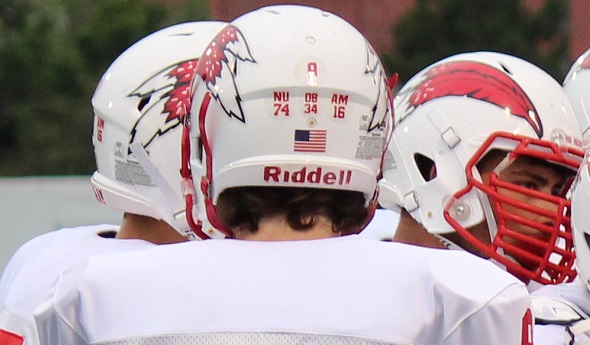
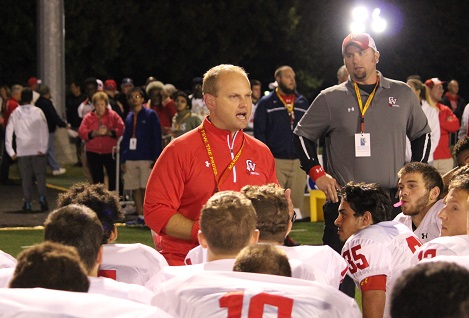
PHOTOS: (Top) Chippewa Valley players are wearing the numbers of three deceased teammates on the backs of their helmets this season. (Middle) Coach Scott Merchant addresses his players after last week's win against Lake Orion at Wayne State University.
1st & Goal: 2025 Week 6 Preview
By
Geoff Kimmerly
MHSAA.com senior editor
October 3, 2025
League title time has arrived as this Michigan high school football season rumbles into October.
 We've already celebrated one champion this season, and that crowd should grow substantially this weekend as several leagues move into the final games of their schedules and leaders begin guaranteeing they'll finish with at least a share of the conference crown.
All of our games featured below will have league title implications either this week or over the next few. Watch for scores for every game across the state this weekend as they are reported on the MHSAA Scores page, and tune into several on the NFHS Network, including those with “WATCH” linked below.
Bay & Thumb
Ithaca (5-0) at Saginaw Valley Lutheran (5-0)
Tonight’s winner claims a share of the Tri-Valley Conference Blue championship with one more league game to play. Ithaca has won every matchup with Valley Lutheran since they joined the TVC together in 2006, but the Chargers over the last three seasons also are enjoying their best run of success in more than a decade. Both have played comparably close games against Michigan Lutheran Seminary this fall – Ithaca winning by two points in Week 3 and Valley Lutheran by 10 last week.
Keep an eye on these FRIDAY Armada (4-1) at Almont (5-0) WATCH, Mount Pleasant (5-0) at Bay City Western (3-2) WATCH, Bay City John Glenn (4-1) at Frankenmuth (4-1) WATCH, Ogemaw Heights (4-1) at Midland Bullock Creek (3-2) WATCH.
Greater Detroit
Macomb Dakota (5-0) at Romeo (3-2) WATCH
Reigning co-champ Dakota can clinch a share of its third Macomb Area Conference Red title over the last four seasons, while Romeo would clinch a share of its first since 2021. A Romeo victory also would be its first in the series since that Bulldogs’ title-winning run. They’ve put together a nice string of victories heading into this matchup, starting with a 34-28 win over the other reigning Red co-champ Utica Eisenhower in Week 3. Dakota’s only single-digit game was a 14-10 season-opening win over Bloomfield Hills Brother Rice, although Romeo and then Eisenhower should make the start of October their toughest challenge to date.
Keep an eye on these FRIDAY South Lyon (5-0) at Waterford Mott (3-2) WATCH, Hazel Park (4-1) at Madison Heights Madison (4-1), West Bloomfield (5-0) at Oxford (3-2) WATCH, Rochester Adams (3-2) at Rochester Hills Stoney Creek (4-1) WATCH.
Mid-Michigan
Williamston (5-0) at Haslett (4-1)
The winner earns a share of the Capital Area Activities Conference Red title – Williamston potentially continuing its rebound from last year’s 3-7 season, and Haslett after just missing out on last year’s championship due to an overtime loss to eventual Red winner Mason. While the focus tonight may be on offense – Williamston with it’s high-powered passing game and Haslett with its college recruit-loaded running attack – defense may be the decider. The Hornets haven’t allowed a point since Week 2. Haslett – after holding DeWitt to a season-low 21 points in their opener – hasn’t given up more than 14 in a game.
Keep an eye on these FRIDAY Lansing Everett (4-1) at Grand Ledge (5-0) WATCH, DeWitt (5-0) at Holt (3-2) WATCH, Goodrich (5-0) at Owosso (4-1) WATCH, Howell (4-1) at Hartland (3-2) WATCH.
Northern Lower Peninsula
Boyne City (4-1) at Traverse City St. Francis (5-0)
St. Francis can finish its Northern Michigan Football Conference Legends slate undefeated after getting past Kingsley by a point a week ago. Kingsley owns a Week 4 win over Boyne City – setting up an identical scenario as last year when Boyne City also fell to the Stags but then defeated the Gladiators 23-20 to create a three-way shared title. And it doesn’t easier from here for either team; Boyne’s last two opponents this regular season are both still undefeated, and St. Francis takes on reigning Division 5 champion Pontiac Notre Dame Prep and 2024 Division 6 winner Lumen Christi over the next two weeks.
Keep an eye on these FRIDAY Mancelona (3-2) at East Jordan (3-2) WATCH, Maple City Glen Lake (3-1) at Kalkaska (5-0) WATCH, Cadillac (2-3) at Petoskey (2-3) WATCH, Midland Dow (4-1) at Traverse City West (3-2).
Southeast & Border
Chelsea (4-1) at Ypsilanti Community (3-2)
Although Chelsea would still need one more win after this weekend to clinch a share of another Southeastern Conference White title, a victory tonight would be a nice rebound off last week’s 42-28 loss to Dexter and extend the Bulldogs’ league winning streak to 14 over the last three seasons. Ypsilanti hasn’t downed Chelsea since 2015, but needs just one more win this fall to guarantee its best finish since 2020 after defeating Pinckney last week to avenge a 2024 defeat.
Keep an eye on these FRIDAY Tecumseh (3-2) at Adrian (4-1) WATCH, Saline (5-0) at Ann Arbor Huron (3-2) WATCH, Adrian Madison (3-2) at Ida (4-1) WATCH, Stockbridge (2-3) at Springport (5-0) WATCH.
Southwest Corridor
Schoolcraft (4-1) at Lawton (4-1) WATCH
Recent history sends this matchup to the front of a strong slate of games in the southwest this week. After matching up from different divisions of the Southwestern Athletic Conference in a 2019 District Final – won by Schoolcraft – these two have played together in the SAC Valley and determined that league’s champion four of the last five seasons. Schoolcraft broke Lawton’s three-year hold on the Valley title with a 17-3 win in last year’s regular-season meeting, and also claimed a Division 7 District Final rematch 38-0.
Keep an eye on these FRIDAY Kalamazoo United (3-2) at Constantine (4-1), Berrien Springs (3-1) at Dowagiac (4-1), Three Rivers (4-1) at Niles (5-0) WATCH, St. Joseph (3-2) at Portage Northern (4-1) WATCH.
Upper Peninsula
Marquette (3-2) at Escanaba (5-0) WATCH
This annual rivalry showdown assures Escanaba won't look ahead to a potential Big North Conference-deciding Week 7 matchup against Gaylord. Escanaba is one win away from guaranteeing its best finish since 2019 and seeking its first victory over Marquette since 2017, after the Sentinels won last year’s meeting 28-7. Marquette fell to undefeated Gaylord by just a point in Week 3 and will be Escanaba’s biggest fan if it can get a win tonight and revive its BNC title hopes.
Keep an eye on these FRIDAY Houghton (2-3) at Calumet (3-2) WATCH, Bark River-Harris (3-1) at L’Anse (4-1) WATCH, Gladstone (2-3) at Menominee (5-0) WATCH.
West Michigan
Hudsonville (5-0) at Rockford (4-1) WATCH
The Ottawa-Kent Conference Red, top to bottom, may be as strong as it’s ever been – and these two are again the frontrunners. Hudsonville broke through last season for its first win over the Rams since 2016 and went on to finish the season at Ford Field as the Division 1 runner-up. The Eagles faced arguably their toughest challenge this season last week and shut out Jenison 42-0, while Rockford also is coming off a 28-0 shutout of a solid Grandville team.
Keep an eye on these FRIDAY Grand Rapids Christian (3-2) at Grand Rapids West Catholic (4-1), Belding (4-1) at Fruitport (3-2), Muskegon (3-2) at Muskegon Mona Shores (3-2), Hudsonville Unity Christian (5-0) at Zeeland West (4-1).
8-Player
Lake Linden-Hubbell (4-1) at Power North Central (4-1) WATCH
This is only the second week of the Great Lakes Eight Conference West schedule, but this game almost assuredly will impact the league championship picture with these two and undefeated Bessemer the anticipated contenders. North Central’s Week 2 loss to Norway looks better by the week as the undefeated Knights lead the GLEC East, and the same can be said of LL-H’s season-opening defeat to still-unbeaten Felch North Dickinson from the GLEC Central. The Jets have won six of their last eight against the Lakes, including 60-8 a year ago but after LL-H swept regular-season and playoff matchups in 2023.
Keep an eye on these FRIDAY Peck (4-1) at Kinde North Huron (3-1) WATCH, Concord (3-2) at Pittsford (4-1) WATCH, Indian River Inland Lakes (5-0) at Rogers City (4-1), Central Lake (3-2) at Onekama (5-0) WATCH.
MHSAA.com's weekly “1st & Goal” previews and reviews are powered by MI Student Aid, a division within the Department of Lifelong Education, Advancement, and Potential (MiLEAP). MI Student Aid encourages students to pursue postsecondary education by providing access to student financial resources and information. MI Student Aid administers the state’s scholarship and grant programs that help make college Accessible, Affordable and Attainable for you. Click to connect with MI Student Aid and find more information on Facebook and Twitter @mistudentaid.
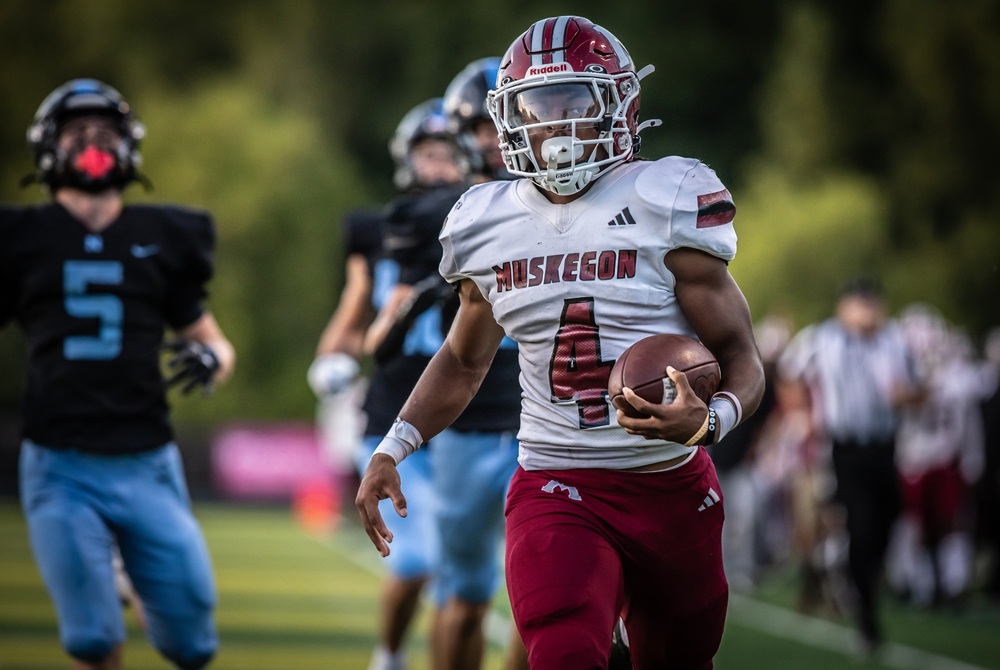
PHOTO A Muskegon ball carrier outruns Grand Rapids Forest Hills Northern's pursuing defenders during the Big Reds' 40-21 win last week. (Photo by Tim Reilly.)