


Football’s Future
March 20, 2012
Many folks, including me, will too often focus on the destination more than the trip. More on results than process. The end more than the means.
This is epidemic in sports, on all levels. There’s so much focus on the postseason that it overshadows the regular season.
In contrast, in educational athletics, we are supposed to hold to the principle that opportunities for teaching and learning are as plentiful, maybe more so, in regular season as in tournaments, at subvarsity levels as at varsity, during practices as during games.
This disease affects football as much as any high school sport. There’s been too much focus on the end of the season – playoffs. Postseason tournaments have been the demise of many great Thanksgiving Day high school football classics across the country. Playoffs continue to ruin rivalries and collapse conferences nationwide.
And, disturbingly, the focus on the end of the season misses what is most wrong with football, and may be most threatening to its future. It’s practice. Specifically, what’s allowed during preseason practice and then at practice throughout the season.
We can predict that, in high school football’s future, two-a-day practices will be fewer, practice hours will be shorter and activities will be different. Among proposals we will be presented (and should seriously consider) will be:
If this all sounds silly or radical, remember that the NCAA and NFL are already making such changes. NFL players face contact in practice on only 14 days during a 17-week regular season. Meanwhile, many high school coaches have kids knocking heads and bruising bodies two to four days a week, all season long. Giving critics the impression that interscholastic football for teens is more brutal than the higher levels of football for grown men. Inviting interference from people who think they know better.
Actually, we know better; and we need to do better. Soon.
1st & Goal: 2023 Football Finals Review
By
Geoff Kimmerly
MHSAA.com senior editor
November 29, 2023
On jaw-dropping moments alone, the 2023 Football Finals played over the last two weekends at Northern Michigan University’s Superior Dome and Ford Field were an unforgettable success.
 The two longest active winning streaks in the state were ended by first-time champions. Perhaps the two most recognizable players in Michigan faced off in the season finale. The winningest active coach in state history led his team to a record-tying title, while two more coaches retired with their program’s first. The lone repeat champion needed every last second to score all of its points during the fourth quarter, and four reigning champions saw their repeat or three-peat bids denied.
Consider those an opening kickoff of the final “1st & Goal Review” this season.
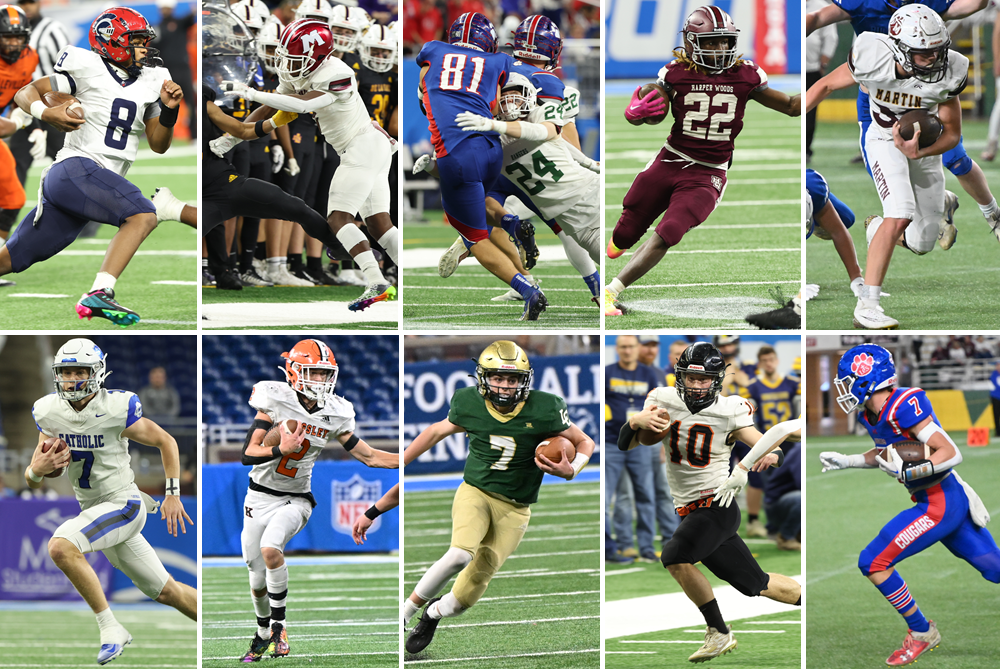
MHSAA.com covered all 10 championship games, with quick recaps and links (click on the game scores) to those stories below followed by notations of performances entered into the MHSAA Finals record book and a report on some of the main storylines to emerge as those championships were being decided.
Finals in Review
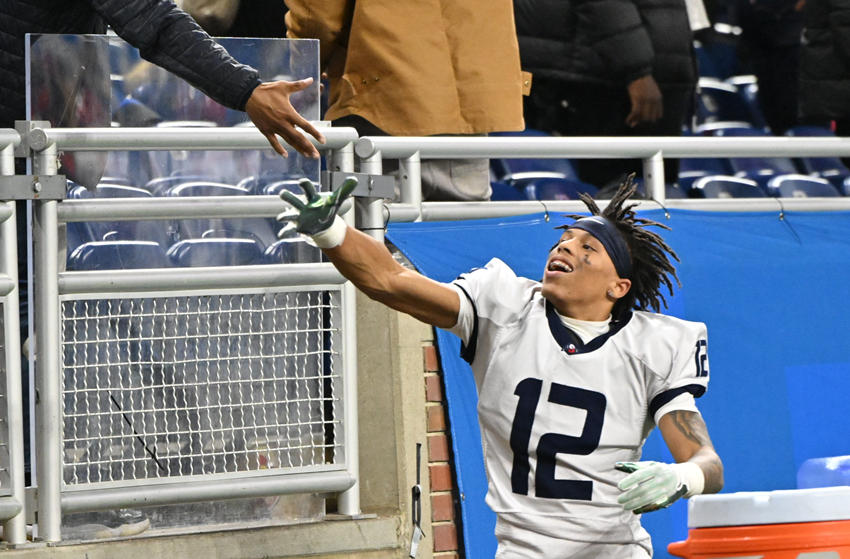
11-Player Division 1: Southfield Arts & Technology 36, Belleville 32 – Read
The concluding game of this season’s Finals kept everyone on the edge of their seats as A&T not only claimed its first championship but ended reigning champ Belleville’s winning streak at 38 games. This matched up arguably the top quarterbacks in the state, with senior Isaiah Marshall piling up 415 total yards while running for a touchdown and throwing for two more, and Belleville junior Bryce Underwood totaling 203 total yards with a passing score as he attempted to lead the Tigers to a Division 1 title for the third-straight season.
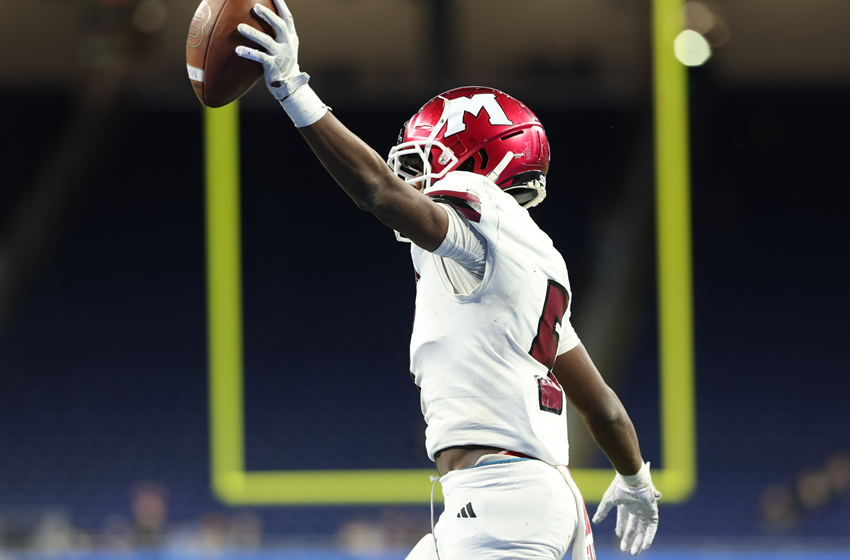
11-Player Division 2: Muskegon 33, Warren De La Salle Collegiate 21 – Read
Muskegon also ended a two-year title streak, as De La Salle was the reigning champion and making its fourth-straight Finals appearance. The Big Reds had finished Division 3 runner-up in 2022, but followed senior quarterback M’Khi Guy, who piled up 374 total yards, ran for a pair of touchdowns and threw for two more.
11-Player Division 3: Grand Rapids Forest Hills Central 27, Mason 10 – Read
Both were playing for a first championship, and Forest Hills Central after finishing Division 2 runner-up last season. Several top contributors from the 2022 Rangers team were back, and they limited a Mason offense that had averaged 41 points per game entering the finale. In doing so, FHC sent retiring coach Tim Rogers out with the ultimate win.
11-Player Division 4: Harper Woods 33, Grand Rapids South Christian 27 – Read
Harper Woods was another first-time champion, carrying a 14-0 lead into the second quarter and extending it to as many as 20 before South Christian made a late run behind the record-setting passing of junior quarterback Carson Vis. Harper Woods lost junior lead back Colby Bailey on the second play, but junior Donald Adams stepped in and averaged 10 yards per carry with 174 total.
11-Player Division 5: Grand Rapids Catholic Central 21, Corunna 7 – Read
After missing out on a Ford Field trip last fall, Grand Rapids Catholic Central claimed its third Division 5 title over the last four seasons. Senior quarterback Connor Wolf ran for all three touchdowns and senior running back Kellen Russell-Dixon powered the attack with 133 yards on the ground. Corunna was making its first Finals appearance and gave the Cougars one of their closest games, as all but three wins had come by at least 32 points.
11-Player Division 6: Kingsley 38, Almont 24 – Read
Kingsley claimed its first Finals championship since 2005 led by another record-setting performance. Senior running back Eli Graves tied the Finals record scoring 30 points, the last of his four touchdowns with 2:19 to play and after Almont had pulled within six points of the lead. The Stags controlled the ball for more than 33 minutes – or nearly 70 percent of the game.
11-Player Division 7: Jackson Lumen Christi 34, Menominee 30 – Read
The Titans and longtime coach Herb Brogan tied the MHSAA record with their 13th Finals championship as they scored the game-winning points with 4:04 to play to complete this repeat title run. Junior running back Kadale Williams ran for 276 yards, the fifth-most in Finals history, and scored his first two touchdowns during the second quarter to bring Lumen back from an early 14-0 deficit.
11-Player Division 8: Ubly 21, Ottawa Lake Whiteford 6 – Read
The rematch of the 2022 Division 8 Final – won by Whiteford – this time went Ubly’s way as the Bearcats also ended the Bobcats’ 27-game winning streak in coach Eric Sweeney's final game. Ubly had finished Finals runner-up three times, but concluded its first championship season 14-0. The teams played a scoreless first quarter and Whiteford scored first in the second before the Bearcats stacked three scoring drives of at least 5 minutes, 30 seconds apiece.
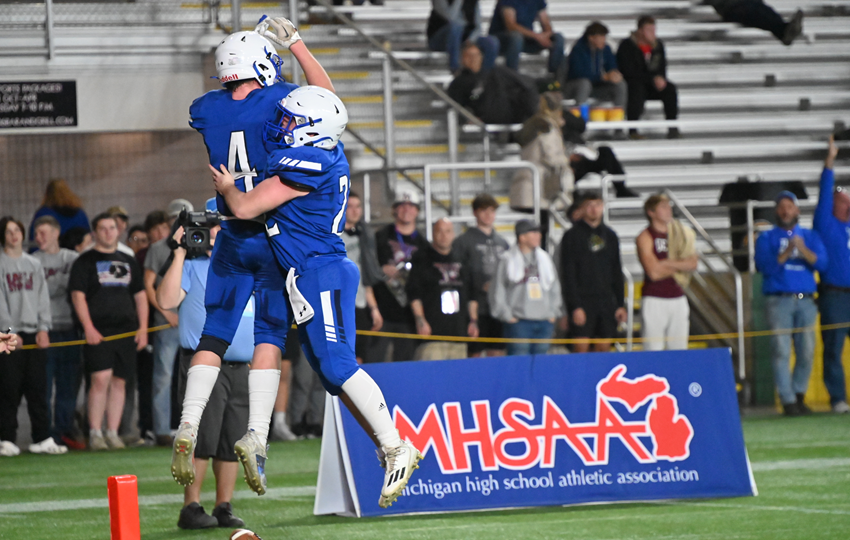
8-Player Division 1: Martin 30, Indian River Inland Lakes 26 – Read
Martin scored all 30 of its points during the final 10:17 to repeat as Division 1 champion in unimaginable fashion. Junior quarterback Gavin Meyers’ 21-yard run with five seconds to play put the Clippers ahead for good, and he finished with 358 total yards and also threw a touchdown pass with 33 seconds left to pull Martin within four points of the lead. Inland Lakes was playing its first Final.
8-Player Division 2: Adrian Lenawee Christin 36, Marion 18 – Read
Lenawee Christian clinched its third Finals championship over the last four seasons and after falling short a year ago. Senior quarterback Sam Lutz piled up one more massive statistical performance, throwing for 350 yards and three touchdowns on near-perfect passing, while also running for two scores. Marion was making its first Finals appearance since 1990.
Records Report
As noted above, Jackson Lumen Christi tied the MHSAA football record by winning its 13th Finals championship. The Titans share that top spot with now-closed Farmington Hills Harrison, and Grand Rapids Catholic Central and Muskegon also moved up that list with their eighth and seventh titles, respectively. Lumen Christi also played in its 16th championship game – third-most and two short of Harrison’s record in that category, while Muskegon played in its 14th, GRCC in its 10th and Grand Rapids South Christian and Warren De La Salle Collegiate both in their ninth Final.
Kingsley senior Eli Graves became one of five to score a record 30 points in an 11-Player Final, doing so with four rushing touchdowns and three 2-point conversions. His four touchdowns tied for fifth-most TDs in a Final and tied for third-most rushing scores. Graves also made the single-game rushing yards list with 210 yards on 33 carries.
Jackson Lumen Christi junior Kadale Williams finished his season with more than 1,900 yards rushing after reaching the single-game Finals rushing list with 276 on 27 carries. Muskegon senior quarterback M’Khi Guy joined Williams and Graves with 215 rushing yards on 25 carries.
Although Harper Woods and Grand Rapids South Christian combined to score just 60 points, they combined for 1,030 total yards, second-most on the list for both teams combined, and South Christian’s 533 total yards alone tied for fourth-most by a single team. Sailors junior quarterback Carson Vis set 11-Player Finals records with 441 passing yards, 30 completions and 513 total yards, and his 44 pass attempts rank second. His senior receiver Jake Vermaas made lists with 10 receptions and 176 yards. Not surprisingly, Vis’ passing yards also make the most by one team in an 11-Player Final.
Southfield A&T senior Isaiah Marshall also made the total yardage list with 415, ranking fourth, and his 281 passing yards and 20 completions also earned entries. Guy made the total yardage list with 374 and also the longest pass list with a 94-yarder to senior Destin Piggee for a score. De La Salle junior Sante Gasperoni made the single-game passing yardage list with 249, and Harper Woods sophomore Nate Rocheleau also made the longest throw list with a 90-yard scoring toss to senior Ramonty Houze. Mason junior Cason Carswell made the attempts and completions lists connecting on 22 of 40 passes.
Grand Rapids Forest Hills Central senior Alex Moeller made the single-game field goals list in 11-player with two, from 35 and 27 yards out. Lumen Christi junior Andrew Salazar made the single-game extra points list with five in five tries.
Senior Tashi Braceful was on the other end of some of Marshall’s record work making the 11-player receptions list with 10 catches, for 152 yards.
Conversely, two teams made the list for fewest passing attempts in an 11-player championship game – Almont, which completed one pass on two attempts, and Ubly, which attempted three passes and completed two.
South Christian earned one more entry from the Division 4 game, tying for third-most first downs with 28. Kingsley also made that list, ranking sixth with 27.
Kingsley and Ubly also made the list for fewest punts in an 11-Player Final, as neither punted last weekend.
Marion senior Gavin Prielipp set the 8-Player Finals record for the fastest touchdown scored on an opening kickoff, bringing it back in Division 2 76 yards for a score over the game’s first nine seconds.
Lenawee Christian sophomore Max Stamats made the records for longest field goal also in that game, drilling a 42-yarder.
Cougars senior quarterback Sam Lutz is all over the record book. His 396 total yards in the Division 2 Final rank fifth on that list, while his 350 passing yards are third and .870 percentage throwing the ball (20 for 23) is the first entry in that category. The 350 passing yards also represent the third-most on the team list for 8-Player Finals.
Senior teammate Easton Boggs also made his marks in Division 2, with his 210 receiving yards ranking third and his three touchdown receptions tying for second-most in an 8-Player title game.
Both Division 1 quarterbacks also made the 8-Player Finals list for total offense, Martin junior Gavin Meyers with 358 yards and Inland Lakes junior Aidan Fenstermaker with 323.
Martin as a team ranked second on the 8-player list for most points scored in a quarter, with its 30 during the fourth, and also made the first downs list with 27. Neither Martin nor Inland Lakes punted in that Division 1 game, placing those teams on the lists for fewest punts by one team and fewest between both teams in one game.
Stories Behind the Scores
Legendary Lineup: From a competitiveness point of view, this was as strong a set of Football Finals as we’ve enjoyed in recent memory. Over the last five seasons alone, only 12 championship games – out of 50 – had been decided by seven points or fewer, and only 24 had margins of 14 or fewer points, including only three of 10 games in 2022. But the last two weekends saw four games decided by seven points or fewer, three more by 8-14 points, and the remaining three by 15, 17 and 18.
Some Old, Some New: Of 10 champions this season, four earned football titles for the first time – and only two were repeat winners from 2022. While nine teams played in Finals for at least the second season in a row, five played in a championship game in this sport for the first time. More than 45,000 fans attended the 11-Player Finals, up 2,000 from a year ago and thanks in part to notable crowds from first-time finalists Mason, Corunna and A&T.
Scheduling Notes: Due to Michigan State playing Penn State on Friday at Ford Field, the MHSAA 11-Player Finals were moved to Saturday and Sunday, and Sunday’s games also started at 9:30 a.m. instead of the traditional 10 kickoff time. The schedule adjustment also allowed for experimentation with the order of games, with the largest schools each day – Division 2 on Saturday and Division 1 on Sunday – moved to the final time slots those evenings.
Dazzling Finishes: The Division 1 games – both in 11-player and 8-player – provided last-minute game-winning touchdowns to cap storybook seasons. In 11-player, Isaiah Marshall’s 11-yard scoring run with 47 seconds to play pushed Southfield Arts & Technology past Belleville 36-32 after the Tigers previously had come back from an 18-point deficit. In 8-Player Division 1, Martin scored all of its 30 points during the fourth quarter – the last 16 over the final 33 seconds – and with quarterback Gavin Meyers scrambling 21 yards for the winning score with five seconds to play. The Martin win kicked off the championship weekends, while the Southfield A&T victory ended the season.
MHSAA.com's weekly “1st & Goal” previews and reviews are powered by MI Student Aid, a part of the Office of Postsecondary Financial Planning located within the Michigan Department of Treasury. MI Student Aid encourages students to pursue postsecondary education by providing access to student financial resources and information. MI Student Aid administers the state’s 529 college savings programs (MET/MESP), as well as scholarship and grant programs that help make college Accessible, Affordable and Attainable for you. Connect with MI Student Aid at www.michigan.gov/mistudentaid and find more information on Facebook and X (Twitter) @mistudentaid.
PHOTOS (Top) Our collage includes photos from all 10 MHSAA Football Finals. (2) Muskegon’s Da'Carion Taylor holds up the ball after his touchdown catch during the 11-Player Division 2 game. (3) Inland Lakes’ Jacob Willey (4) and Avery Enos celebrate Willey’s second touchdown of the 8-Player Division 1 Final. (4) Southfield A&T’s DeMario Quarles enjoys a moment after his team’s 11-Player Division 1 victory. (11-Player Finals photos by Hockey Weekly Action Photos. 8-Player Finals photos by Cara Kamps.)