


Football’s Future
March 20, 2012
Many folks, including me, will too often focus on the destination more than the trip. More on results than process. The end more than the means.
This is epidemic in sports, on all levels. There’s so much focus on the postseason that it overshadows the regular season.
In contrast, in educational athletics, we are supposed to hold to the principle that opportunities for teaching and learning are as plentiful, maybe more so, in regular season as in tournaments, at subvarsity levels as at varsity, during practices as during games.
This disease affects football as much as any high school sport. There’s been too much focus on the end of the season – playoffs. Postseason tournaments have been the demise of many great Thanksgiving Day high school football classics across the country. Playoffs continue to ruin rivalries and collapse conferences nationwide.
And, disturbingly, the focus on the end of the season misses what is most wrong with football, and may be most threatening to its future. It’s practice. Specifically, what’s allowed during preseason practice and then at practice throughout the season.
We can predict that, in high school football’s future, two-a-day practices will be fewer, practice hours will be shorter and activities will be different. Among proposals we will be presented (and should seriously consider) will be:
If this all sounds silly or radical, remember that the NCAA and NFL are already making such changes. NFL players face contact in practice on only 14 days during a 17-week regular season. Meanwhile, many high school coaches have kids knocking heads and bruising bodies two to four days a week, all season long. Giving critics the impression that interscholastic football for teens is more brutal than the higher levels of football for grown men. Inviting interference from people who think they know better.
Actually, we know better; and we need to do better. Soon.
Ubly Sends Out Retiring Coach with Program's 1st Finals Win in D8 Rematch
By
Scott DeCamp
Special for MHSAA.com
November 25, 2023
DETROIT – You could not have written a better script for Ubly’s football program and its tight-knit Thumb community Saturday at Ford Field.
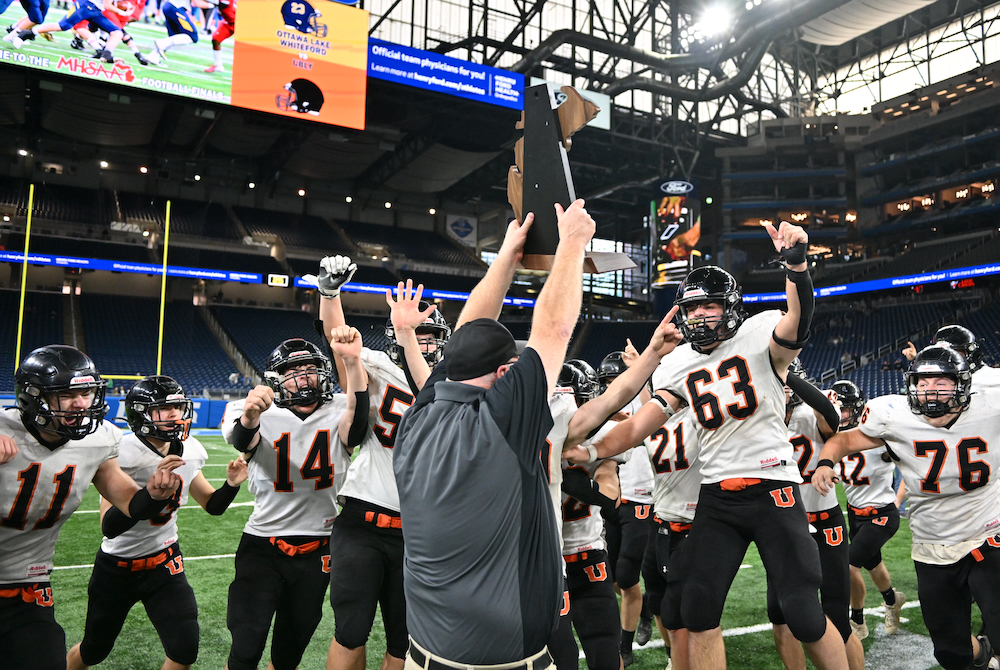
The Bearcats captured their first Finals championship, avenged last year’s title-game loss to Ottawa Lake Whiteford, and sent head coach Eric Sweeney into retirement a champion with a 21-6 victory over the Bobcats in the Division 8 title game.
Might Sweeney consider an encore and coach another year?
“No!” Sweeney quickly responded with conviction, prompting laughter among attendees of the press conference and even his own players before adding another “no.”
Sweeney served as Ubly’s head varsity coach for only four seasons, but he compiled a 48-5 overall record. He led the Bearcats to the top of the mountain after the program had made several title pursuits prior to Saturday, including a last year’s which ended with a 26-20 loss to Whiteford and a 2020 Finals run that concluded with a 22-0 defeat to Centreville.
“You know, I’m done. I’ve coached for 23 years at every level there is. No, this makes it easier to walk away,” Sweeney said. “I loved coaching all these years. I got to coach these guys (referring to his players at the press conference) for four years at the varsity level. I coached them in seventh-grade basketball. I know these kids pretty good.
“My kids are all well out of high school, and there’s just other things I want to do in life. I’m just proud I’m leaving the program in the condition that it is.”
It may be impossible to leave it better than Sweeney and the Bearcats did Saturday and throughout their perfect journey in 2023.
 Ubly completed this run with a 14-0 record and did it the Bearcat way – with physicality at the point of attack, a clock-grinding, ball-control offense; and a very stingy defense. The Bearcats outscored their opponents this season by a combined 596-134 margin.
“It means a lot. Like, last year, we lost here and we felt terrible for the seniors, the way we went out, basically on a last-second thing,” said Ubly senior Evan Peruski, who also started at quarterback in the Bearcats’ 2022 and 2020 Finals losses.
“It means everything. I mean, a lot of us up here, we’re friends with kids that played 10, 20 years ago. I saw about 30 of them in the crowd, people I knew that played 20, 30 years ago. They’re there supporting us.”
Whiteford, which was seeking its third Division 8 title since 2017, saw a 27-game winning streak end and closed the season with a 13-1 record – a tough conclusion to a tremendous two-year run.
“I’ve been coaching football a long time. I don’t think I’ve ever had an experience of a senior group like these guys that we have,” said Todd Thieken, who finished his second season as Whiteford’s head coach but has been in the game since the late 1980s with various stops in Michigan and Ohio.
“A couple of seniors came up to me after the game and they said, ‘I’m sorry, coach.’ I just said to them, ‘I’m just sorry that I don’t ever get to coach you again,’” Thieken added, getting a bit choked up. “I’m still going to be around and in their lives and making sure that they continue to get through school and be successful young men.”
Well-executing Ubly and Whiteford squads engaged in a game of keep-away, both aiming to possess the football and keep it out of the opponent’s hands.
Ubly won that battle, possessing the ball for nearly a 2-to-1 margin (31:51-16:09). The Bearcats nearly doubled up the Bobcats in total offense as well, 310-165, led by an overwhelming advantage in rushing yardage (281-60).
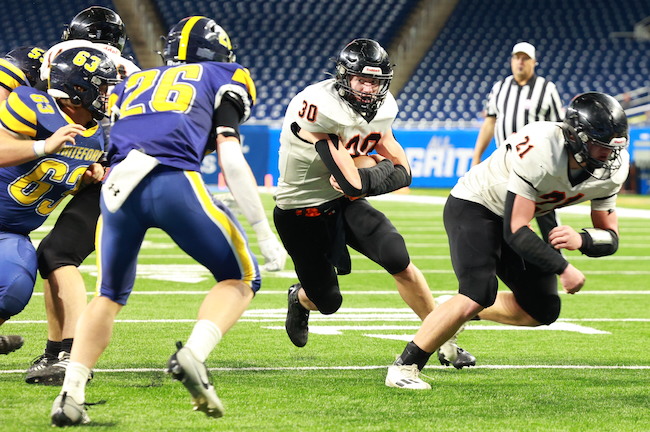
Senior Seth Maurer led Ubly with 138 yards on 27 carries, highlighted by his 4-yard touchdown run that drew the teams even with 1:31 left in the first half before senior Brett Mueller hammered through the ensuing PAT for a 7-6 edge.
Whiteford had struck first in the contest. Ubly’s game-opening, 16-play, 79-yard drive that consumed 8:01 of the clock was stopped just shy of the goal line after a review determined Peruski’s knee was down inside the 1. Whiteford then marched 99 yards the other way and got into the end zone on a 4-yard scoring pass from freshman Tre Eitniear to senior Hunter DeBarr. The two-point conversion pass failed, but the Bobcats led 6-0 with 8:11 left in the second quarter.
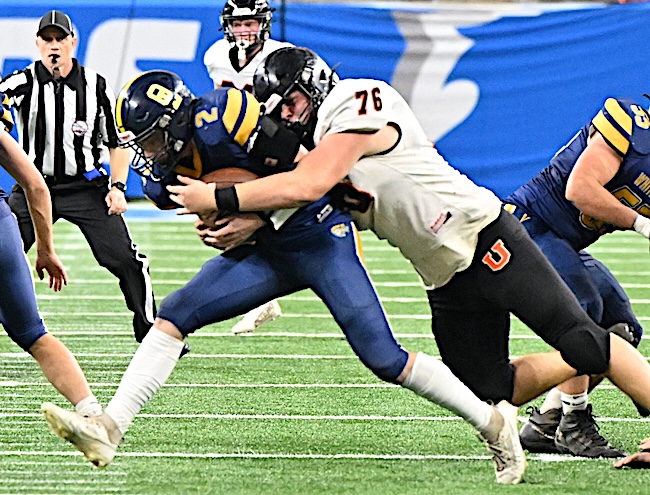 Ubly’s defense settled in after that, allowing only 66 yards the rest of the way.
Meanwhile, Ubly’s offense continued to move the ball. The Bearcats extended their lead to 14-6 on Peruski’s 11-yard TD pass to senior Ryan Learman on 4th-and-goal from the 11. Junior Luke Volmering all but put the game away with his 3-yard scoring run with 6:13 remaining.
“I think our line does a great job. The big fella here (pointing to 6-foot-3, 270-pound senior lineman Mitchell Foote) had a heck of a game today,” Sweeney said. “When you’re running our offense, it’s an offensive line game. I’m an offensive line coach, so you know, it’s kind of my kind of game. I’m not smart enough for all this fancy passing stuff.
“We’ve got to play the game at the line of scrimmage, and I thought defensively our D-line made some big plays as it went on and the secondary did a great job, too. … The game was won at the line of scrimmage.”
Peruski did enough to keep Whiteford’s defense honest. He ran six times for 32 yards and completed 2 of 3 passes for 29 yards. Volmering ran 16 times for 77 yards. Ubly senior Canden Peruski led the defense with 11 tackles.
Whiteford senior Jake Iott was all over the field, registering 18 tackles. Bobcats senior Kolby Masserant made 13 stops, while senior teammate Ryin Ruddy notched 11 tackles. Eitniear was 6-of-11 passing for 78 yards, while Ruddy went 3-of-4 for 27 yards. Iott led his team on the ground with 37 yards on 12 carries.
“I’m grateful for the opportunity. You know, I’ve been starting for four years on varsity,” DeBarr said. “I’m glad the coaches and some of my teammates could make me a better player for those four years. We won a lot of big games and, you know, you lose a couple of big games. It was fun.”
Saturday marked Ubly’s fourth Finals appearance. The Bearcats also had lost to Traverse City St. Francis in the Division 7 Final in 2008.
Sweeney attributed much of Ubly’s success over the past couple of decades to his cousin, former head coach Bill Sweeney. The Bearcats have won 10 Regional titles over the last 20 years.
Eric Sweeney also credited the unwavering support of Ubly’s community and that of the Bearcats’ rival schools along the way. Ubly spent the week practicing indoors at the Laker Legacy Center of rival Elkton-Pigeon-Bay Port.
“It’s not as much for me personally. It’s for our community,” Sweeney said. “The support we get from the Thumb area is unreal. It just means a lot.”
Said Foote: “It just means the world. Best coach I’ve ever had. He’s always pushed us. (They) just had to make him go out with a state championship. It would be a shame to not give him one.”
PHOTOS (Top) Ubly coach Eric Sweeney presents the Division 8 championship trophy to his team Saturday morning at Ford Field. (Middle) The Bearcats’ Seth Maurer (30) follows teammate Canden Peruski’s block into a small gap in the Whiteford defense. (Below) Mitchell Foote (76) brings down the Bobcats’ Ryin Ruddy. (Photos by Hockey Weekly Action Photos.)