


Football’s Future
March 20, 2012
Many folks, including me, will too often focus on the destination more than the trip. More on results than process. The end more than the means.
This is epidemic in sports, on all levels. There’s so much focus on the postseason that it overshadows the regular season.
In contrast, in educational athletics, we are supposed to hold to the principle that opportunities for teaching and learning are as plentiful, maybe more so, in regular season as in tournaments, at subvarsity levels as at varsity, during practices as during games.
This disease affects football as much as any high school sport. There’s been too much focus on the end of the season – playoffs. Postseason tournaments have been the demise of many great Thanksgiving Day high school football classics across the country. Playoffs continue to ruin rivalries and collapse conferences nationwide.
And, disturbingly, the focus on the end of the season misses what is most wrong with football, and may be most threatening to its future. It’s practice. Specifically, what’s allowed during preseason practice and then at practice throughout the season.
We can predict that, in high school football’s future, two-a-day practices will be fewer, practice hours will be shorter and activities will be different. Among proposals we will be presented (and should seriously consider) will be:
If this all sounds silly or radical, remember that the NCAA and NFL are already making such changes. NFL players face contact in practice on only 14 days during a 17-week regular season. Meanwhile, many high school coaches have kids knocking heads and bruising bodies two to four days a week, all season long. Giving critics the impression that interscholastic football for teens is more brutal than the higher levels of football for grown men. Inviting interference from people who think they know better.
Actually, we know better; and we need to do better. Soon.
Drive for Detroit: Week 5 in Review
September 25, 2017
By Geoff Kimmerly
Second Half editor
If there was a theme that emerged across much of the state during Week 5 in Michigan high school football, it boiled down to this: Not so fast.
 Not so fast, teams appearing to break away from the pack.
Not so fast, new contenders on the block who have won big but still have big opponents to play.
Not so fast, those counting out those old favorites because they’ve fallen early to teams on the rise.
And not so fast, if you’re thinking a slow start is sure to be followed by a disappointing finish.
We’ve passed the midpoint of the regular season, but this week’s Drive for Detroit review – powered by MI Student Aid – saw a number of teams show there’s plenty yet to prove and decide over the next month.
Bay & Thumb
Elkton-Pigeon-Bay Port Laker 20, Cass City 14
This could be the eventual decider in the Greater Thumb Conference West as Laker handed Cass City (4-1) its first loss this season while beating the Red Hawks for the seventh straight year. The Lakers (4-1), perfect since falling to still-undefeated Hudson on opening night, held on as Cass City finished the game four yards from tying the score. Click for more from the Huron Daily Tribune (and check out the video below from Thumb Tailgater Sports).
The final Laker defensive play with 4 sec. Left in game as Lakers win 20-14 over Cass City
Webaudio Replay CH 1 https://t.co/lpuKgz4eee pic.twitter.com/dx2I8b0OqC— ThumbTailgaterSports (@ThumbTailgater) September 23, 2017
Also noted:
New Lothrop 56, Flint Hamady 34 – Make that 66 wins in its last 67 regular-season games for New Lothrop (5-0), although Hamady (3-2) scored more than any opponent had on the Hornets in any game since 2014.
Midland 42, Bay City Central 35 – Midland (4-1) earned a solid win in a matchup of teams in first place in their respective Saginaw Valley League divisions; the Chemics are co-leaders in the Blue, and Central (3-2) is one of two atop the Red.
Lake Fenton 24, Byron 6 – The Blue Devils (4-1) held on to a slim lead over Montrose in the Genesee Area Conference Red while sending Byron (3-2) to fourth place in what continues to be a tight league race.
Frankenmuth 47, Bridgeport 42 – The Eagles (5-0) trailed by 21 during the second half before coming back to beat a Bridgeport team that at 3-2 has more wins already than it finished with in any of the last three seasons.
Greater Detroit
West Bloomfield 17, Rochester Adams 16
Over two weeks West Bloomfield broke open the Oakland Activities Association Red title chase, handing Adams its first loss after doing the same to Clarkston in Week 4. Quarterback Bryce Veasley threw two touchdown passes including a 99-yarder to Tre Mosley, and the Lakers (3-2) stopped an Adams two-point conversion attempt after the Highlanders (4-1) scored during the final minutes. Click for more from the Oakland Press (and see highlights from State Champs! Sports Network).
ICYMI: Check out the highlights from West Bloomfield's 17-16 win over Rochester Adams on Friday night! @Wblakers @wbhslakernation @19Bellamy pic.twitter.com/IPM35W5bie
— STATE CHAMPS! (@statechampsnet) September 25, 2017
Also noted:
Madison Heights Madison 28, Marine City 24 – A contender in the Macomb Area Conference Silver, Madison (5-0) got a major playoff points boost from handing MAC Gold co-leader Marine City (4-1) its first loss.
Detroit Mumford 13, Detroit Cody 7 – Mumford (4-1) kept just ahead of Cass Tech with one more league win in the Detroit Public School League Green title hunt, and likely will cheer for Cody (3-2) to beat the Technicians this week.
Birmingham Groves 32, Farmington Hills Harrison 31 – The reigning champ Falcons (4-1) kept themselves alive in the OAA White, moving into a second place tie now with Harrison (3-2) and Troy one win behind Oak Park.
Clinton Township Clintondale 30, Hazel Park 14 – MAC Bronze leader Clintondale (5-0) eclipsed last year’s win total with an impressive one over the OAA Blue-leading Vikings (3-2), who are already one win better than last year with their most since 2012.
Mid-Michigan
Portland 35, Lansing Catholic 6
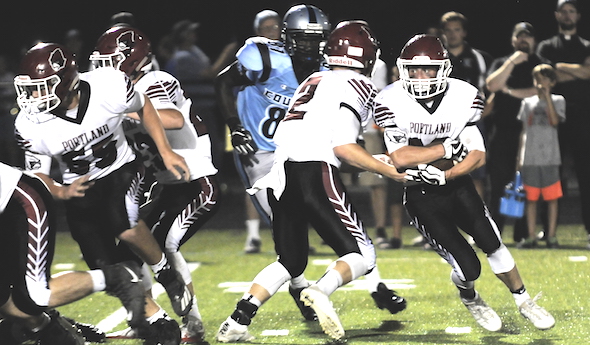
The Raiders, adding this win to another over Williamston in Week 3, own a commanding lead in the Capital Area Activities Association White as they play for a three-peat. Portland (4-1) scored the first 28 points this time and locked down an offense that was averaging 39 points per game entering the night. Lansing Catholic (4-1) is 29-3 during the regular season since the start of 2014 – with all three losses to the Raiders. Click for more from the Lansing State Journal.
Brock Gross scores again for Portland from 14 yards. Gross has 4TDs in the first half. Portland 28, Lansing Catholic 0. pic.twitter.com/uUS2OW930F
— Jake Atnip (@JakeAtnip) September 23, 2017
Also noted:
Williamston 35, Ionia 34 – The Hornets (3-2) bounced back from painful losses to Portland and Lansing Catholic by edging the Bulldogs (3-2), who similarly have lost two games by a combined nine points.
Clare 42, Harrison 14 – A potential Jack Pine Conference-deciding matchup with Beaverton wouldn’t come until Week 9, but Clare (4-1) took a step toward making it happen by knocking the Hornets (3-2) into a tie for third place.
Laingsburg 33, Fowler 0 – The Wolfpack (4-1) set up this week’s matchup with Pewamo-Westphalia for first place in the Central Michigan Athletic Conference by extending a two-year winning streak over Fowler (2-3) for the first time since 2008-09.
Grand Ledge 28, Okemos 20 – This kept reigning champ Grand Ledge (4-1) tied atop the CAAC Blue with Holt, but also showed that Okemos (4-1) can hang with the league’s best after a fast start against opponents that haven’t had much success this fall.
Northern Lower Peninsula
Boyne City 21, Grayling 6
The Ramblers (5-0) extended their winning streak over Grayling to four straight and in doing so took a sizable step toward making Week 9’s matchup with Traverse City St. Francis a potential decider in the Northern Michigan Football League Legends division. Those two met to decide the title in Week 9 in 2016 and are tied for first place again. Click for more from the Petoskey News-Review.
Also noted:
Cheboygan 22, Kalkaska 15 – Also in the NMFL Legends, Cheboygan (2-3) equaled its most wins in a season since 2013 by avenging last year’s 35-0 loss to the Blazers (3-2).
Frankfort 52, Johannesburg-Lewiston 14 – The Panthers (4-1) took their points-per-game average this season to 47 against the rebounding Cardinals (3-2), who will equal last year’s win total with their next victory.
Lake City 20, Beal City 14 – The Trojans (5-0) have now handed losses to two of three teams tied for second in the Highland Conference, while Beal City (3-2) will face those other two over the next two weeks as it looks to stay in contention.
Harbor Springs 20, St. Ignace 16 – The Rams (3-2) downed the reigning league champion Saints (1-4) to maintain first place in the NMFL Legacy.
Southeast & Border
Michigan Center 36, Addison 24
The Cardinals (4-1) dissolved at least some of the excitement surrounding Addison’s best start in more than a decade by creating a three-way tie for first in the Cascades Conference with the Panthers (4-1) and Napoleon (which had beaten Michigan Center in Week 3). Addison and Napoleon already have met as well. Click for more from the Jackson Citizen Patriot.
That will likely do it. Michigan Center converts on fourth-and-9 to move the sticks to Addison's 18. 3 minutes to play, Addison 0 timeouts. pic.twitter.com/hqJujg7SQ5
— Tony Garcia (@RealTonyGarcia) September 23, 2017
Also noted:
Brighton 30, Livonia Stevenson 10 – The Bulldogs (3-2) kept themselves in contention for at least a shared title in the Kensington Lakes Activities Association Black by handing Stevenson (4-1) its first loss.
Blissfield 25, Brooklyn Columbia Central 14 – After leader Hudson, the Lenawee County Athletic Association is a bit of a jumble with Blissfield (3-2) now in the mix a week after Columbia Central (3-2) looked to be joining.
Jackson 35, Lansing Sexton 28 – The Vikings might be the best 1-4 team in Michigan and showed it against the talented Big Reds (3-2) after earlier absorbing one and two-point losses.
Reading 13, Quincy 12 – The Rangers (4-1) kept themselves tied for first in the Big 8 Conference with Union City; Quincy (3-2) faced them both over the last two weeks.
Southwest Corridor
Watervliet 52, Kalamazoo United 34
Watervliet and quarterback Zach Pickens are putting up huge offensive numbers, and the Panthers (5-0) kept their streak going of scoring at least 50 points in every game this season. This was only the opener of the Southwestern Athletic Conference Valley schedule, but Kalamazoo United (4-1) was a strong first test in a league loaded with them. Click for more from the St. Joseph Herald-Palladium.
Also noted:
Coloma 41, Constantine 0 – Staying in the SAC Valley, the Comets (4-1) guaranteed their best finish since 2009 and after losing to Constantine (3-2) by scores of 68-35 and 46-0 over the last two seasons.
Hartford 39, Decatur 38 – The Indians (4-1) have doubled their wins and nearly their points scored as well from 2016 already, with downing Decatur (3-2) their best victory so far.
Three Rivers 14, Paw Paw 0 – The Wildcats (4-1) will get to affect the Wolverine B Conference race as one of four teams in first or second, while Paw Paw (3-2) will need some breaks to get back in the mix.
St. Joseph 42, Mattawan 7 – The Bears (4-1) will need help to win the Southwestern Michigan Athletic Conference West, but can claim a win over the SMAC East-leading Wildcats (3-2).
Upper Peninsula
Gladstone 20, Ishpeming 8
The Braves (5-0), new to the Mid-Peninsula Conference this season, clinched a share of the league title with this victory; they will face winless Iron Mountain in Week 8 with an opportunity to win the championship outright. Ishpeming scored first, but Gladstone scored the final three touchdowns of the game. Click for more from the Escanaba Daily Press.
Also noted:
L'Anse 20, Hurley (Wis.) 18 – The Purple Hornets (4-1) held on to a share of the lead in the Western Peninsula Athletic Conference by downing another contender in Hurley (4-2).
Hancock 42, Calumet 24 – Staying in the West PAC, the Bulldogs (4-1) could still find their way into the title conversation after moving to 3-1 in the league by downing the Copper Kings (3-2).
Norway 28, Bark River-Harris 14 – Norway (5-0) controlled its destiny to remain in first in Mid-Eastern Conference by handing Bark River-Harris (3-2) a second league loss, then got some help (see below).
Lake Linden-Hubbell 34, Newberry 20 – Lake Linden-Hubbell (1-3) is in playoff mode already as it seeks a fifth straight postseason berth, and the Lakes started to bounce back from a slow start by handing Newberry (3-2) its first M-EC defeat.
West Michigan
Montague 46, Whitehall 44
The West Michigan Conference has been one of the state’s most exciting the last two weeks, with Whitehall handing reigning champion Muskegon Oakridge a loss in Week 4 only to be edged Friday by Montague (5-0) – which faces Oakridge in Week 7. Whitehall (3-2) came back from 20 points down to make the 111th meeting between the teams a close finish; Montague owns a 61-48-2 edge in the series. Click for more from the Muskegon Chronicle (and see below for a highlight from FOX 17.)
Whitehall scores but the two point conversion is no good, they trail Montague 46-44 with 3:59 left @FOX17Blitz pic.twitter.com/0TYmOoALZX
— Chris Gorski (@Chrisgorski88) September 23, 2017
Also noted:
Hudsonville Unity Christian 35, Comstock Park 32 – The Crusades (3-2) had opened Ottawa-Kent Conference Green play with two defeats, but may have turned things around by downing the O-K Blue co-leading Panthers (4-1).
Grandville 28, East Kentwood 14 – East Kentwood (4-1) arguably had been the most impressive O-K Red team heading into Week 5, but the Falcons will need help to get back in the title hunt as Grandville (4-1) held onto a first-place tie with Holland West Ottawa (Rockford also is without a league loss, but with one fewer game so far).
Grand Rapids Christian 48, Cedar Springs 44 – The Eagles (5-0) scored on a 46-yard touchdown pass from Isaac Dykema to Anthony Ladd with six seconds to play to down the Red Hawks (3-2).
Muskegon Heights Academy 36, Ludington 27 – The Tigers (3-2) hadn’t won more than two games the last two seasons and haven’t won more than three since 2011; they’ll face Muskegon Catholic Central this week with first place in the Lakes 8 Conference on the line after handing the Orioles (2-3) their third league defeat.
8-Player
Morrice 40, Flint International Academy 28
Morrice (5-0) set itself up for a matchup with undefeated Deckerville this week for first place in the North Central Thumb League Stars division. The Orioles have won all of their games by at least 12 points, but third-place International Academy (4-1) gave them their closest game and gets its chance against Deckerville in Week 7. Click for more from the Owosso Argus-Press.
Also noted:
Onekama 54, Suttons Bay 18 – The Portagers (5-0) have won all of their games since switching to 8-player this season by at least 24 points and are tied for first in the Midwest Central Michigan Conference, while Suttons Bay (3-2) is among four teams tied for third.
Central Lake 58, Wyoming Tri-unity Christian 31 – Central Lake also is a first-year 8-player team and is tied with Onekama for first in the MCMC; Tri-unity fell to 2-3 after facing the co-leaders in back-to-back weeks.
Kingston 64, Lawrence 42 – The Cardinals (3-2) tied their wins total from last season while also sending Lawrence to 3-2.
Stephenson 54, Eben Junction Superior Central 30 – The Eagles (5-0) also have won all of their games this season by 24 points, this time despite giving up a season-high 30 to the Cougars (1-4).
Second Half’s weekly “Drive for Detroit” previews are powered by MI Student Aid, a part of the Student Financial Services Bureau located within the Michigan Department of Treasury. MI Student Aid encourages students to pursue postsecondary education by providing access to student financial resources and information, including various student financial assistance programs to help make college more affordable for Michigan students. MI Student Aid administers the state’s 529 savings programs (MET/MESP) and eight additional aid programs within its Student Scholarships and Grants division. Click for more information and connect with MI Student Aid on Facebook and Twitter @mistudentaid.
PHOTO: Portland's running game found success in its 35-6 win over Lansing Catholic on Friday. (Click for more from HighSchoolSportsScene.com.)