

Ford Swaps Frustration for Focus
October 24, 2017
By Tim Robinson
Special for Second Half
Midway through the 2016 season, Marcus Ford was frustrated.
 He was on the Pinckney football team, but not playing much.
A big part of that was due to his size — 6-foot-5 and over 400 pounds — but then-defensive coordinator Rod Beaton sensed there was more.
“We feel that we coach very hard,” said Beaton, now Pinckney’s head coach. “We’re very aggressive (on the varsity), and sometimes it’s an adjustment for juniors to understand that when they come out here, there’s expectations.
“There were a couple times where Marcus was questioning … whether football was for him.”
“I didn’t want to be there,” Ford said. “I thought, ‘This is stupid. Why am I here so late?’”
And then came a change.
“It came to a point where he went home and took a day off to re-gather himself,” Beaton said. “Marcus came back and he said to me, ‘Coach, I really want to be a part of things here.’”
And Ford did more than that.
He grew from a young man who bristled when his coaches pointed out mistakes to one who doesn’t react as if it were a personal attack, from an overweight kid who admits he was on his way to weighing 600 pounds to a big kid who is a key part of Livingston County’s most successful football team as a senior.
He rarely comes out of games, his coach says, and the quiet giant who rarely interacted with his teammates has transformed into a happy, smiling kid who dishes out and takes teasing from them.
It’s a story of transformation that only football could have done for Marcus Ford, who couldn’t play youth football because of his size and whose options for high school athletics seemed limited to football for the same reason.
“I may sound a little clichéd and corny,” Beaton said, “but I think this is why every single coach in America coaches football, to watch the development of a young man, from freshman to sophomore to junior and to see what football has done for him.”
How did Ford do it?
He turned his mental approach 180 degrees and made drastic changes to his diet and work ethic.
One clue came in looking at Pinckney’s roster from 2016 compared to 2017. Last year, Ford was listed at 380, which was about 40 pounds less than his actual weight.
This year, he’s listed at 405, which is a dozen pounds more than what he weighs now.
Last year, he played mostly in mop-up roles.
This year, he is a starter on defense, regularly occupying two blockers at a time, which in turn frees linebackers Cauy Hendee and Levi Collins to make tackles.
“I can play a lot longer,” he said. “I was tired when we were out there, but we don’t believe in the word ‘tired.’ We prefer ‘winded.’ We just need to catch our breath. So I get ‘winded’ a lot less.”
The first thing Marcus decided to change was his diet, and he got his cues by looking in the mirror.
“I didn’t like the muffin cap that was hanging down,” he said. “I didn’t like my stomach hanging over. ... I thought, ‘I don’t what to have a heart attack at age 25.’ I was doing ‘diets,’ per se, but eventually I thought, ‘This is stupid. Cut out pop and eat better,’ And I did.
“The only thing I would eat that was green was green beans, and they had to be made a certain way,” he said. “Now, I’m more like ‘this is somewhat appetizing. Let me try that.’ I don’t eat candy bars anymore. I don’t eat ice cream when my family does. I drink a lot less milk than I used to, and I drink more water.”
 Pinckney offensive coordinator Cody Patton noticed.
“His mom came to me about getting a weight plan, and he stuck with it,” Patton said. “They can only do so much in the weight room. When they leave, there’s not much you can control what they put into their bodies.”
But Ford also changed his mindset about football and being coached.
“His first real commitment was ninth-grade high school football, and it was a big adjustment for him,” Beaton said. “We knew there would be days where he might be a little confrontational, there may be some days where he goes through the motions.”
But after that midseason meeting last year, Ford redoubled his efforts in practice and in the offseason.
The first hint that he was a different player came in June, when Ford earned the team’s first bone helmet sticker of the season for effort in a drill.
“It was our first pursuit drill,” Beaton said. “We go four downs, and those kids have to sprint. There’s no exception. Marcus stepped to his gap, made his reads, flew to the football and didn’t say a word, every single time. He did it four times in a row. It really set the stage. I could tell he was wanting do to things right this year.
“When you see a 6-5, 400-pound kid moving with effort and tenacity, you sit there and go, ‘That young man can help us.’”
And so he has.
As a result, Marcus Ford is part of a Pinckney defense that has lifted the Pirates to an 8-1 regular-season record and shared Southeastern Conference White championship. He has transformed from a player who had little stamina to one who can go from opening kickoff to final horn.
“He can play a whole football game,” Beaton said. “He can go through a whole practice. One of the challenges we were talking about in the offseason is he has to put his body and mind in a position to not come off the field.”
That moment came on a warm night early in the season.
“We were in a huddle at Chelsea, and it was late,” Beaton recalled. “He’s drenched in sweat, and I said, ‘Marcus, you need a breather?’ And he said, ‘No, coach. I’m ready.’ That’s pretty cool.”
Asked his ideal weight, Ford said, “I would like to be at 250 if I could,” then laughs. His bone structure is such that at his height, he would be almost gaunt at 250. “I would settle for 340. That’s the dream within a dream goal.”
Next year, he plans to attend college.
“I want to go into bartending or being a head chef, or get a business degree,” he said. “One other choice is going to a police academy. As long as I can run a mile within 15 minutes, I should be good.”
There’s no reason, now, to think he couldn’t accomplish that.
He got his first sack against Dexter.
‘I grabbed him and rolled him over on top of me,” Marcus said. “I would have liked to have landed on him, but I got him down in the backfield. It’s good.”
And football now is fun.
“A lot more fun,” he said.
“Marcus made a concerted effort to our strength and agility program,” Beaton said. “It wasn’t two days at a time, then not be there five or six days. Marcus was there. He would stay after everyone had left and get some extra lifts in or do some extra work to make sure he was putting himself in a (good) position.
“He said, ‘Coach, I want to be your starting nose (tackle).’ The first day of June camp, he ran out to the nose tackle, and we haven’t looked back.”
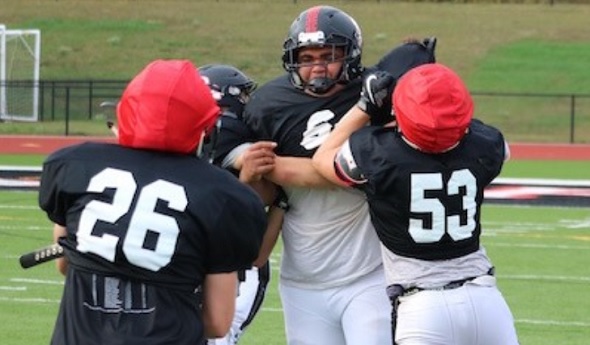
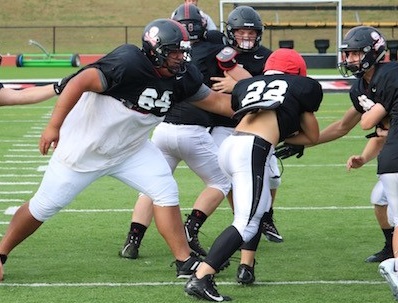
PHOTO: (Top) A pair of Pinckney blockers try to contain nose tackle Marcus Ford during a practice this season. (Middle) Ford breaks free to get an arm on a ball carrier. (Photos by Tim Robinson.)
1st & Goal: 11-Player Semifinals Preview
January 15, 2021
By Geoff Kimmerly
Second Half editor
Five months have passed since the first football practices of this season.
But 24 hours from now, 16 11-player teams will have earned tickets to the destination they’ve been dreaming about since long before those first snaps of the fall.
The last outdoor MHSAA football games of January 2021 will send 15 more teams to Ford Field for the Jan. 22-23 Finals, with Semifinals to be played all over the Lower Peninsula (and one finalist already decided as Centreville will advance after a forfeit).
Spectators remain limited this weekend, but every game will be streamed live by FOX Sports Detroit or MHSAA.com – Click for the list of broadcasts.
Visit the MHSAA Football Playoff Home for Saturday’s entire schedule and scores as they come in, and see below for a glance at the matchups that will determine this season’s championship weekend field.
Division 1
Davison (10-0) at Rockford (8-0)
Reigning Division 1 champion Davison might be missing quarterback Brendan Sullivan, now at Northwestern, but Dion Brown Jr. stepped in mightily last week after leading the team in receiving prior to the move. Carter Cryderman (848 yards/11 TDs) paces a rushing attack averaging 215 yards per game. The Rams have succeeded with a similar style, averaging 222 yards on the ground with lead back Ethan Nash and quarterback Zak Ahern combining for 1,217 yards and 14 touchdowns rushing. Ahern also has 20 touchdowns passes.
West Bloomfield (9-1) at Belleville (10-0)
Two of the most exciting offensive stars in the state will face off among a collection of future college players taking the field in this Semifinal. West Bloomfield running back Donovan Edwards ran for four touchdowns in last week’s return-to-play Regional Final win over Romeo, while Belleville quarterback Christian Dhue-Reid threw three touchdowns passes as the Tigers handed Detroit Cass Tech its lone loss of this season.
Division 2
Traverse City Central (9-1) at Muskegon Mona Shores (10-0)
Shores quarterback Brady Rose started his star run stepping in for an injured all-stater at last year’s Final and leading the Sailors to the Division 2 title. Now he has his team one win from returning to Ford Field having run for 1,057 yards and 17 touchdowns and thrown for 949 yards and 10 scores this season. The Trojans are playing for their first Finals berth since 1988, before the old Traverse City High split into Central and West. Josh Burnham is another standout quarterback, with 903 yards and 18 TDs rushing and 1,215 yards and 16 scores through the air.
Oak Park (5-5) at Warren De La Salle Collegiate (6-4)
Oak Park is one of the best stories so far of this playoffs, as it entered the first all-in postseason in MHSAA football history with a single victory. Running back Davion Primm is another of the top talents in the entire state and the focus of an offense that scored 25 points total over five regular-season games followed by a combined 119 over four playoff wins. The Pilots will attempt to end that dream run, in part with a defense that has given up only 23 points during the postseason. Brady Drogosh (949 yards/9 TDs passing) directs a balanced attack.
Division 3
Muskegon (9-1) vs. DeWitt (10-0) at Lansing Catholic
These two have met in the playoffs two of the last three seasons, and Muskegon won the 2019 Semifinal matchup 28-21. Senior Amari Crowley is the Big Reds’ latest standout quarterback; he’s thrown for 1,008 yards and 12 touchdowns and run for 884 yards and 13 scores. DeWitt also has a playmaking QB, with Tyler Holtz throwing for 2,109 yards and 31 scores – and equally important will be a defense that gives up only 157 total yards per game. The Panthers also must stop running back Jacarri Kitchen, who averages 11.3 yards per carry and has 1,098 total over 10 games.
River Rouge (8-1) at Chelsea (10-0)
Reigning Division 3 champion River Rouge is a win away from what would be a third championship game appearance in six seasons, and with quarterback Mareyohn Hrabowski again one of the toughest to stop in any division. Chelsea is playing in a Semifinal for the third-straight season and also hoping to make the Finals for the third time in six seasons. The Bulldogs also have enjoyed one of the state’s top game changers, receiver Joe Taylor, who has caught 14 touchdowns passes, run for two scores and returned a kickoff for one more.
Division 4
Cadillac (7-2) at Edwardsburg (9-0)
The Eddies are running for their third championship game appearance in four seasons, and as always running for a ton with 3,098 yards in only eight games on the field (the ninth was a forfeit). They’re averaging 55 points per game with their top two rushers, Jackson Hoover and Brett Allen, both averaging at least 14 yards per carry. Cadillac is making its first appearance in the Semifinals and following the same strategy. The Vikings have run for 2,507 yards, with top rusher Aden Gurden gaining 878 on 8.4 per carry.
Detroit Country Day (7-2) vs. Williamston (9-1) at Okemos
Reigning Division 4 runner-up Country Day is playing to reach its third championship game in five seasons. The Yellowjackets were able to get only four games in during the regular season but have played the same number during the playoffs and downed unbeaten North Branch last week. Jacob Yarberry is a playmaker to watch on both sides of the field. The Hornets have been on the verge as well with this their second Semifinal in three seasons. Williamston’s attack is tough on both fronts; quarterback Luke Mahaney guides an offense that has nearly equal yardage and touchdowns rushing and passing.
Division 5
Freeland (9-1) at Grand Rapids Catholic Central (9-0)
The Cougars claimed the Division 4 title last season, their third in four years, and are riding a 21-game winning streak. They returned last week with their highest-scoring performance since 2018, a 58-7 win over Muskegon Oakridge. Freeland’s 14th-straight winning season has landed the Falcons in their first Semifinal since 1998. Four players have scored at least six touchdowns; leading rusher Jacob Kundinger (519 yards) is one of three with a team-best eight touchdowns.
Lansing Catholic (8-2) at Frankenmuth (10-0)
The Eagles are attempting to reach the Finals for the first time, but standing in the way is reigning Division 5 champion Lansing Catholic. Junior Alex Watters stepped in at quarterback last week and finished with 153 yards rushing with a touchdown and 73 yards and a score passing. Frankenmuth will be playing in its third Semifinal in five seasons, this time paced by a running attack averaging 286 yards per game. Cole Lindow is the top ground gainer with 907 yards, plus 12 scores, with quarterback Davin Reif adding more than 800 yards rushing and throwing.
Division 6
Grayling (7-3) at Montague (10-0)
After winning Division 6 in 2018, the Wildcats missed a return trip to the Finals by a one-point Semifinal loss last fall. Quarterback Drew Collins is leading the return attempt, topping the team in rushing with 638 yards (with 16 touchdowns) while passing for 1,640 yards and 20 scores. After two straight 3-6 seasons, Grayling has reached its first Semifinal with a six-game winning streak. David Millikin is averaging 10.1 yards per carry and 151 per game, with 29 rushing touchdowns total.
Constantine (9-1) at Clinton (9-1)
Clinton will be playing in its first Semifinal since 2015 after winning its last two playoff games, over unbeaten opponents, by a combined four points. Constantine has reached nine wins and the Semifinals both for the first time since 2012. The Falcons are averaging an obliterating 524 yards and 7.5 touchdowns on the ground per game.
Division 7
Traverse City St. Francis (8-2) at Cass City (10-0)
Cass City earned home field for its Semifinal with a road win last week over undefeated Ithaca. This will be the second-straight appearance in this round for the Red Hawks, who average 339 rushing yards per game behind backs Alex Perry (897 yards/13 TDs) and Jordan Mester (847/11 TDs). St. Francis also dominates in the ground game, averaging 215 rush yards per game led by Owen Mueller (523 yards/5 TDs) among a large group of contributing backs.
Schoolcraft (9-1) at New Lothrop (9-0)
The Hornets will be playing in their third Semifinal in six seasons and are looking to win their second Division 7 title in three seasons. No opponent has scored more than 16 points against them, which works well with an offense scoring 50 points per game. Quarterback Cam Orr (1,721 yards/24 TDs passing, 569 yards/16 TDs rushing) is among standouts. Schoolcraft turned its third-straight Regional Finals run into its first Semifinal since 2001. Alex Thole has thrown for 2,288 yards and 32 touchdowns. The Eagles downed reigning Division 7 runner-up Jackson Lumen Christi 29-22 last week and handed Division 6 semifinalist Constantine its only loss, in the season opener.
Division 8
Ubly (8-2) at Johannesburg-Lewiston (10-0)
Johannesburg-Lewiston also earned a home Semifinal after a Regional Final road trip, edging Iron Mountain 7-6 last week at the Superior Dome. Sheldon Huff paces another dominating running attack, averaging 9.3 yards per carry for 1,295 total and 16 touchdowns on the ground. This will be the Cardinals’ first Semifinal since 1998, but Ubly’s second straight and third in four seasons. The Bearcats missed Ford Field in 2019 with a one-point loss to Beal City.
NOTE: Centreville (10-0) advanced to the Division 8 Final after Clarkston Everest Collegiate had to withdraw from the playoffs this week.
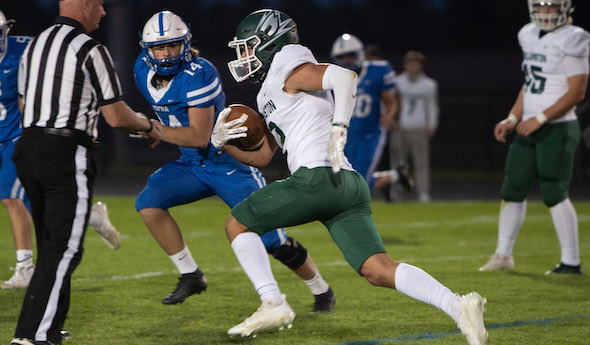
PHOTO: Williamston, here during a 45-7 win over Ionia in Week 7, is back in the Semifinals this weekend for the second time in three seasons. (Click to see more from HighSchoolSportsScene.com.)