

Ford Swaps Frustration for Focus
October 24, 2017
By Tim Robinson
Special for Second Half
Midway through the 2016 season, Marcus Ford was frustrated.
 He was on the Pinckney football team, but not playing much.
A big part of that was due to his size — 6-foot-5 and over 400 pounds — but then-defensive coordinator Rod Beaton sensed there was more.
“We feel that we coach very hard,” said Beaton, now Pinckney’s head coach. “We’re very aggressive (on the varsity), and sometimes it’s an adjustment for juniors to understand that when they come out here, there’s expectations.
“There were a couple times where Marcus was questioning … whether football was for him.”
“I didn’t want to be there,” Ford said. “I thought, ‘This is stupid. Why am I here so late?’”
And then came a change.
“It came to a point where he went home and took a day off to re-gather himself,” Beaton said. “Marcus came back and he said to me, ‘Coach, I really want to be a part of things here.’”
And Ford did more than that.
He grew from a young man who bristled when his coaches pointed out mistakes to one who doesn’t react as if it were a personal attack, from an overweight kid who admits he was on his way to weighing 600 pounds to a big kid who is a key part of Livingston County’s most successful football team as a senior.
He rarely comes out of games, his coach says, and the quiet giant who rarely interacted with his teammates has transformed into a happy, smiling kid who dishes out and takes teasing from them.
It’s a story of transformation that only football could have done for Marcus Ford, who couldn’t play youth football because of his size and whose options for high school athletics seemed limited to football for the same reason.
“I may sound a little clichéd and corny,” Beaton said, “but I think this is why every single coach in America coaches football, to watch the development of a young man, from freshman to sophomore to junior and to see what football has done for him.”
How did Ford do it?
He turned his mental approach 180 degrees and made drastic changes to his diet and work ethic.
One clue came in looking at Pinckney’s roster from 2016 compared to 2017. Last year, Ford was listed at 380, which was about 40 pounds less than his actual weight.
This year, he’s listed at 405, which is a dozen pounds more than what he weighs now.
Last year, he played mostly in mop-up roles.
This year, he is a starter on defense, regularly occupying two blockers at a time, which in turn frees linebackers Cauy Hendee and Levi Collins to make tackles.
“I can play a lot longer,” he said. “I was tired when we were out there, but we don’t believe in the word ‘tired.’ We prefer ‘winded.’ We just need to catch our breath. So I get ‘winded’ a lot less.”
The first thing Marcus decided to change was his diet, and he got his cues by looking in the mirror.
“I didn’t like the muffin cap that was hanging down,” he said. “I didn’t like my stomach hanging over. ... I thought, ‘I don’t what to have a heart attack at age 25.’ I was doing ‘diets,’ per se, but eventually I thought, ‘This is stupid. Cut out pop and eat better,’ And I did.
“The only thing I would eat that was green was green beans, and they had to be made a certain way,” he said. “Now, I’m more like ‘this is somewhat appetizing. Let me try that.’ I don’t eat candy bars anymore. I don’t eat ice cream when my family does. I drink a lot less milk than I used to, and I drink more water.”
 Pinckney offensive coordinator Cody Patton noticed.
“His mom came to me about getting a weight plan, and he stuck with it,” Patton said. “They can only do so much in the weight room. When they leave, there’s not much you can control what they put into their bodies.”
But Ford also changed his mindset about football and being coached.
“His first real commitment was ninth-grade high school football, and it was a big adjustment for him,” Beaton said. “We knew there would be days where he might be a little confrontational, there may be some days where he goes through the motions.”
But after that midseason meeting last year, Ford redoubled his efforts in practice and in the offseason.
The first hint that he was a different player came in June, when Ford earned the team’s first bone helmet sticker of the season for effort in a drill.
“It was our first pursuit drill,” Beaton said. “We go four downs, and those kids have to sprint. There’s no exception. Marcus stepped to his gap, made his reads, flew to the football and didn’t say a word, every single time. He did it four times in a row. It really set the stage. I could tell he was wanting do to things right this year.
“When you see a 6-5, 400-pound kid moving with effort and tenacity, you sit there and go, ‘That young man can help us.’”
And so he has.
As a result, Marcus Ford is part of a Pinckney defense that has lifted the Pirates to an 8-1 regular-season record and shared Southeastern Conference White championship. He has transformed from a player who had little stamina to one who can go from opening kickoff to final horn.
“He can play a whole football game,” Beaton said. “He can go through a whole practice. One of the challenges we were talking about in the offseason is he has to put his body and mind in a position to not come off the field.”
That moment came on a warm night early in the season.
“We were in a huddle at Chelsea, and it was late,” Beaton recalled. “He’s drenched in sweat, and I said, ‘Marcus, you need a breather?’ And he said, ‘No, coach. I’m ready.’ That’s pretty cool.”
Asked his ideal weight, Ford said, “I would like to be at 250 if I could,” then laughs. His bone structure is such that at his height, he would be almost gaunt at 250. “I would settle for 340. That’s the dream within a dream goal.”
Next year, he plans to attend college.
“I want to go into bartending or being a head chef, or get a business degree,” he said. “One other choice is going to a police academy. As long as I can run a mile within 15 minutes, I should be good.”
There’s no reason, now, to think he couldn’t accomplish that.
He got his first sack against Dexter.
‘I grabbed him and rolled him over on top of me,” Marcus said. “I would have liked to have landed on him, but I got him down in the backfield. It’s good.”
And football now is fun.
“A lot more fun,” he said.
“Marcus made a concerted effort to our strength and agility program,” Beaton said. “It wasn’t two days at a time, then not be there five or six days. Marcus was there. He would stay after everyone had left and get some extra lifts in or do some extra work to make sure he was putting himself in a (good) position.
“He said, ‘Coach, I want to be your starting nose (tackle).’ The first day of June camp, he ran out to the nose tackle, and we haven’t looked back.”
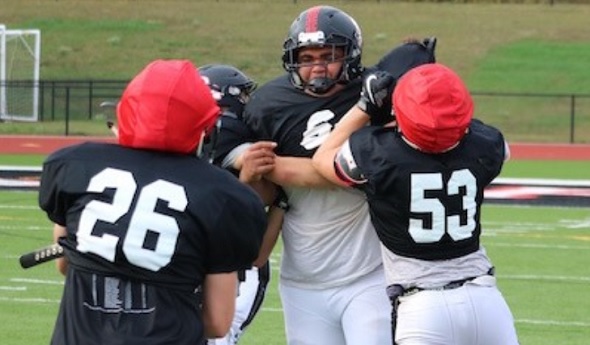
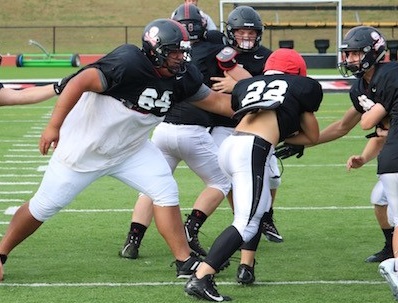
PHOTO: (Top) A pair of Pinckney blockers try to contain nose tackle Marcus Ford during a practice this season. (Middle) Ford breaks free to get an arm on a ball carrier. (Photos by Tim Robinson.)
Reading Reaches Next Level with Repeat
November 29, 2019
By Geoff Kimmerly
Second Half editor
DETROIT – An arduous playoff road over the last five weeks pushed Reading up against some of the most established football programs in Michigan high school history.
Pre-District opponent Mendon is tied for 10th with 12 MHSAA Finals football titles. Semifinal foe Fowler has won seven championships. Those two, Cassopolis and Adrian Lenawee Christian all were state-ranked during the regular season. Friday’s championship game opponent Beal City was not, but is tied for the most playoff appearances in MHSAA history with 35 over the 45-year history of the tournament.
Reading made its 25th playoff appearance this fall, an impressive feat on its own. But by winning a second straight Division 8 championship – after last year’s first in school history – the Rangers launched their program into that group of the most revered.
They concluded this chapter with a 33-6 win over the Aggies on Friday at Ford Field, extending an incredible run while allowing a star-studded senior class to leave its personal imprint on what Reading has accomplished.
“I really think we left a mark in the playoff book,” Rangers senior Hunter Midtgard said. “Just because we came through last year, we had a really good team, and then we came through this year and we wanted to prove a point that this was our team and we wanted to leave a legacy. We just wanted to finish the job.”
Reading finished this fall 13-1, winning 13 straight after a 14-0 opening loss to Pewamo-Westphalia, which will play Saturday for a third Division 7 title in four years. The Rangers are 27-1 over the last two seasons.
Not that the senior class needed motivation after making a major contribution to last season’s title run. But coach Rick Bailey emphasized that those seniors shouldn’t feel like reigning champions, and instead pursue making their own impact – and the P-W loss threw kindling on that message.
“We worked hard over the summer, but that first loss … kinda lit a fire in us and told us what it took to make it back here, so we really wanted it,” Reading senior lineman Nick Affholter said.
“Also, I thought it was great, because it was our team this year,” said senior linebacker/tight end – and Nick’s twin – Ben Affholter. “We got to be seniors and we got to be leaders, and that drove us to win it as our team.”
Friday’s matchup with the Aggies (12-2) was set up to be strength on strength – especially considering the two starting quarterbacks together combined for only about 1,500 yards passing this fall.
The game stayed within a score until midway through the third quarter, when Reading began to show it was stronger in the long run.
The Rangers scored the final 19 points, all on runs, and outgained Beal City on the ground 260-42. Reading also had 10.5 tackles for loss, with Ben Affholter leading with 4.5.
 Beal City senior quarterback Jack Schafer was able to counter with 115 yards and a touchdown passing, completing five of nine attempts. But Rangers junior Porter Mauk also made the most of his six attempts, connecting on scoring passes for his team’s first two touchdowns.
“I think their up front gave us fits,” Beal City coach Brad Gross said. “Number 44 in the middle (Ben Affholter) obviously was stunting, and we didn’t do a very good job of picking him up. But I’m sure that kid is an all-state football player. … They’re big, bigger than we are, and also a lot faster than you think they are.”
Reading finished the season having given up 103 points, or 7.4 per game. Lenawee Christian (21) was the only team to score more than 18. Ben Affholter finished with 10 tackles total Friday, and brother Nick had eight. The Rangers recovered two fumbles and snagged an interception.
Senior Elijah Strine ran for 73 yards and a touchdown and Midtgard added 68 yards and a score on the ground and a 40-yard touchdown reception. Senior Jayson Scoville caught an 18-yard touchdown pass to open the scoring with 3:21 left in the first quarter. Sophomore Matthew Stewart added a 12-yard touchdown run with 13 seconds to play.
Schafer connected with junior T.J. Maxon on a 56-yard touchdown pass two minutes into the second quarter for Beal City’s lone points. Senior linebacker Seth Schafer had 14 tackles and junior linebacker Ethan Locke had 10.
The Aggies made their eighth appearance in an MHSAA Final, and first since 2013. They had finished below .500 the last two seasons, including 2-7 a year ago, before mounting arguably the strongest comeback in the state this fall.
“I think they fit right in there with the best (in school history),” said Gross, who quarterbacked the 1994 team to the Class D title. “I can’t ask for anything more from these guys, starting from last year at the end of the year. It didn’t start in June; it started last year, in November. These kids made a commitment to be there and get things done, and that’s what they did.”
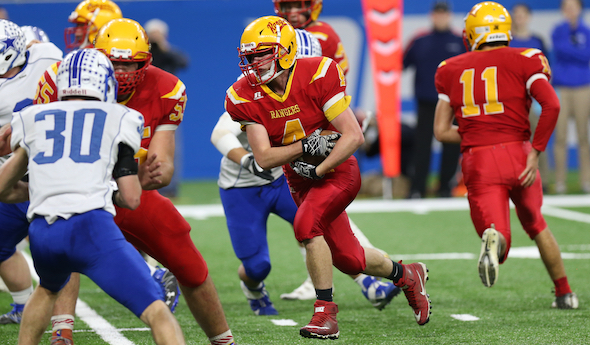
PHOTOS: (Top) Reading’s Roger Hill rushes into Beal City’s defense Saturday at Ford Field. (Middle) The Rangers’ Elijah Strine (30) stretches into the end zone just ahead of Beal City’s Logan Chilman.