

Ford Swaps Frustration for Focus
October 24, 2017
By Tim Robinson
Special for Second Half
Midway through the 2016 season, Marcus Ford was frustrated.
 He was on the Pinckney football team, but not playing much.
A big part of that was due to his size — 6-foot-5 and over 400 pounds — but then-defensive coordinator Rod Beaton sensed there was more.
“We feel that we coach very hard,” said Beaton, now Pinckney’s head coach. “We’re very aggressive (on the varsity), and sometimes it’s an adjustment for juniors to understand that when they come out here, there’s expectations.
“There were a couple times where Marcus was questioning … whether football was for him.”
“I didn’t want to be there,” Ford said. “I thought, ‘This is stupid. Why am I here so late?’”
And then came a change.
“It came to a point where he went home and took a day off to re-gather himself,” Beaton said. “Marcus came back and he said to me, ‘Coach, I really want to be a part of things here.’”
And Ford did more than that.
He grew from a young man who bristled when his coaches pointed out mistakes to one who doesn’t react as if it were a personal attack, from an overweight kid who admits he was on his way to weighing 600 pounds to a big kid who is a key part of Livingston County’s most successful football team as a senior.
He rarely comes out of games, his coach says, and the quiet giant who rarely interacted with his teammates has transformed into a happy, smiling kid who dishes out and takes teasing from them.
It’s a story of transformation that only football could have done for Marcus Ford, who couldn’t play youth football because of his size and whose options for high school athletics seemed limited to football for the same reason.
“I may sound a little clichéd and corny,” Beaton said, “but I think this is why every single coach in America coaches football, to watch the development of a young man, from freshman to sophomore to junior and to see what football has done for him.”
How did Ford do it?
He turned his mental approach 180 degrees and made drastic changes to his diet and work ethic.
One clue came in looking at Pinckney’s roster from 2016 compared to 2017. Last year, Ford was listed at 380, which was about 40 pounds less than his actual weight.
This year, he’s listed at 405, which is a dozen pounds more than what he weighs now.
Last year, he played mostly in mop-up roles.
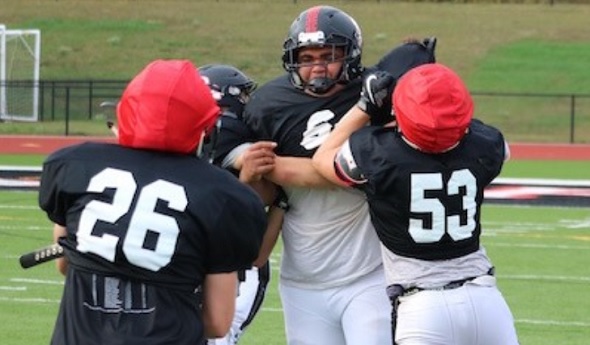
This year, he is a starter on defense, regularly occupying two blockers at a time, which in turn frees linebackers Cauy Hendee and Levi Collins to make tackles.
“I can play a lot longer,” he said. “I was tired when we were out there, but we don’t believe in the word ‘tired.’ We prefer ‘winded.’ We just need to catch our breath. So I get ‘winded’ a lot less.”
The first thing Marcus decided to change was his diet, and he got his cues by looking in the mirror.
“I didn’t like the muffin cap that was hanging down,” he said. “I didn’t like my stomach hanging over. ... I thought, ‘I don’t what to have a heart attack at age 25.’ I was doing ‘diets,’ per se, but eventually I thought, ‘This is stupid. Cut out pop and eat better,’ And I did.
“The only thing I would eat that was green was green beans, and they had to be made a certain way,” he said. “Now, I’m more like ‘this is somewhat appetizing. Let me try that.’ I don’t eat candy bars anymore. I don’t eat ice cream when my family does. I drink a lot less milk than I used to, and I drink more water.”
 Pinckney offensive coordinator Cody Patton noticed.
“His mom came to me about getting a weight plan, and he stuck with it,” Patton said. “They can only do so much in the weight room. When they leave, there’s not much you can control what they put into their bodies.”
But Ford also changed his mindset about football and being coached.
“His first real commitment was ninth-grade high school football, and it was a big adjustment for him,” Beaton said. “We knew there would be days where he might be a little confrontational, there may be some days where he goes through the motions.”
But after that midseason meeting last year, Ford redoubled his efforts in practice and in the offseason.
The first hint that he was a different player came in June, when Ford earned the team’s first bone helmet sticker of the season for effort in a drill.
“It was our first pursuit drill,” Beaton said. “We go four downs, and those kids have to sprint. There’s no exception. Marcus stepped to his gap, made his reads, flew to the football and didn’t say a word, every single time. He did it four times in a row. It really set the stage. I could tell he was wanting do to things right this year.
“When you see a 6-5, 400-pound kid moving with effort and tenacity, you sit there and go, ‘That young man can help us.’”
And so he has.
As a result, Marcus Ford is part of a Pinckney defense that has lifted the Pirates to an 8-1 regular-season record and shared Southeastern Conference White championship. He has transformed from a player who had little stamina to one who can go from opening kickoff to final horn.
“He can play a whole football game,” Beaton said. “He can go through a whole practice. One of the challenges we were talking about in the offseason is he has to put his body and mind in a position to not come off the field.”
That moment came on a warm night early in the season.
“We were in a huddle at Chelsea, and it was late,” Beaton recalled. “He’s drenched in sweat, and I said, ‘Marcus, you need a breather?’ And he said, ‘No, coach. I’m ready.’ That’s pretty cool.”
Asked his ideal weight, Ford said, “I would like to be at 250 if I could,” then laughs. His bone structure is such that at his height, he would be almost gaunt at 250. “I would settle for 340. That’s the dream within a dream goal.”
Next year, he plans to attend college.
“I want to go into bartending or being a head chef, or get a business degree,” he said. “One other choice is going to a police academy. As long as I can run a mile within 15 minutes, I should be good.”
There’s no reason, now, to think he couldn’t accomplish that.
He got his first sack against Dexter.
‘I grabbed him and rolled him over on top of me,” Marcus said. “I would have liked to have landed on him, but I got him down in the backfield. It’s good.”
And football now is fun.
“A lot more fun,” he said.
“Marcus made a concerted effort to our strength and agility program,” Beaton said. “It wasn’t two days at a time, then not be there five or six days. Marcus was there. He would stay after everyone had left and get some extra lifts in or do some extra work to make sure he was putting himself in a (good) position.
“He said, ‘Coach, I want to be your starting nose (tackle).’ The first day of June camp, he ran out to the nose tackle, and we haven’t looked back.”
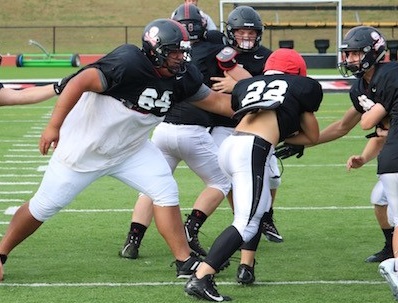
PHOTO: (Top) A pair of Pinckney blockers try to contain nose tackle Marcus Ford during a practice this season. (Middle) Ford breaks free to get an arm on a ball carrier. (Photos by Tim Robinson.)
8-Player Takes Flight in Upper Peninsula
September 28, 2017
By Dennis Grall
Special for Second Half
ESCANABA – Three yards and a cloud of dust. That was the highly successful version of football applied by veteran Ohio State coach Woody Hayes as big bruisers dominated the game.
 It certainly is not the preferred style on the fields of 8-player football. Nope, this version is much more open-field and definitely more exciting, full of big plays and a ton of scoring.
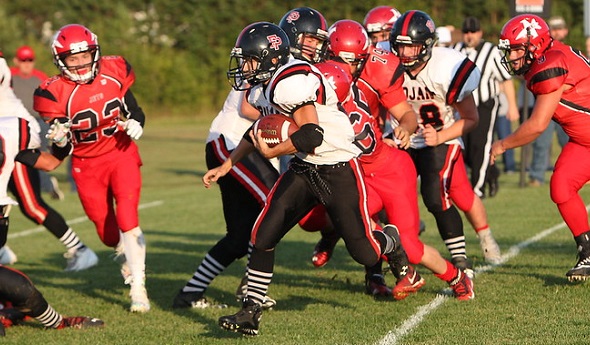
Take Powers North Central as the prime example. The Jets have won the last two 8-player MHSAA championships with back-to-back 13-0 seasons, piling up yards and points in their first two seasons in the 8-player game with a large group of skilled athletes.
Their winning streak ended at 27 games earlier this season, but the style they displayed with exceptional athleticism led by Jason Whitens and Bobby Kleiman has caught on with many other programs.
The Upper Peninsula, at the forefront of the 8-player game due largely to decreasing enrollments, has been lighting up the scoreboards this year. Teams like Pickford and Cedarville, Rapid River and Stephenson, Ontonagon and Crystal Falls Forest Park are progressing with the same formula as North Central by featuring explosive offenses.
Citing some 8-player detractors who don't think the game is real football, veteran Cedarville coach Scott Barr said, "I don't think anyone can argue that it (8-player) has not been healthy for football. It has been healthy."
The game is thriving in small schools because the 8-player version simply has allowed football to remain in the athletic program despite shrinking enrollments across the state.
"It has allowed us to keep football," said veteran coach Steve Ostrenga of Rapid River, who led the Rockets into 8-player Finals in 2011 and 2013 and into the playoffs every season since making the switch after going 1-7 in 11-player in 2010.
"We did it out of necessity. We may have waited too long," added Ostrenga, recalling that last year of 11-player football when only one sub was available at several games.
Veteran Pickford skipper Josh Rader has an idea why the 8-player game has met approval at so many small schools. "It is a high-octane game. It is a lot of fun to watch," he said. "It puts a lot of pressure on defenses because it is such a wide open game. It makes it exciting for the fans."
No longer do fans have to squint and squirm in their seats to see what is happening among the goliaths in the line. Now the football is visible in the wide open spaces as skilled athletes display dazzling moves, whether the team favors the extremely popular spread offense or uses the more familiar run-oriented approach.
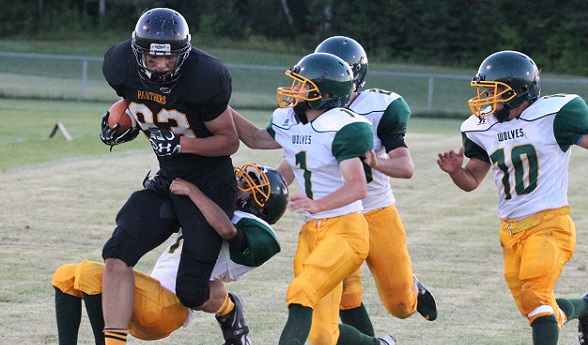 "It is more a one-on-one oriented game now," said coach Ben Mayer of Ontonagon, whose program has consolidated with neighboring Ewen-Trout Creek, which yearly battled small player turnouts just to keep the game alive. Fifteen E-TC students are playing football at Ontonagon, with six on the varsity, highlighted by 6-foot-7 receiver Jacob Witt, who caught MHSAA 8-player record 24 touchdown passes last season.
"Without 8-player, we would have gone under a while back," said Mayer, who played for U.P. Sports Hall of Fame coach Bob "Cubby" Carlson at Ontonagon. He said the Gladiators were forced to use four freshmen and had 130-pound athletes on the line in past years.
"Football has changed a lot in the last four years," he said of the time since the Gladiators moved to the 8-player game. "The ball is in the air. It is fun to watch.”
Mayer said 8-player also enables his program to offer junior varsity football to younger students, instead of having them compete against older, bigger and stronger players with the potential to increase injuries.
"There is not as much violence between the tight ends now because we don't play in those tight spaces," said Mayer.
He also recalls putting "wildly undersized kids in the line against bigger schools with monsters from legitimate programs, with kids getting stepped on and squashed on.
"You do have a lot of choices in 8-man. I can put smaller kids somewhere and they will be all right, and we can still play football."
Ostrenga said it seems injuries, especially of the serious variety, have also seemed to decrease. "We used to hit a lot more in practice. Now we do a lot of teaching and drill work and conditioning," he said, adding MHSAA officials have been in the forefront of trying to reduce injuries with new regulations.
Ostrenga said in the 11-player version, many times it came down to "men playing against boys."
He did say, however, that under the 8-player game coaches "can tend to overuse a player. You get a really good athlete and use him as a crutch in a game."
Ostrenga said it took time to support the change to 8-player football. "I was against 8-man football at first. Now it has made me more open-minded and allowed me to become more understanding." He said 8-player athletes need to have speed, strength, balance and shiftiness.
"Some big guys can't move that well," he said, indicating this version of football requires more agile and nimble athletes to cover the wide-open spaces. "The big thing is understanding you have to get your athletes on the field. You just have eight guys on the field and you are (more) exposed. In 11-man you can hide someone. In 8-man, coaches will find your weaknesses."
Rader agreed, noting, "It puts a lot of pressure on the defense because the game is so wide open. There is a little different strategy. It is a disadvantage for the defense because (the field) is so wide open and there is not a lot of help. You want to take the advantage your offense has over the defense in one-on-ones.
"We like to run the ball and throw the ball, so our athletes can utilize the open field.”
Barr said 8-player quarterbacks are more difficult to contain than typical pocket passers. "They are more elusive," he said, recalling how the 6-foot-4 Whitens could take the direct snap, survey the field and decide whether to throw or run the ball himself.
In the 2016 MHSAA title game, Whitens ran 17 times for a record 352 yards and six touchdowns as the Jets beat Deckerville 58-22. The Jets ran for 469 yards that night.
"You rarely see teams ground and pound," Barr said of the8-man game, noting he began to rely on the spread offense in 11-player football as he tried to figure out how to match up with the over-powering tailback-oriented rushing attack of perennial power Forest Park, which began playing 8-player football in 2016.
Barr said the kicking game is of vital importance now and that secondary tackling is a tough transition because of the explosive offense athletes.
He said "the hybrid player who has size and speed" is featured in 8-player "and it can eliminate the real big kids," which he said are seldom a factor for small schools anyway.
Another plus for the 8-player game comes in scheduling, where Class D schools no longer have to face larger Class C programs and can also find opponents in northern Wisconsin, which also has declining enrollments.
Bark River-Harris and Lake Linden-Hubbell are the only Class D schools still fielding 11-player football teams in the Upper Peninsula. Three other schools, Class D Wakefield-Marenisco and Bessemer and Class C Ironwood have formed a cooperative program, Gogebic Miners, for football purposes.
 Denny Grall retired in 2012 after 39 years at the Escanaba Daily Press and four at the Green Bay Press-Gazette, plus 15 months for WLST radio in Escanaba; he served as the Daily Press sports editor from 1970-80 and again from 1984-2012. Grall was inducted into the Upper Peninsula Sports Hall of Fame in 2002 and serves as its executive secretary. E-mail him at [email protected] with story ideas for the Upper Peninsula.
PHOTOS: (Top) Crystal Falls Forest Park downed Powers North Central 66-58 in Week 2 as the teams combined to score more than 100 points for the third time in two seasons. (Middle) Ewen-Trout Creek’s Jacob Witt, here against Carney-Nadeau last season, caught 24 touchdown passes in 2016 and is playing as part of a co-op team with Ontonagon this fall. (Photos by Paul Gerard.)