

Ford Swaps Frustration for Focus
October 24, 2017
By Tim Robinson
Special for Second Half
Midway through the 2016 season, Marcus Ford was frustrated.
 He was on the Pinckney football team, but not playing much.
A big part of that was due to his size — 6-foot-5 and over 400 pounds — but then-defensive coordinator Rod Beaton sensed there was more.
“We feel that we coach very hard,” said Beaton, now Pinckney’s head coach. “We’re very aggressive (on the varsity), and sometimes it’s an adjustment for juniors to understand that when they come out here, there’s expectations.
“There were a couple times where Marcus was questioning … whether football was for him.”
“I didn’t want to be there,” Ford said. “I thought, ‘This is stupid. Why am I here so late?’”
And then came a change.
“It came to a point where he went home and took a day off to re-gather himself,” Beaton said. “Marcus came back and he said to me, ‘Coach, I really want to be a part of things here.’”
And Ford did more than that.
He grew from a young man who bristled when his coaches pointed out mistakes to one who doesn’t react as if it were a personal attack, from an overweight kid who admits he was on his way to weighing 600 pounds to a big kid who is a key part of Livingston County’s most successful football team as a senior.
He rarely comes out of games, his coach says, and the quiet giant who rarely interacted with his teammates has transformed into a happy, smiling kid who dishes out and takes teasing from them.
It’s a story of transformation that only football could have done for Marcus Ford, who couldn’t play youth football because of his size and whose options for high school athletics seemed limited to football for the same reason.
“I may sound a little clichéd and corny,” Beaton said, “but I think this is why every single coach in America coaches football, to watch the development of a young man, from freshman to sophomore to junior and to see what football has done for him.”
How did Ford do it?
He turned his mental approach 180 degrees and made drastic changes to his diet and work ethic.
One clue came in looking at Pinckney’s roster from 2016 compared to 2017. Last year, Ford was listed at 380, which was about 40 pounds less than his actual weight.
This year, he’s listed at 405, which is a dozen pounds more than what he weighs now.
Last year, he played mostly in mop-up roles.
This year, he is a starter on defense, regularly occupying two blockers at a time, which in turn frees linebackers Cauy Hendee and Levi Collins to make tackles.
“I can play a lot longer,” he said. “I was tired when we were out there, but we don’t believe in the word ‘tired.’ We prefer ‘winded.’ We just need to catch our breath. So I get ‘winded’ a lot less.”
The first thing Marcus decided to change was his diet, and he got his cues by looking in the mirror.
“I didn’t like the muffin cap that was hanging down,” he said. “I didn’t like my stomach hanging over. ... I thought, ‘I don’t what to have a heart attack at age 25.’ I was doing ‘diets,’ per se, but eventually I thought, ‘This is stupid. Cut out pop and eat better,’ And I did.
“The only thing I would eat that was green was green beans, and they had to be made a certain way,” he said. “Now, I’m more like ‘this is somewhat appetizing. Let me try that.’ I don’t eat candy bars anymore. I don’t eat ice cream when my family does. I drink a lot less milk than I used to, and I drink more water.”
 Pinckney offensive coordinator Cody Patton noticed.
“His mom came to me about getting a weight plan, and he stuck with it,” Patton said. “They can only do so much in the weight room. When they leave, there’s not much you can control what they put into their bodies.”
But Ford also changed his mindset about football and being coached.
“His first real commitment was ninth-grade high school football, and it was a big adjustment for him,” Beaton said. “We knew there would be days where he might be a little confrontational, there may be some days where he goes through the motions.”
But after that midseason meeting last year, Ford redoubled his efforts in practice and in the offseason.
The first hint that he was a different player came in June, when Ford earned the team’s first bone helmet sticker of the season for effort in a drill.
“It was our first pursuit drill,” Beaton said. “We go four downs, and those kids have to sprint. There’s no exception. Marcus stepped to his gap, made his reads, flew to the football and didn’t say a word, every single time. He did it four times in a row. It really set the stage. I could tell he was wanting do to things right this year.
“When you see a 6-5, 400-pound kid moving with effort and tenacity, you sit there and go, ‘That young man can help us.’”
And so he has.
As a result, Marcus Ford is part of a Pinckney defense that has lifted the Pirates to an 8-1 regular-season record and shared Southeastern Conference White championship. He has transformed from a player who had little stamina to one who can go from opening kickoff to final horn.
“He can play a whole football game,” Beaton said. “He can go through a whole practice. One of the challenges we were talking about in the offseason is he has to put his body and mind in a position to not come off the field.”
That moment came on a warm night early in the season.
“We were in a huddle at Chelsea, and it was late,” Beaton recalled. “He’s drenched in sweat, and I said, ‘Marcus, you need a breather?’ And he said, ‘No, coach. I’m ready.’ That’s pretty cool.”
Asked his ideal weight, Ford said, “I would like to be at 250 if I could,” then laughs. His bone structure is such that at his height, he would be almost gaunt at 250. “I would settle for 340. That’s the dream within a dream goal.”
Next year, he plans to attend college.
“I want to go into bartending or being a head chef, or get a business degree,” he said. “One other choice is going to a police academy. As long as I can run a mile within 15 minutes, I should be good.”
There’s no reason, now, to think he couldn’t accomplish that.
He got his first sack against Dexter.
‘I grabbed him and rolled him over on top of me,” Marcus said. “I would have liked to have landed on him, but I got him down in the backfield. It’s good.”
And football now is fun.
“A lot more fun,” he said.
“Marcus made a concerted effort to our strength and agility program,” Beaton said. “It wasn’t two days at a time, then not be there five or six days. Marcus was there. He would stay after everyone had left and get some extra lifts in or do some extra work to make sure he was putting himself in a (good) position.
“He said, ‘Coach, I want to be your starting nose (tackle).’ The first day of June camp, he ran out to the nose tackle, and we haven’t looked back.”
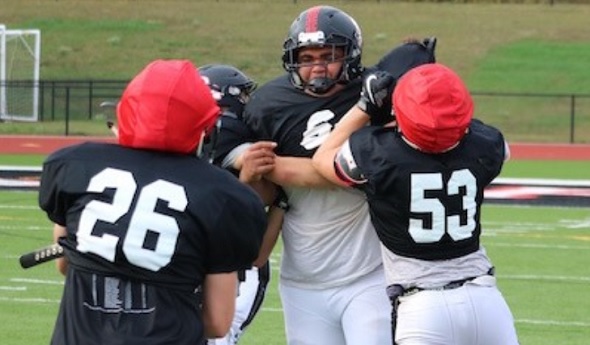
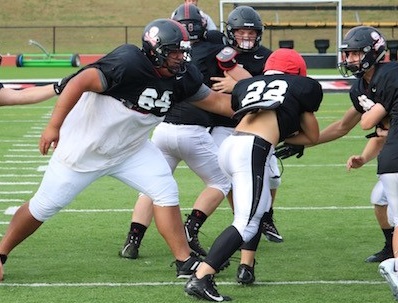
PHOTO: (Top) A pair of Pinckney blockers try to contain nose tackle Marcus Ford during a practice this season. (Middle) Ford breaks free to get an arm on a ball carrier. (Photos by Tim Robinson.)
1st & Goal: 2025 Week 7 Preview
By
Geoff Kimmerly
MHSAA.com senior editor
October 10, 2025
The MHSAA Football Playoffs don't start for three more weeks. But this weekend definitely feels playoff caliber.
 At least 25 games could end tonight or Saturday with a team celebrating a share or more of a league championship. A few more of our top matchups will set up similar showdowns over the final two weeks of the regular season.
Follow scores for every game across the state this weekend on the MHSAA Scores page, check out standings for every league on those teams' pages, and watch several of those title deciders unfold on the NFHS Network, including all games with “WATCH” linked below.
Bay & Thumb
Millington (5-1) at Elkton-Pigeon-Bay Port Laker (6-0) WATCH
Millington’s loss to Cass City in Week 4 was in league play since 2022, but the Cardinals still can claim a share of the Big Thumb Conference West title with a win over the Lakers, whose only single-digit game this season was an 18-13 win over Cass City in Week 3. Millington won last year’s regular-season matchup 28-0 and then a 42-14 playoff rematch on the way to claiming the Division 7 title. Laker has given up only 47 points this season with impressive shutouts of Ubly and Central Montcalm.
Keep an eye on these FRIDAY Linden (5-1) at Fenton (4-2) WATCH, Bay City John Glenn (4-2) at Freeland (5-1) WATCH, Reese (4-2) at Harbor Beach (6-0) WATCH, Ithaca (5-1) at Saginaw Nouvel Catholic Central (5-1) WATCH.
Greater Detroit
Gibraltar Carlson (6-0) at Brownstown Woodhaven (6-0) WATCH
Carlson brings a combined 34-3 record in Downriver League play this decade as it seeks a fifth-straight league title – and fifth-straight win over Woodhaven, which last won the Downriver in 2019. The Marauders spent their lone nonleague week doubling up reigning Division 5 champion Pontiac Notre Dame Prep 42-21 in Week 3, and a week later they avenged last season’s lone Downriver defeat by edging Trenton 17-14. Woodhaven also working to return to the playoffs for the first time since 2022 and hasn’t had a game closer than 24 points this fall.
Keep an eye on these FRIDAY Clarkston (5-1) at West Bloomfield (5-1) WATCH, Detroit Central (5-1) at Detroit Pershing (4-2), Almont (6-0) at Richmond (6-0) WATCH, Detroit Edison (5-1) at Harper Woods Chandler Park (5-1).
Mid-Michigan
Fowler (5-1) at Pewamo-Westphalia (5-0) WATCH
These longtime rivals have split their last four games against each other, Fowler claiming last year’s 14-11 on the way to the Central Michigan Athletic Conference title. This time they’ll meet in a league schedule finale, with a winner-take-all for the title guaranteed. The lone loss between them this fall was Fowler’s to still-undefeated Hudson in a season opener, and the Eagles have not given up more than seven points in a game since. The Pirates haven’t given up more than six points in a game all season and had an extra week to prepare for this one with an open date last week.
Keep an eye on these FRIDAY Kent City (6-0) at Central Montcalm (5-1) WATCH, Montrose (6-0) at New Lothrop (5-1) WATCH, Grand Ledge (6-0) at DeWitt (6-0) WATCH, Battle Creek Harper Creek (5-1) at Hastings (5-1) WATCH.
Northern Lower Peninsula
Mancelona (4-2) at Charlevoix (6-0) WATCH
Charlevoix has clinched an outright championship in the Northern Michigan Football Conference Leaders division, while Mancelona is tied for first in the Legacy with two league games to play and the big one a Week 9 date with co-leader Maple City Glen Lake. The Rayders certainly will provide some prep as the Ironmen ready for that deciding matchup, but there’s plenty at stake for Charlevoix too as it’s downed Mancelona in eight straight and is one of only six Division 7 teams still undefeated this fall.
Keep an eye on these FRIDAY Kingsley (4-2) at Cheboygan (3-3) WATCH, East Jordan (3-3) at Harbor Springs (3-3) WATCH, LeRoy Pine River (4-2) at Manton (4-2), Bay City Western (3-3) at Traverse City Central (3-3).
Southeast & Border
Hudson (6-0) at Clinton (5-1) WATCH
Undefeated and with all of its games against Division 5, 6 and 7 opponents, Hudson has the highest playoff-point average in Division 8 by a comfortable margin and can add to it against Division 7 Clinton. More importantly, they are the only two teams undefeated in Lenawee County Athletic Association play, and the winner this weekend clinches a share of the championship. They’ve split their last two meetings, Hudson claiming last year’s 22-6 during an outright championship run and after Clinton handed the Tigers their most recent league loss, in 2023.
Keep an eye on these FRIDAY Riverview (4-2) at Monroe St. Mary Catholic Central (6-0), Leslie (4-2) at Napoleon (4-2), Harper Woods (6-0) at Saline (6-0) WATCH, Adrian (5-1) at Ypsilanti Community (3-3).
Southwest Corridor
Portage Northern (5-1) at Portage Central (6-0) WATCH
The winner clinches a share of the Southwestern Michigan Athletic Conference West title. Northern also is seeking its first win in the rivalry since 2022, and they almost assuredly will meet again in the playoffs next month with Central fourth in Division 2 playoff-point average and Northern No. 13. Central also has given up only 10 points this season – all coming over the last two weeks – giving Northern another potential spoiler goal coming off last week’s 42-36 win over St. Joseph and having scored at least that many in four straight games. To that end, Central has yet to score fewer than 41 this season.
Keep an eye on these FRIDAY Kalamazoo Central (3-3) at Battle Creek Central (4-2), Dowagiac (4-2) at Buchanan (4-2) WATCH, Bronson (5-1) at White Pigeon (6-0) WATCH, Springport (6-0) at Quincy (4-2).
Upper Peninsula
Gaylord (6-0) at Escanaba (6-0) WATCH
Neither of these teams made the playoffs in 2024, much less competed for the Big North Conference title. But they did play one of the league’s closest games, a 19-15 Gaylord win, and this time the victor will clinch a share of the league title and keep an undefeated season going. Escanaba is coming off breaking a seven-game losing streak against rival Marquette with last week’s 38-20 victory – while Gaylord started league play with a 28-27 win over the Sentinels a month ago.
Keep an eye on these FRIDAY Iron Mountain (4-1) at Bark River-Harris (4-1) WATCH, L’Anse (4-2) at West Iron County (2-3) WATCH, Petoskey (3-3) at Marquette (3-3) WATCH, Negaunee (4-2) at Menominee (6-0) WATCH.
West Michigan
East Kentwood (5-1) at Hudsonville (6-0) WATCH
East Kentwood faded just a bit from the Ottawa-Kent Conference Red spotlight after a 21-14 Week 4 loss to Rockford, but can reclaim it almost entirely with a win over the Eagles – who themselves are coming off a 35-28 win over the rival Rams. When last these two met, Hudsonville edged East Kentwood 25-23 in a District opener last fall. A Falcons win this time could result in up to four teams being tied for first in the league, while a Hudsonville win would put them one away from clinching a repeat title.
Keep an eye on these FRIDAY Grand Rapids South Christian (3-3) at Zeeland East (4-2), Grand Rapids Catholic Central (6-0) at Holland Christian (4-2) WATCH, Whitehall (4-2) at Ludington (6-0), Belding (5-1) at Muskegon Oakridge (5-1) WATCH.
8-Player
Deckerville (6-0) at Kingston (6-0) WATCH
No one should be stunned if both of these rivals end up playing for 8-player championships next month at Superior Dome; Deckerville is No. 4 in Division 2 playoff-point average, and Kingston is No. 5 in Division 1. But first they must face off in what may turn end up one of the best 8-player games this regular season, with a share of the Big Thumb Conference Blue title on the line. Deckerville swept last year’s meetings, winning by 44 and then 34 points on the way to a perfect season and Division 1 title. Kingston has reached 64 points in four games this season and will face an Eagles defense that hasn’t given up more than 20.
Keep an eye on these FRIDAY Breckenridge (4-2) at Gaylord St. Mary (6-0), Rogers City (4-2) at Mio (5-1) WATCH, Norway (6-0) at Newberry (5-1). SATURDAY Gogebic (6-0) at Lake Linden-Hubbell (5-1) WATCH.
MHSAA.com's weekly “1st & Goal” previews and reviews are powered by MI Student Aid, a division within the Department of Lifelong Education, Advancement, and Potential (MiLEAP). MI Student Aid encourages students to pursue postsecondary education by providing access to student financial resources and information. MI Student Aid administers the state’s scholarship and grant programs that help make college Accessible, Affordable and Attainable for you. Click to connect with MI Student Aid and find more information on Facebook and Twitter @mistudentaid.
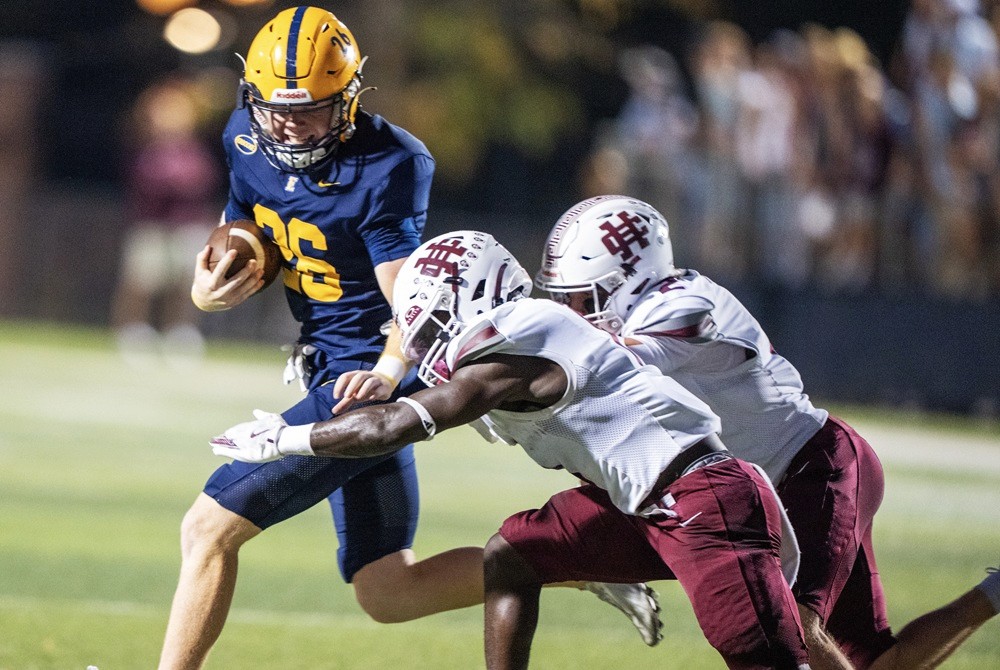
PHOTO A pair of Holland Christian defenders pursue an East Grand Rapids ball carrier during the Pioneers' 41-21 win last week. (Click for more by MI Sports Photo.)