

Forest Park's Playoff Tradition Began with Statement-Making Title Run
By
Jason Juno
Special for MHSAA.com
November 29, 2024
CRYSTAL FALLS — The Crystal Falls Forest Park football team played in its 15th Football Final last weekend, tying it for fourth-most championship game appearances in MHSAA history.
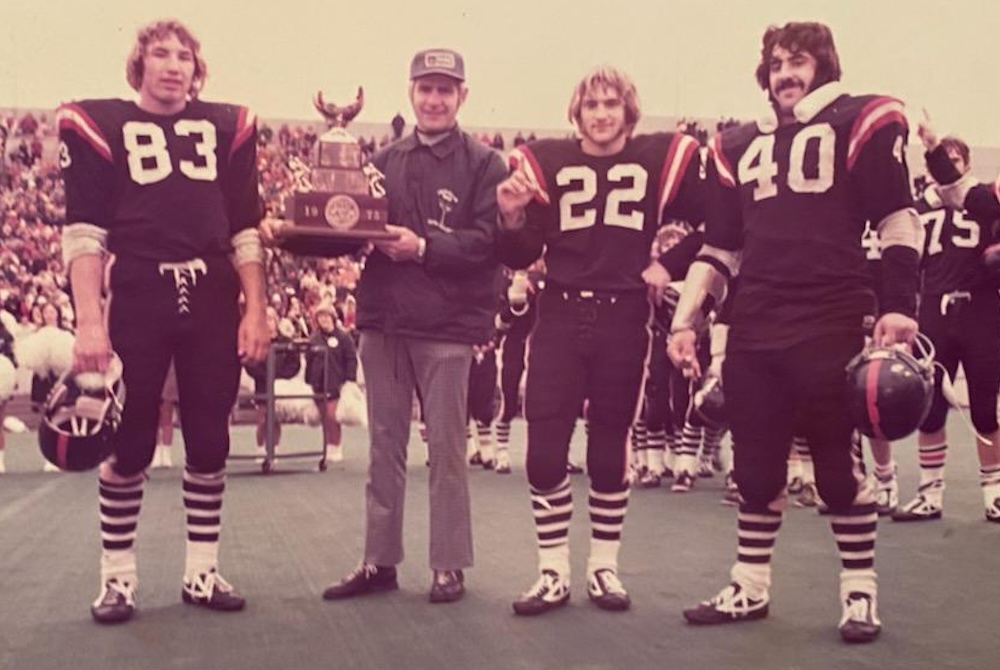
The first came back in 1975, the very first year the MHSAA conducted a football postseason tournament.
The Trojans already had a strong tradition before that, but champions were only mythical then, based on records, strength of schedule and opinions.
Forest Park players were excited to hear about the chance to prove it on the field, said Bill Santilli, the team’s standout running back that season.
“We had high expectations,” said Santilli, who also took the Trojans to seven Finals as their coach, leading them to the Division 8 title in 2007. “The team that we had put together my senior year, I felt we had a lot of really good athletes and our school had a strong tradition of football back then through the 60s and early 70s.”
Only four teams in each class made the MHSAA Playoffs that first year. So when Forest Park lost to Norway – a physical team that finished the season undefeated – 14-13 during the regular season, the Trojans thought their playoff hopes were pretty dim.
Their schedule, though, was made up of mostly larger schools and the point system rewarded them for it, making Forest Park the region’s Class D representative.
The Semifinal final game against Posen was scheduled to be played in Traverse City on Nov. 15, the first day of deer season. One of the coaches joked they had never missed a first day and he was going hunting.
The only hunting they did that day was for a spot in the state title game, and they traded bagging a buck for blanking Posen 67-0.
“Their credit was they had a strong running game,” Santilli said. “They had been beating teams by quite a margin throughout the season. We just played and did a great job of what we had to do by our game plan.”
Up next was Flint Holy Rosary in the Final at Western Michigan University the next Saturday.
“I would say we had a confidence as a team, based on the confidence of our coaching staff, based on the confidence of our Semifinal victory,” Santilli said. “We were ready to play.”
Beyond seeking the thrill of a championship, the Trojans wanted to prove how good the football was in the Upper Peninsula. Players kept track of high school football results throughout the state – this being well before the internet made finding news and results so easy, they looked to the Detroit Free Press — and found teams in the larger metropolitan areas were more highly-touted.
“We wanted to prove that there were some good football teams in the Upper Peninsula that in my opinion seemed to get overlooked,” Santilli said. “I think it was not only our mission to win that first state championship, but also our mission to make a statement that we play good football.”
Forest Park won 50-0.
“Just the feeling to play and win the inaugural event, to be able to have the memories, to talk about it, to play so well and to hold onto that state championship trophy, the real, true state championship trophy, we didn’t think there was anything better in our lives,” Santilli said.
No team reached 50 points in a championship game again until 1994; no one exceeded it until 2002.
“We played extremely well,” Santilli said.
The Trojans led by that score going into the fourth quarter. They were able to put the second unit in and watch those teammates preserve the shutout.
“We just had a good group of athletes, we all got along, we had guys that knew their role, they were all very good at their positions and we just gelled as a group,” Santilli said. “We had really good linemen, we had tough hitters on defense, we had defensive backs who could cover a pass and yet had the speed to come up and make tackles on the line of scrimmage. We had an offensive running game that I would describe as consistent and powerful. And if we needed to throw, we had a good quarterback and receivers.”
Santilli, a 5-foot-9 senior, was double and triple-teamed, according to MHSAA accounts of the game, and he still rushed for 178 yards and three touchdowns on 37 carries. He finished with 226 points for the season, including 46 in the Semifinal, setting an MHSAA single-season record at the time. Quarterback Rich Mettlach tallied 148 yards through the air, with 103 to Bryan LaChapelle.
Forest Park’s defense was dominant, holding Holy Rosary to minus-32 yards rushing, 78 passing and just four first downs.
“They told us the competition got tougher the farther south we got,” coach Richard Mettlach said afterward. “We like it down here and may come back next year.”
Santilli was the first Class D player to earn a spot on the Detroit Free Press all-state Dream Team, according to the U.P. Sports Hall of Fame, which welcomed Santilli in 2005. His 1,865 rushing yards were a state record, the Hall of Fame indicated.
He said he received much of the recognition that season because he was the ballcarrier, but he credited his teammates with making it all possible.
“I got the recognition only because of the other guys with the jerseys with the same team name on them,” he said.
Forest Park football has been good ever since.
They beat Flint Holy Rosary again the next year in the Class D title game, although the score was closer, 14-6. Rosary came out on top in 1977 with a 21-20 win over Forest Park, and the Trojans fell 38-14 to Detroit St. Martin dePorres in the 1978 finale.
PHOTO From left: Forest Park’s Bryan LaChapelle, coach Dick Mettlach, Dick Mettlach Jr., and Bill Santilli pose with the first Class D championship trophy Nov. 22, 1975, at Waldo Field in Kalamazoo. (Photo by Bill Santilli.)

Longtime Crew Leader Harrelson Begins 32nd Season on Chains, Amid Cancer Fight
By
Tom Spencer
Special for MHSAA.com
September 11, 2026
First down! Move the chains.
 As a member of the Suttons Bay chain gang, Jim Harrelson doesn’t know how many more times he’ll follow the referee crew’s direction on the Norsemen sideline. Similarly, he has no idea how many times he’s already moved the chains.
But, in the meantime, every time he does, it will undoubtedly be a school record. An unofficial record of course, but a well-earned and appreciated achievement nonetheless.
Harrelson stepped on the field Wednesday night sporting a down marker for the 32nd straight year. This time, it was for the Norse’s middle school contest with Onekama. Harrelson was joined by Curt Murphy and Dave Faught. Mike Gordon, another regular member of the crew, was also on hand to celebrate Harrelson’s 32nd season.
Wednesday’s chain gang team was organized – no surprise – by Harrelson. It’s something he’s done on a volunteer basis for Suttons Bay the last 16 years.
Harrelson’s crews have staffed middle school, junior varsity and varsity football games, including the home contests during the Norsemen’s three straight seasons from 2019-21 that culminated in three trips to 8-Player Division 1 Finals. Harrelson, Faught, Murphy and Gordon are in their 10th season working together.
“The chain gang was always his baby, and he was always able to go find other people to help him out,” said Doug Periard, a long-time member of the Norse football coaching staff and former school athletic director. “Somehow he managed to get some of those who might not have done much in football, to suddenly come on board and enjoy doing it.”
Harrelson, who last spring retired from a coaching career spanning 35 years, has no intentions of letting anything get in the way of holding the down marker for the Norsemen.
 “I've always loved sports, and being a part of the chain gang was always big part of it,” Harrelson said. “The ADs didn’t have to worry about it, knowing it was taken care of.”
Jamie Hawkins, Suttons Bay’s principal and current athletic director, was on hand for Wednesday’s kickoff as well. Hawkins, one of the administrators who has relied on Harrelson, believes the community owes Harrelson a huge thank you, acknowledging he has marked more first downs than anyone could ever comprehend.
“Jim’s years as a coach and chain gang chief are an amazing commitment to our student-athletes, our football program, and the entire Suttons Bay community,” said Hawkins. “His time, energy, and passion have been a part of countless Friday nights and memories for generations of Norsemen.”
Harrelson, now 82, is battling cancer for the second time in his life. He was first diagnosed with colorectal cancer in 2010. Early this year, he was told cancer had returned.
Working with doctors and his wife of 53 years, Brenda, Harrelson picked a six-week treatment plan this summer timing it so he could return to the sidelines for the first football game. He’s awaiting word from his medical team on the outcome of the most recent treatment.
“I haven't let it dominate my life – everybody's going to have trials and tribulations no matter what,” Harrelson said of his cancer return. “Cancer is something that thousands of people find themselves having to deal with, and I'm pretty proud I've been able to function pretty much as normal as could be even though it’s obviously right there in front of me.”
Harrelson’s coaching journey began in 1991 with softball, drawn into the role as his children made their way through the Suttons Bay school system. He went on to serve as an assistant and head volleyball coach from 1996 through 2004.
Eventually he served as an assistant or head coach for Suttons Bay in golf, cross country and track.
 Among the highlights of his time on the volleyball bench was helping guide the 2001 squad all the way to the MHSAA Finals, where the team earned a runner-up finish in Class C.
A short while ago, Harrelson was honored with the Don Lukens Legacy Award at the Traverse City Record-Eagle John Lober Honor Roll Meet for his coaching of student-athletes from all four Leelanau County schools – Maple City Glen Lake, Leland, Lake Leelanau St. Mary’s and Northport (with some of that coaching was made possible through the schools becoming a part of a co-op with Suttons Bay).
Much of Harrelson’s coaching was on a purely volunteer basis – even while serving as a head coach responsible for running an entire program.
Now, Harrelson’s favorite thing is watching his grandchildren grow and compete in sports, while admiring his adult children’s great parenting.
Harrelson points to his first grandchild’s birth 15 years ago as a prime motivator during the first cancer round. The Harrelsons have seven grandchildren now, one of whom was playing volleyball Wednesday night for Suttons Bay’s middle school team – with Grandma in the stands.
And while he’s remembered fondly by Leelanau athletes and athletic directors for his coaching commitment and success, Harrelson has only one thought for his family legacy.
“I just hope if I’m remembered for anything by my grandchildren and my kids is that I handled cancer pretty well without letting it affect me in any way, shape, or form in how I behave, how I coach or whatever,” Harrelson said. “I am pretty doggone proud of the fact that I've been able to put that on the table and still be able to function.”
Periard already views Harrelson as a great student-athlete advocate and solution finder.
“It was an incredible amount of time he put in doing the stuff he did and how much he loved it,” recalled Periard. “Cross country, track, whatever he was called upon, he was there to help out. He's a jack of all trades, a great kids guy at heart.”
 Harrelson’s first paid coaching job was as an assistant for track in 2006. At the time he was hired by Cody Ingils, then the Suttons Bay athletic director and now a senior assistant director for the MHSAA.
Harrelson asked Inglis a decade ago to delivery his eulogy someday upon the veteran coach’s passing.
“Jim also always wanted the best for kids at every turn, and he wanted to be a positive force in kids’ lives – and I think Jim's ultimate takeaway is he met the kids where they were and tried to make sure that they got better,” Inglis said. “Jim was able to work with elite athletes, and he was able to work with kids that had never done that sport before. And that was the beauty of his coaching, is that it applied to anybody and everybody because of his positive way of dealing with kids.”
Harrelson, who points to track as his favorite sport to coach because of the camaraderie, is ready to keep moving the down marker as he battles the return of cancer.
“What I've been experiencing is part of who I am,” Harrelson said. “It’s just the cards I've been dealt. I just want to do it with class if I can.”
 Tom Spencer is a longtime MHSAA-registered basketball and soccer official, and former softball and baseball official, and he also has coached in the northern Lower Peninsula area. He previously has written for the Saginaw News, Bay County Sports Page and Midland Daily News. He can be reached at [email protected] with story ideas for Manistee, Wexford, Missaukee, Roscommon, Ogemaw, Iosco, Alcona, Oscoda, Crawford, Kalkaska, Grand Traverse, Benzie, Leelanau, Antrim, Otsego, Montmorency, Alpena, Presque Isle, Cheboygan, Charlevoix and Emmet counties.
PHOTOS (Top) Suttons Bay football chain gang leader Jim Harrelson plants his down marker on the sideline during Wednesday’s middle school game with Onekama. (2) Harrelson shakes hands with referee Ed Blough. (3) Harrelson stands for a photo with Suttons Bay principal and athletic director Jamie Hawkins, far left, past athletic director and longtime coach Doug Periard, far right, and his chain gang of (from left) Dave Faught, Curt Murphy and Mike Gordon. (4) Harrelson enjoys a break in the shade. (Top and sitting photos by Meredith McNabb Photography. Others by Tom Spencer.)