


Friday Night Football
September 23, 2016
There continues to be among high school athletic administrators a great gnashing of teeth over encroachment of televised college football on the Friday night turf that long tradition reserves for high school football games. Little by little and year by year, college games drift to all times of the day and all days of the week, and Friday night is no longer hallowed ground for the high school game alone.
The Friday night intercollegiate fare remains mostly irrelevant games by second tier teams, but televised nonetheless because of the overabundance of production entities and networks seeking live sports events. But high school leadership is right to be on guard.
Known to very few people is a million dollar offer in the 1970s by then NCAA Executive Director Walter Byers to the National Federation of State High School Associations if it would not oppose televised college football games on Friday nights. Clifford Fagan, then executive director of the National Federation, declined the offer from his good friend; and the mutual respect these two men enjoyed brought an end to the negotiation.
Then, as now, the National Football League was prohibited by law (part of its anti-trust exception) from televising games on Friday nights and Saturdays from mid-September through mid-December where the broadcast would conflict with a live high school or college game. Under Byers, and until the NCAA lost control of intercollegiate football broadcasting as a result of a legal challenge by what was then called the College Football Association, college football leadership voluntarily gave high school football the same deference on Friday nights that the NFL did under federal law.
Today, major college football is such a ravenous revenue beast that it will schedule play at any time on any day in any location, televising every game – on college conference-controlled networks if the matchup is not attractive enough for national or even regional broadcasts. The Friday night high school football tradition can expect to be trampled as college football swarms and grunts around the feed trough like hungry hogs.
Divine Child Delivers in Defining Moments to End 40-Year Championship Wait
By
Paul Costanzo
Special for MHSAA.com
November 28, 2025
DETROIT – Marcello Vitti knew his teammates had his back.
After fumbling near midfield with five minutes to play and his Dearborn Divine Child team clinging to a one-point lead, Vitti’s faith was rewarded as the Falcons forced a four-and-out from the Hudsonville Unity Christian offense.
Then he paid them back.
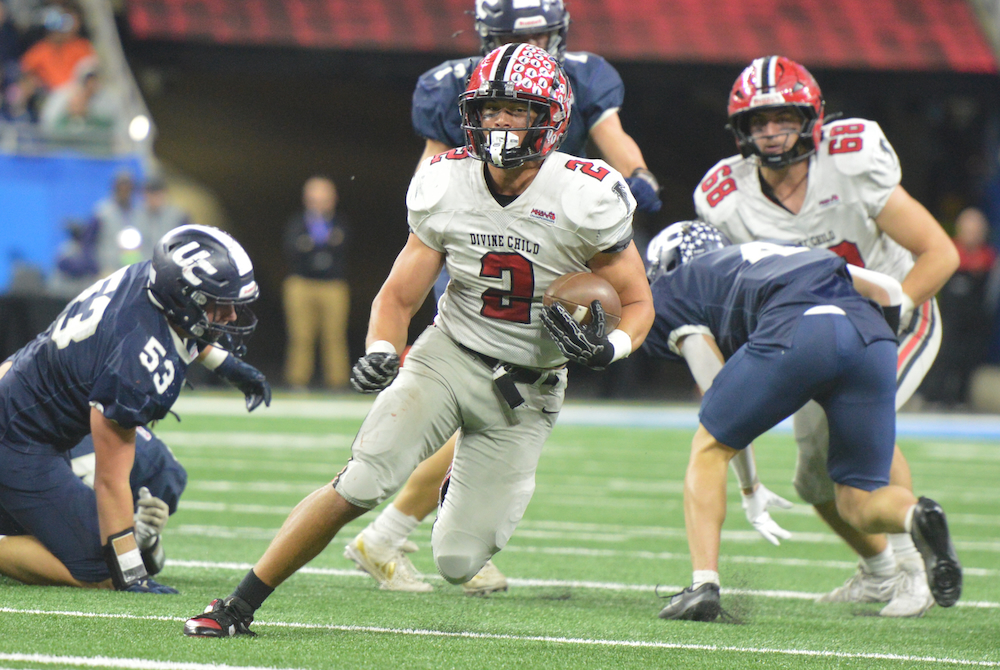
The senior running back rushed for 20 yards and a pair of first downs on the final drive, including the game clincher, as Divine Child picked up a 23-22 victory Friday in the Division 4 Football Final at Ford Field.
“I knew that I was going to have to make plays to win this game,” said Vitti, who rushed for 120 yards and a touchdown. “I fumbled at the end, and I knew that my team’s got my back. This team isn’t good because of me. We have a lot of guys that do their jobs and maybe a little bit extra. There’s so many good guys and good players, Division I, Division II players on our team that they make me that much better.”
The title is the third in program history for the Falcons, and first since 1985.
To win it, Divine Child (13-1) had to survive a back-and-forth battle with several plays that felt as if they could be game-defining in the moment.
Vitti’s fumble felt like it could have been that, as Unity Christian took over near midfield with an offense that had been rolling through the second half.
 The Crusaders (12-2) had gained 205 yards on 35 plays on their first three second-half drives, scoring a pair of touchdowns and getting inside the 5 on the other.
But after the turnover, Divine Child’s defense stiffened up, holding Unity Christian to two yards and forcing a turnover on downs.
“I do want to say, congratulations to Unity Christian,” Divine Child coach Chris Laney said. “I think they replaced 18 starters going into this year, and (coach Craig Tibbe) does a tremendous job; that scheme gives you nightmares. But, I wasn’t the one that coined it, but defense wins championships, and we had a great defense this year. Great defensive staff. The kids bought in, they really checked their egos this year at the door and played within our scheme defensively.”
Divine Child had its lead thanks to a five-yard touchdown rush by Vitti and a 2-point conversion run on which he broke multiple tackles and pushed through several defenders at the goal line with the help of his teammates.
All of that was set up by a toe-tapping catch from sophomore Rayshawn Thomas on the sideline on a pass from fellow sophomore Drew Sheridan. Initially, it was called incomplete, but was overturned on replay.
“To be honest, I thought I had my foot down,” Thomas said. “Then I saw that I had my foot down (on the big screen) and I was like, ‘Oh my God, I caught it.’”
Unity Christian answered with a 10-play, 69-yard drive capped off with a two-yard touchdown run from Jared DeVries.
The Crusaders lined up to kick an extra point to tie the game, but faked it. The pass was intercepted by Divine Child’s Adam Garcia, preserving the one-point lead.
“Silly stuff, isn’t it?” Tibbe said. “I’d like a do-over, for sure. They defended it well. I look at myself, I’m kicking myself, asking, ‘Why did you get so cute?’ Just pound the ball. They hadn’t stopped these guys. These guys had just been tearing it up, then I go and do something like that. So, yeah, I would like a do-over there.”
Tibbe’s offense was strong throughout the game, gaining 332 yards on the ground and averaging five yards per carry. That was led by Lucas Elliott, who had 115 yards, and DeVries, who had 90 yards and a pair of touchdowns, including the game’s first score. Joshua Bremer added 60 yards, and had the fumble recovery in the fourth quarter.
 Quarterback Justin Febus rushed for 48 yards and a touchdown, which, following a DeVries conversion run, gave his team a 16-15 lead early in the third quarter.
“I’m super proud of how we hung,” Tibbe said. “The fact that we were right there with this team says a lot about these guys. There’s probably a couple times in this game where it didn’t look great, but they didn’t quit. They kept chugging along.”
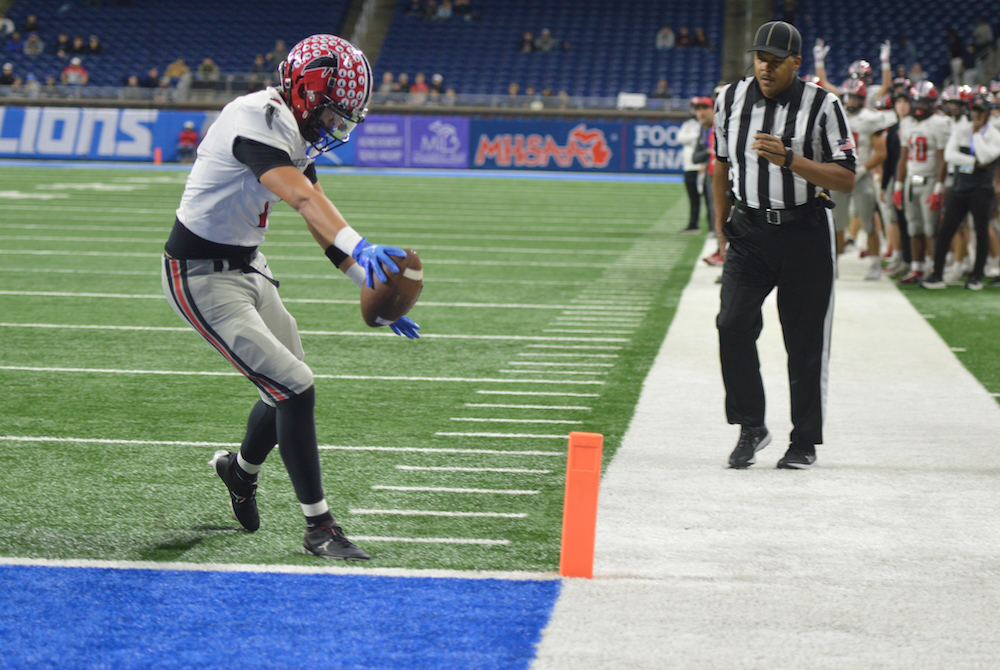
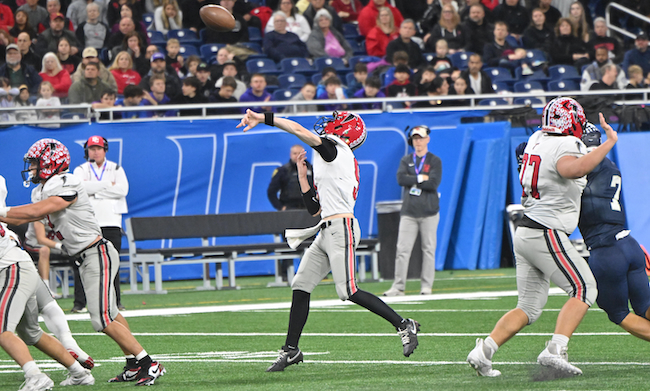
The offensive output was needed to keep up with Divine Child’s balanced attack, led by Vitti and Sheridan. The left-handed quarterback completed 13 of his first 15 passes in the game, and finished 19-of-25 for 241 yards and a pair of first-half touchdown throws to Antonio Solares-Vitti. He did it all with his non-throwing shoulder in a brace thanks to an injury suffered in the Regional Final against Harper Woods.
“My mindset, honestly, the past two weeks was do whatever it takes to win,” Sheridan said. “Harper Woods, we didn’t really throw the ball, I got injured. Last week, I made plays when they had to be made. Marcello made plays, Ray made plays, Giancarlo (Vitti), Antonio, they’ve all been making plays for me. So, for me, it’s been about rehabbing and getting better. Today, the mindset was, it was just a next-play mentality. If we don’t have a good play, we had to make up for it the next play. And the guys made plays for me today.”
Solares-Vitti had seven catches for 88 yards, including a big 13-yarder on the final drive. Thomas had four for 64.
Marcello Vitti led the defense with 14 tackles, while Andre Davis Jr. had 12 and Giancarlo Vitti had an interception.
Unity Christian’s defense was led by DeVries’ 10 tackles, while Febus and Jack Portenga each had eight.
PHOTOS (Top) Dearborn Divine Child’s Marcello Vitti (2) breaks through the line during Friday’s Division 4 Final. (Middle) Antonio Solares-Vitti stretches across the goal line for a score. (Below) Divine Child quarterback Drew Sheridan tosses a pass.