

Friendships Bind Long-Ago Champions
By
Ron Pesch
MHSAA historian
August 28, 2015
Twenty-five years ago, the story of Permian Panthers of Odessa, Texas, was famously told in the book Friday Night Lights written by H.G. Bissinger.
The author recently reunited with various team members as he recalled the book’s silver anniversary in an article for the August 3, 2015, issue of Sports Illustrated.
“It took me about 10 to 15 years of working in different groups, different places, different environments, to finally come to the conclusion that I’m not gonna have a group of coworkers and teammates like I had then,” said Jerrod McDougal, recalling his days playing high school football for the Panthers.
That same feeling is certainly shared by groups of former gridders around the state of Michigan.
A chance meeting led me to breakfast with one such group. The members of Grand Rapids Central's 1947 mythical football state champions gather at a Russ’ restaurant in Grand Rapids on a Monday each month.
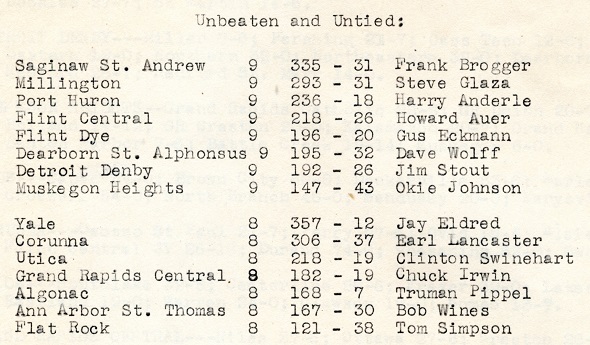
Central was one of 17 football squads in the state spread across four classifications who could call themselves state champions after that season. Back in those days, the Michigan High School Athletic Association did not sponsor a football playoff, so any team with an unblemished win-loss record could lay claim to the crown. With eight wins and no losses or ties, The Hilltoppers, as they were then known, did exactly that.
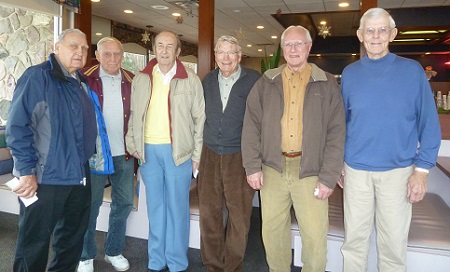 Nearly 70 years later, Don Hill can recall the circumstances of all 19 points allowed by the defense that season. The team remembered its coach, Chuck Irwin, who would go on to become Grand Valley State University’s first athletic director, and the days when summer conditioning wasn't 7 on 7 camps, but rather throwing a football around an empty lot, or a city park.
When I noted that Muskegon Heights’ Tigers also laid claim to the state crown that year, I was quickly reminded that both teams had defeated Holland High that season, but that Central had vanquished the Dutchmen 14-0, while the Tigers struggled to defeat Holland 14-12.
For the record, most newspaper writers gave the nod to both Flint Central and Muskegon Heights as the best in the state that season. Orville Peterson recalled that Flint Central had beaten an undefeated but once-tied Flint Northern team to end the year. That was indeed the case, as Coach Harold Auer's Indians downed coach Guy Houston's Vikings 20-6 on Thanksgiving Day at historic Atwood Stadium.
During the Grand Rapids Central gathering, a pair of restaurant patrons, who could overhear our conversation, wandered over to the table to congratulate the teammates on their accomplishment and to share a few memories of their own covering the value of prep sports in a proper education.
Similar gatherings are quite common across the state.
Each fall, the “Leather Helmets Club,” comprised of football players from Muskegon High School gather for a catered dinner at a rental hall on the shores of Muskegon Lake.
“The 1950 season was the first year that the Big Reds moved from leather helmets to plastic,” recalled Bob Ludwig, now 87 yards old and a member of the 1944 mythical state champions. “We started the Leather Helmet about 25 years ago with 65 guys.”
Ray Carlson, who served as starting quarterback for Muskegon’s mythical state champions back in 1940, still can recall the season.
“It was the year the district installed lights at Hackley Stadium,” said Carlson. “That’s when most of the games were moved from Saturday afternoon to Friday night.”
For many years, the event was a perch fry, but as time marched steadily on, the task became too challenging for this collection of gridiron greats from Big Reds teams, as membership in the club has shrunk to 25. The group will again gather in the fall, and debate inviting members from the 1950s to the gathering to expand membership.
Sometimes, such reunions are single one-time events. In 1993, Ann Arbor High School’s team from 50 years back collected to celebrate its 1943 mythical state crown. In 2013, the 1973 Saginaw Arthur Hill team, undefeated and unscored upon over the season, gathered.
Pat Brady graduated in 1950 from Saginaw St. Andrews. For three seasons – 1948, 1949 and 1950 – the Bulldogs lay claim to mythical state titles in Class C. Over the span, the team racked up 27 straight victories.
“We had a pretty good group of kids,” said Brady recalling the days. “Frank Brogger was our coach, and he made sure we took on a good schedule. We played schools in Flint, Detroit, Saginaw, Bay City and Jackson. We played Sunday evenings at our own field. They really took care of that field. During the week, we practiced in the cinders behind the field. On Saturdays we would go through things on the field in our socks.”
Induction into the Saginaw County Hall of Fame in 2005 led to regular gatherings by team members. A group of seven and another former player from Saginaw St. Peter and Paul meets for coffee at an area McDonald’s at least twice a week.
“He was a rival back then, but we’re friends now,” added Brady, laughing. “We’ve lost a lot of the guys; we’re all in our 80s now. Still, it’s a lot of fun to get together and talk about old times and new times.”
“Whether you play in front of a crowd of 900 or 19,000, the experience of high school football is unlike any other,” noted Bissinger in Sports Illustrated, recalling something shared across state lines and across generations.
The beauty of high school competition is found in the friendships made that last a lifetime.
 Ron Pesch has taken an active role in researching the history of MHSAA events since 1985 and began writing for MHSAA Finals programs in 1986, adding additional features and "flashbacks" in 1992. He inherited the title of MHSAA historian from the late Dick Kishpaugh following the 1993-94 school year, and resides in Muskegon. Contact him at [email protected] with ideas for historical articles.
PHOTOS: (Top) A report from Pesch's wealth of documents shows most of the undefeated football teams at the end of the 1947 season. (Middle) The Grand Rapids Central group stands together after a gathering last December, from left: Tony Krenselewski, Orville Peterson, Don Hill, Bud Hall, Herb Carpenter, Gordon Osmun and Floyd Hall.
Dedication Continues to Make Difference as Pittman Elevates Game, Shores' Offense
By
Tom Kendra
Special for MHSAA.com
September 11, 2024
Jonathan Pittman lives by the acronym “PGF.”
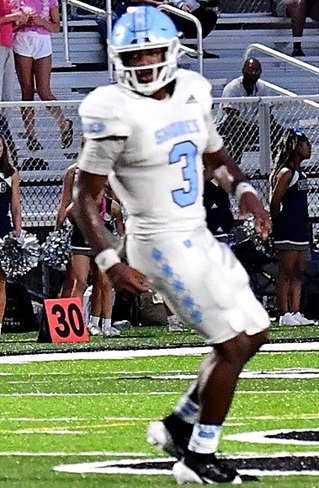
 “My mom gave me that life motto; it stands for 'Put God First,'” explained Pittman, the senior quarterback for Muskegon Mona Shores, which is off to a 2-0 start.
“That is the core of who I am.”
Those aren’t just words for Pittman, who starts every day – Monday through Friday, from 6 a.m. to 7, when much of the world and most 17-year-olds are still sleeping – by going to church to study his Mormon faith at the Spring Lake Ward of the Church of Jesus Christ of Latter-day Saints.
He heads directly from there to school, where he either practices throwing the football or shooting the basketball (Pittman is also a standout on the Sailors’ hoops team). Then it’s off to the classroom – where, by the way, he is a straight-A student in honors classes.
Only when all of that is completed does he switch his focus solely to football. The 6-foot-2, 205-pound senior is a three-year starter with a rocket arm and the power to run over linebackers like a fullback.
“Pitt is the hardest-working kid I have ever coached,” said 14th-year Mona Shores coach Matt Koziak, who has led the Sailors to four Division 2 championship games and won two, in 2019 and 2020.
“He is very critical of his own game. He identifies where he needs to get better, and he just keeps working at it.”
Koziak can track how much film his players are watching. One day, he checked and noticed that senior linebacker and film study devotee Solomon Robertson had logged two hours on that day. The only player with more was Pittman – with six hours.
Pittman’s work ethic appears to be paying dividends, as he’s led the Sailors to impressive road wins over Grand Blanc (28-26) and River Rouge (21-6) to open the season and heading into yet another road game this week at undefeated Flint Hamady.
He did it with his feet against Grand Blanc, running 25 times for 192 yards and throwing for only 43. Against River Rouge, it was just the opposite – he completed 9-of-13 passes for 127 yards, while rushing for just 30.
Pittman comes from good pedigree. His father, also Jonathan Pittman, is a California native and former standout receiver at Brigham Young University who went on to play three years in the NFL for Buffalo, Tampa Bay and the New York Jets. His mother, Quintina, was a three-sport high school star whose college sports dreams were cut short by a knee injury.
 The Pittmans moved to Muskegon in 2014 when his father was hired as the general manager at The Lakes Mall, a position he held for five years. (The younger Pittman, who is the second oldest of four children, said his family is not related to any of the many Pittmans in the Muskegon area.)
Pittman has always had a big arm, which allowed him to earn the varsity starting role as a sophomore. Last fall, he completed 87-of-134 passes for 1,391 yards and 15 TDs. His main targets this fall are wideouts Jaeger Johnson and Micah Carafelle and tight end George Duggins.
Pittman is equally well-known for his power running, forming a tough-to-tackle 1-2 duo with junior running back Tomarion “Ike” Steward (5-11, 205).
The biggest improvement for Pittman so far this season has been his increased speed and agility, as he has slimmed down from 218 pounds to 205.
“I wasn’t as fast as I needed to be and couldn’t execute some of the things we like to run,” said Pittman. “I needed to work on that. Our offense is much more diverse this year. We have a ton of weapons, and we can hit teams from all angles.”
Koziak hopes his quicker quarterback will give his team the extra edge it needs in huge Ottawa-Kent Conference Green games at home against Byron Center (Sept. 20) and at Muskegon (Sept. 27) – both against likely Division 2 playoff opponents.
Shores made it to the Division 2 Final four times in eight years, losing to Warren De La Salle Collegiate in 2014 and 2018, then defeating Detroit Martin Luther King in 2019 and De La Salle in 2020. The Sailors have not advanced out of their District the past three years.
Right now, Shores is just waiting to play a game in West Michigan, and will have traveled 1,030 miles round-trip for their first three this season.
The most puzzling aspect of Pittman’s football career thus far is his surprisingly small number of college scholarship offers. Wayne State, Lawrence Tech and Siena Heights have made offers, while Eastern Michigan and Northern Illinois have made the trip to Muskegon to watch him throw.
Pittman, who plans to major in accounting, is not doing any lobbying – preferring to let his play on Friday nights speak for itself.
One thing is for certain: He has made a believer out of Koziak, who has been coaching football for more than 20 years, with prior stops as offensive coordinator at Muskegon Heights and head coach at Muskegon High in 2009.
“I will say this: Wherever he goes, by his junior year, he will be a team captain,” said Koziak. “You combine his athletic ability and his work ethic, and it’s magic. He’s a special kid; a generational kid.”
 Tom Kendra worked 23 years at The Muskegon Chronicle, including five as assistant sports editor and the final six as sports editor through 2011. E-mail him at [email protected] with story ideas for Muskegon, Oceana, Mason, Lake, Oceola, Mecosta and Newaygo counties.
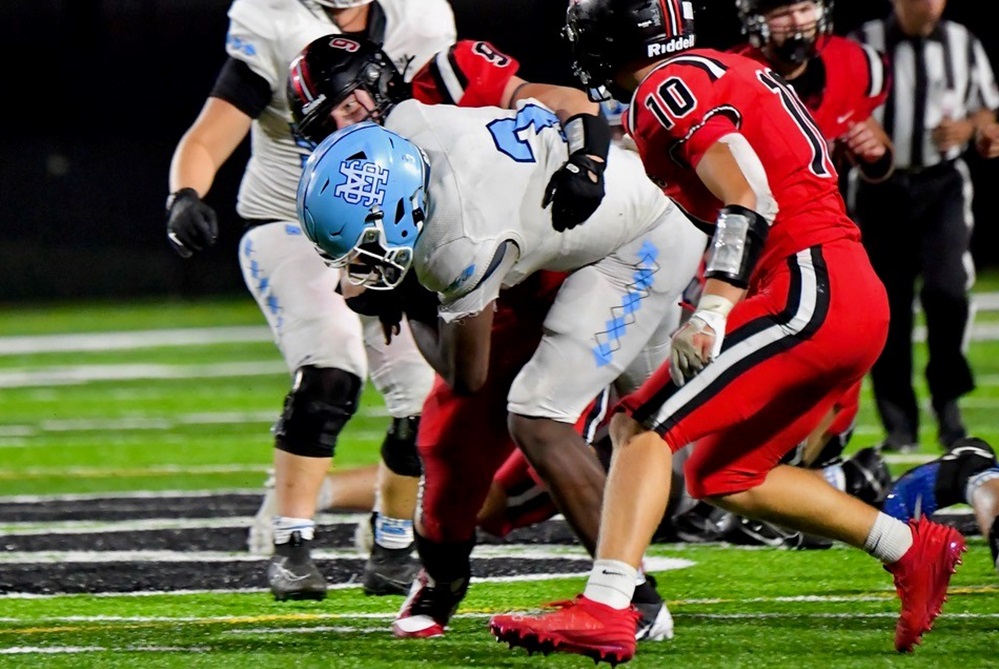
PHOTOS (Top) Muskegon Mona Shores' Jonathan Pittman powers into the Grand Blanc defense during his team's season-opening win. (Middle) Pittman watches as a teammate carries the ball upfield. (Photos by Terry Lyons.)