

Friendships Bind Long-Ago Champions
By
Ron Pesch
MHSAA historian
August 28, 2015
Twenty-five years ago, the story of Permian Panthers of Odessa, Texas, was famously told in the book Friday Night Lights written by H.G. Bissinger.
The author recently reunited with various team members as he recalled the book’s silver anniversary in an article for the August 3, 2015, issue of Sports Illustrated.
“It took me about 10 to 15 years of working in different groups, different places, different environments, to finally come to the conclusion that I’m not gonna have a group of coworkers and teammates like I had then,” said Jerrod McDougal, recalling his days playing high school football for the Panthers.
That same feeling is certainly shared by groups of former gridders around the state of Michigan.
A chance meeting led me to breakfast with one such group. The members of Grand Rapids Central's 1947 mythical football state champions gather at a Russ’ restaurant in Grand Rapids on a Monday each month.
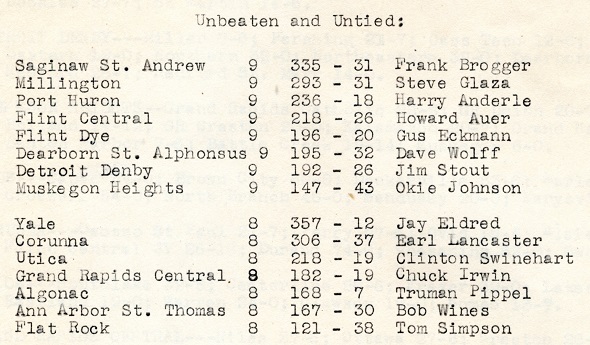
Central was one of 17 football squads in the state spread across four classifications who could call themselves state champions after that season. Back in those days, the Michigan High School Athletic Association did not sponsor a football playoff, so any team with an unblemished win-loss record could lay claim to the crown. With eight wins and no losses or ties, The Hilltoppers, as they were then known, did exactly that.
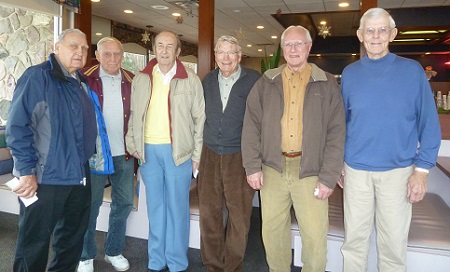 Nearly 70 years later, Don Hill can recall the circumstances of all 19 points allowed by the defense that season. The team remembered its coach, Chuck Irwin, who would go on to become Grand Valley State University’s first athletic director, and the days when summer conditioning wasn't 7 on 7 camps, but rather throwing a football around an empty lot, or a city park.
When I noted that Muskegon Heights’ Tigers also laid claim to the state crown that year, I was quickly reminded that both teams had defeated Holland High that season, but that Central had vanquished the Dutchmen 14-0, while the Tigers struggled to defeat Holland 14-12.
For the record, most newspaper writers gave the nod to both Flint Central and Muskegon Heights as the best in the state that season. Orville Peterson recalled that Flint Central had beaten an undefeated but once-tied Flint Northern team to end the year. That was indeed the case, as Coach Harold Auer's Indians downed coach Guy Houston's Vikings 20-6 on Thanksgiving Day at historic Atwood Stadium.
During the Grand Rapids Central gathering, a pair of restaurant patrons, who could overhear our conversation, wandered over to the table to congratulate the teammates on their accomplishment and to share a few memories of their own covering the value of prep sports in a proper education.
Similar gatherings are quite common across the state.
Each fall, the “Leather Helmets Club,” comprised of football players from Muskegon High School gather for a catered dinner at a rental hall on the shores of Muskegon Lake.
“The 1950 season was the first year that the Big Reds moved from leather helmets to plastic,” recalled Bob Ludwig, now 87 yards old and a member of the 1944 mythical state champions. “We started the Leather Helmet about 25 years ago with 65 guys.”
Ray Carlson, who served as starting quarterback for Muskegon’s mythical state champions back in 1940, still can recall the season.
“It was the year the district installed lights at Hackley Stadium,” said Carlson. “That’s when most of the games were moved from Saturday afternoon to Friday night.”
For many years, the event was a perch fry, but as time marched steadily on, the task became too challenging for this collection of gridiron greats from Big Reds teams, as membership in the club has shrunk to 25. The group will again gather in the fall, and debate inviting members from the 1950s to the gathering to expand membership.
Sometimes, such reunions are single one-time events. In 1993, Ann Arbor High School’s team from 50 years back collected to celebrate its 1943 mythical state crown. In 2013, the 1973 Saginaw Arthur Hill team, undefeated and unscored upon over the season, gathered.
Pat Brady graduated in 1950 from Saginaw St. Andrews. For three seasons – 1948, 1949 and 1950 – the Bulldogs lay claim to mythical state titles in Class C. Over the span, the team racked up 27 straight victories.
“We had a pretty good group of kids,” said Brady recalling the days. “Frank Brogger was our coach, and he made sure we took on a good schedule. We played schools in Flint, Detroit, Saginaw, Bay City and Jackson. We played Sunday evenings at our own field. They really took care of that field. During the week, we practiced in the cinders behind the field. On Saturdays we would go through things on the field in our socks.”
Induction into the Saginaw County Hall of Fame in 2005 led to regular gatherings by team members. A group of seven and another former player from Saginaw St. Peter and Paul meets for coffee at an area McDonald’s at least twice a week.
“He was a rival back then, but we’re friends now,” added Brady, laughing. “We’ve lost a lot of the guys; we’re all in our 80s now. Still, it’s a lot of fun to get together and talk about old times and new times.”
“Whether you play in front of a crowd of 900 or 19,000, the experience of high school football is unlike any other,” noted Bissinger in Sports Illustrated, recalling something shared across state lines and across generations.
The beauty of high school competition is found in the friendships made that last a lifetime.
 Ron Pesch has taken an active role in researching the history of MHSAA events since 1985 and began writing for MHSAA Finals programs in 1986, adding additional features and "flashbacks" in 1992. He inherited the title of MHSAA historian from the late Dick Kishpaugh following the 1993-94 school year, and resides in Muskegon. Contact him at [email protected] with ideas for historical articles.
PHOTOS: (Top) A report from Pesch's wealth of documents shows most of the undefeated football teams at the end of the 1947 season. (Middle) The Grand Rapids Central group stands together after a gathering last December, from left: Tony Krenselewski, Orville Peterson, Don Hill, Bud Hall, Herb Carpenter, Gordon Osmun and Floyd Hall.
Quick Study Central Lake Clinches 1st Title
November 18, 2017
By Geoff Kimmerly
Second Half editor
MARQUETTE – Central Lake may not have been totally sure what it got itself into switching to 8-player football heading into this fall.
 Clearly it didn’t take the Trojans long to figure things out.
A year after finishing 2-7 with 11 players on the field, Central Lake finished Saturday afternoon at the Superior Dome with its first football championship, downing Deckerville 32-30 in the inaugural 8-Player Division 1 Final.
The championship was the first for the school in any MHSAA tournament sport since claiming the Class D softball title in 1980. The Trojans also finished 13-0 this fall.
“Last year it was not even something. Or just growing up, you’re watching the Finals on TV … ‘I’m never going to be there,’ but it’s cool to watch,” Central Lake senior quarterback Gavin Mortensen said. “You dream about it. And then all of a sudden, you’re a state champion. It’s crazy.”
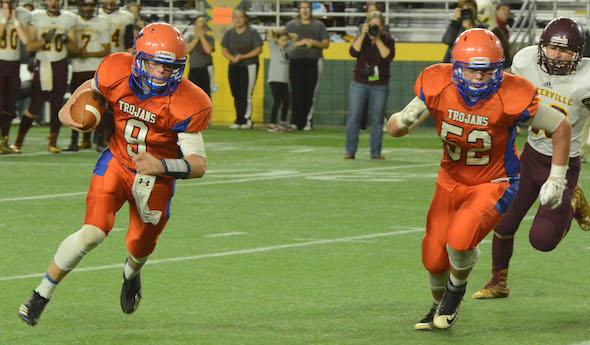
And so was the finish, as Mortensen put his team ahead to stay on a six-yard touchdown run with 2:49 to play. Central Lake came back from 10 points down with under a minute to play in the third quarter, riding a powerful running game to the final two of four rushing touchdowns on the day, while also halting two Deckerville fourth-quarter drives that reached the Trojans’ 21-yard line.
“Those get your heart pumping, don’t they, those stops? But what a great way to win,” Central Lake coach Rob Heeke said.
Junior running back Grant Papineau went over 2,000 yards rushing for the season, adding 183 for a final total of 2,067 while also rushing for his 26th touchdown of the fall. Junior Skyler Spangler had 101 yards and two scores on the ground to finish the season with 1,753 yards and 28 touchdowns rushing.
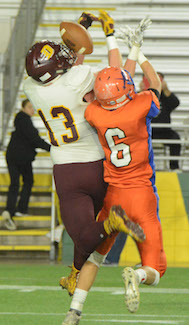 Mortensen, in addition to running the show, made it count when his number was called, adding a 49-yard touchdown pass to senior Jayce Hoogerhyde. And Hoogerhyde, who had 15 pass break-ups as a defensive back entering the game, made an equally significant play on that side of the ball batting down Deckerville’s final pass into the end zone.
Those are the guys who got most of the attention during the perfect run. But a most unlikely contributor deserved his share as well Saturday. Junior center Dalin Clark (6-foot, 265 pounds) left the game with an injury near the end of the first half. In came sophomore Vance Hoeksema (5-6, 140), who had played that position only a couple of times this fall. But the Central Lake attack just kept rolling.
“We just kinda rallied around Vance, and he did a great job,” Mortensen said. “After we got the first few bad snaps out of the way, exchange-wise, he did really well.
Guys on the line picked him up and told him what to do if he didn’t know, and it worked out.”
Hoogerhyde said it wasn’t until a 14-point Week 8 win over Onekama – that clinched for the Trojans the Midwest Central Michigan Conference championship – that he and his teammates started to realize what they might be capable of accomplishing this fall.
Deckerville had been to this level before, winning the 8-player championship in 2012 and finishing runner-up to two-time champion Powers North Central a year ago. That the Eagles (11-2) returned to the final game Saturday was impressive though, considering they replaced nearly their entire backfield from a year ago and then didn’t have injured leading rusher Cruz Ibarra for the last two games.
Senior Kenton Bowerman ran for 83 yards and also caught three passes for 93 yards and a score in the Final. Sophomore quarterback Isaac Keinath threw for three scores total.
“We’d love to win that state championship, but I think we overachieved maybe a little bit,” Deckerville coach Bill Brown said. “They really came together as a team midway through the season and as a head football coach, when you watch your kids and they come together and they’re playing as a team, and you’re getting those selfless acts … we have kids giving just everything they have out there. When you’re a coach, that’s all you ask for.
“I’m disappointed in the outcome of course. That doesn’t define this football team. We could play that game again, and we might win by two touchdowns.”
Spangler had 15 tackles, Mortensen 14, Papineau 13 and senior Dylan Michael 12 for Central Lake. Junior Curtis Vogel had 20 tackles and senior Wyatt Janowiak had 15 for the Eagles. Senior Zach Ostrowski also caught a touchdown pass, and senior Brendan Hadley ran for a score.
The MHSAA Playoffs are sponsored by the Michigan Army National Guard.
PHOTOS: (Top) Central Lake quarterback Gavin Mortensen begins to turn the corner on the way to scoring the go-head touchdown Saturday. (Middle) Deckerville’s Wyatt Janowiak hauls in a third-quarter touchdown pass over the tight coverage of Jayce Hoogerhyde. (Photos by John Johnson.)