

Friendships Bind Long-Ago Champions
By
Ron Pesch
MHSAA historian
August 28, 2015
Twenty-five years ago, the story of Permian Panthers of Odessa, Texas, was famously told in the book Friday Night Lights written by H.G. Bissinger.
The author recently reunited with various team members as he recalled the book’s silver anniversary in an article for the August 3, 2015, issue of Sports Illustrated.
“It took me about 10 to 15 years of working in different groups, different places, different environments, to finally come to the conclusion that I’m not gonna have a group of coworkers and teammates like I had then,” said Jerrod McDougal, recalling his days playing high school football for the Panthers.
That same feeling is certainly shared by groups of former gridders around the state of Michigan.
A chance meeting led me to breakfast with one such group. The members of Grand Rapids Central's 1947 mythical football state champions gather at a Russ’ restaurant in Grand Rapids on a Monday each month.
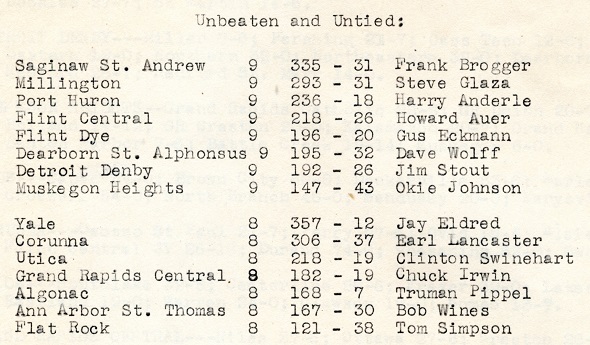
Central was one of 17 football squads in the state spread across four classifications who could call themselves state champions after that season. Back in those days, the Michigan High School Athletic Association did not sponsor a football playoff, so any team with an unblemished win-loss record could lay claim to the crown. With eight wins and no losses or ties, The Hilltoppers, as they were then known, did exactly that.
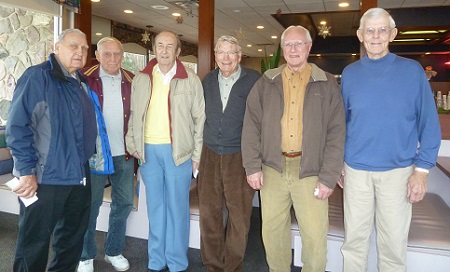 Nearly 70 years later, Don Hill can recall the circumstances of all 19 points allowed by the defense that season. The team remembered its coach, Chuck Irwin, who would go on to become Grand Valley State University’s first athletic director, and the days when summer conditioning wasn't 7 on 7 camps, but rather throwing a football around an empty lot, or a city park.
When I noted that Muskegon Heights’ Tigers also laid claim to the state crown that year, I was quickly reminded that both teams had defeated Holland High that season, but that Central had vanquished the Dutchmen 14-0, while the Tigers struggled to defeat Holland 14-12.
For the record, most newspaper writers gave the nod to both Flint Central and Muskegon Heights as the best in the state that season. Orville Peterson recalled that Flint Central had beaten an undefeated but once-tied Flint Northern team to end the year. That was indeed the case, as Coach Harold Auer's Indians downed coach Guy Houston's Vikings 20-6 on Thanksgiving Day at historic Atwood Stadium.
During the Grand Rapids Central gathering, a pair of restaurant patrons, who could overhear our conversation, wandered over to the table to congratulate the teammates on their accomplishment and to share a few memories of their own covering the value of prep sports in a proper education.
Similar gatherings are quite common across the state.
Each fall, the “Leather Helmets Club,” comprised of football players from Muskegon High School gather for a catered dinner at a rental hall on the shores of Muskegon Lake.
“The 1950 season was the first year that the Big Reds moved from leather helmets to plastic,” recalled Bob Ludwig, now 87 yards old and a member of the 1944 mythical state champions. “We started the Leather Helmet about 25 years ago with 65 guys.”
Ray Carlson, who served as starting quarterback for Muskegon’s mythical state champions back in 1940, still can recall the season.
“It was the year the district installed lights at Hackley Stadium,” said Carlson. “That’s when most of the games were moved from Saturday afternoon to Friday night.”
For many years, the event was a perch fry, but as time marched steadily on, the task became too challenging for this collection of gridiron greats from Big Reds teams, as membership in the club has shrunk to 25. The group will again gather in the fall, and debate inviting members from the 1950s to the gathering to expand membership.
Sometimes, such reunions are single one-time events. In 1993, Ann Arbor High School’s team from 50 years back collected to celebrate its 1943 mythical state crown. In 2013, the 1973 Saginaw Arthur Hill team, undefeated and unscored upon over the season, gathered.
Pat Brady graduated in 1950 from Saginaw St. Andrews. For three seasons – 1948, 1949 and 1950 – the Bulldogs lay claim to mythical state titles in Class C. Over the span, the team racked up 27 straight victories.
“We had a pretty good group of kids,” said Brady recalling the days. “Frank Brogger was our coach, and he made sure we took on a good schedule. We played schools in Flint, Detroit, Saginaw, Bay City and Jackson. We played Sunday evenings at our own field. They really took care of that field. During the week, we practiced in the cinders behind the field. On Saturdays we would go through things on the field in our socks.”
Induction into the Saginaw County Hall of Fame in 2005 led to regular gatherings by team members. A group of seven and another former player from Saginaw St. Peter and Paul meets for coffee at an area McDonald’s at least twice a week.
“He was a rival back then, but we’re friends now,” added Brady, laughing. “We’ve lost a lot of the guys; we’re all in our 80s now. Still, it’s a lot of fun to get together and talk about old times and new times.”
“Whether you play in front of a crowd of 900 or 19,000, the experience of high school football is unlike any other,” noted Bissinger in Sports Illustrated, recalling something shared across state lines and across generations.
The beauty of high school competition is found in the friendships made that last a lifetime.
 Ron Pesch has taken an active role in researching the history of MHSAA events since 1985 and began writing for MHSAA Finals programs in 1986, adding additional features and "flashbacks" in 1992. He inherited the title of MHSAA historian from the late Dick Kishpaugh following the 1993-94 school year, and resides in Muskegon. Contact him at [email protected] with ideas for historical articles.
PHOTOS: (Top) A report from Pesch's wealth of documents shows most of the undefeated football teams at the end of the 1947 season. (Middle) The Grand Rapids Central group stands together after a gathering last December, from left: Tony Krenselewski, Orville Peterson, Don Hill, Bud Hall, Herb Carpenter, Gordon Osmun and Floyd Hall.
Hutchinson Makes Name at Divine Child
By
Tom Markowski
Special for Second Half
September 13, 2017
DEARBORN – Often, a child of a successful athlete has difficulty living up to that standard.
 To this point, that’s not the case with Aidan Hutchinson.
He plays a similar position as did his father Chris, an All-America defensive lineman at University of Michigan in 1992. But there are differences as well between father and son – although like his dad, Aidan also will head to Ann Arbor after he graduates from Dearborn Divine Child.
All Falcons fourth-year coach John Filiatraut knows is that he hit the lottery when the Hutchinsons decided Aidan would attend Divine Child – not that he didn’t see it coming, given Aidan’s mother, Melissa Hutchinson, and his two older sisters, Mia and Aria, all attended the Catholic school.
“They’re great people,” said Filiatraut, a 1986 Divine Child graduate. “It’s a treat. Coaches can complain and whine with the best of them. But we’re lucky to have Aidan.
“And Chris is not very intrusive. I was worried about that at the beginning. With his background, it would be easy to step in. We as coaches are trying to do things right here. (Chris) is committed to Aidan and for him to do this on his own, and not cast a shadow on Aidan.”
Coming off its winningest season (10-3) since 1985 and a Division 3 Semifinals berth in 2016, Divine Child is off to a 3-0 start this fall.
As for those differences between father and son, size is one. The elder Hutchinson was 6-foot-2 and weighed 221 pounds when he graduated from high school. His playing weight at U-M was 250. His son is 6-6 and weighs 255 pounds, and is considered one of the top prospects in the class of 2018. Aidan plays defensive end and tight end. His father was a defensive tackle.
Chris Hutchinson grew up in Houston and played football at Cypress Creek High before going on to University of Michigan, where he played four seasons and was named first team All-America as a senior defensive lineman in 1992. Chris Hutchinson said private school education was all new to him, but he couldn’t be more pleased with the educational – and now with his son – athletic experiences his family has enjoyed.
Not surprisingly, Aidan has accepted a scholarship offer to attend U-M. He did make unofficial visits to Notre Dame and Wisconsin, in addition to his interest in attending Penn State, but eventually U-M won out.
 And so far his senior season has unfolded as planned.
“We’re 3-0. It’s great,” he said. “Michigan is undefeated. We’re undefeated. It’s all great.”
Chris Hutchinson didn’t allow Aidan to play tackle football until he was in the seventh grade. Aidan did play flag football, and other sports like soccer, but his father held him out of the physical contact until he thought Aidan was ready.
“It was a big change for me,” Aidan said of playing tackle football. “I had to learn a lot because most of the other kids had been playing two or three years. It wasn’t too bad a transition. I just had to learn quickly.”
Despite his size, and his weight as an infant (11 pounds, one ounce), Aidan wasn’t a large child growing up. He weighed 135 pounds when he was in the eighth grade, then 160 as a freshman playing on the line on Divine Child’s junior varsity team. Over the next two years, he grew seven inches and added 70 pounds.
“I’ve been (growing) all through high school,” he said. “Am I done growing? I don’t think so, but I’m hoping I am.”
The answer is likely the former. Aidan just turned 17 last month (Aug. 9).
Though his size is a plus once he gets to college, there are times when it can work against him at the high school level.
“It’s different when you’re 6-6 going against a 6-foot kid,” Chris Hutchinson said. “You have to keep your head down, and stay low.”
Chris Hutchinson, who’s a doctor in the emergency room at Beaumont Hospital in Royal Oak, understands it’s not his place to coach his son from the sideline, even though, as the team physician, it’s his job to be on the sideline. He keeps a safe distance and allows Filiatraut and his staff do their jobs.
At home, it’s a different story. The two view film constantly to determine where improvements can be made.
“Thank God for Hudl,” Chris said. “I only focus on technique. When Aidan tells me they’re using a double team, I ask what type? There are different ways you can use a double team.
 “It’s important not to be that dad who coaches. There are way too many dads who do the coaching thing. The hardest thing for me is not to say something, and have him come to me. When they do ask, then you can go forward.”
Aidan is quick for his size, and he attributes much of that quickness and his ability to react quickly to the other sport he plays, lacrosse. He started playing lacrosse the same year he began playing tackle football, and to him they go hand in hand.
“It’s a ton of fun (playing lacrosse),” he said. “My whole group of friends play. All six of us started (on varsity) as freshmen, so we should be pretty good this year. There’s no question it helps me in football. One hundred percent. It helps with my hip movement, and in lacrosse it forces you to back pedal.”
Filiatraut said Hutchinson is a special part of a special team at Divine Child. Its quarterback, Theo Day, is one of the state’s best. Day led the Falcons to the Division 3 Semifinals last season and has committed to sing with Michigan State.
“Aidan gives great effort all of the time,” Filiatraut said. “Honestly, he’s on the shy side. He’s trying to figure it all out. He’s doing his best to be a vocal leader, but it’s not in his nature.
“He’s got a ton of want-to. He wants to be good, and to get better.”
 Tom Markowski is a columnist and directs website coverage for the State Champs! Sports Network. He previously covered primarily high school sports for the The Detroit News from 1984-2014, focusing on the Detroit area and contributing to statewide coverage of football and basketball. Contact him at [email protected] with story ideas for Oakland, Macomb and Wayne counties.
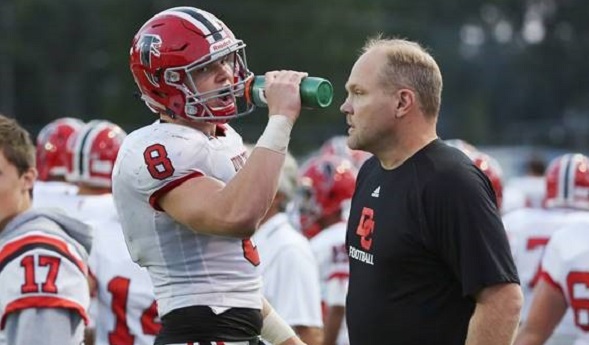
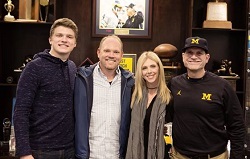
PHOTOS: (Top) Deaborn Divine Child’s Aidan Hutchinson grabs a water break while dad and team physician Chris Hutchinson keeps an eye on the field. (Middle) Hutchinson blocks against Benton Harbor during his team’s Week 1 win. (Below) Aidan, Chris, mom Melissa and U-M coach Jim Harbaugh take a photo after Aidan commits to sign with the Wolverines. (Photos courtesy of the Hutchinson family.)