

A Game for Every Fan: Week 7
October 10, 2013
By Geoff Kimmerly
Second Half editor
Something's gonna give in many football leagues all over Michigan this weekend.
In the southeastern corner alone at least seven matchups feature first and second-place teams aiming at claiming league titles. And titanic face-offs can be found continuing north to the coast of Lake Superior.
Here's a look at some that stuck out most from this week's schedule. Be sure to check MHSAA Score Center all weekend for up-to-date scores and standings, and then again each morning for updated playoff points averages.
West Michigan
Caledonia (5-1) at Lowell (6-0)
There's never much of a break in the O-K White, and Lowell gets to follow up last week’s four-overtime win at East Grand Rapids with a home game against second-place Caledonia. The Fighting Scots’ only loss was to much-improved Muskegon Mona Shores, and they’ve scored a combined 136 points in three wins since that Week 3 defeat. The Red Arrows are used to top competition with wins also against River Rouge (4-1) and Muskegon (5-1) this fall, and they get to follow this one with Grand Rapids Christian next week.
Others that caught my eye: Holland West Ottawa (4-2) at East Kentwood (4-2), Belding (4-2) at Hopkins (4-2), Spring Lake (5-1) at Ludington (4-2), Zeeland East (5-1) at Muskegon Mona Shores (5-1).
Greater Detroit and Southeast
Canton (6-0) at Plymouth (5-1)
A set of baseball and softball fields separate these neighbors, and they’ve also seen each other twice each of the last five seasons – once during league play and again during the playoffs. A three-point loss by Plymouth to Livonia Franklin is all that kept this from being a matchup of undefeated teams – and if Plymouth wins, it will force Canton to share the Kensington Lakes Activities Association South title.
Others that caught my eye: Belleville (4-2) at Dearborn Fordson (4-2), Detroit Denby (5-1) at Detroit Martin Luther King (5-0), Oak Park (5-1) at Farmington Hills Harrison (5-1), Detroit Mumford (6-0) at Detroit Cass Tech (6-0)
Thumb and Bay
Montrose (6-0) at Flint Beecher (5-1)
Beecher’s only loss this season was two weeks ago against Lake Fenton – which is tied with Montrose for first place in the Genesee Area Conference Red. If the Buccaneers can beat the Rams, a three-team shared title will remain a possibility – Montrose ends the regular season against Lake Fenton and has beaten the Blue Devils in three straight.
Others that caught my eye: Reese (5-1) at Elkton-Pigeon-Bay Port (5-1), Flint Powers (3-3) at Flint Carman-Ainsworth (5-1), Traverse City St. Francis (4-2) at Saginaw Nouvel (5-1), Gladwin (4-2) at Sanford Meridian (6-0).
Southwest and Border
Paw Paw (6-0) at Plainwell (6-0)
How little have these Wolverine Conference East leaders been tested this fall? Combined, they’ve given up 68 points. It’s fair to say the Trojans have been the tiniest bit more impressive – they have three shutouts including one over Wolverine Conference West leader Dowagiac. But Paw Paw does have history on its side – the Redskins have won all eight meetings (including one in the playoffs) since the two became league foes in 2006.
Others that caught my eye: Climax-Scotts (6-0) at Bellevue (4-2), St. Joseph Lake Michigan Catholic (5-0) at Niles Brandywine (6-0), Coldwater (3-3) at Battle Creek Lakeview (6-0), Three Rivers (4-2) at Dowagiac (5-1).
Lower Up North
Beal City (6-0) at Lake City (6-0)
Talk about two teams that have simply dominated so far; these two have outscored their opponents by a combined 678-33. The winner claims a share of the Highland Conference title, which Beal City has won nine of the last 10 seasons. It’s anyone’s guess how this matchup might go; Lake City has given up six points this season and Beal City has scored at least 60 four times.
Others that caught my eye: Traverse City West (4-2) at Cadillac (6-0), Kalkaska (5-1) at Grayling (5-1), Evart (5-1) at McBain (4-2), Maple City Glen Lake (6-0) at Suttons Bay (3-3).
Upper Peninsula
Negaunee (6-0) at Ishpeming (6-0)
Ishpeming finished an incredible playoff run as the Division 7 champion last fall, but Negaunee can boast that it claimed the Mid-Peninsula Conference championship during the regular season thanks to a 20-8 win over the Hematites. Both have been similarly dominating again this season, making this arguably the best game in the Upper Peninsula for all of 2013.
Others that caught my eye: Powers North Central (5-1) at Felch North Dickinson (5-1), Cheboygan (5-1) at Sault Ste. Marie (3-3), Pickford (4-2) at St. Ignace (5-1), Marinette, Wis. (2-5) at Menominee (6-0).
Mid-Michigan
Fowler (5-1) at Pewamo-Westphalia (6-0)
That this Central Michigan Athletic Conference clash is considered one of the best rivalries throughout mid-Michigan despite including two of its smallest schools speaks volumes both to how much these programs are respected by others big and small and how good this matchup has been over the last 40-plus seasons. During the last decade alone both have played in MHSAA Finals at Ford Field and faced each other in four games decided by eight or fewer points.
Others that caught my eye: Lansing Everett (5-1) at Grand Ledge (3-3), Carson City-Crystal (6-0) at Mount Pleasant Sacred Heart (5-1), Battle Creek Pennfield (5-1) at Olivet (6-0), Homer (6-0) at Springport (5-1).
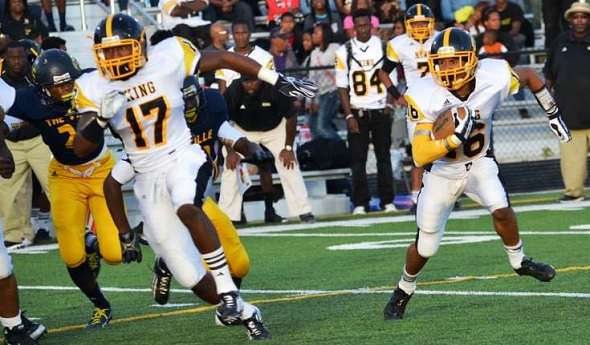
PHOTO: Detroit Martin Luther King (white jerseys), here against Detroit East English, has claimed a share of the Detroit Public School League East title, but can win it outright by defeating second place Detroit Denby tonight. (Photo courtesy of the Detroit Public School League).
Eriksen, Clarkston Finish 'Dream' Run
November 30, 2013
By Bill Khan
Special to Second Half
DETROIT — Ian Eriksen's senior season was slipping away.
And so was his lifelong dream.
Eriksen and his football-playing buddies in Clarkston talked about earning an MHSAA championship back when they were in elementary school and winning the Super Bowl of the Northern Youth Football League in Oakland County.
But after rushing for 2,167 yards and 33 touchdowns as a junior, Eriksen came into his senior year with Achilles and ankle injuries, then underwent arthroscopic surgery for a partially torn meniscus in his right knee on Sept. 19.
Four Friday nights passed with Eriksen in street clothes, unsure of when — or if — he'd ever rejoin his teammates in pursuit of their shared dream.
"That was really tough, because I've never been injured that seriously," Eriksen said. "It could've been a lot worse. I tried to be positive. All you can do is be positive rather than mope over it."
One positive out of the situation may be that Eriksen was fresh enough by the end of the playoffs to take on a heavy workload and help carry the Wolves to their first MHSAA football title.
Eriksen ran 32 times for 237 yards and three touchdowns in Clarkston's 32-14 victory over perennial power Detroit Catholic Central in the MHSAA Division 1 championship game Saturday at Ford Field.
He also had a 30-yard catch to extend Clarkston's first touchdown drive, and a sack. In Clarkston's last two games, Eriksen ran 76 times for 592 yards and nine touchdowns.
"He gave us a lot of problems," said veteran Catholic Central coach Tom Mach, who has built a dynasty with the power-running game. "He was a very good running back. He would be a good running back in our program. We would've loved to have him. We had a lot of trouble tackling him. He got the extra yard and put in the extra effort.
“They kept the ball away from us, getting those first downs, getting those first downs, getting those first downs. That's frustrating on a team, especially when you do get the ball when you're a ball-control offense like us."
 Bringing Clarkston its first MHSAA championship was the fulfillment of a dream for Eriksen and his teammates after the program reached three Semifinals and made the postseason 16 times under 27-year coach Kurt Richardson.
"In Little League, there's a Super Bowl," Eriksen said. "We won the Super Bowl together in 2006 when we were in fourth and fifth grade. The next thing we started talking about was winning a high school championship if we could do it. We knew we could."
Eriksen and some of the players who delivered that championship were in the stands at Troy Athens four years ago when Clarkston lost by two points in a Semifinal to Sterling Heights Stevenson.
"I remember when that happened," Eriksen said. "Everyone in the community was just so upset about that. Me and the other guys were like, 'That's not going to happen to us when we get there.'"
Clarkston made Catholic Central settle for a third straight runner-up finish by stealing a page from the Shamrocks' script.
Led by Eriksen and an outstanding offensive line, the Wolves ground out 288 yards on 45 carries. They had a 27:58 to 20:02 advantage in time of possession.
"The offensive line doesn't get enough credit," Richardson said. "They deserve it for this one."
After a punt and interception ended Clarkston's first two drives, the Wolves scored touchdowns on their next five possessions.
Both teams had promising drives end with interceptions deep in the opponent's territory before Clarkston broke through for the game's first score with 13 seconds left in the first half.
Converting three times on third down and once on fourth, Clarkston moved 91 yards in 17 plays, taking 6:36 off the clock, before D.J. Zezula hit Shane Holler with a 15-yard touchdown pass on a post route. The extra point failed.
The key play on the drive was a 30-yard pass to Eriksen on third-and-12 from Clarkston's 15-yard line.
"We knew we had to score, because we got the ball to start the second half," Zezula said. "It was 0-0 and we knew we had to get up on CC. They brought in an extra (defensive back). The play-action with Ian helps me out a lot with time and the O-line helps me a lot with time. We knew the play-action would work."
Catholic Central's best drive of the first half came following the opening kickoff. The Shamrocks marched to the Clarkston 24 before Tim Cason intercepted a pass, only the second pick thrown by Catholic Central all season.
Jack Van Acker made two big plays to keep Clarkston out of the end zone on the Wolves' second possession. First, he made a touchdown-saving tackle on a 35-yard run by Eriksen to the Shamrocks' 10-yard line. Then, two plays later, he picked off a pass in the end zone after Clarkston moved to the 6.
A 63-yard punt by Zach Bock pinned Clarkston at its own 9-yard line with 6:49 left in the second quarter before the Wolves drove for the only touchdown of the first half. Clarkston's average starting field position on three first-half possessions was its own 10.
Armed with a lead and momentum, Clarkston took the opening kickoff of the second half and marched 80 yards in eight plays, taking a 12-0 lead on a 37-yard run by Eriksen with 8:18 left in the third quarter.
The lead reached 18-0 on a 1-yard run by Eriksen with 3:59 left in the third.
Catholic Central got on the board when Dylan Roney scored on a 2-yard run with 45 seconds left in the third quarter, cutting Clarkston's lead to 18-7.
The Wolves responded with a seven-play, 71-yard drive that ended on a 47-yard pass from Zezula to Caine Watlington with 8:35 left in the game.
The Shamrocks scored again on a 48-yard pass from Sean Birney to Alexander Bock with 5:46 left, but Clarkston again had an answer, with Eriksen scoring on a 12-yard run to cap the scoring with 4:06 left.
Zezula was 10 for 15 for 154 yards, two touchdowns and one interception. Birney was 13 for 23 for 166 yards, one touchdown and one interception.
Clarkston won its final 13 games after a season-opening loss to Rochester Adams, a loss the Wolves avenged in the playoffs.
"A lot of these kids have been playing together since fifth grade," Richardson said. "They've played Chiefs together, so they've come up through the junior ranks. We all felt this could be a special season. We had some issues at the start. We talked to the kids at the time about turning a negative into a positive. You're going to get slapped in the face in life. We got slapped in the face in the first game. They learned from it. It was a huge coming-together point for us as a team."
Catholic Central (11-3) became the third team to finish runner-up three straight years. Utica Eisenhower was the Division 1 runner-up from 1999-2001 and Crystal Falls Forest Park was the Division 8 runner-up from 2004-06.
The Shamrocks' 2012 runner-up team was led defensively by sophomore middle linebacker David Widzinski, who had a game-high 15 tackles. Less than two weeks later, he died in his sleep.
Tributes to Widzinski were visible at Ford Field. Catholic Central's uniforms had a patch with his No. 33 inside a shamrock. In the student section, some students wore white and formed a 33 within a field of blue shirts worn by the others. Widzinski's jersey hung on the wall on the Catholic Central sideline.
"We brought up David a lot," Mach said. "He was a force behind our team all year long. Every day after practice, we would say a prayer for him and the people in our community who are suffering. It was a real learning experience for our kids to put something bigger than themselves in place of winning and losing."
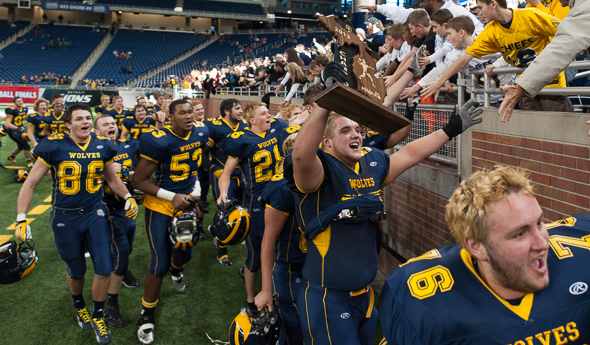
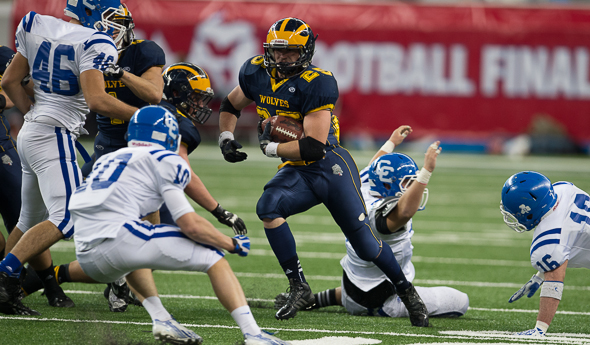
PHOTOS: (Top) Clarkston players trade high fives with fans as they march off the Ford Field turf with their first MHSAA championship trophy. (Middle) Clarkston running back Ian Eriksen runs through the reaching arms of Detroit Catholic Central defenders Saturday. (Click to see more from Terry McNamara Photography.)