

Glen Lake Blazes Trail Back to Finals
November 23, 2016
By Dennis Chase
Special for Second Half
TRAVERSE CITY – Congratulatory messages streamed in Saturday after Maple City Glen Lake defeated Leroy Pine River 34-20 in a Division 6 football Semifinal at snow-covered Thirlby Field – a win that secured the Lakers’ first MHSAA Finals appearance in 20 years.
 Head coach Jerry Angers’ phone was particularly active. Among those calling or texting: Former Traverse City West coach Matt Prisk, who Angers previously worked under as a defensive coordinator; retiring St. Ignace coach Marty Spencer, whose Saints fell to defending Division 8 champion Muskegon Catholic earlier in the day; and Eric Gordon, the former Michigan State linebacker, who played for Prisk and Angers at West.
Angers, who was still fielding calls and texts late into the night Saturday, was “touched” by the show of support for his Glen Lake program.
Most of all, he was proud of his players, who kept improving every week to make this moment possible.
“They have worked hard for this opportunity,” he said. “I told them (after Saturday’s game), ‘You’re going to Ford Field. You’re one of 16 teams still playing. A lot of people will be watching, but I want you to enjoy it.’
“It’s like the Alan Jackson song ‘Remember When.’ I said in 20 years when you come back to see me I want you to say, ‘Remember when.’”
Glen Lake, which faces Jackson Lumen Christi for the title Friday, won the Class DD championship in 1994 under coach Bill Hollenbeck. The Lakers lost in the Class DD Final in 1996. Now, 20 years later, Glen Lake’s back.
“It’s an incredible feeling,” all-state linebacker Duke Angers, the coach’s son, said a few hours after the game. “It seems surreal right now. Growing up as a kid, you dream about playing at Ford Field. Now we get that opportunity. We’ll enjoy this for 24 hours and then get to work for Jackson Lumen Christi.”
Junior quarterback Cade Peterson, who rushed for 179 yards and three touchdowns in the win over Pine River, is also a coach’s son. His father, Tim, was head coach at Lake City for 15 seasons. The family moved into the Glen Lake school system this year. Tim is the quarterbacks coach for the Lakers.
“I’ve been going down to the state finals since I was 12,” Cade said. “And I would always think, ‘I want to play in this (state finals).’ Now it’s happening. You can ask any team in the state, and their ultimate goal would be to go to Ford Field and play for a state title. Only a few teams can say they accomplished that – and we did. As soon as that moment set in (Saturday), it was ‘Hey, we achieved our goal. Now let’s go win a state championship.’”
For Tim Peterson, who led Lake City to nine playoff berths, including Regional appearances in 2012 and 2013, it was a moment to savor.
“You work your whole life as a coach to try to get to the apex – and this is it,” he said. “We’re there. I couldn’t be happier for the kids, the program and the community.”
Now the task for the 11-2 Lakers is to a win a 12th game. Glen Lake will be taking on a program steeped in tradition. This will be Lumen Christi’s eighth MHSAA Finals appearance since 2000. The Titans have won five crowns during that span under coach Herb Brogan.
“Our kids have been facing challenges all year, and people keep underestimating them,” Tim Peterson said. “They just keep doing what they do – and they do it very well.”
Glen Lake’s losses were to Traverse City St. Francis (21-13) and Frankfort (26-21), teams that finished 11-1. The Lakers came in second to Frankfort in the Northern Michigan Football League’s Leaders division. Jerry Angers, now in his eighth season at the helm, said his team learned valuable lessons from those defeats.
“Sometimes losses are good for you,” he said. “We, as coaches and fans, never want to believe that, but in our two losses we had 15 or so penalties in one and five turnovers in the other. So you go back and you work on it. You try to reduce the penalties, reduce the turnovers. That became a great focus for our kids. I think we’ve had eight penalties in four playoff games – total. And we’ve kept our turnovers to a minimum. If you focus on the task at hand, and what’s in front of you, those things are going to be eliminated.”
Cade Peterson said the setbacks brought the team closer together, too.
“People can start pointing fingers (in defeat),” he said. “That didn’t go on here. Everybody picked each other up and kept fighting, kept going.”
 The 16 seniors on the team led the way.
“They set the tone,” Tim Peterson said. “The senior leadership has been phenomenal in keeping the focus.”
Glen Lake had to go on the road at Roscommon and Calumet to win two of its four playoff games. On Saturday, the Lakers, who were averaging 160 yards passing and 215 yards rushing per contest out of their spread offense, stuck to the ground to beat Pine River in blustery conditions that forced officials to clear snow off the artificial turf before and during the game.
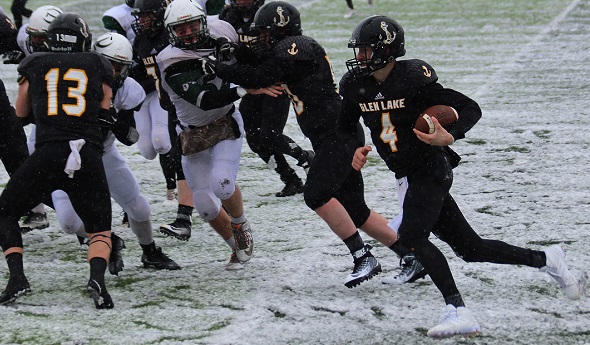
Glen Lake rushed for 309 yards. In addition to Peterson’s 179 yards, Duke Angers picked up 59 and Nick Apsey 54. Apsey also hauled in two catches for 34 yards. The Laker backs – running behind a line that features tackles Jake Palmer and Brandon Tremble, guards Ryan Nadlicki and Zack Gushurst and center Tommy Kendall – averaged nearly five yards a carry. Nadlicki’s uncle, Mike, was a star on Traverse City’s state championship team in 1988.
“The weather forced us to be very one-dimensional (Saturday), but we’re real pleased with our ability to run the football as well as throw it,” Tim Peterson said. “That’s a good combination to have when you go deep into the playoffs because you never know what the weather will be.”
For the season, Cade Peterson’s completed 106 of 207 passes for 1,953 yards and 20 touchdowns. Jared Jackson, last year’s starting quarterback, has caught 30 passes, Apsey 23.
The 6-foot-4, 190-pound Peterson leads the team in rushing with 843 yards. Apsey, also a junior, has added 791 yards.
Defensively, Duke Angers, a four-year starter, is averaging 10 stops a game and Tony Duperon seven. Glen Lake is surrendering less than 200 yards in offense per game. Angers was the Traverse City Record-Eagle’s Defensive Player of the Year a year ago.
“As a football coach, he’s one of the best leaders and overall players that I’ve ever been associated with,” Jerry Angers said.
Jerry Angers led Glen Lake to back-to-back 9-2 seasons in 2012-13. The Lakers reached the District Finals those years.
Glen Lake qualified for the playoffs a year ago, finishing 5-5. This season, with a number of experienced players returning, coupled with the addition of Cade and Drew Peterson, the team has flourished. Drew is a sophomore defensive end and receiver. He had an interception Saturday.
Cade Peterson was a two-year starter at Lake City, throwing for 1,753 yards and 19 touchdowns as a sophomore.
“I feel a big part of why I’ve been successful (at Glen Lake) is because of how welcoming everybody was – not only the team and coaches, but the school and community,” he said.
“When those two (Peterson) boys walked in, our kids just grabbed them and said, ‘Hey, let’s go. You’re part of us now,’” Jerry Angers added.
Tim Peterson retired as a principal in June of 2015. He coached the Trojans that fall, but after the school year the family decided to make a move. Peterson was familiar with the Glen Lake area, since he worked camps with Hollenbeck. He was also good friends with Angers.
“It was time for a change,” Peterson explained. “We came up and looked at the academic piece of it, which is most important to us, and we said this is where we want to go.
“We’ve always said, at some point, we’d like to get here. This community is so supportive of their kids and of their school and that’s what you look for as a parent.”
Now the Lakers are one win away from a second MHSAA title. Regardless of what happens, though, Duke Angers said he believes his senior class has made an impact.
“We raised the bar a little,” he said. “We wanted to leave a trail to follow – and I think we have.”
 Dennis Chase worked 32 years as a sportswriter at the Traverse City Record-Eagle, including as sports editor from 2000-14. He can be reached at [email protected] with story ideas for Manistee, Wexford, Missaukee, Roscommon, Ogemaw, Iosco, Alcona, Oscoda, Crawford, Kalkaska, Grand Traverse, Benzie, Leelanau, Antrim, Otsego, Montmorency, Alpena, Presque Isle, Cheboygan, Charlevoix and Emmet counties.
PHOTOS: (Top) Maple City Glen Lake’s Nick Apsey (5) follows his blockers on the way to the end zone during Saturday’s Semifinal win over Leroy Pine River. (Middle) Wes Peplinski (68) drops the Pine River quarterback in the 34-20 victory. (Photos by Kim Jackson.)
St. Patrick Immediately Sets Tone On Way to Claiming 1st Title Since 1992
By
Jason Juno
Special for MHSAA.com
November 22, 2025
MARQUETTE — Portland St. Patrick has been no stranger to the MHSAA Finals since moving to 8-player football, but the Shamrocks had come up short of a title in three appearances since 2017.
They were back in the Division 2 championship game Saturday, and again facing a team from the Upper Peninsula, just like the other three times. But this time, St. Patrick made it clear from the opening kick it had no intention of going back below the Mackinac Bridge without the championship trophy.
The Shamrocks rode the momentum from a fast start and blanked Felch North Dickinson 53-0 at the Superior Dome.
“It means a lot,” St. Patrick senior back Brady Leonard said with the trophy in his hand. “Having a couple classes before us come here and not be able to finish the job, it was not just for our team, but it was for everyone that came and wasn’t able to finish it.”
Aiden Fandel set the tone when he took the opening kick to the Nordics’ 3-yard line. Jerryd Scheurer ran three yards on the first play from scrimmage, and Leonard ran in the conversion for an 8-0 lead just 20 seconds into the game.
 “It was huge, just to flip the field position right away was a big deal,” St. Patrick coach Patrick Russman said.
The Shamrocks scored two more times during the first quarter, taking advantage of excellent field position.
St. Patrick’s Tyler Thelen blocked a punt to set up its next score. The Shamrocks took over at the North Dickinson 9, and Charlie Thelen caught a four-yard pass from Scheurer on the second play of the drive for a 14-0 lead.
The Nordics went for it on fourth-and-1 at their own 29 on the ensuing possession, but they were stuffed for no gain, giving St. Patrick the ball not far from the red zone.
Leonard ran eight yards for the touchdown and a 20-0 lead with 5:34 still left in the first quarter.
What a start.
"It was very important," Leonard said. "We knew if we came off hot, we knew that we'd be able to punch them in the mouth and we'd get off to the start that we normally have.”
The Shamrocks scored two more times in the first half, both on runs by Hudson King, who led with 120 yards on 10 carries. His 30-yarder came just seven seconds into the second quarter, and his 21-yard rush gave them a 33-0 lead that held until halftime.
The Nordics drove into St. Patrick territory twice in the period. The first stalled at the 44 when the game was still within reach at 26-0. The second got all the way to the 24, but incomplete passes on third and fourth downs gave St. Patrick the ball back with four seconds on the first-half clock.
North Dickinson just couldn’t overcome that start, or the talent level of the Shamrocks.
“We’ve been punched in the mouth before, but they’re way better,” Nordics coach Mike Christian said. “They were just so much better than us today. They’re bigger, faster, stronger. We just couldn’t get anything going.”
 The second half proved to be more of the same. St. Patrick reached the end zone three more times, on short runs by Caleb Pline and two players listed as linemen, Logan Krieger and Nick Pung.
St. Patrick finished a perfect 13-0, and went unbeaten even with a tough schedule. Russman said the Shamrocks started off with tough Mid-State Activities Conference foes Merrill and Morrice. They ended the regular season with a win over eventual Division 1 runner-up Blanchard Montabella. Their playoff run included wins over Mendon, ranked No. 1 in the final media poll of the season, and last year’s Division 1 champion, Deckerville.
“We didn’t have any time to not be ready this year,” Russman said. “We’ve had a pretty good run of some very quality football teams throughout the stretch of the year. They didn’t give us any rest, so the kids did a good job of getting ready each week. Sometimes you slip, and these guys didn’t slip.”
He credited the team’s chemistry for the special season. The practices were superb all year. And they of course had some really good players.
“Our line has been working hard and they just continued to grind it out today, and our backs finished plays on the offensive end,” Russman said. “We’ve been trying to get a faster and faster defense each week, and I think they’ve really done that and accepted that challenge.”
St. Patrick’s last Finals win came when it was playing 11-player football in 1992, in Class D. North Dickinson was seeking its first championship but had to settle for its second runner-up finish (11-player, Class D, 1998).
The Nordics’ 17-game winning streak came to an end. They finished at 12-1 this year after winning their final five games last season.
North Dickinson canceled its varsity season in 2023, announcing at the time that it would play a JV schedule with only four upperclassmen on the roster. Two years later, the Nordics made it to the final game.
“My seniors would have been sophomores then,” Christian said. “I didn’t want to throw them into that right away. This is kind of what we were aiming for when we did that.”
It all worked out. Missing the playoffs last year proved to be a good motivator as well.
“They really put the extra work in,” he said. “They’re such great kids, and they worked their tails off all summer and I’m just so proud of them.”
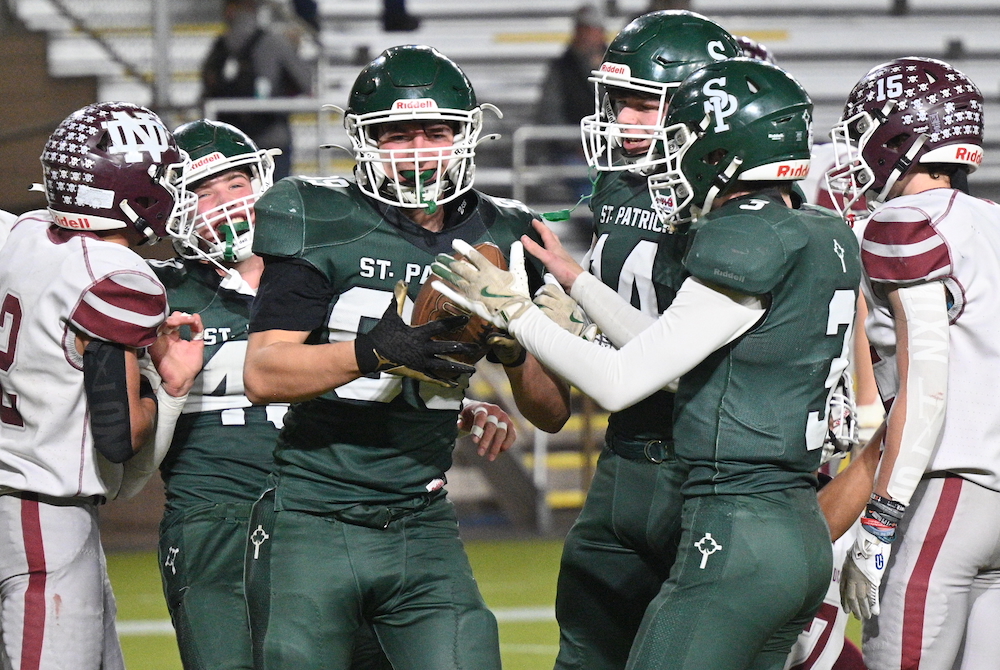
PHOTOS (Top) Portland St. Patrick players celebrate a touchdown Saturday at Superior Dome. (Middle) North Dickinson quarterback Brady Jungwirth (15) works to pull away from a tackler. (Below) The Shamrocks’ Charlie Thelen (12) goes high to pull in a pass. (Click for more from Cara Kamps.)