


Going on Offense
March 3, 2015
I was a defensive back on my college football team, but I refuse to be put on the defensive about the game of football.
The game is good for students, their schools and our communities. High school football is character-building for students, spirit-building for schools and community-building for cities and towns. Local school football programs ought to be part of the development plans and place-making strategies of all communities of Michigan.
The school-sponsored game has never been safer to play. The equipment has never been more protective, coaches have never had more safety training, the rules have never been more safety-oriented, and game officials have never had more encouragement to enforce those rules. The result is fewer injuries of all kinds – from nicks and bruises to ankles, knees and necks.
When the game of football has faults, we find and fix them. To continue doing so requires that we be honest with ourselves about where the game has weaknesses and be constantly alert to effective ways to improve the game.
Defensiveness gets in the way of discovering ways to go on offense. It blocks innovation and sacks aspirations before they can be launched.
I want our public to know that school-sponsored football is a great game. I also want the public to know that we aspire to keep improving the game and to exceed legal mandates. We will continue to do more than what is required and, in fact, we intend to do what’s unexpected to assure football remains a positive influence on students, schools and communities.
1st & Goal: 2024 Week 8 Preview
By
Geoff Kimmerly
MHSAA.com senior editor
October 18, 2024
It all comes down to this weekend for several of this football season's league title races across Michigan.
 As one might expect at this late date, Week 8’s schedule is filled with clashes that will be remembered for decades by those who are part of them over the next two days.
All but one of our featured matchups have league championship implications, as do several more that will be played this week across both peninsulas.
Games listed below are tonight unless noted, with results posting as they are reported all weekend on the MHSAA Scores page. Updated standings also are available by clicking the schools on the score list, and every division’s playoff points summary updates as well as scores are received.
Bay & Thumb
Frankenmuth (7-0) at Freeland (7-0) WATCH
Another year, another opportunity for these two to play for a Tri-Valley Conference title. The Red championship is again on the line, as is Frankenmuth’s 65-game league winning streak going back to 2014. The Eagles have defeated Freeland in five straight, including 38-13 last season when both entered undefeated as well. The Falcons’ defense has been exceptional this season, with four shutouts and no more than six points given up in a game before allowing 27 last week to Bay City John Glenn. The Eagles will counter with an offense that hasn’t scored fewer than 41 points since a season-opening 22-0 shutout of Goodrich.
Keep an eye on these FRIDAY North Branch (5-2) at Almont (7-0) WATCH, Goodrich (6-1) at Fenton (7-0) WATCH, Grand Blanc (6-1) at Davison (6-1), Clare (6-1) at Pinconning (5-2) WATCH.
Grater Detroit
Detroit Cass Tech (5-2) vs. Detroit Martin Luther King (6-1) at Ford Field WATCH
This is another annual rematch, for the Detroit Public School League City title, with these two playing each other for the second time in the same season for the fifth-straight year. King won the first meeting this season 18-12 in overtime in Week 4, and over the last four years the winner of the first game has won the rematch as well three times – including Cass Tech claiming both a year ago. The Technicians’ defense has remained stellar, giving up just six points with two shutouts in its three games since the first loss to the Crusaders, while King has two shutouts as well over its last three games.
Keep an eye on these FRIDAY Clarkston Everest Collegiate (7-0) at Royal Oak Shrine Catholic (6-1), Dearborn Fordson (5-2) at Belleville (7-0) WATCH, Gibraltar Carlson (6-1) at Allen Park (6-1), Ann Arbor Father Gabriel Richard (5-2) at Macomb Lutheran North (6-1) WATCH, Detroit Central (5-2) vs. Detroit Denby (5-2) at Ford Field WATCH.
Mid-Michigan
Brighton (6-1) at Howell (7-0) WATCH
Howell has already clinched a share of the Kensington Lakes Activities Association West championship thanks to last week’s 35-21 win over Novi. But Brighton can mash things up tonight, as a Bulldogs win would create a three-team title share between Howell, Brighton and Novi. The Highlanders and Bulldogs have split their last four meetings, with Howell winning last year’s 43-7. Brighton’s only loss this fall was 37-34 to Novi in Week 4 – but the Bulldogs also have shown the ability to pull out a close win with one-point victories over Northville and Plymouth.
Keep an eye on these FRIDAY Ogemaw Heights (6-1) at Harrison (7-0), Lansing Sexton (4-3) at Portland (7-0), Lansing Catholic (5-2) at Olivet (5-2) WATCH, Walled Lake Western (7-0) at Mason (6-1).
Northern Lower Peninsula
East Jordan (5-2) at Frankfort (6-1) WATCH
These two will hold out hope for a Mancelona win over Maple City Glen Lake in Week 9 – a victory by the Ironmen next week would give tonight’s winner a share of the Northern Michigan Football League Legacy title. But in the meantime, Frankfort and East Jordan also are setting up playoff position, with Frankfort entering this week No. 15 on the Division 8 playoff points list and East Jordan just one spot behind at No. 16. A home playoff game very well could be on the line, and every little advantage counts as these two have played four straight games decided by six or fewer points – including the Red Devils’ 38-36 victory in East Jordan a year ago.
Keep an eye on these FRIDAY Oscoda (5-2) at Boyne City (5-2) WATCH, Montague (3-4) at Manistee (4-3) WATCH, Bay City Western (2-5) at Traverse City West (4-3) WATCH, Kalkaska (2-5) at Kingsley (5-2) WATCH.
Southeast & Border
Clinton (6-1) at Hudson (6-1) WATCH
The Lenawee County Athletic Association title comes down almost completely to this matchup, as these two are tied atop the standings with two league games to play and the winner tonight clinching a share of the championship. Clinton won it outright last year, with Hudson finishing runner-up thanks to a 29-0 Redwolves victory in the regular-season finale. The Tigers’ lone loss this season came to still-undefeated Fowler, and they haven’t been challenged much since. Clinton also opened with a defeat, to also still-undefeated Monroe St. Mary Catholic Central, and since has advanced through four wins by 10 or fewer points.
Keep an eye on these FRIDAY Bronson (5-2) at Springport (6-1) WATCH, Brooklyn Columbia Central (3-4) at Hanover-Horton (7-0) WATCH, Grass Lake (4-3) at Leslie (7-0) WATCH, Manchester (5-2) at Michigan Center (3-4) WATCH.
Southwest Corridor
Kalamazoo United (6-1) at Parchment (6-1)
This is a winner-take-all for the Southwestern Athletic Conference Lakeshore championship, and both are bringing significant momentum into this matchup. Parchment downed last season’s champion Constantine last week 51-30 and has given up 46 points total this season not counting its 48-16 loss to Dowagiac in Week 3. United’s loss also came in Week 3, 27-18 to Lawton, and the Titans otherwise have allowed just 41 points this fall with the majority also coming during a 33-21 win over Constantine. United has defeated Parchment in six straight, including the last five as league opponents, but only 30-28 a year ago.
Keep an eye on these FRIDAY Kalamazoo Central (5-2) at Mattawan (4-3), Buchanan (4-3) at Dowagiac (5-2), Portage Northern (4-3) at Kalamazoo Loy Norrix (5-2) WATCH, Saugatuck (5-2) at Lawton (5-2) WATCH.
Upper Peninsula
Kingsford (7-0) at Menominee (7-0)
Kingsford and Menominee also met last season with league title implications, and the Flivvers’ 41-32 victory resulted in a shared Western Peninsula Athletic Conference Copper title between Kingsford and Negaunee, while the Maroons finished tied for third. This time, it’s winner take all. Menominee is coming off a 34-19 win over Negaunee, while Kingsford got its 29-27 Negaunee win in Week 4 and hasn’t been challenged much the last few weeks. The Flivvers have three shutouts and are giving up only seven points per game, a notable detail as Menominee is averaging 50 points per game.
Keep an eye on these FRIDAY Iron Mountain (7-0) at Manistique (4-3) WATCH, Houghton (3-4) at Negaunee (5-2), Bark River-Harris (4-3) at West Iron County (3-4) WATCH. SATURDAY Cadillac (4-3) at Marquette (5-2).
West Michigan
Holland Christian (6-1) at Grand Rapids Northview (7-0)
A week after what has to be considered one of the most memorable wins in program history, Northview must finish the job in the Ottawa-Kent Conference Black against another contender enjoying one of its best seasons in some time. The Wildcats are coming off a 12-3 win over always-powerful Grand Rapids Catholic Central, and Holland Christian’s only defeat came to the Cougars 42-18 the week before. The Maroons rebounded off of that loss with a one-point win last week over one-win Middleville Thornapple Kellogg, but now have a chance at a shared league title if they can prevail tonight – although there haven’t been many down moments for Northview during a run that’s also included wins over Southeastern Conference White champion Chelsea and East Grand Rapids to start the league schedule.
Keep an eye on these FRIDAY Coopersville (5-2) at Big Rapids (6-1) WATCH, Muskegon (3-3) at Byron Center (6-1), Hamilton (5-2) at Grand Rapids West Catholic (5-2), Decatur (6-1) at Hopkins (6-1) WATCH.
8-Player
Pickford (7-0) at Norway (6-1) WATCH
This may end up just the first of multiple meetings between these two this season – they played each other during the regular season and playoffs a year ago – but this matchup carries much more significance than their first last fall as the winner tonight will earn a share of the Great Lakes Eight Conference East title. Pickford is the reigning champ, but Norway played in the GLEC West last season and won that division in similarly dominant fashion. The Panthers did claim both of their 2023 meetings, 40-18 and then 34-16 in a Division 1 Regional Final, and they are averaging 54 points per game and allowing just under seven. But Norway might provide the greatest challenge yet, having kicked things up a notch offensively with an already high-caliber offense averaging 45 points a game.
Keep an eye on these FRIDAY Mendon (7-0) vs. Climax-Scotts (6-1), Pittsford (6-1) at Waldron (5-2), Bellaire (6-1) at Indian River Inland Lakes (7-0) WATCH, Bay City All Saints (6-1) at Kinde North Huron (6-1) WATCH.
MHSAA.com's weekly “1st & Goal” previews and reviews are powered by MI Student Aid, a division within the Department of Lifelong Education, Advancement, and Potential (MiLEAP). MI Student Aid encourages students to pursue postsecondary education by providing access to student financial resources and information. MI Student Aid administers the state’s scholarship and grant programs that help make college Accessible, Affordable and Attainable for you. Click to connect with MI Student Aid and find more information on Facebook and Twitter @mistudentaid.
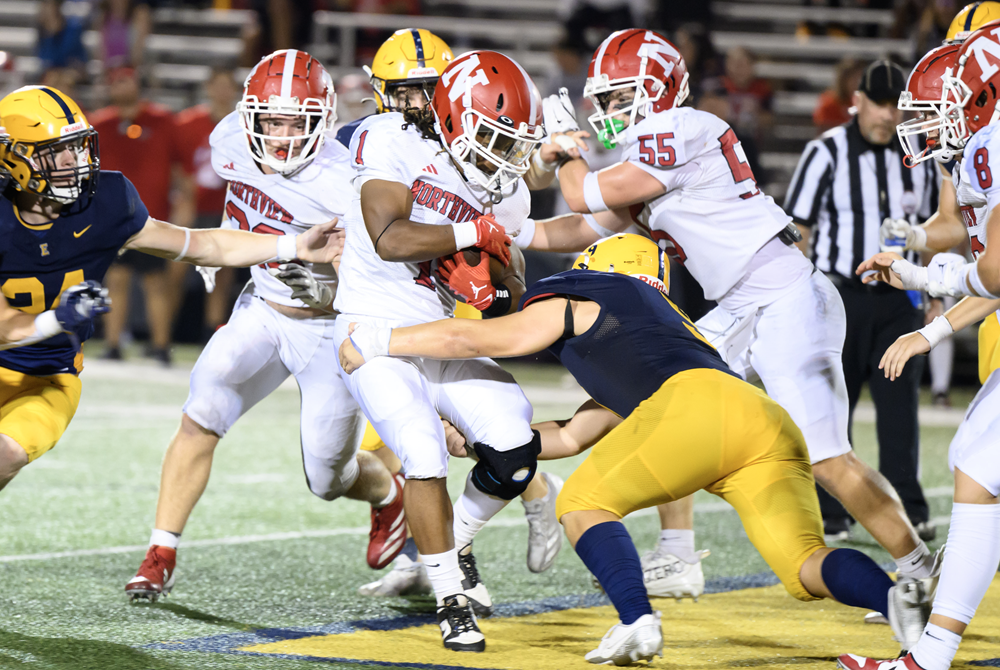
PHOTO Grand Rapids Northview's Jalen Gant (1) works to break a tackle against East Grand Rapids during a Week 4 win. (Photo by Michigan Sports Photo.)