

Grass Lake Thriving But Driving for More
September 13, 2019
By Doug Donnelly
Special for Second Half
GRASS LAKE – Cameron Darrow remembers the play like it was yesterday.
 “It was the third quarter and there was nine minutes left,” the Grass Lake middle linebacker said. “I had 14 tackles in the game already. I came up through the hole and it was raining, and I tackled the running back. As I was lifting him up, my foot got caught in the ground and twisted and popped.”
Darrow broke his ankle in two spots in that game against Addison, which was near the end of his sophomore season. It was a long road back, but the Warriors senior captain made a full recovery. He’s one of the reasons Grass Lake is off to a 2-0 start and has its sights set on a big season.
“We just take it game by game,” Darrow said. “We just want to keep winning. Our goal at the end of every week is to be 1-0.”
The reigning Cascades Conference champions earned a spot in The Associated Press’ Division 6 top 10 poll earlier this week. And going into tonight’s game against East Jackson, the Warriors are in midseason form. Grass Lake beat Stockbridge 58-12 in the season opener and handled Vandercook Lake 51-0 in the first game of league play.
“You can’t argue with how the kids have played,” said 20th-year Grass Lake head coach Randy Cole. “It’s very early in the season, though. We have a long way to go. We just have to keep getting better.”
Over the past six seasons, Cole has employed a high-powered, up-tempo offense. His son Anthony was an assistant coach at Albion College when Cole asked him his thoughts about implementing the offense at Grass Lake. It’s worked.
“It gives us a lot of versatility,” Cole said. “We spread the ball around. We get the ball out quick. It’s fun. The kids like it.”
Grass Lake is used to winning. The Warriors have made the playoffs 13 of the last 14 years and are 145-60, a winning percentage above .700, during Cole’s tenure.
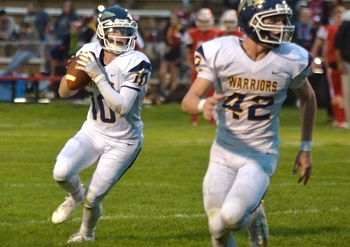 This year’s offense is led by junior quarterback Carson Farley. He’s been dynamite through two weeks, completing 26 of his 30 passes for 440 yards and nine touchdowns. He hasn’t thrown an interception.
“He’s new,” Cole said. “He was our JV quarterback last year. He’s off to a great start. He makes good decisions. He has good knowledge of the offense. We run the same thing on the JV, and he ran it well last year. He knew coming in that he was going to be our quarterback, so he worked hard this summer.”
Farley has spread the ball around. Over just two games, six Warriors have at least one rushing attempt and eight receivers have caught passes. Six of those eight pass-catchers have a touchdown.
“We don’t really have a No. 1 receiver,” Cole said. “We spread it around. We take what the defense gives us.”
Trenton Holden leads the Warriors in rushing with more than 300 yards on nearly 12 yards per carry.
Grass Lake never huddles on offense.
“We don’t even use the word huddle,” Darrow said. “We call it a gathering. The only time we ‘gather’ is late in a game if we are trying to use up the clock.”
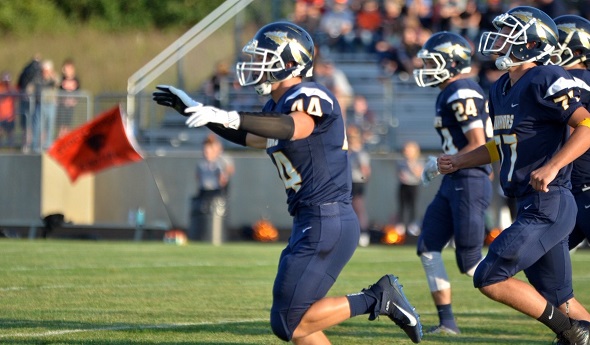
On defense, Darrow is the signal-caller from his middle linebacker spot. He’s been in on 24 tackles over two games – credited with 20 solo tackles and four assists. He has three tackles for loss and one sack.
“He’s the guts and glue of our defense,” said Cole.
Grass Lake’s No. 1 goal, as usual, is to win the Cascades Conference. After that, the Warriors are hoping to make a deeper run in the playoffs. Last season they started 8-0 before losing to eventual Division 8 champion Reading in the Week 9 Big 8 Conference crossover game 55-7 and then to Cascades foe Michigan Center 35-6 in the first round of the playoffs.
“We were humbled,” Darrow said. “We really wanted to be the third team in Grass Lake history to go 9-0 in the regular season, but we just fell short. We definitely have that in the back of our minds. We want revenge and want to make it further in the playoffs.”
During the winter and summer workouts, Darrow said, those two losses were motivation for the Warriors players.
“We had 30 to 40 kids there lifting all summer,” he said. “We talked about those losses. We want to be better this year.”
Darrow, who is one of three team captains along with Gage Lee and Shane Holcomb, said this year’s Warriors are a tight group.
“We play for each other,” he said. “We all have the same goals. We’ve been playing together since the third grade and we just love football. When I was coming back from my injury last year, everyone lifted me up and helped me get back. Not coming back wasn’t an option. I love football too much.
“Football is a brotherhood. We play for each other.”
 Doug Donnelly has served as a sports and news reporter and city editor over 25 years, writing for the Daily Chief-Union in Upper Sandusky, Ohio from 1992-1995, the Monroe Evening News from 1995-2012 and the Adrian Daily Telegram since 2013. He's also written a book on high school basketball in Monroe County and compiles record books for various schools in southeast Michigan. E-mail him at [email protected] with story ideas for Jackson, Washtenaw, Hillsdale, Lenawee and Monroe counties.
PHOTOS: (Top) Cameron Darrow is back leading the Grass Lake defense this season. (Middle) Carson Farley looks downfield for a receiver (Photos courtesy of Amy Farley.)
MHSAA Vault: Shooks a Legend as Freshman Coach
By
Geoff Kimmerly
MHSAA.com senior editor
September 4, 2026
The following originally appeared in the Lansing State Journal on Oct. 28, 2004, and was reprinted by the MHSAA that winter.
Wayne Shooks retired from coaching entirely in 2008 and died Tuesday at the age of 84.
Wayne Shooks tried the varsity football thing once. Some time during the late 1980s, longtime DeWitt coach Gail Thornton asked Shooks to be his offensive coordinator.
“I didn't sleep a night. My wife, after three weeks, said, ‘You're going back to freshmen,’” Shooks remembered.
And those three weeks were in the month of June.
But Shooks' wife must have been on to something. Because few, if any, freshman football coaches have accomplished what Shooks finished with one last win last fall.
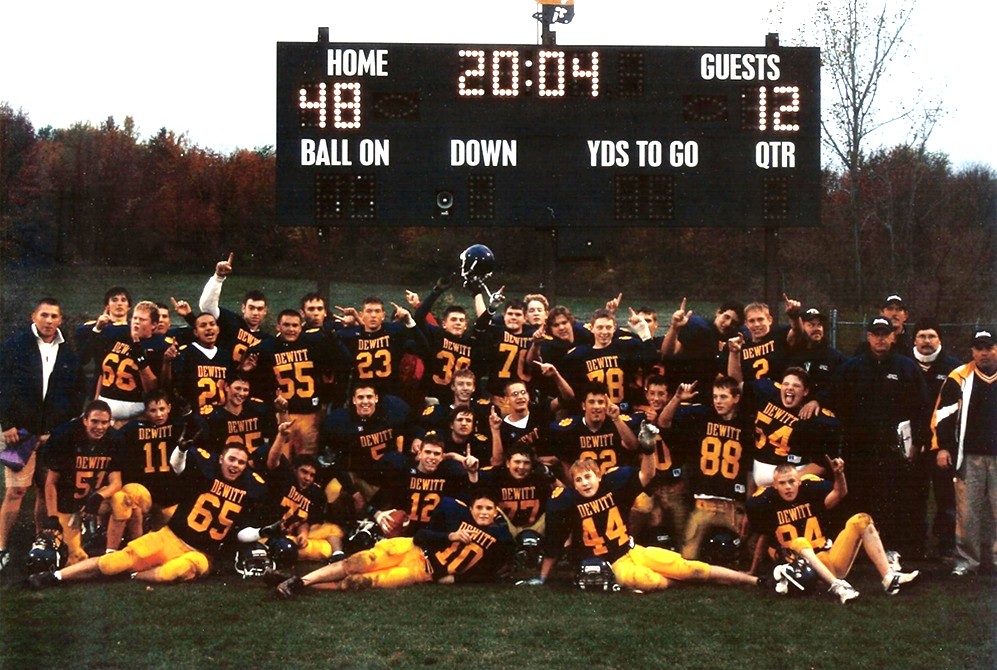
He ended his 16th and final season as freshman coach with a 135-2-1 record.
Amazing.
“You can't lose a game for him, or you'll feel bad,” DeWitt senior Mat Brynick recalled from his days as a freshman. “Coach never says it, but it's what everyone expects.
“He taught us how to win.”
 Guys like Shooks, 62, usually go unappreciated.
They get the kids fresh to high school, fresh to high school sports, and still learning things like not spiking the ball after a touchdown.
But few freshman football coaches are as legendary as Shooks is in DeWitt. They are so unappreciated that it's impossible to find out if anyone has accomplished what he's done.
Shook is not big on numbers. Never has been during his 41 years teaching in the district, or more than 20 coaching everything from football to basketball to wrestling to tennis. Oh, and track since 1980.
He also coached 8th-grade football for a few years, junior varsity for one season and was a varsity assistant. But he'll be remembered for what he did with the freshmen.
The losses came in 1993 to Mason during a terrible wind storm, and in 2002 to Greenville. That same year, the Panthers tied Haslett, meaning it was the only year during his tenure that DeWitt wasn't sure if it finished first in its league, since league titles aren't handed out at the freshmen level.
“The kids felt bad. They did their best,” Shooks remembered.
But the losses, however few, were more of a relief for Shooks than a letdown.
Don't take that to mean Shooks doesn't like to win.
Sure, he embraced the role of teacher as much as any freshman coach. But as DeWitt varsity coach Rob Zimmerman said, “If he was a 5th-grade coach, he'd be the most competitive 5th-grade coach you've ever seen.”
“I never pointed (our record) out, it was not our goal,” Shooks said. “Our goal was to win the next week. Although the kids knew it. They just assumed we were going to go 9-0, I guess.”
Guess so.
Shooks had more easily-attainable goals:
- Have fun
- Learn fundamentals
- Emphasize the logical stuff, like the importance of bringing equipment to school every day
“He does a really good job teaching expectations about being young men and being great students,” Zimmerman said. “It's gigantic.”
And it kept kids coming back to junior varsity and varsity. You could hear the fun coming out in Brynick's voice.
He was remembering his freshman football experience, remembering his time with perhaps Michigan's most successful coach at that level.
“I remember a few games, we'd find one play that works, and we ran it to death, pounding it and pounding it,” Brynick recalled. “He loves running the same play over and over. If you can do that, march 80 yards down the field, you're doing something right. No one could stop us.”
That was not all Brynick remembered, or didn't.
Shooks almost never yelled. If he did, it meant a kid messed something up over and over and over again.
He has a doctorate in zoology. Education is obviously a big deal. He loves to win, but he loves to teach. And he's hesitant to go looking for any attention for what he's done.
All made him a perfect freshmen football coach.
“Sometimes I don't think people understand about coaches. You think college level, they are coaches first, that's their job, but not at the high school level,” Shooks said.
“It's not what I've done, it's what they've done. I've always believed the focus should be on the kids. My job is a teacher. I coach because I love to coach.”
PHOTO DeWitt freshman coach Wayne Shooks, fourth from right, stands for a photo with this final football team in 2004. (Photos courtesy of the DeWitt football program.)