

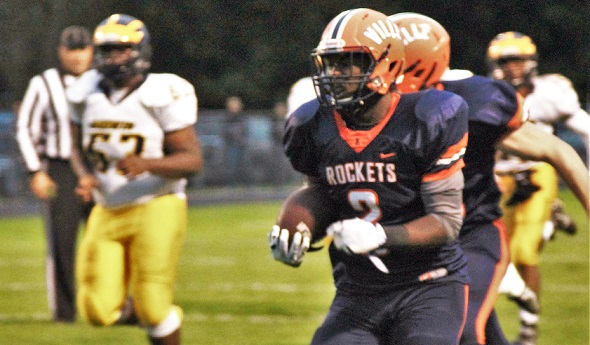
Griggs, Kelloggsville Set to Break Free Again
August 22, 2017
By Dean Holzwarth
Special for Second Half
WYOMING – If opposing teams think it’s going to be easy tackling Thomas Griggs this season, they might want to rethink their approach.
 Griggs, a 5-foot-10, 210-pound running back for the Wyoming Kelloggsville football team, is difficult to stop and a load to bring down.
“He was referred to in the South Bend Tribune last year as a bowling ball with legs,” longtime Rockets head coach Don Galster said. “Those kids did not want to tackle him.”
Just a year ago, Griggs blossomed into one of the top running backs in the Grand Rapids area while leading Kelloggsville to a major turnaround.
The Rockets went 3-6 in 2015, but behind Grigg’s breakout season, finished 8-2 while winning the Ottawa-Kent Conference Silver title with an unbeaten league run.
Those eight were the most wins for a Kelloggsville team since 2009, when it went 10-1.
After a wild 50-47 loss to Whitehall in the opener, Kelloggsville reeled off eight straight wins and advanced to the playoffs. Its season, however, ended in Pre-District play against former conference rival Allendale.
“Last year was really good,” said Griggs, a three-year starter. “Everybody didn’t think we were capable of doing what we did, but our senior class last year put in the hard work. Being able to contribute to last year’s success made me feel even better.”
Griggs rushed for nearly 1,400 yards and tallied 20 touchdowns. He averaged 8.7 yards per carry while wreaking havoc on opposing defenses.
“My stats were good as a sophomore, but we didn’t win a lot of games,” Griggs said. “Coming into my junior year I knew I was going to do better because I worked hard over the summer.”
Griggs, a soft-spoken young man with aspirations to play college football, has a valuable skill set. He’s a punishing hard-nosed runner, but possesses other key attributes.
“What makes him special is he’s got great vision, great feet and he reads blocks very well,” Galster said. “He just doesn’t want to go down, and he has learned how to run the ball in our offense, which has been key.”
As evident by his yards per carry average, it typically takes more than one defender to pull Griggs to the ground. He takes pride in his ability to stay on his feet.
“I always want to break at least one tackle every play,” Griggs said. “I don’t want to let that first person tackle me, and I try to get as many yards as I can.”
 Galster remembers his first encounter with his standout senior. It was an early glimpse into the future.
“He was in eighth grade and the principal brought him over to introduce me to him,” Galster recalled. “I thought, ‘This is a big kid,’ and he just has a ton of ability. He works hard, and he’s a quiet leader. Every year he’s gotten better, and he makes the other guys better.”
Griggs started playing football when he was 7. He actually started out as a center before moving to fullback.
It was a role he embraced.
“In my head, I think I can do anything. So when they put me at center, I had the mindset of I was going to be the best center,” Griggs said.
The Rockets are expected to compete for another conference crown with a bevy of talent back in the fold.
Griggs is one of three returning to the backfield, including dual-threat quarterback Alex Guzman. The Rockets graduated only two seniors on offense.
“There’s not a lot of jealousy with those guys, and it motivates them to work harder,” Galster said. “We have a lot of weapons, but these guys understand that it all starts with the offensive line. If they open holes for them, then we will have some success.”
Griggs said having multiple options on the ground will make it tough for other teams to game plan.
“It’s better for us as a team because other teams can’t come into the game saying they are only going to stop me and then they are going to win,” he said. “We have other players that are going to show up and do what they have to do.”
Kelloggsville’s senior class is a tight-knit group with the potential to duplicate last year’s run.
“As a group, we’re pretty good, and we have that hate-to-lose mentality,” said Griggs, who also averaged 19 points per game as a starting basketball point guard last winter. “I’m glad people have started to notice us, and now we just have to keep it going.”
 Dean Holzwarth covered primarily high school sports for the Grand Rapids Press and MLive for 16 years and more recently served as sports editor of the Ionia Sentinel and as a sports photojournalist for WZZM and WOODTV. Contact him at [email protected] with story ideas for Allegan, Kent and Ottawa counties.
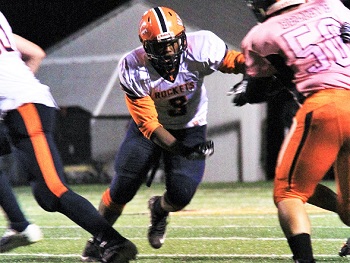
PHOTOS: (Top) Wyoming Kelloggsville's Thomas Griggs runs away from the crowd against Wyoming Godwin Heights. (Middle) Griggs readies to receive a handoff against Belding. (Photos courtesy of the Wyoming Kelloggsville yearbook staff.)
Drive for Detroit: Week 6 Preview
September 28, 2017
By Geoff Kimmerly
Second Half editor
Starting tonight, the playoff field begins to take shape.
 Last week, AuGres-Sims – 5-0 but playing only eight games this regular season – clinched the first playoff berth of the 2017 MHSAA Playoffs. This weekend, 63 more teams can qualify for the 11-player tournament.
Below are the games of most intrigue in every region of the state, not counting 21 games played Thursday night. Go to the MHSAA Score Center to find those and for scores as they come in tonight and Saturday (and for links to each team’s schedule, league standings and playoff points average). Check out MHSAA.tv for six live broadcasts – click here for the schedule.
Bay & Thumb
Almont (4-1) at Richmond (5-0), Friday
The Blue Water Area Conference appears to be a two-team race with Richmond and Algonac tied at 4-0 in league play. But Almont can make it a three-team race again by avenging last season’s 34-21 loss to the Blue Devils. Almont already fell to Algonac in Week 2 28-7; Richmond gets its turn against the Muskrats in Week 8.
Others that caught my eye: FRIDAY Corunna (3-2) at Goodrich (4-1), St. Clair Shores Lake Shore (3-2) at Port Huron Northern (4-1), Unionville-Sebewaing (3-2) at Reese (3-2), SATURDAY Bay City Central (3-2) at Flint Carman-Ainsworth (3-2).
Greater Detroit
Belleville (5-0) at Dearborn Fordson (5-0), Friday
Not only are these teams tied for first in the Western Wayne Athletic Conference Red, but Belleville has the second-highest playoff points average among teams projected to be in Division 1, and Fordson’s average is tied for fourth-highest. Fordson won the WWAC Blue last season and has given up no more than 14 points in a game this fall. The Tigers came into the Red from the Blue with Fordson after finishing second to the Tractors in that league last season – the result of a 34-25 loss in their meeting. The Tigers are riding a streak of three straight shutouts and after giving up only six points in Week 2.
Others that caught my eye: FRIDAY Detroit Martin Luther King (4-1) at Detroit Denby (4-0), Canton (4-1) at Livonia Stevenson (4-1), Southfield Arts & Technology (3-2) at Rochester Adams (4-1), Dearborn Divine Child (5-0) at Warren DeLaSalle (4-1)
Mid-Michigan
Freeland (4-1) at Alma (5-0), Friday
The Falcons’ 24-game regular-season win streak came to an end in Week 4, and Alma will now try to end Freeland’s Tri-Valley Conference Central title streak at two in a row after finishing second in the league last year because of a 12-6 loss when these teams last met. The Panthers have the highest playoff point average among teams projected to play in Division 4 and sit tied for first in the Central with Saginaw Swan Valley, which downed Freeland two weeks ago.
Others that caught my eye: FRIDAY Grand Rapids NorthPointe Christian (5-0) at Belding (4-1), Laingsburg (4-1) at Pewamo-Westphalia (4-1), Lansing Sexton (3-2) at Okemos (4-1), Olivet (5-0) at Lake Odessa Lakewood (5-0).
Northern Lower Peninsula
Frankfort (4-1) at Maple City Glen Lake (2-2), Friday
After finishing Division 6 runner-up last season, Glen Lake loaded up the schedule for this fall – and its losses are to undefeated Traverse City St. Francis and Watervliet. The Lakers came back from an open Week 4 to shut out Charlevoix last week, and they remain the biggest obstacle to Frankfort winning a third straight Northern Michigan Football Conference Leaders division title. The Panthers claimed last year’s championship thanks to a 26-21 win over Glen Lake. They also have only eight regular-season games, with an open date in Week 9, and this looks like the toughest test left before a potentially promising playoff run.
Others that caught my eye: FRIDAY Lincoln Alcona (4-1) at Oscoda (4-1), Benton Harbor (2-3) at Traverse City West (5-0), AuGres-Sims (5-0) at Whittemore-Prescott (2-3), SATURDAY Grayling (4-1) at Traverse City St. Francis (5-0).
Southeast & Border
Ottawa Lake Whiteford (5-0) at Morenci (3-2), Friday
Whiteford hasn’t lost a regular-season game since 2015 and has yet to be challenged since finishing runner-up in Division 8 last season. The Bobcats have outscored their opponents 281-52 and handed Petersburg-Summerfield its only loss in their Tri-County Conference opener. Morenci joins Whiteford as undefeated in the league and with a deceptive overall record – those losses came the first two weeks by a combined three points against Pittsford and Hudson teams that together are 9-1. The Bulldogs have lost twice to Whiteford the last two seasons and beat Whiteford twice in 2014, meaning this could be only chapter one of two again for these rivals.
Others that caught my eye: FRIDAY Climax-Scotts (4-1) at Adrian Lenawee Christian (4-1), Tecumseh (3-2) at Pinckney (4-1), Clinton (3-2) at Petersburg-Summerfield (4-1), Adrian (3-2) at Ypsilanti Lincoln (3-2).
Southwest Corridor
Plainwell (4-1) at Edwardsburg (5-0), Friday
As noted earlier this season, Edwardsburg hasn’t lost a Wolverine B Conference game since 2012 (and now has 29 straight regular-season wins overall). But three teams have only one loss in the league this fall and are ready to pounce – and the Eddies face those three teams over the next three weeks. First up is Plainwell, followed by Three Rivers and then Vicksburg in Week 8. The Trojans have beaten Vicksburg and lost to Three Rivers so far, but given up only 33 points since falling to the Wildcats on opening night. Edwardsburg has given up only 34 points this season – and scored 290.
Others that caught my eye: FRIDAY Parchment (4-1) at Berrien Springs (4-1), Jackson Lumen Christi (4-1) at Coldwater (4-1), Schoolcraft (4-1) at Constantine (3-2), Paw Paw (3-2) at Vicksburg (4-1).
Upper Peninsula
Escanaba (4-1) at Menominee (4-1), Friday
This will be the 121st meeting between the Great Northern Conference rivals, and Menominee holds a 66-51-3 edge in the longtime rivalry. The Maroons swung the advantage their way with 18 straight wins over the Eskymos, including by 28-14 last year in the game that ended up deciding the league title. This will be Menominee’s first game against an in-state opponent after five versus Wisconsin teams to start the fall. It may be the Maroons’ toughest remaining before the playoffs; Escanaba’s lone loss was to much-improved Petoskey in Week 2.
Others that caught my eye: FRIDAY Hurley, Wis. (4-2) at Hancock (4-1), Calumet (3-2) at Iron River West Iron County (4-1), Negaunee (2-3) at Ishpeming (2-3), Norway (5-0) at Munising (3-2).
West Michigan
East Grand Rapids (5-0) at Grand Rapids Christian (5-0), Friday
The west side of the Lower Peninsula is loaded with outstanding matchups this weekend. But this one rises to the top as a rematch of last season’s decider in the Ottawa-Kent Conference Gold in addition to featuring one of the best rivalries in the Grand Rapids area. Christian and EGR rank third and fourth, respectively, in playoff point average among teams projected to play in Division 3. Christian also started 5-0 last year before falling to the Pioneers 28-7 in Week 6, and this time East Grand Rapids has been more dominating with two straight shutouts while giving up only 42 points total so far.
Others that caught my eye: FRIDAY Wyoming Kelloggsville (5-0) at Wyoming Godwin Heights (5-0), Remus Chippewa Hills (4-1) at Reed City (4-1), Rockford (3-2) at Grandville (4-1), Morley Stanwood (5-0) at Kent City (5-0).
8-Player
Deckerville (5-0) at Morrice (5-0), Friday
From a numbers standpoint, these North Central Thumb League Stars contenders are nearly even; both are 4-0 in league play, Deckerville outscoring its opponents 214-40 this season and Morrice by a 223-46 margin. But the Eagles are the team to beat in at least the Lower Peninsula until proven otherwise, with 16 straight regular-season wins and after finishing 8-player runner-up a year ago – when they also beat Morrice 46-6. That said, the Orioles handed Flint International Academy its first loss last week and should make this game much more even as well.
Others that caught my eye: FRIDAY Camden-Frontier (5-0) at Bellevue (5-0), Flint International Academy (4-1) at Lawrence (3-2), Ontonagon (3-1) at Stephenson (5-0), SATURDAY Suttons Bay (3-2) at Central Lake (5-0).
Second Half’s weekly “Drive for Detroit” previews are powered by MI Student Aid, a part of the Student Financial Services Bureau located within the Michigan Department of Treasury. MI Student Aid encourages students to pursue postsecondary education by providing access to student financial resources and information, including various student financial assistance programs to help make college more affordable for Michigan students. MI Student Aid administers the state’s 529 savings programs (MET/MESP) and eight additional aid programs within its Student Scholarships and Grants division. Click for more information and connect with MI Student Aid on Facebook and Twitter @mistudentaid.
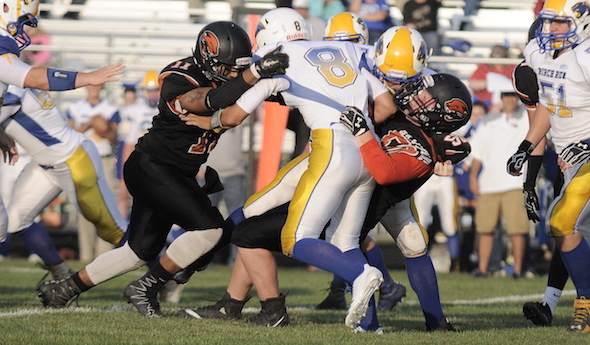
PHOTO: Alma defenders wrap up a Birch Run ball carrier during a 21-10 win on opening night. (Click for more from HighSchoolSportsScene.com.)