

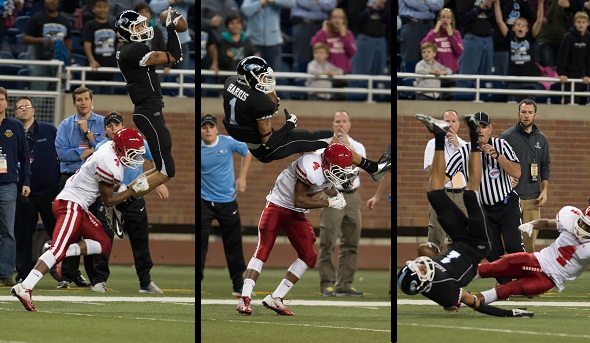
Harris Flies Like a Record-Setting Eagle
By
Geoff Kimmerly
MHSAA.com senior editor
November 30, 2012
Drake Harris may not have expected the full force of the performance he put up Saturday to cap an incredible junior season for Grand Rapids Christian.
But he had a pretty good idea at the start that it could turn into a special night.
When Orchard Lake St. Mary’s attempted to cover him with just one player – and continued to do so frequently throughout the Division 3 Final at Ford Field – the 6-foot-4, 180-pound Harris found himself in a dream come true.
“I kinda figured they would come out like that and play me like that. My coach knew that, and he just put me in the right position to make plays,” Harris said. “And I was happy they came out like that.
“I’m not the type to brag on myself. But when I see that, man-to-man coverage, that’s my dream. I love when people go man, and no safety over the top. It’s just me and the DB. The better man wins.”
Harris gets a Second Half High 5 this week after probably the most victorious day in his young career.
He grabbed eight passes for an MHSAA Finals record 243 yards and a touchdown as the Eagles beat St. Mary’s 40-37 in overtime to claim their first football championship.
Saturday’s numbers gave him, unofficially, 91 catches for 2,015 yards and 25 scores this fall. While those totals still must be confirmed for record book purposes, the yardage will be the most in MHSAA history for one season and rank 12thnationally. His yards per game this fall will rank fourth nationally and his yards per catch sixth. His catches will rank fourth in MHSAA history and his touchdown catches second.
Harris has committed to sign next fall with Michigan State for basketball and then the following February for football too. He’s expected to do big things again this winter for a Grand Rapids Christian basketball team that advanced to the Class A Quarterfinals last season.
Hoops always was his sport – he wasn't sure at one point that he’d even play football in high school. But Harris said Spartans men’s basketball coach Tom Izzo told him he loves players who are on their football teams as well. And Harris said he is starting to realize his football future might be the brighter of the two.
Saturday couldn't have hurt that observation.
Harris caught passes of 49 and 22 yards before hauling in a 74-yard scoring strike early in the second quarter. He had an 85-yarder called back during the third quarter, but caught passes of 24 and 38 yards to set up a touchdown early in the fourth. He then caught his final three passes during the team’s final possession of regulation, gaining a total of 36 yards in helping to set up Joel Schipper’s 28-yard game-tying field goal with four seconds left.
One catch will live on in Finals memory for years to come. In the fourth quarter, Harris went so high as to nearly jump over his defensive back. The defender tackled his legs mid-air, dumping Harris back-first into the turf. But Harris held on, and the Eagles continued to move.
After gaining more than 1,000 yards receiving as a sophomore too, Harris will need only 609 as a senior to set that MHSAA career record. He needs 66 catches and four for touchdowns to tie those records. And if a record was kept for highlight-reel catches, he might already be the holder.
“People don’t necessarily think he’s tough or something. But to have a guy go up 3-4 feet in the air and get flipped, catch the ball and land on his back or head; that’s pretty tough in my book,” Grand Rapids Christian senior quarterback Alex VanDeVusse said. “I’d take him on my team every single day. He’s amazing.”
PHOTO: Drake Harris went high to make this grab during the fourth quarter of Saturday's Division 3 Final against Orchard Lake St. Mary's. (Click for more from Terry McNamara Photography.)

Best Practices
April 10, 2012
For decades, football has had the greatest participation among high school sports. In recent years it’s become the greatest spectator sport as well. Today, MHSAA Football Playoff revenue exceeds that of Boys and Girls Basketball Tournaments combined. And if I ever want to generate comments to a blog, all I have to do is mention football.
I can write either the most inspired or inane words about most topics, and not generate a comment. But mention “football,” and opinions come fast and usually furious.
So it was with my eyes wide open that I challenged some “sacred cows” in my posting of March 20, questioned some of the standard operating procedures of high school football practice, and predicted that we will soon be making some changes in the sport I played through four years of college and coached in high school and to which I owe more of my character development than any other sport. I knew some readers would call me out of date and out of touch, knowing nothing of my past or my passion.
I knew some readers would challenge any comparison made with college and professional players, asserting that older players need fewer practices with less contact because they already have the skills and techniques of blocking and tackling. However, they miss the fact that it is the younger and still growing body that needs more care and caution, not less. Less hitting, not more. More heat and humidity acclimatization, not less.
I knew some readers would complain about diminishing time to develop young players, overlooking the proliferation of camps, clinics, combines, 7-on-7 leagues and the like which have improved skills and conditioning for many athletes prior to the official start of practice. If that were not true or if we would dial down the out-of-season demands, then I might not join the amassing advocates for reduced in-season practice demands. But sadly, it is true; coaches already have these kids year-round.
On the same day that I posted predictions of changes for football practice policies in Michigan, including more days before pads and fewer days with double sessions, the Georgia High School Association adopted policies that did just that, requiring five days of practice before the first with full pads and prohibiting two-a-day practices on consecutive days.
Such changes reflect the growing body of evidence regarding “best practices” for high school football, including the recommendations of the American Academy of Pediatrics, the Centers for Disease Control and Prevention, and the National Federation of State High School Associations. This train has left the station; and Michigan should be an early stop, an early adopter of practice policies modifications. We put our players, coaches and selves in peril if we ignore the evidence.
I’m embarrassed to say that for too long I avoided this topic because I knew it would bring ridicule. Then recently, a young but experienced head football coach told me that these are the kinds of changes that football needs. Needs to keep the game attractive to kids; and needs to keep the game safe for kids.