

Harris Soars, Eagles Fly to D3 Championship
November 24, 2012
By Bill Khan
Special to Second Half
DETROIT — A funny thing happened on Drake Harris’ way to hoops stardom.
He discovered he’s even greater on the gridiron.
The junior wide receiver didn’t intend to play high school football at Grand Rapids Christian, but now figures that’s his meal ticket in college — and perhaps beyond — after a record-breaking season that culminated with an epic performance in the MHSAA Division 3 championship game against Orchard Lake St. Mary’s.
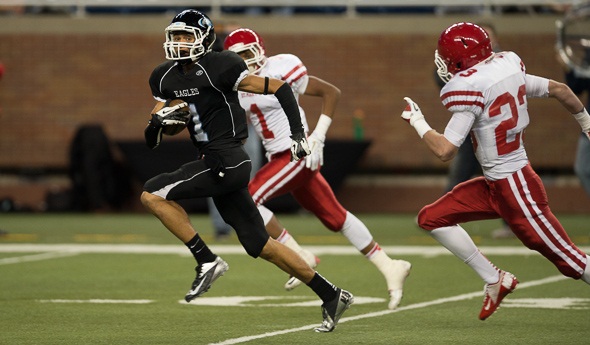
Harris made three clutch catches in the final eight minutes to keep scoring drives alive and finished with a MHSAA Finals record of 243 yards on eight catches in the Eagles’ 40-37 overtime victory Saturday night at Ford Field.
Twice on the game-tying drive, Harris made leaping catches on fourth down. His 7-yarder on fourth-and-three and 15-yarder on fourth-and-eight set up a 28-yard field goal by Joel Schipper with four seconds left in the fourth quarter.
After the Eagles stopped St. Mary’s on fourth-and-three on the first series of overtime, Schipper came out on first down and kicked the championship-clinching 27-yard field goal.
In the process, Harris became only the 12th player nationally and first from Michigan to rack up 2,000 receiving yards for one season. He finished the season with 2,016.
“It’s a great achievement for me,” Harris said. “I have to thank the quarterback, the line and my coaching staff for putting me in the right position to make plays. All I care about is that state championship.”
It's the first for Grand Rapids Christian, which also made its first MHSAA Final appearance and finished this fall 13-1. St. Mary's, last season's Division 3 champion, ended 11-3.
Harris had hoop dreams coming into high school, figuring he would specialize in basketball to enhance his college opportunities. After getting talked into playing football by Eagles coach Don Fellows, Harris discovered a hidden talent. He wound up making a verbal commitment last summer to Michigan State to play both sports, but football may eventually win out.
“I never realized the talent I had for football,” the 6-foot-4, 180-pound Harris said. “I’m putting it all together. I’m going to keep working hard to achieve my goals.
“(MSU basketball coach Tom Izzo) loves players that play football. He told me that. He encouraged me. He’s with me with the whole situation and loves that I play football. I’m kind of starting to lean more towards football. I just feel like I’m probably better in football and that I can go further in football.”
 Grand Rapids Christian quarterback Alex VanDeVusse was 16 for 26 for 307 yards and a touchdown, but deflected any credit for his performance to his outstanding wide receiver. VanDeVusse noted that a couple of Harris’ catches late in the game came on passes that would’ve eluded the grasp of most high school receivers.
“He makes me look really, really good,” VanDeVusse said. “Balls that are behind him, he slows down and catches it with one hand if he has to. Balls that are too high, he jumps and gets flipped. People don’t necessarily think he’s tough or something, but to have a guy go three or four feet in the air to get flipped, catch the ball and land on his back and his head, he’s pretty tough in my book. I’ll take him on my team every single day. He’s amazing.”
VanDeVusse looked to Harris in every clutch situation, of which there were several in a wild fourth quarter.
“We joke around that he’s our toy,” VanDeVusse said. “If you have a toy, you’re going to want to play with it all the time. We use him a lot and he does every bit that we ask of him.”
The Eaglets knew that Harris would be targeted when Grand Rapids Christian needed a big play, but even double coverage couldn’t stop him.
“He makes you shift,” St. Mary’s coach George Porritt said. “You have to bring more people to him. You can’t guard him with one. It might leave somebody else open. He forces you to bring two, maybe three.”
A 42-yard run by VanDeVusse gave Grand Rapids Christian a 20-7 lead with 4:42 left in the first half, but St. Mary’s rallied behind a ground game that rolled up 459 yards to take its first lead at 30-27 with 9:37 left in the fourth quarter.
Harris made a 38-yard catch on third-and-27 with 8:00 remaining, one play before a 32-yard touchdown run by Seth McIntosh put the Eagles ahead 34-30 with 7:45 to go.
St. Mary’s then marched 80 yards in 12 plays to grab a 37-34 lead with 2:06 left on a 3-yard run by Grant Niemiec.
Harris made four catches for 47 yards on the ensuing drive, which culminated in Schipper’s game-tying field goal.
St. Mary’s got the ball first in overtime. A pass by Matt Linehan intended for running back Parker McInnis in the end zone fell incomplete on fourth-and-three.
Grand Rapids Christian didn’t hesitate to bring in Schipper to end the game with his right foot on first down.
“I knew it was a big kick starting off, but I just tried to block it all out,” Schipper said. “It felt just like at practice. Coach puts a lot of pressure on us during the week so these situations don’t come as big in the games. That really helped me. I’m just glad I could get the win for the team tonight.
“He’s got the whole team screaming in my ear in practice when I’m trying to make field goals. That really helps in this environment.”
St. Mary’s lost, despite setting a finals record with 579 yards of total offense. The teams combined for a record 1,033 yards.
McInnis ran 25 times for 269 yards, while Niemiec carried 28 times for 168 yards and three touchdowns for St. Mary’s.
Click for full statistics and to watch a replay of the game.
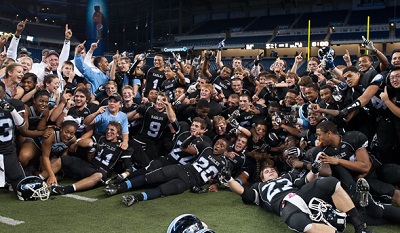
PHOTOS: (Top) Grand Rapids Christian receiver Drake Harris runs away from two Orchard Lake St. Mary's defenders for some of his record-breaking yardage Saturday. (Middle) The Eagles celebrate their first MHSAA championship. (Click for more from Terry McNamara Photography.)

Best Practices
April 10, 2012
For decades, football has had the greatest participation among high school sports. In recent years it’s become the greatest spectator sport as well. Today, MHSAA Football Playoff revenue exceeds that of Boys and Girls Basketball Tournaments combined. And if I ever want to generate comments to a blog, all I have to do is mention football.
I can write either the most inspired or inane words about most topics, and not generate a comment. But mention “football,” and opinions come fast and usually furious.
So it was with my eyes wide open that I challenged some “sacred cows” in my posting of March 20, questioned some of the standard operating procedures of high school football practice, and predicted that we will soon be making some changes in the sport I played through four years of college and coached in high school and to which I owe more of my character development than any other sport. I knew some readers would call me out of date and out of touch, knowing nothing of my past or my passion.
I knew some readers would challenge any comparison made with college and professional players, asserting that older players need fewer practices with less contact because they already have the skills and techniques of blocking and tackling. However, they miss the fact that it is the younger and still growing body that needs more care and caution, not less. Less hitting, not more. More heat and humidity acclimatization, not less.
I knew some readers would complain about diminishing time to develop young players, overlooking the proliferation of camps, clinics, combines, 7-on-7 leagues and the like which have improved skills and conditioning for many athletes prior to the official start of practice. If that were not true or if we would dial down the out-of-season demands, then I might not join the amassing advocates for reduced in-season practice demands. But sadly, it is true; coaches already have these kids year-round.
On the same day that I posted predictions of changes for football practice policies in Michigan, including more days before pads and fewer days with double sessions, the Georgia High School Association adopted policies that did just that, requiring five days of practice before the first with full pads and prohibiting two-a-day practices on consecutive days.
Such changes reflect the growing body of evidence regarding “best practices” for high school football, including the recommendations of the American Academy of Pediatrics, the Centers for Disease Control and Prevention, and the National Federation of State High School Associations. This train has left the station; and Michigan should be an early stop, an early adopter of practice policies modifications. We put our players, coaches and selves in peril if we ignore the evidence.
I’m embarrassed to say that for too long I avoided this topic because I knew it would bring ridicule. Then recently, a young but experienced head football coach told me that these are the kinds of changes that football needs. Needs to keep the game attractive to kids; and needs to keep the game safe for kids.