

Harris Soars, Eagles Fly to D3 Championship
November 24, 2012
By Bill Khan
Special to Second Half
DETROIT — A funny thing happened on Drake Harris’ way to hoops stardom.
He discovered he’s even greater on the gridiron.
The junior wide receiver didn’t intend to play high school football at Grand Rapids Christian, but now figures that’s his meal ticket in college — and perhaps beyond — after a record-breaking season that culminated with an epic performance in the MHSAA Division 3 championship game against Orchard Lake St. Mary’s.
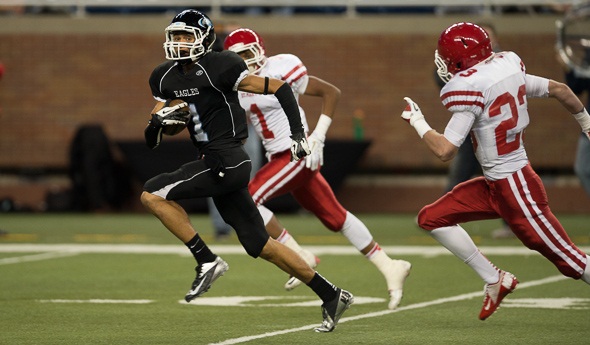
Harris made three clutch catches in the final eight minutes to keep scoring drives alive and finished with a MHSAA Finals record of 243 yards on eight catches in the Eagles’ 40-37 overtime victory Saturday night at Ford Field.
Twice on the game-tying drive, Harris made leaping catches on fourth down. His 7-yarder on fourth-and-three and 15-yarder on fourth-and-eight set up a 28-yard field goal by Joel Schipper with four seconds left in the fourth quarter.
After the Eagles stopped St. Mary’s on fourth-and-three on the first series of overtime, Schipper came out on first down and kicked the championship-clinching 27-yard field goal.
In the process, Harris became only the 12th player nationally and first from Michigan to rack up 2,000 receiving yards for one season. He finished the season with 2,016.
“It’s a great achievement for me,” Harris said. “I have to thank the quarterback, the line and my coaching staff for putting me in the right position to make plays. All I care about is that state championship.”
It's the first for Grand Rapids Christian, which also made its first MHSAA Final appearance and finished this fall 13-1. St. Mary's, last season's Division 3 champion, ended 11-3.
Harris had hoop dreams coming into high school, figuring he would specialize in basketball to enhance his college opportunities. After getting talked into playing football by Eagles coach Don Fellows, Harris discovered a hidden talent. He wound up making a verbal commitment last summer to Michigan State to play both sports, but football may eventually win out.
“I never realized the talent I had for football,” the 6-foot-4, 180-pound Harris said. “I’m putting it all together. I’m going to keep working hard to achieve my goals.
“(MSU basketball coach Tom Izzo) loves players that play football. He told me that. He encouraged me. He’s with me with the whole situation and loves that I play football. I’m kind of starting to lean more towards football. I just feel like I’m probably better in football and that I can go further in football.”
 Grand Rapids Christian quarterback Alex VanDeVusse was 16 for 26 for 307 yards and a touchdown, but deflected any credit for his performance to his outstanding wide receiver. VanDeVusse noted that a couple of Harris’ catches late in the game came on passes that would’ve eluded the grasp of most high school receivers.
“He makes me look really, really good,” VanDeVusse said. “Balls that are behind him, he slows down and catches it with one hand if he has to. Balls that are too high, he jumps and gets flipped. People don’t necessarily think he’s tough or something, but to have a guy go three or four feet in the air to get flipped, catch the ball and land on his back and his head, he’s pretty tough in my book. I’ll take him on my team every single day. He’s amazing.”
VanDeVusse looked to Harris in every clutch situation, of which there were several in a wild fourth quarter.
“We joke around that he’s our toy,” VanDeVusse said. “If you have a toy, you’re going to want to play with it all the time. We use him a lot and he does every bit that we ask of him.”
The Eaglets knew that Harris would be targeted when Grand Rapids Christian needed a big play, but even double coverage couldn’t stop him.
“He makes you shift,” St. Mary’s coach George Porritt said. “You have to bring more people to him. You can’t guard him with one. It might leave somebody else open. He forces you to bring two, maybe three.”
A 42-yard run by VanDeVusse gave Grand Rapids Christian a 20-7 lead with 4:42 left in the first half, but St. Mary’s rallied behind a ground game that rolled up 459 yards to take its first lead at 30-27 with 9:37 left in the fourth quarter.
Harris made a 38-yard catch on third-and-27 with 8:00 remaining, one play before a 32-yard touchdown run by Seth McIntosh put the Eagles ahead 34-30 with 7:45 to go.
St. Mary’s then marched 80 yards in 12 plays to grab a 37-34 lead with 2:06 left on a 3-yard run by Grant Niemiec.
Harris made four catches for 47 yards on the ensuing drive, which culminated in Schipper’s game-tying field goal.
St. Mary’s got the ball first in overtime. A pass by Matt Linehan intended for running back Parker McInnis in the end zone fell incomplete on fourth-and-three.
Grand Rapids Christian didn’t hesitate to bring in Schipper to end the game with his right foot on first down.
“I knew it was a big kick starting off, but I just tried to block it all out,” Schipper said. “It felt just like at practice. Coach puts a lot of pressure on us during the week so these situations don’t come as big in the games. That really helped me. I’m just glad I could get the win for the team tonight.
“He’s got the whole team screaming in my ear in practice when I’m trying to make field goals. That really helps in this environment.”
St. Mary’s lost, despite setting a finals record with 579 yards of total offense. The teams combined for a record 1,033 yards.
McInnis ran 25 times for 269 yards, while Niemiec carried 28 times for 168 yards and three touchdowns for St. Mary’s.
Click for full statistics and to watch a replay of the game.
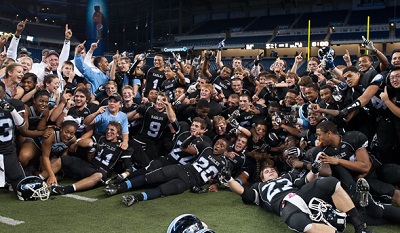
PHOTOS: (Top) Grand Rapids Christian receiver Drake Harris runs away from two Orchard Lake St. Mary's defenders for some of his record-breaking yardage Saturday. (Middle) The Eagles celebrate their first MHSAA championship. (Click for more from Terry McNamara Photography.)

1st & Goal: Playoff Week 1 Preview
October 29, 2020
By Geoff Kimmerly
Second Half editor
During a football season full of new and different this fall, this weekend will be right up there for first-time opportunities.
With the regular season shortened to six games because of COVID-19 precautions, tonight begins the first MHSAA Playoffs with nearly every team in the state taking part. And with more playoff games than ever before, this first round will see 15 games played Thursday night.
The 11-player bracket kicks off with District First Round games, while 8-player begins in the Regional First Round. Click for links to all 10 brackets and monitor the MHSAA Score Center all weekend for scores as they come in.
Spectator limits remain in effect (check with your local school for purchasing information). So if you can’t attend in person, check out one or more of 87 games being broadcast on MHSAA.tv or FOX Sports Detroit.
Let’s take a glance at a game that jumps out from each division this opening weekend. Games below are Friday unless noted.
11-Player
DIVISION 1
Lake Orion (3-2) at Grand Blanc (5-1)
The Bobcats haven’t reached the second round of the playoffs since 2012, but have seemed on the verge of taking a step – and last week’s 14-13 win over previously-undefeated Saline provided an indication the time may be now. Lake Orion had trouble with league rivals Clarkston and West Bloomfield this fall, but has to be one of the stronger five seeds – this District is topped by three undefeated teams.
Keep an eye on these FRIDAY Lapeer (3-3) at Davison (6-0), Utica Eisenhower (2-4) at Clinton Township Chippewa Valley (2-3). SATURDAY East Kentwood (2-3) at Hudsonville (4-2), Detroit Western (5-1) at Dearborn Fordson (4-2).
DIVISION 2
Grand Rapids Forest Hills Northern (4-2) vs. Grand Rapids Forest Hills Central (5-1) at Forest Hills Eastern
Everything looks to be going the Rangers’ way heading into this rematch, as they’ve won all five recent meetings with Forest Hills Northern – including 28-13 in Week 5 – and picked up a share of the Ottawa-Kent Conference White championship with Friday’s win over Lowell. But the Huskies are on a roll too; they’ve won their last four games, all by double digits, and also including a victory over the Red Arrows.
Keep an eye on these FRIDAY Lowell (3-3) at Byron Center (5-1), Warren De La Salle Collegiate (2-4) at Roseville (4-2), Ypsilanti Community (3-3) at Dearborn Heights Crestwood (5-1), Birmingham Groves (3-3) at Auburn Hills Avondale (3-3).
DIVISION 3
Trenton (3-3) at Allen Park (4-2)
These Downriver League rivals also have met in the playoffs the last two seasons. Allen Park won both of those games and also this regular season’s opener, 29-7. But that’s only half the history. Before this fall’s first meeting, Trenton had taken the last three during the regular season. Semi-related, both played Brownstown Woodhaven to nearly matching one-score losses over the last five weeks.
Keep an eye on these FRIDAY Parma Western (4-2) at Battle Creek Harper Creek (4-2), Sturgis (3-3) at Coldwater (4-2), Garden City (3-3) at South Lyon East (4-2), Gibraltar Carlson (4-2) at River Rouge (4-1).
DIVISION 4
Imlay City (4-2) at Croswell-Lexington (5-1)
This is a rematch of a season opener, won by the Pioneers 54-12. But the Spartans have gone on to guarantee their second-straight winning finish (after a string of mostly sub-.500 seasons over the last decade). That said, Croswell-Lexington was a seven-point loss to North Branch from a perfect regular season and league title – also a good improvement story after finishing 4-5 a year ago.
Keep an eye on these FRIDAY Ada Forest Hills Eastern (3-3) at Allendale (3-3), Plainwell (3-2) at Vicksburg (4-2), Armada (3-3) at Goodrich (5-1), Detroit Henry Ford (3-3) at Detroit Country Day (3-2).
DIVISION 5
Belding (5-1) at Hopkins (5-1), Saturday
This is among the most surprising first-round matchups, as these two played for the O-K Silver championship just three weeks ago. Chalk it up to being in a District that includes an unbeaten team and four at 5-1. The Vikings’ got the best of their first meeting with Belding, 34-28, but are coming back off a week off while the Black Knights went on to win their last two games by a combined 108-3.
Keep an eye on these FRIDAY Lake Odessa Lakewood (3-3) at Portland (5-1), South Haven (4-2) at Dowagiac (3-3), Hillsdale (4-2) at Olivet (5-1). SATURDAY Ogemaw Heights (3-3) at Kingsford (3-2).
DIVISION 6
Kent City (5-1) at Clare (6-0)
This is another big-time matchup for the first round, with third-seeded Clare the Jack Pine Conference champion and sixth-seeded Kent City the winner of the Central State Activities Association Silver title. The Eagles’ lone loss came in last week’s finale, 26-20 to Muskegon Orchard View, and they’ll surely be revved up play spoiler this time. But they’ll have to figure out a Pioneers defense giving up only 9.3 points per game in what could be a low-scoring one – Kent City gives up just 8.8 on average.
Keep an eye on these FRIDAY Negaunee (3-3) at Gladstone (2-3), Harrison (4-2) at Sanford Meridian (4-2), Comstock (3-3) at Niles Brandywine (3-3). SATURDAY Flint Hamady (3-3) at Detroit Pershing (3-3).
DIVISION 7
Houghton Lake (4-2) at Evart (4-2)
In just six games, Evart tied its win total from a year ago and best season since 2016. After opening 0-2, the Wildcats got rolling with a 29-22 win over Houghton Lake and now are seeking their first playoff win since 2012. The Bobcats are coming off a loss to undefeated Oscoda but still guaranteed to end with their third winning season in four years. Whoever comes out on top in this rematch will see Highland Conference champ McBain next week.
Keep an eye on these FRIDAY Morley Stanwood (4-2) at Ravenna (3-3), Hesperia (4-2) at Pewamo-Westphalia (5-1), Delton Kellogg (3-3) at Bronson (3-2), Jackson Lumen Christi (2-4) at Hanover-Horton (4-2).
DIVISION 8
Gwinn (3-3) at East Jordan (3-3)
One of these teams will end the night celebrating its first playoff win since 1999 – both are seeking to break a two-decade drought. After a fast start, East Jordan has had some troubles especially on offense the last two weeks – but with one more win, the Red Devils would equal their total from last season. Gwinn is a tough read because two wins came by forfeit. But a 22-14 loss two weeks ago to undefeated West Iron County is an indication the Modeltowners will be up for this challenge.
Keep an eye on these FRIDAY Frankfort (3-3) at Saginaw Nouvel (4-2), Marlette (3-3) at Unionville-Sebewaing (4-2), Saugatuck (3-3) at White Pigeon (3-2). SATURDAY Saginaw Michigan Lutheran Seminary (2-4) at Harbor Beach (3-3).
8-Player
DIVISION 1
Deckerville (4-2) at Merrill (5-1), Saturday
Deckerville had a few stumbles against the co-champions in its league, but few programs have done the playoffs better over the last decade – Deckerville is 16-7 during the postseason since moving to 8-player in 2012. Merrill is the latest new force in 8-player, not entirely surprising after back-to-back 6-4 finishes in 11-player the last two seasons, and will be looking to extend the run into its first playoff win since 2010.
Keep an eye on these THURSDAY Genesee (4-2) at Mayville (6-0). SATURDAY Newberry (3-3) at Onaway (6-0), International Academy of Flint (3-3) at Adrian Lenawee Christian (6-0), Camden-Frontier (2-4) at New Buffalo (3-3).
DIVISION 2
Lake Linden-Hubbell (3-3) at Crystal Falls Forest Park (4-1), Saturday
These longtime league and occasional playoff rivals in 11-player will face off for the first time in 8-player – and first time at all since 2015 since Lake Linden-Hubbell made the format switch this fall. The Lakes are 3-1 on the field and gave undefeated Powers North Central easily its closest game, falling 34-22 two weeks ago. Forest Park has played two games on the field, but both were wins over teams that entered the postseason with .500 records.
Keep an eye on these THURSDAY Rudyard (3-3) at Rapid River (5-1), Climax-Scotts (3-3) at Colon (5-1). SATURDAY Ashley (3-3) at Peck (3-3), Waldron (4-2) at Tekonsha (4-2).
PHOTO by Robert Batzloff.