

Harris Soars, Eagles Fly to D3 Championship
November 24, 2012
By Bill Khan
Special to Second Half
DETROIT — A funny thing happened on Drake Harris’ way to hoops stardom.
He discovered he’s even greater on the gridiron.
The junior wide receiver didn’t intend to play high school football at Grand Rapids Christian, but now figures that’s his meal ticket in college — and perhaps beyond — after a record-breaking season that culminated with an epic performance in the MHSAA Division 3 championship game against Orchard Lake St. Mary’s.
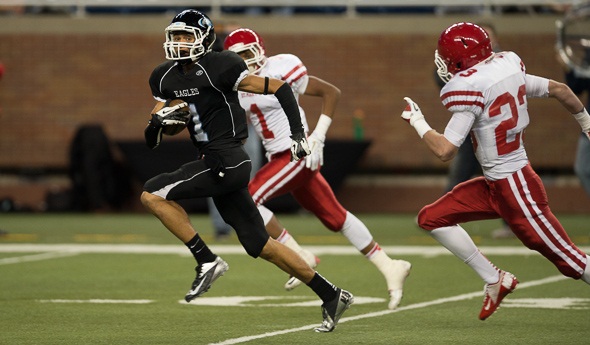
Harris made three clutch catches in the final eight minutes to keep scoring drives alive and finished with a MHSAA Finals record of 243 yards on eight catches in the Eagles’ 40-37 overtime victory Saturday night at Ford Field.
Twice on the game-tying drive, Harris made leaping catches on fourth down. His 7-yarder on fourth-and-three and 15-yarder on fourth-and-eight set up a 28-yard field goal by Joel Schipper with four seconds left in the fourth quarter.
After the Eagles stopped St. Mary’s on fourth-and-three on the first series of overtime, Schipper came out on first down and kicked the championship-clinching 27-yard field goal.
In the process, Harris became only the 12th player nationally and first from Michigan to rack up 2,000 receiving yards for one season. He finished the season with 2,016.
“It’s a great achievement for me,” Harris said. “I have to thank the quarterback, the line and my coaching staff for putting me in the right position to make plays. All I care about is that state championship.”
It's the first for Grand Rapids Christian, which also made its first MHSAA Final appearance and finished this fall 13-1. St. Mary's, last season's Division 3 champion, ended 11-3.
Harris had hoop dreams coming into high school, figuring he would specialize in basketball to enhance his college opportunities. After getting talked into playing football by Eagles coach Don Fellows, Harris discovered a hidden talent. He wound up making a verbal commitment last summer to Michigan State to play both sports, but football may eventually win out.
“I never realized the talent I had for football,” the 6-foot-4, 180-pound Harris said. “I’m putting it all together. I’m going to keep working hard to achieve my goals.
“(MSU basketball coach Tom Izzo) loves players that play football. He told me that. He encouraged me. He’s with me with the whole situation and loves that I play football. I’m kind of starting to lean more towards football. I just feel like I’m probably better in football and that I can go further in football.”
 Grand Rapids Christian quarterback Alex VanDeVusse was 16 for 26 for 307 yards and a touchdown, but deflected any credit for his performance to his outstanding wide receiver. VanDeVusse noted that a couple of Harris’ catches late in the game came on passes that would’ve eluded the grasp of most high school receivers.
“He makes me look really, really good,” VanDeVusse said. “Balls that are behind him, he slows down and catches it with one hand if he has to. Balls that are too high, he jumps and gets flipped. People don’t necessarily think he’s tough or something, but to have a guy go three or four feet in the air to get flipped, catch the ball and land on his back and his head, he’s pretty tough in my book. I’ll take him on my team every single day. He’s amazing.”
VanDeVusse looked to Harris in every clutch situation, of which there were several in a wild fourth quarter.
“We joke around that he’s our toy,” VanDeVusse said. “If you have a toy, you’re going to want to play with it all the time. We use him a lot and he does every bit that we ask of him.”
The Eaglets knew that Harris would be targeted when Grand Rapids Christian needed a big play, but even double coverage couldn’t stop him.
“He makes you shift,” St. Mary’s coach George Porritt said. “You have to bring more people to him. You can’t guard him with one. It might leave somebody else open. He forces you to bring two, maybe three.”
A 42-yard run by VanDeVusse gave Grand Rapids Christian a 20-7 lead with 4:42 left in the first half, but St. Mary’s rallied behind a ground game that rolled up 459 yards to take its first lead at 30-27 with 9:37 left in the fourth quarter.
Harris made a 38-yard catch on third-and-27 with 8:00 remaining, one play before a 32-yard touchdown run by Seth McIntosh put the Eagles ahead 34-30 with 7:45 to go.
St. Mary’s then marched 80 yards in 12 plays to grab a 37-34 lead with 2:06 left on a 3-yard run by Grant Niemiec.
Harris made four catches for 47 yards on the ensuing drive, which culminated in Schipper’s game-tying field goal.
St. Mary’s got the ball first in overtime. A pass by Matt Linehan intended for running back Parker McInnis in the end zone fell incomplete on fourth-and-three.
Grand Rapids Christian didn’t hesitate to bring in Schipper to end the game with his right foot on first down.
“I knew it was a big kick starting off, but I just tried to block it all out,” Schipper said. “It felt just like at practice. Coach puts a lot of pressure on us during the week so these situations don’t come as big in the games. That really helped me. I’m just glad I could get the win for the team tonight.
“He’s got the whole team screaming in my ear in practice when I’m trying to make field goals. That really helps in this environment.”
St. Mary’s lost, despite setting a finals record with 579 yards of total offense. The teams combined for a record 1,033 yards.
McInnis ran 25 times for 269 yards, while Niemiec carried 28 times for 168 yards and three touchdowns for St. Mary’s.
Click for full statistics and to watch a replay of the game.
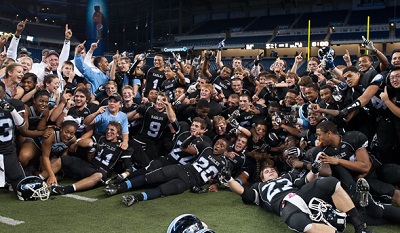
PHOTOS: (Top) Grand Rapids Christian receiver Drake Harris runs away from two Orchard Lake St. Mary's defenders for some of his record-breaking yardage Saturday. (Middle) The Eagles celebrate their first MHSAA championship. (Click for more from Terry McNamara Photography.)
Whiteford Returns to Familiar, but Differently
By
Doug Donnelly
Special for MHSAA.com
August 10, 2020
OTTAWA LAKE – Jason Mensing believes high school football can happen this year safely.
Monday was the first official practice of the 2020 high school football season across Michigan. Thousands of athletes put helmets on and started the journey, including Mensing’s Ottawa Lake Whiteford Bobcats.
Like any other year, Mensing said early-season practices are about finding out the personality of his team and what motivates them.
“Every year is different, without question,” Mensing said. “Every year is a new challenge.”
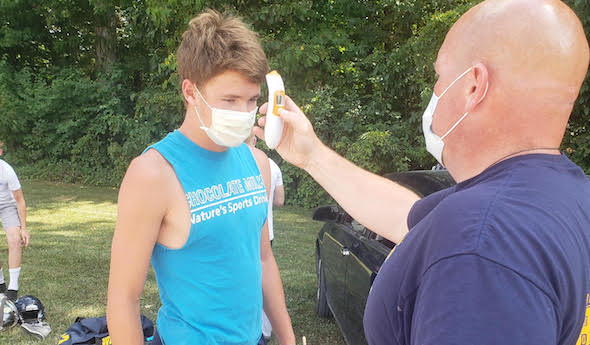
The start of practice this year is certainly unlike any other. While welcoming players, Mensing was busy going through MHSAA safety protocols, including asking a series of health questions and taking the temperature of every player and every assistant coach. With Covid-19 and the worldwide pandemic on everyone’s mind, the football season still started.
“I think the kids just want to be together,” Mensing said. “That’s the biggest thing. A lot of their travel teams that they played on this summer in other sports, those kids might be friends, but those aren’t their classmates. It’s different.”
While practice started Monday, there are still some questions about the upcoming season. For one, teams won’t be able to put on shoulder pads and equipment other than helmets until Aug. 17. In normal years, shoulder pads and then full pads are added gradually during the first week.
Week 1 games this season are scheduled for the final weekend of August, but the MHSAA has not announced yet if competition is cleared to resume. That announcement will be made by Aug. 20.
As a member of the MHSAA’s Representative Council, Mensing has been part of this summer's discussions about Fall sports moving ahead. He’s also part of the Michigan High School Football Coaches Association, serving as its awards chairperson.
He’s a firm believer in football happening this fall.
“It extends beyond football practice,” Mensing said. “It extends to the school experience, to school sports. We know from the last six months that socially and emotionally kids need this outlet. They need to connect. They need to be with one another and with people for their development.”
Mensing points to research that suggests two-thirds of youth today are depressed.
“That’s not acceptable in my world and I think a lot of others,” he said. “We can address that with outlets like arts and athletic programs.”
Playing high school sports, he said, can help teach student-athletes to be safe, to wash their hands, to wear masks during a pandemic and to social distance – in other words, to take the necessary steps to stop the spread of the virus.
 “It’s been very, very apparent to me that our young people, out of their need to socialize and engage with one another, are going to,” he said. “What’s concerning me when it comes to the virus and the transmission of it, is that it’s our job to mitigate that and reduce it so it doesn’t get spread. When there isn’t structure and protocols in place and there isn’t an education about why those structures are necessary, the spread is only going to get worse.
“Through sports and our arts programs, we can establish safe routines to educate people on why we need these protocols and why we need to mitigate and slow the spread of the disease.”
Coaches have a unique opportunity to instill the message into their team members.
“It’s a challenge every day because it’s not what they are doing outside of this,” he said. “It’s definitely a challenge. It’s not natural for people to stay six feet apart or wear a facial mask.”
The Tecumseh native played college football at Adrian College, coached for one year at both Adrian College and Siena Heights University and has been a head coach at Addison, Grayling, Owosso, Tecumseh and is starting his ninth year at Whiteford. His Bobcats won the 2017 Division 8 championship after finishing runners-up the season before.
Among changes to this preseason is the elimination of the scrimmage at the end of the second week of practice. Mensing was fine with that move, he said, because it gives the coaching staff a little more teaching time.
“From an instructional standpoint, I think we can have a little more patience,” he said. “We’re not in such a hurry. Our pace can be a little more reserved. We are three weeks out from playing anyone.”
The Bobcats will be young this season after finishing 5-5 a year ago and making the playoffs for the eighth straight season. They do return three of their top four rushers from last season in senior Devon Shaw (883 yards) and juniors Cole Giesige (668 yards) and Levi Hillard (132 yards). Other returning starters include sophomore quarterback Shea Ruddy, tight end Luke Masserant and all-state offensive lineman Noah Bauman.
“We have a long way to go,” Mensing said.
Returning starters and numbers aside, Mensing is optimistic the season will go forward.
“As long as it’s driven by the science and it’s based around us making sure we are following protocols, yes,” he said. “Ultimately if teams aren’t having transmission of the virus, we will have a safer society. Can it happen? Sure.”
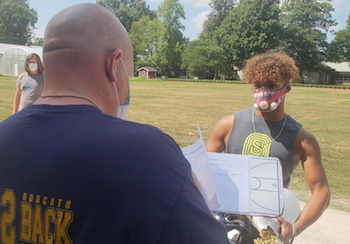
PHOTOS: (Top) Ottawa Lake Whiteford football coach Jason Mensing, right, takes the temperature of Cole Giesige prior to the start of Monday’s first practice of the 2020 season. (Middle) Mensing fills in a questionnaire with Devon Shaw. (Photos by Doug Donnelly.)