

Haslett Saving Big Hits for Game Time
August 16, 2016
By Geoff Kimmerly
Second Half editor
HASLETT – The sound of cleats on pavement. He and his teammates, hand in hand, walking toward the field together minutes before kickoff. Manowar’s “Heart of Steel” ringing in their ears from a few minutes before.
 Justin Kuchnicki gave himself goose bumps Monday describing Haslett’s weekly pregame ritual, which the senior lineman will take part in again beginning Aug. 26 when the Vikings open this season against Remus Chippewa Hills.
They’ll certainly be revved up – and especially to lay some big hits after saving them up during three weeks of non-collision practices.
Haslett has one of the most successful football programs in the Lansing area, with two trips to MHSAA championship games and 14 playoff appearances total over the last 18 seasons. The Vikings finished 6-4 a year ago against a schedule featuring four eventual playoff teams.
The program also might be the first in all of Michigan high school football to fully eliminate full-speed hitting at practice, something Haslett has moved toward over the last few seasons before longtime coach Charlie Otlewski decided to knock it out of his practice plans completely this fall in large part to keep his players healthier for when it matters most.
“It gives you the edge when it gets to game day. You practice all week and you’re not really hitting or doing anything like that, and you get to game day … and everyone’s ready to just go out there and fly around and make plays,” Kuchnicki said. “You’re not really worried about kinks and stuff in your body that you’d have from practices, so you just go out there and lay it on the line.”
Friday was the first day Michigan high school players were allowed to practice in full pads. Storms drenched mid-Michigan that afternoon, so Haslett’s first day in full gear was Monday. And from a distance, it sounded like any other full-contact practice with the normal hoots and hollers and smacking of pads.
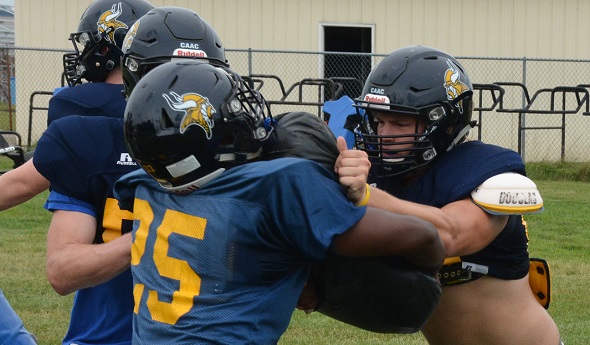
But on closer look, it was anything but. Lineman worked against blocking dummies on a sled or teammates holding hand pads. When the offense came together to run plays, linemen blocked against overturned plastic trash barrels. On the opposite end of the field, subvarsity players worked on defensive pursuit angles but again without hitting. Under a set of uprights laid an old gymnastics mat used to soften the fall during tackling drills, which players again did against standup dummies instead of their teammates.
Reducing collisions – that is, live, game-speed, player-vs.-player hitting – remains the focus of most conversations on health and safety in football. Much of the discussion is centered on reducing concussions, and MHSAA rules changes that took effect beginning with the 2014 season limit teams to one practice per day during the preseason (when teams frequently practice twice) where collisions can take place. During the regular season, teams can have collisions during practice only two days per week.
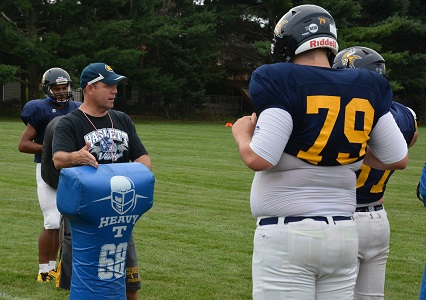 Otlewski – who formerly coached St. Ignace from 1990-93 before taking over at Haslett in 1994 – said his practices used to follow what could be considered a traditional after-school plan: individual position drills for an hour or more followed by 11-on-11 full contact team practice for 30-40 minutes, twice a week.
But a handful of reasons, chiefly the desire to avoid injuries, started his program on a different path five years ago.
“Nobody wants injuries, but you surely don’t want them in practice. Then the concussion thing started to happen. (But) we didn’t do it because of concussions; we did it because of general overall injuries,” Otlewski said.
“If we lose a guy in Thursday’s scrimmage, or next Thursday in a game, OK, that’s football. But what we don’t want to do is lose someone in practice, because that seems unnecessary.”
The initial changes Haslett began to make to practices that fall of 2011 became drastic two years later, when he and his staff went to a different practice model completely. The Vikings now break every practice into 10-minute sessions alternating between team time and position drills, so position coaches can work with players individually before and after seeing how they perform when all 11 are running plays together.
This new breakdown brought the amount of player-on-player contact at practice down significantly as much more time was dedicated to learning proper footwork, blocking and tackling techniques and other fundamentals. Players on Monday worked at 50-percent speed, at most, against teammates either in front of them and also not moving at game speed, or against others holding pads and dummies.
The last two seasons, the only full-contact session during practices came during preparation for goalline situations; Otlewski and his staff decided to eliminate those this fall as well.
“We’re OK with a certain level (of contact). But we never want to go on the ground; we always want to stay up,” he said. “We want to go fast enough so where we have to use the perfect technique to get there footwork-wise. But we’re trying to eliminate the physicality part.”
To be clear, eliminating all collisions/contact is not required by the MHSAA. And there are probably more than a few in the coaching fraternity who would think Haslett is making a massive mistake.
But the Vikings’ no-contact strategy follows a way of thinking made popular in part by coaches like Dartmouth College’s Buddy Teevens, whose team hasn’t tackled during practices in six years. The Ivy League as a whole adopted a policy of no tackling in practice for the regular season beginning this fall.
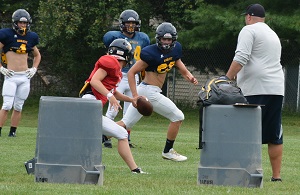 Otlewski said teaching to tackle without contact allows his players to practice the same technique-building drills during four-player offseason workouts, his team’s no-pads summer camp and then while wearing pads during the season. His defense doesn’t face a live offense during the week, but he doesn’t think his players lose out because they can gain just as much from watching film and working on pursuit angles and recognizing formations. Same goes for his offense, which can still practice skill work and the passing game full-speed while lineman go half-speed working on footwork and blocking technique.
And he sees 37 players on his varsity roster, with that total remaining consistent over the last many seasons – while three opponents on this year’s schedule don’t have junior varsities and a fourth won’t field a freshman team.
His players three seasons ago didn’t really like the idea of not hitting in practice at first. But they’ve since bought in. He hasn’t heard a ton from parents either way; but he taught a class on football for local moms over the winter, and they seemed to like the idea as well.
“On one hand, I’m a little apprehensive,” Otlewski said. “OK, we haven’t gone full go. Is there a difference all of a sudden when it’s live Thursday against (Grand Rapids) Christian? Are we going to be up to speed?
“I think I still worry about that a little bit. But once we get into it, it’s fine.”
Kuchnicki is just as confident. Contact doesn’t bother this guy. He’s 6-foot-6 and in the neighborhood of 320 pounds. Sure, he’d love to have one contact practice this year so he and his teammates can back up some of the trash-talking they do to each other on the field.
But he’s fine with saving his biggest hits for opponents – and especially those who might think Haslett won’t be prepared for a physical game.
“They’d probably think we’re soft,” Kuchnicki said. “But when it comes game day, they change their minds instantly. I’ll tell you that.”
 Geoff Kimmerly joined the MHSAA as its Media & Content Coordinator in Sept. 2011 after 12 years as Prep Sports Editor of the Lansing State Journal. He has served as Editor of Second Half since its creation in Jan. 2012. Contact him at [email protected] with story ideas for the Barry, Eaton, Ingham, Livingston, Ionia, Clinton, Shiawassee, Gratiot, Isabella, Clare and Montcalm counties.
PHOTOS: (Top) Haslett lineman work on blocking during Monday's practice. (Middle) Vikings coach Charlie Otlewski instructs his players on one of the team's blocking schemes. (Below) Backs work on the option with barrels serving as the defensive front.
Drive for Detroit: Week 4 in Review
September 23, 2019
By Geoff Kimmerly
Second Half editor
Week 4 of Michigan’s high school football season was filled with great stories, and we tried to make mention of as many as we could in this week’s “Drive for Detroit” review.
 A legendary coach returns with a big win. A neighbor beats its rival for the first time in a number of years – or decades. A league title contender gives up a sure win and takes a chance to help another celebrate those who have served our country.
And as often written in these opening paragraphs each week, those were just the start.
"Drive for Detroit" is sponsored by MI Student Aid.
Bay & Thumb
HEADLINER Frankenmuth 21, Freeland 7 The Eagles (4-0) now share the lead in the Tri-Valley Conference East with only Saginaw Swan Valley after sending Freeland (3-1) a game back. Frankenmuth avenged last season’s 15-8 loss to the Falcons with 21 unanswered second-half points, but can’t celebrate for long with Swan Valley up this week. Click for more from the Saginaw News and see highlights below from WJRT.
Frankenmuth avenges last years' loss to Freeland as the Eagles defeat the Falcons 21-7.@FrankenmuthF @muthstudentshttps://t.co/fsDxGNQewy
— ABC12WJRT (@ABC12WJRT) September 21, 2019
Watch list Richmond 35, Croswell-Lexington 18 The Blue Water Area Conference also has just two teams at the top now – Richmond and Almont – after the Blue Devils (4-0) sent Croswell-Lexington (2-2) into a tie for third.
Remember this one Millington 15, Hemlock 6 The Cardinals (1-3) took the first step needed to win out and guarantee extending their 15-year playoff streak by handing Hemlock (2-2) its second straight defeat.
More shoutouts Davison 48, Flint Powers Catholic 0 The Cardinals (4-0) posted their second straight shutout to hand Powers (3-1) its first defeat and stay atop the Saginaw Valley League Blue. Harbor Beach 47, Brown City 0 The Pirates (4-0) have given up just 17 points over four games but next will take on Ubly (40.5 ppg) for first place in the Greater Thumb Conference East.
Greater Detroit
HEADLINER Plymouth 14, Brighton 7 The Wildcats are 4-0 for the first time since 2011 and alone atop the Kensington Lakes Activities Association West after edging the reigning champion Bulldogs. Brighton (3-1) is one of four teams in the league sharing second with one defeat – and Plymouth handed that loss to three of them. Click for more from the Livingston Daily Press & Argus.
Watch list Oak Park 26, Birmingham Groves 14 Oak Park (3-1) has been one of Groves’ few regular-season stoppers the last few seasons and made it three in a row over the Falcons (3-1) to remain with Birmingham Seaholm the only teams undefeated in Oakland Activities Association White play.
Remember this one Detroit Martin Luther King 47, Detroit Cass Tech 7 Much credit goes to both Detroit Public School League powers for opening against some of the Midwest’s best – even though both started 0-2. King (2-2) gave itself a little bit of breathing room with a second straight win after opening with defeats to Detroit Catholic Central and Muskegon. Cass Tech (1-3) finds itself in a rare position; the Technicians fell to out-of-state powers Chicago Phillips and Lakewood St. Edward (Ohio), the first two weeks and likely will have to win out – including against King during the Detroit Public School League playoffs – to extend an 11-year playoff streak.
More shoutouts Orchard Lake St. Mary's 38, Walled Lake Western 35 The Eaglets, after going a combined 5-12 over the last two seasons, are 4-0 after handing Western its first loss. Bloomfield Hills Brother Rice 16, Warren De La Salle Collegiate 14 The Warriors (4-0) downed the reigning Division 2 champion Pilots (2-2) for the first time since 2016.
Mid-Michigan
HEADLINER East Lansing 35, Portage Northern 28 (OT) The Trojans (3-1) earned a major win for Lansing-area football as a whole, taking down arguably the top team from the southwest so far this fall in Northern (3-1). The Huskies are undefeated in Southwestern Michigan Athletic Conference West play along with St. Joseph, but gave up a season high in points to East Lansing. The Trojans couldn’t have wished for better heading into their next matchup with league rival DeWitt, a big winner over Holt this weekend. Click for more from East Lansing Info and see below for highlights from State Champs Sports Network.
ICYMI: Check out the highlights of the East Lansing (@eltrojans) vs. Portage Northern (@PortageNorthern) game from Friday night.
Brought to you by @LawrenceTechU, @MHSAA and @hungryhowies pic.twitter.com/gEGFhiiJOM— STATE CHAMPS! (@statechampsnet) September 22, 2019
Watch list New Lothrop 42, Montrose 21 The reigning Division 7 champion Hornets (4-0) haven’t slowed down a step from last season, with Montrose (3-1) the second of three second-place teams in the Mid-Michigan Activities Conference to fall to New Lothrop over the last two weeks.
Remember this one St. Johns 33, Williamston 21 The Redwings (3-1) got off to a deflating start with a Week 1 shutout against East Lansing, but that loss looks better with the Trojans’ success and also forgettable after wins like this one over the Hornets (2-2).
More shoutouts Beal City 35, Evart 7 The Aggies (4-0) stand alone in the Highland Conference after handing Evart (3-1) its first defeat, which continued a three-week string of dealing contenders their first league loss. Fowler 46, Laingsburg 24 By handing Laingsburg (3-1) its only loss, the Eagles (4-0) got past the main obstacle on the way to what could be a battle of unbeatens against rival Pewamo-Westphalia in Week 8.
Northern Lower Peninsula
HEADLINER Kingsley 26, Traverse City St. Francis 7 The Stags (4-0) broke a six-game losing streak against the Gladiators that had seen them struggle to even score against their rivals. But this time, St. Francis (2-2) was held to just seven points for the second time this season – and also just the second time in a regular-season game since the start of 2014. Kingsley sits atop the Northern Michigan Football League Legends standings with Week 9 opponent Boyne City. Click for more from the Traverse City Record-Eagle and see highlights below from MI Sports Now.
.@KASAthletics bests TC St. Francis for first win in series since 2012https://t.co/lXe5fnHTvh pic.twitter.com/A6jynno6cV
— MISportsNow (@MISportsNow) September 21, 2019
Watch list Alpena 41, Cadillac 38 Are the Wildcats (2-2) contenders in the Big North Conference? They join Travers City Central as the only teams without a league loss as they play for their first overall winning season since 2004, and this was a nice win with Cadillac (2-2) also on the rise.
Remember this one Traverse City Central 32, Traverse City West 0 The “Patriot Game” always is memorable, but will be this time especially for Central (3-1) as it avenged last season’s 21-14 defeat with a margin unrivaled in the series since West’s 31-point win in 2002.
More shoutouts Maple City Glen Lake 53, Frankfort 7 The Lakers (4-0) continued to shine with a season high in points against the Panthers (2-2). Johannesburg-Lewiston 40, St. Ignace 0 The Cardinals put up a third straight big win to start a string of five games against teams that are .500 or better so far.
Southeast & Border
HEADLINER Chelsea 28, Ypsilanti Lincoln 18 The Bulldogs (4-0) made the Division 4 championship game last season, even more impressive considering they didn’t win their league. But they took a major step toward earning that local crown this fall by ending a two-year losing streak to the rival Railsplitters (2-2) – and next up is reigning Southeastern Conference White champion Jackson. Click for more from the Chelsea Sun Times News.
Watch list Blissfield 28, Brooklyn Columbia Central 14 Seven of eight teams in the Lenawee County Athletic Association are 2-2 or better, and Blissfield (3-1) finds itself tied for first place after handing reigning co-champ Columbia Central (3-1) a loss for the second straight season.
Remember this one Clinton 34, Sand Creek 28 A late rally kept Clinton (4-0) tied for first in the Tri-County Conference and could be the difference down the road as Sand Creek (3-1) hopes for help to get back in the title mix.
More shoutouts Dexter 57, Jackson 21 The Dreadnaughts (3-1) are halfway to earning a second playoff berth in two seasons – and ever – after avenging last season’s 10-point loss to the Vikings (3-1). Jonesville 52, Union City 0 This win over 2018 playoff qualifier Union City moved Jonesville to 3-1, giving the Comets their most wins in a season since 2016 – and tying their most wins since 2014.
Southwest Corridor
HEADLINER St. Joseph 22, Stevensville Lakeshore 14 The coach Andrew Pratley era is only four games old, but the Bears (4-0) are only one win shy of tying last year’s success and in position to decide their fate in the SMAC West after this victory over Lakeshore (2-2). St. Joseph had lost eight straight to the Lancers, going back to 2013. The final month could be even more telling with league foes Portage Central and Northern sandwiching undefeated Battle Creek Lakeview and perennial power DeWitt. Click for more from the St. Joseph Herald-Palladium.
Watch list White Pigeon 14, Centreville 8 The Chiefs (4-0) won this matchup of 2018 playoff qualifiers to hold on to a share of first in the Southwest 10 Conference, with Centreville (2-2) now having lost to both co-leaders over the last two weeks.
Remember this one Lawton 29, Delton Kellogg 12 These two could end up champions in the Southwestern Athletic Conference divisions. Delton (3-1) should be pursuing the Valley title with Schoolcraft and Constantine. Lawton (4-0) and Gobles look to be early favorites in the SAC Lakeshore.
More shoutouts Edwardsburg 54, Vicksburg 7 The Eddies (4-0) are back on top in the Wolverine Conference sharing first with only Paw Paw after handing Vicksburg (3-1) its first loss. Portage Central 21, Battle Creek Central 19 Both made the playoffs a year ago, and the Mustangs (2-2) are just a bit more comfortable as they try to advance again while the Bearcats (1-3) now are forced to win out to guarantee a return.
Upper Peninsula
HEADLINER Ishpeming Westwood 38, Ishpeming 0 The Patriots (2-2) find themselves needing a number of things to fall their way to get back into their league’s title mix, but a great consolation prize at the end of the season will be this win over the rival Hematites (3-1). It broke a losing streak (on the field, not counting a forfeit victory in 2017) against Ishpeming that began in 1999 and included four playoff defeats. Click for more from the Marquette Mining Journal.
VIDEO: Check out the highlights of the Westwood (@westwoodpats) vs. Ishpeming game from Friday night.
Brought to you by @LawrenceTechU, @MHSAA & @hungryhowies pic.twitter.com/FDWzBLMC1D— STATE CHAMPS! (@statechampsnet) September 21, 2019
Watch list Calumet 14, West Iron County 0 The Copper Kings (4-0) have given up only 21 points over four games, handing West Iron (3-1) a shutout for its first defeat.
Remember this one Marquette 17, Escanaba 14 The Redmen (2-2) started this season with losses to Traverse City powers St. Francis and Central. But those games no doubt prepared them well to open Great Northern Conference play with a big win against their rival and the other reigning league co-champ Eskymos (3-1).
More shoutouts Kingsford 20, Gladstone 7 The Flivvers (2-2) enjoyed a jumpstart in their first game this fall against a Michigan opponent, handing Gladstone (2-2) a second straight defeat. Sault Ste. Marie 8, Petoskey 7 (OT) The Blue Devils (3-1) scored their only points in overtime to improve on their best start on the field since 2007 (not including 2015 when a Week 4 win came by forfeit).
West Michigan
HEADLINER Rockford 34, Muskegon Mona Shores 21 The Rams (4-0) welcomed back the state’s sixth winningest coach Ralph Munger after preseason heart surgery kept him off the sideline to start the fall, and they no doubt rode some added inspiration in avenging losses to Mona Shores (3-1) from the last two seasons. Jaiden Friesen scored five touchdowns, and Rockford’s defense held the reigning Division 2 runner-up Sailors to their second-fewest points over the last three seasons. Click for more from the Grand Rapids Press.
VIDEO: Check out the highlights of the Rockford (@rock4rams) vs. Mona Shores game from Friday night. Brought to you by @LawrenceTechU, @MHSAA & @hungryhowies pic.twitter.com/fJzslE7TxK
— STATE CHAMPS! (@statechampsnet) September 22, 2019
Watch list Byron Center 33, Holland Christian 6 The much-improved Bulldogs (4-0) have handed losses to three .500 teams including Holland Christian (2-2) to get to the Ottawa-Kent Conference Green powers, starting with Zeeland West this week.
Remember this one Muskegon Catholic Central 34, Ludington 21 This one jumped off the page, mostly because Ludington (3-1) had beaten reigning Lakes 8 Conference champ Manistee the week before. With Orchard View also surging, this league could be wide open.
More shoutouts Zeeland West 40, Lowell 26 The Dux (4-0) actually saw their scoring average fall to 45 ppg, and with wins as well over East Grand Rapids, Grand Rapids Christian and Holland appear ready for league competition. Muskegon Orchard View 42, Belding 35 Every week the story gets better for the Cardinals (4-0), who have guaranteed their best finish since 2014 and with another win will tie their best since 2008.
8-Player
HEADLINER Suttons Bay 20, Onekama 14 This was one of the week’s best stories, and it had nothing to do with how the teams played. Although these two are the likely Midwest Central Michigan Conference West favorites and will meet again possibly to decide the champion Week 8, they agreed to play a nonleague game this past week as well. Although both were eligible to receive forfeit wins against other opponents no longer playing this fall, Onekama (3-1) had made big plans for its “Warrior Game” military appreciation night and needed an on-field opponent to make it go. In stepped Suttons Bay, which moved to 4-0 with its best win this season. Click for more from the Manistee News-Advocate.
Suttons Bay rallies past Onekama in Warrior Gamehttps://t.co/OyA8MJUB6i pic.twitter.com/s6vGwNYnJC
— MISportsNow (@MISportsNow) September 21, 2019
Watch list Climax-Scotts 16, Camden-Frontier 12 It’s been impossible to not make mention of Climax-Scotts (4-0) almost every week so far with how it’s marched through some of the traditional best from its corner of the Lower Peninsula. Camden-Frontier (3-1) entered undefeated, and unbeaten Colon is up next.
Remember this one Litchfield 36, Waldron 22 The Terriers (3-1) now have as many wins as the last seven seasons combined, and could be set up to make a run at the playoffs for the first time since 2011.
More shoutouts Rapid River 66, Cedarville 58 (OT) The Rockets (1-3) haven’t scored like usual this season, but this overtime back-and-forth was a quick reminder of their past firepower – and a good time for it with Cedarville (2-2) always a force and league play starting. Hillman 52, Au Gres-Sims 20 The Tigers (4-0) stormed back after taking a forfeit win in Week 3, breaking a streak of three regular-season losses to the Wolverines (1-3).
Second Half’s weekly “Drive for Detroit” previews are powered by MI Student Aid, a part of the Office of Postsecondary Financial Planning located within the Michigan Department of Treasury. MI Student Aid encourages students to pursue postsecondary education by providing access to student financial resources and information. MI Student Aid administers the state’s 529 college savings programs (MET/MESP), as well as scholarship and grant programs that help make college Accessible, Affordable and Attainable for you. Connect with MI Student Aid at www.michigan.gov/mistudentaid and find more information on Facebook and Twitter @mistudentaid.
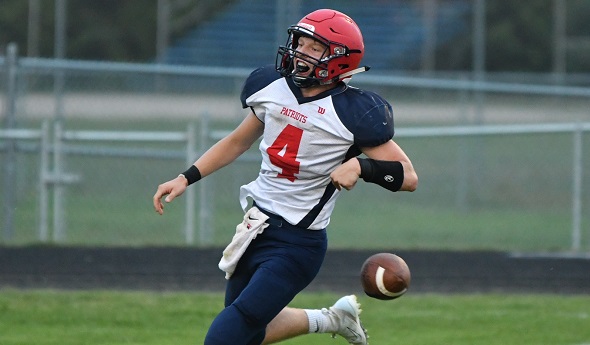
PHOTO: Ishpeming Westwood quarterback Taylor Dellangelo celebrates a touchdown against Ishpeming. (Photo by Cara Kamps.)