

Haslett Saving Big Hits for Game Time
August 16, 2016
By Geoff Kimmerly
Second Half editor
HASLETT – The sound of cleats on pavement. He and his teammates, hand in hand, walking toward the field together minutes before kickoff. Manowar’s “Heart of Steel” ringing in their ears from a few minutes before.
 Justin Kuchnicki gave himself goose bumps Monday describing Haslett’s weekly pregame ritual, which the senior lineman will take part in again beginning Aug. 26 when the Vikings open this season against Remus Chippewa Hills.
They’ll certainly be revved up – and especially to lay some big hits after saving them up during three weeks of non-collision practices.
Haslett has one of the most successful football programs in the Lansing area, with two trips to MHSAA championship games and 14 playoff appearances total over the last 18 seasons. The Vikings finished 6-4 a year ago against a schedule featuring four eventual playoff teams.
The program also might be the first in all of Michigan high school football to fully eliminate full-speed hitting at practice, something Haslett has moved toward over the last few seasons before longtime coach Charlie Otlewski decided to knock it out of his practice plans completely this fall in large part to keep his players healthier for when it matters most.
“It gives you the edge when it gets to game day. You practice all week and you’re not really hitting or doing anything like that, and you get to game day … and everyone’s ready to just go out there and fly around and make plays,” Kuchnicki said. “You’re not really worried about kinks and stuff in your body that you’d have from practices, so you just go out there and lay it on the line.”
Friday was the first day Michigan high school players were allowed to practice in full pads. Storms drenched mid-Michigan that afternoon, so Haslett’s first day in full gear was Monday. And from a distance, it sounded like any other full-contact practice with the normal hoots and hollers and smacking of pads.
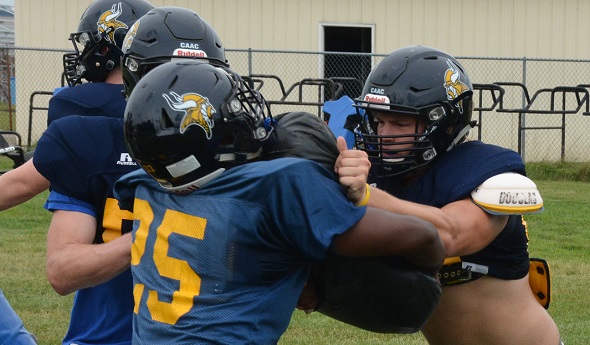
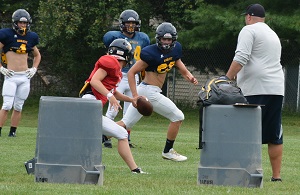
But on closer look, it was anything but. Lineman worked against blocking dummies on a sled or teammates holding hand pads. When the offense came together to run plays, linemen blocked against overturned plastic trash barrels. On the opposite end of the field, subvarsity players worked on defensive pursuit angles but again without hitting. Under a set of uprights laid an old gymnastics mat used to soften the fall during tackling drills, which players again did against standup dummies instead of their teammates.
Reducing collisions – that is, live, game-speed, player-vs.-player hitting – remains the focus of most conversations on health and safety in football. Much of the discussion is centered on reducing concussions, and MHSAA rules changes that took effect beginning with the 2014 season limit teams to one practice per day during the preseason (when teams frequently practice twice) where collisions can take place. During the regular season, teams can have collisions during practice only two days per week.
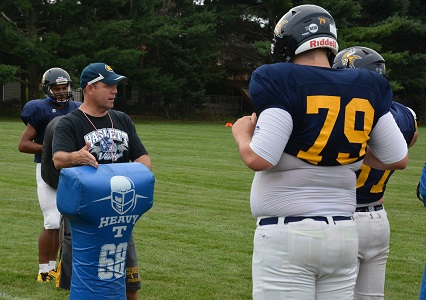 Otlewski – who formerly coached St. Ignace from 1990-93 before taking over at Haslett in 1994 – said his practices used to follow what could be considered a traditional after-school plan: individual position drills for an hour or more followed by 11-on-11 full contact team practice for 30-40 minutes, twice a week.
But a handful of reasons, chiefly the desire to avoid injuries, started his program on a different path five years ago.
“Nobody wants injuries, but you surely don’t want them in practice. Then the concussion thing started to happen. (But) we didn’t do it because of concussions; we did it because of general overall injuries,” Otlewski said.
“If we lose a guy in Thursday’s scrimmage, or next Thursday in a game, OK, that’s football. But what we don’t want to do is lose someone in practice, because that seems unnecessary.”
The initial changes Haslett began to make to practices that fall of 2011 became drastic two years later, when he and his staff went to a different practice model completely. The Vikings now break every practice into 10-minute sessions alternating between team time and position drills, so position coaches can work with players individually before and after seeing how they perform when all 11 are running plays together.
This new breakdown brought the amount of player-on-player contact at practice down significantly as much more time was dedicated to learning proper footwork, blocking and tackling techniques and other fundamentals. Players on Monday worked at 50-percent speed, at most, against teammates either in front of them and also not moving at game speed, or against others holding pads and dummies.
The last two seasons, the only full-contact session during practices came during preparation for goalline situations; Otlewski and his staff decided to eliminate those this fall as well.
“We’re OK with a certain level (of contact). But we never want to go on the ground; we always want to stay up,” he said. “We want to go fast enough so where we have to use the perfect technique to get there footwork-wise. But we’re trying to eliminate the physicality part.”
To be clear, eliminating all collisions/contact is not required by the MHSAA. And there are probably more than a few in the coaching fraternity who would think Haslett is making a massive mistake.
But the Vikings’ no-contact strategy follows a way of thinking made popular in part by coaches like Dartmouth College’s Buddy Teevens, whose team hasn’t tackled during practices in six years. The Ivy League as a whole adopted a policy of no tackling in practice for the regular season beginning this fall.
 Otlewski said teaching to tackle without contact allows his players to practice the same technique-building drills during four-player offseason workouts, his team’s no-pads summer camp and then while wearing pads during the season. His defense doesn’t face a live offense during the week, but he doesn’t think his players lose out because they can gain just as much from watching film and working on pursuit angles and recognizing formations. Same goes for his offense, which can still practice skill work and the passing game full-speed while lineman go half-speed working on footwork and blocking technique.
And he sees 37 players on his varsity roster, with that total remaining consistent over the last many seasons – while three opponents on this year’s schedule don’t have junior varsities and a fourth won’t field a freshman team.
His players three seasons ago didn’t really like the idea of not hitting in practice at first. But they’ve since bought in. He hasn’t heard a ton from parents either way; but he taught a class on football for local moms over the winter, and they seemed to like the idea as well.
“On one hand, I’m a little apprehensive,” Otlewski said. “OK, we haven’t gone full go. Is there a difference all of a sudden when it’s live Thursday against (Grand Rapids) Christian? Are we going to be up to speed?
“I think I still worry about that a little bit. But once we get into it, it’s fine.”
Kuchnicki is just as confident. Contact doesn’t bother this guy. He’s 6-foot-6 and in the neighborhood of 320 pounds. Sure, he’d love to have one contact practice this year so he and his teammates can back up some of the trash-talking they do to each other on the field.
But he’s fine with saving his biggest hits for opponents – and especially those who might think Haslett won’t be prepared for a physical game.
“They’d probably think we’re soft,” Kuchnicki said. “But when it comes game day, they change their minds instantly. I’ll tell you that.”
 Geoff Kimmerly joined the MHSAA as its Media & Content Coordinator in Sept. 2011 after 12 years as Prep Sports Editor of the Lansing State Journal. He has served as Editor of Second Half since its creation in Jan. 2012. Contact him at [email protected] with story ideas for the Barry, Eaton, Ingham, Livingston, Ionia, Clinton, Shiawassee, Gratiot, Isabella, Clare and Montcalm counties.
PHOTOS: (Top) Haslett lineman work on blocking during Monday's practice. (Middle) Vikings coach Charlie Otlewski instructs his players on one of the team's blocking schemes. (Below) Backs work on the option with barrels serving as the defensive front.
Beaudrie's Rebuild of Jefferson Football Gaining Speed with Fast Start
By
Doug Donnelly
Special for MHSAA.com
September 17, 2025
NEWPORT – Rob Beaudrie has found the secret formula to building a winning football team.
 Take over as head coach. Tap his freshman son (even if unexpectedly) as the starting quarterback. Mix in a couple of years hitting the weights, consistent offseason workouts and getting the underclassmen to buy into the playbook and new culture.
Oh, and winning a few games doesn’t hurt.
“Kids like to win,” Beaudrie said. “They don’t want to go out and practice two or three hours every day and go 0-9. It’s not fun for them. These kids have bought in. They’ve been playing football together since they were in youth football. It’s a good experience for them.”
Beaudrie is the head football coach at Monroe Jefferson, a Division 6 school in Newport, along the shores of Lake Erie and home to the Fermi 2 nuclear power plant. The Bears were once a football power, winning the Class BB championship in 1994, but have struggled for the last 20 years or so.
Being from the area, Beaudrie knew all about Jefferson. He took the job three seasons ago. He stayed on the course and things slowly improved.
This year, everything has come together as the Bears are off to a 3-0 start for the first time since 2006. One more win and they’ll have more victories than in any one season since 2016, which was the last time Jefferson qualified for the playoffs.
“We’ve come a long way,” Beaudrie said. “We are doing a lot of things right. We are attacking the ball, pursuing. We’re blocking together. There are still some growing pains. We are young in some areas, but they’ve come along well. They are very talented.”
Beaudrie inserted his son Luke, then a freshman, into the starting quarterback role his first year as head coach. It was an unexpected move because Luke had been a slot receiver or running back while playing youth football and middle school football. When the player Beaudrie expected to be the starting quarterback quit the team, Beaudrie turned to his son.
“He’s not a true quarterback, but he’s learning,” Beaudrie said. “He’s learned to understand the offense and read the defense. He’s a leader.”
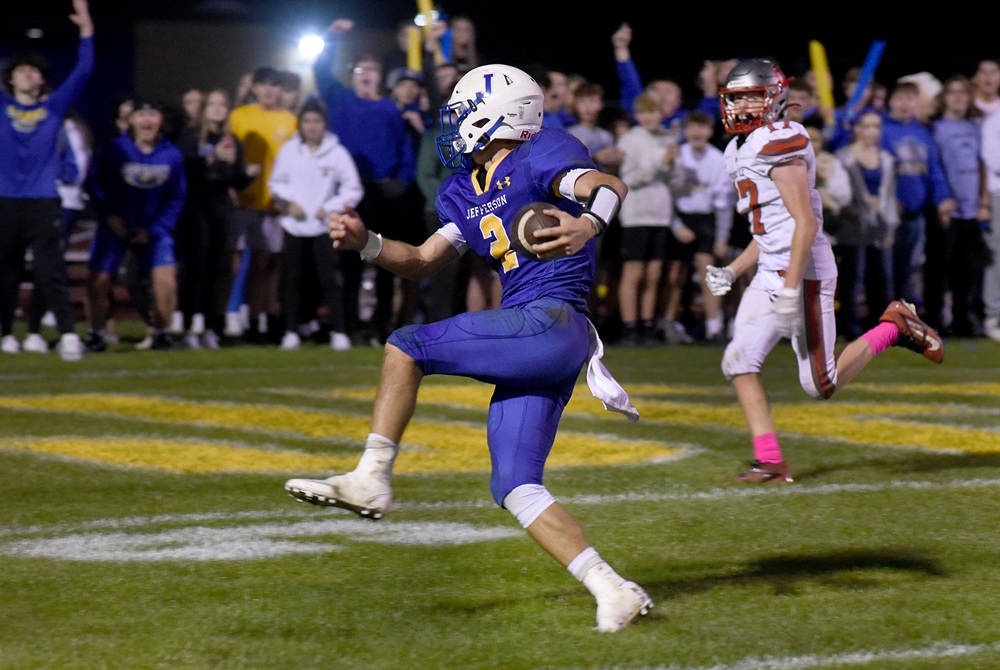
In Jefferson’s 52-21 win over Milan on Friday, Luke Beaudrie returned a kickoff 99 yards, had touchdown runs of 65, 2, 50 and 32 and returned an interception 89 yards for a touchdown – all in the first half.
“He’s a special athlete,” Rob Beaudrie said. “He was never tackled in middle school. He’s very fast and has great vision.”
Luke said he has adapted to being the quarterback.
“When I first started, I didn’t think it was for me,” he said. “But you have to have the mindset ‘whatever is best for the team.’ I started learning it, and now I’m more comfortable.”
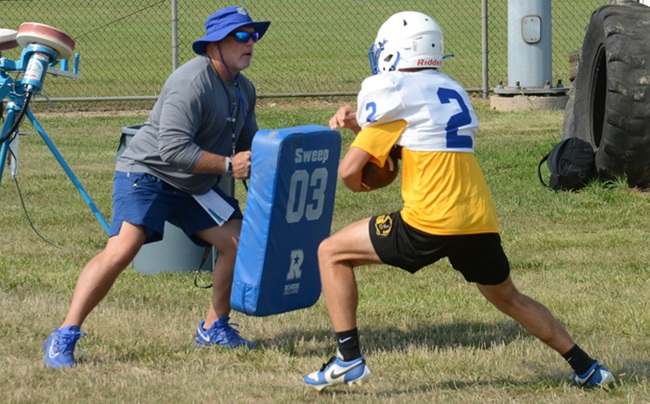 Through three games, Beaudrie has 487 yards rushing, 243 yards passing and has scored 13 touchdowns.
The Beaudries have used this same game plan before, but at a different school. Rob was head coach at Erie Mason, a program that had struggled. His son Noah became the starting quarterback as a freshman, went through some growing pains, but developed into an all-stater his senior season as Mason won a league championship.
Noah went on to play college football at Mount Union University (Ohio) where he quarterbacked the Purple Raiders into the Division III national championship game last season. This year, Noah transferred to Adrian College where he is the starting quarterback and has the Bulldogs off to a 2-0 start.
Being close to home has allowed him to serve as an assistant coach for Jefferson.
“The schedules line up really well,” Rob Beaudrie said. “He can be at (our) practice just about every Sunday and Monday and can be at most of our games. He helps Luke out a lot. He’s brought a lot of college experiences with him to the playbook.”
Another former player Rob had at Mason, Tanner Herrera, is helping coach the Jefferson offense.
“I didn’t want to do it all,” Beaudrie said. “I offered him the OC (offensive coordinator) job, and he’s run with it.”
Beaudrie said he thought this could be the year Jefferson turned things around. The Bears still have a difficult Huron League schedule ahead of them. This week they take on Riverview, then have Flat Rock and Division 7 No. 1-ranked Monroe St. Mary Catholic Central.
“The good thing is, these kids don’t know what they don’t know,” Beaudrie said.
Roster numbers have gone up steadily since Beaudrie took over. His first season the Bears had 23 players in the entire program. Last year they had 36 players in all and no seniors. This year Jefferson counts 61 players – plenty enough for a JV and varsity program.
“That has been a huge help,” he said.
The first two years weren’t easy as he brought his system to Jefferson. He faced skepticism over the team’s passing attack. For years, even decades, Jefferson was known for its rushing offense; at one time, the Bears would go weeks without attempting a pass.
“This is all new at Jefferson. People would tell me, ‘They don’t know anything about passing the ball; you can’t do that,’” Beaudrie said. “I told them, ‘You’d be surprised what kids can learn.’ We came in and did our thing. We were out-manned a bit the first few years.
“Sometimes the first couple of years you get a new coach in, and some people don’t like what you are doing. It wasn’t going to ruffle my feathers. I have thick skin. There’s a plan, and you have to trust the process, trust the system.
“Now, the kids are excited, the parents are excited, everyone is excited. Everybody likes a winner. I’m excited to see what happens next year as well, but we are going to enjoy these wins right now.”
Jefferson athletic director Alyssa Eppler said the football success has brought excitement to the games and district.
"There’s an incredible buzz in our school and community right now, and it’s been building for a few years now,” she said. “It’s exciting to finally see it all come together. You can feel the energy in the hallways and see it in the stands on Friday nights. Or first home game truly had the atmosphere of a homecoming. We’re proud of the momentum and what it means for our kids."
Luke Beaudrie is happy with how things have worked out, even if he had to learn a new position.
“The first few years were a little rough,” he said. “Now, everyone is starting to buy in, and everyone expects some good things the next couple of years. It feels amazing. This hasn’t happened here in a while.”
 Doug Donnelly has served as a news and sports reporter at the Adrian Daily Telegram and the Monroe News for 30 years, including 10 years as city editor in Monroe. He's written a book on high school basketball in Monroe County and compiles record books for various schools in southeast Michigan. He is now publisher and editor of The Blissfield Advance, a weekly newspaper. E-mail him at [email protected] with story ideas for Jackson, Washtenaw, Hillsdale, Lenawee and Monroe counties.
PHOTOS (Top) Monroe Jefferson’s Luke Beaudrie sprints toward the end zone during a game last season. (Middle) Jefferson coach Rob Beaudrie holds a pad while Luke works on making a cut during practice. (Photos courtesy of the Monroe News.)