

Hastings at Home in Interstate 8, Preparing to Begin Next Title Pursuit
By
Steve Vedder
Special for MHSAA.com
August 22, 2025
HASTINGS – Jamie Murphy remembers the decision as relatively simple.

The decision to move to a fourth conference in 29 years was of particular interest to a Saxons football program which had struggled badly during stints in the Ottawa-Kent Conference White and O-K Gold. So Hastings finally pulled the trigger on moving from the O-K Gold to the Interstate 8 Athletics Conference in 2016, and the results have been no less than stunning for the team.
"I encouraged it," said Murphy, the Saxons' coach since 2013. "This conference is more like the Hastings community. There are towns with one high school, one middle school, three or four elementary schools and the schools are all public … . There are similar dynamics with all of them."
While switching conferences naturally effects all of a school's teams, the results are often most judged by what happens under Friday Night Lights. There the decision to move from 21 years in the O-K White and O-K Gold has been like night and day for Saxons teams. Hastings went 16-26 in six years in the O-K White before compiling a 35-59 mark in the O-K Gold. Over two decades in those leagues, Hastings football teams had only six winning seasons and three of them were with 7-2 regular-season records from 2009-2011.
But that's all changed with inclusion in the Interstate 8, which was formed in 2016. The conference includes four old rivals – Coldwater, Battle Creek Harper Creek, Battle Creek Pennfield and Marshall – which were part of the Twin Valley with Hastings from 1977-94. Saxons football teams went 67-58 over 18 years in that conference.
After a slow start in the Interstate 8 which included a 9-19 conference mark from 2016-19, Saxons teams have won 28 of 31 games the last five years. Included are four straight league titles from 2020-2023, with only a 32-0 loss to Battle Creek Harper Creek a year ago keeping Hastings from a fifth championship. That stretch includes one torrid string where Hastings, which opens conference play Sept. 12 against Jackson Northwest, won 21 of 22 league games from Oct.16, 2000, to Oct. 18, 2024.
"Teams are very similar and there are ups and downs with any high school football team," Murphy said. "But we've been competitive in a league which has always been competitive in the state playoffs. How well you do there speaks volumes for how good programs are."
Interstate 8 teams are a respectable 18-18 in the MHSAA Tournament since 2019, including a 6-5 mark from Hastings.
 Murphy said one of the most appealing aspects of the conference is a tight relationship between coaches. Virtually all, he said, have similar philosophies which include an emphasis on supporting multi-sport athletes, work in the weight room in March and April, modest summer programs and making the players a priority during the season. Murphy said coaches freely communicate via meetings, texts and emails with each other up to 10 months a year. Contrast that, Murphy said, with the O-K Conference where a select board determines which schools play in what divisions.
"We all want to keep the sport popular and alive," said Murphy, named a national 2025 Semper Fidelis Coach Award winner for his work upholding the U.S. Marines standard of excellence while developing teen leaders.
First-year Hastings athletic director Mike Mohn wasn't a part of Hastings' decision to move to the Interstate 8, but like Murphy he likes the idea of the similarity between schools, including an emphasis – but not overemphasis – on football programs. Athletic departments rely on income derived from football, and Hastings is no exception. Like many Interstate 8 schools, Hastings' home field, Baum Stadium at Johnson Field, can hold between 2,500 and 2,700 fans, with the home side featuring room for up to 1,600. Mohn said a typical Friday night crowd well exceeds 1,000 fans.
"We have like-minded schools in the Interstate 8," he said. "One of our goals is to build relationships, and we've done that. I think our games are well-attended, we can pack our side of the stadium and they can see a good product on the field. Year-in and year-out, we've been competitive and we're proud of that."
There is good reason to believe Hastings will be in the hunt for a fifth conference title in six years. The team returns 17 letterwinners, including six starters on offense and five on defense. The roster could include five sophomores and help from last year's 5-3 junior varsity club. Among the returnees is junior quarterback Mason Tossava, who ran for 300 yards and passed for 500 more as a sophomore. Hastings lost its top running back from its Wing-T offense, but does return 1,000-yard rushers Cardale Winebrenner and Tyler Frazier. Defensively, two all-conference returnees include cornerback Spencer Wilkins and tackle Trapper Reigler.
"Every year our goal is to win the league and make the playoffs," Murphy said. "That's who we are."
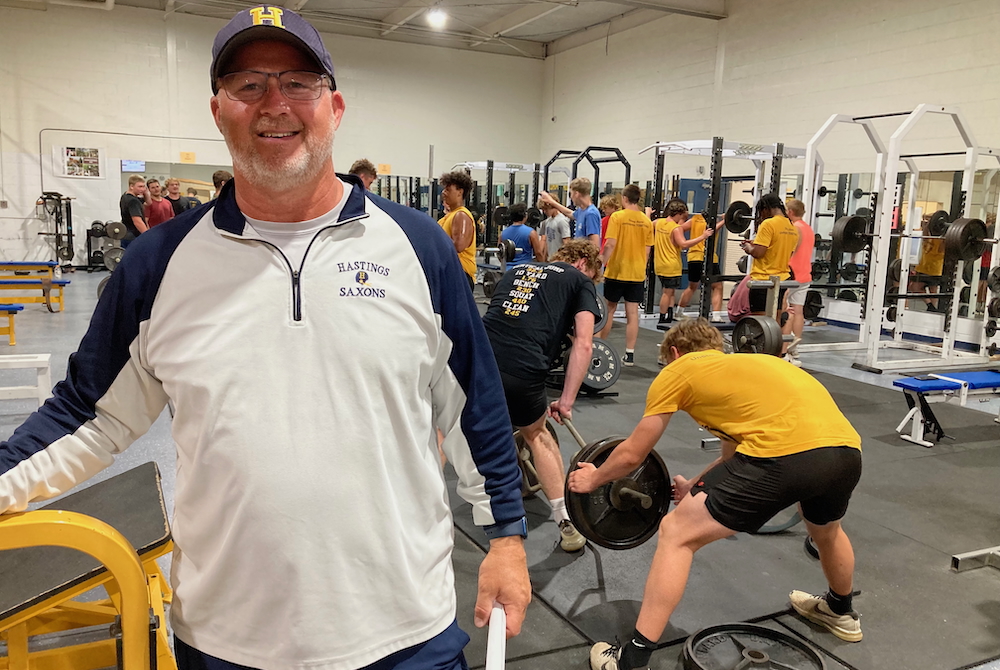
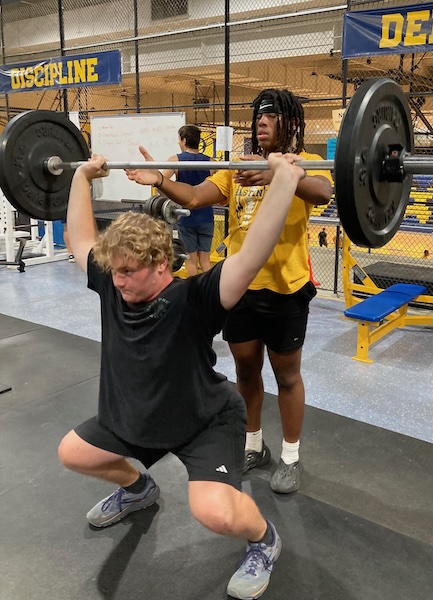
PHOTOS (Top) Hastings coach Jamie Murphy takes a moment for a photo during his team’s weight training session earlier this month. (Middle) Cardale Winebrenner (standing) spots for teammate Trapper Reigler; both are captains this fall. (Photos by Steve Vedder.)
MHSAA Vault: Shooks a Legend as Freshman Coach
By
Geoff Kimmerly
MHSAA.com senior editor
September 4, 2026
The following originally appeared in the Lansing State Journal on Oct. 28, 2004, and was reprinted by the MHSAA that winter.
Wayne Shooks retired from coaching entirely in 2008 and died Tuesday at the age of 84.
Wayne Shooks tried the varsity football thing once. Some time during the late 1980s, longtime DeWitt coach Gail Thornton asked Shooks to be his offensive coordinator.
“I didn't sleep a night. My wife, after three weeks, said, ‘You're going back to freshmen,’” Shooks remembered.
And those three weeks were in the month of June.
But Shooks' wife must have been on to something. Because few, if any, freshman football coaches have accomplished what Shooks finished with one last win last fall.
He ended his 16th and final season as freshman coach with a 135-2-1 record.
Amazing.
“You can't lose a game for him, or you'll feel bad,” DeWitt senior Mat Brynick recalled from his days as a freshman. “Coach never says it, but it's what everyone expects.
“He taught us how to win.”
 Guys like Shooks, 62, usually go unappreciated.
They get the kids fresh to high school, fresh to high school sports, and still learning things like not spiking the ball after a touchdown.
But few freshman football coaches are as legendary as Shooks is in DeWitt. They are so unappreciated that it's impossible to find out if anyone has accomplished what he's done.
Shook is not big on numbers. Never has been during his 41 years teaching in the district, or more than 20 coaching everything from football to basketball to wrestling to tennis. Oh, and track since 1980.
He also coached 8th-grade football for a few years, junior varsity for one season and was a varsity assistant. But he'll be remembered for what he did with the freshmen.
The losses came in 1993 to Mason during a terrible wind storm, and in 2002 to Greenville. That same year, the Panthers tied Haslett, meaning it was the only year during his tenure that DeWitt wasn't sure if it finished first in its league, since league titles aren't handed out at the freshmen level.
“The kids felt bad. They did their best,” Shooks remembered.
But the losses, however few, were more of a relief for Shooks than a letdown.
Don't take that to mean Shooks doesn't like to win.
Sure, he embraced the role of teacher as much as any freshman coach. But as DeWitt varsity coach Rob Zimmerman said, “If he was a 5th-grade coach, he'd be the most competitive 5th-grade coach you've ever seen.”
“I never pointed (our record) out, it was not our goal,” Shooks said. “Our goal was to win the next week. Although the kids knew it. They just assumed we were going to go 9-0, I guess.”
Guess so.
Shooks had more easily-attainable goals:
- Have fun
- Learn fundamentals
- Emphasize the logical stuff, like the importance of bringing equipment to school every day
“He does a really good job teaching expectations about being young men and being great students,” Zimmerman said. “It's gigantic.”
And it kept kids coming back to junior varsity and varsity. You could hear the fun coming out in Brynick's voice.
He was remembering his freshman football experience, remembering his time with perhaps Michigan's most successful coach at that level.
“I remember a few games, we'd find one play that works, and we ran it to death, pounding it and pounding it,” Brynick recalled. “He loves running the same play over and over. If you can do that, march 80 yards down the field, you're doing something right. No one could stop us.”
That was not all Brynick remembered, or didn't.
Shooks almost never yelled. If he did, it meant a kid messed something up over and over and over again.
He has a doctorate in zoology. Education is obviously a big deal. He loves to win, but he loves to teach. And he's hesitant to go looking for any attention for what he's done.
All made him a perfect freshmen football coach.
“Sometimes I don't think people understand about coaches. You think college level, they are coaches first, that's their job, but not at the high school level,” Shooks said.
“It's not what I've done, it's what they've done. I've always believed the focus should be on the kids. My job is a teacher. I coach because I love to coach.”
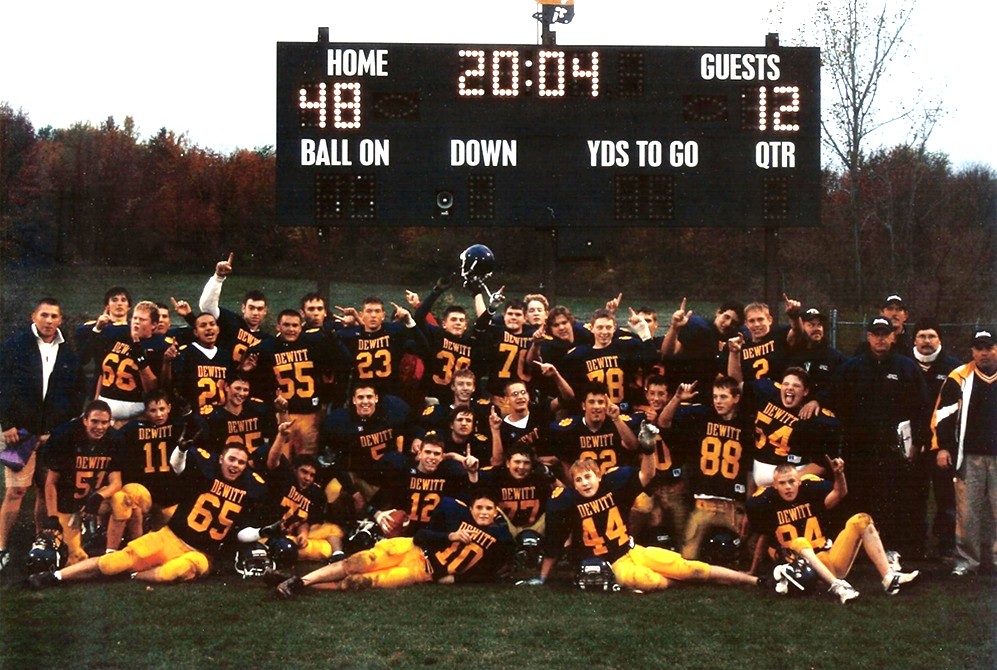
PHOTO DeWitt freshman coach Wayne Shooks, fourth from right, stands for a photo with this final football team in 2004. (Photos courtesy of the DeWitt football program.)