


Heads and Heat
August 16, 2012
We are engaged in very serious discussions. They’re not only complicated, with unintended negative consequences possible from what are thought to be positive actions; they’re also a matter of life and death.
The topic is football – the high school sport under most scrutiny today and suffering from the most criticism it’s seen since the 1970s when catastrophic neck injuries spiked, liability awards soared, many insurers balked, and most helmet manufacturers abandoned the business altogether.
During recent years we have learned about the devastating long-term effects of repeated blows to the head; and we’re trying to reduce such hits. We’ve learned that 70 percent of concussions in football result from helmet-to-helmet contact, and we’re trying to have coaches teach blocking and tackling differently and have officials penalize “high hits” consistently and rigorously.
During the past several years we’ve learned that serious heat illness and heat-related deaths are 100 percent preventable, yet nationwide there were 35 heat-related deaths in high school football alone from 1995 to 2010; and we’re promoting practices that acclimatize athletes more gradually than “old school” traditionalists might advocate.
As we simultaneously address issues of heads and heat in football, some coaches may think we’re being overbearing, while many in medical fields say we’re out of date, citing higher standards of the American Academy of Pediatrics, National Athletic Trainers Association and National Federation of State High School Associations, as well as many of our counterpart organizations across the country.
As we consider in-season changes to improve athlete acclimatization and reduce blows to the head, we should be open to making out-of-season changes that work toward rather than in opposition to those objectives. There can be no sacred cows. The topic is too serious.
Ultimately, if we err in the outcome of this year’s discussions about heads and heat in football, it must be on the side of safety, on minimizing risks for student participants. They deserve it and, once again, the sport of football needs it.
1st & Goal: 2026 Week 9 Preview
By
Geoff Kimmerly
MHSAA.com senior editor
October 22, 2026
By Saturday night, the 2026 football regular season will be over and every league championship race decided. By Sunday evening, the playoff season will be set to begin, with several more championship opportunities ahead.
 And a lot can still happen to influence how the first ends up and the second gets started.
Most of the games listed below will affect league title races, playoff qualification and positioning, or both. Make sure to keep an eye this weekend on the Playoff Point Summary page as teams move in (or out) of potential MHSAA Playoff fields, and stream the NFHS Network at 5 p.m. Sunday to find out what’s next for all 288 teams that qualify to continue their seasons next week.
Games highlighted are tonight unless noted. Tune in to the NFHS Network to watch the majority and follow the MHSAA Scores page for results as they’re submitted.
Bay & Thumb
Chelsea (8-0) at Linden (6-2)
Both of these teams will play in the Division 3 bracket starting next week, with Chelsea entering this matchup No. 3 on the playoff points list and Linden No. 13. The Bulldogs haven’t had a single-digit game since their Week 1 nine-point win over Harper Woods, while Linden’s losses have come by a mere eight and seven points, respectively. Chelsea won last year’s meeting 35-28.
Keep an eye on these FRIDAY Unionville-Sebewaing (6-2) at Saginaw Valley Lutheran (6-2), Algonac (6-2) at Flint Powers Catholic (6-2), Armada (5-3) at Frankenmuth (7-1), Goodrich (8-0) at Gladwin (5-3).
Greater Detroit
Jackson Lumen Christi (7-1) vs. Dearborn Divine Child (7-1) at Ford Field – Saturday
Two of this weekend’s Prep Bowl games will have implications for Catholic High School League championship races, with this a winner-take-all in the CHSL AA. It’s also a matchup of reigning Finals champions, Divine Child in Division 4 and Lumen Christi in Division 6. The Falcons are coming off their lone loss, to Warren De La Salle Collegiate, while Lumen set up this opportunity with a one-point Week 8 win over Detroit Country Day.
Keep an eye on these FRIDAY Gibraltar Carlson (8-0) at Allen Park (7-1), Walled Lake Western (7-1) at Milford (7-1), Madison Heights Madison (7-1) at Ecorse (7-1). SATURDAY Detroit Catholic Central (8-0) vs. Bloomfield Hills Brother Rice (6-2) at Ford Field.
Mid-Michigan
Ithaca (8-0) at Beal City (8-0)
Beal City is seeking to finish off a second-straight perfect regular season and defeated Ithaca 39-8 last year to complete the first. The Aggies haven’t played a single-digit regular-season game over the last two years, and no opponent has come closer than 19 points this fall. Ithaca’s closest win this season was last week’s 35-0 shutout of Fowler – the Yellowjackets’ third shutout over the last four weeks.
Keep an eye on these FRIDAY Harper Woods (7-1) at Mason (7-1), Okemos (5-3) at DeWitt (6-2), Temperance Bedford (7-1) at Grand Ledge (8-0), Northville (7-1) at Howell (8-0).
Northern Lower Peninsula
Harbor Springs (7-1) at East Jordan (7-1)
Nearly every season, the Traverse City schools’ Patriot Game owns its week on the schedule in Northern Michigan. But this matchup deserves plenty of attention as well. Harbor Springs has posted three shutouts over the last four weeks and will attempt to claim a share of the Northern Michigan Football Conference championship from East Jordan, which clinched a share last week and has defeated the Rams in five straight meetings.
Keep an eye on these FRIDAY Oscoda (5-3) at Frankfort (5-3), Fowler (6-2) at McBain (6-2), Traverse City West (5-3) at Traverse City Central (4-4), Manton (6-2) at Johannesburg-Lewiston (3-5).
Southeast & Border
Clinton (7-1) at Monroe Jefferson (8-0)
Jefferson is coming off clinching the Huron League championship outright with an 8-6 win last week over Monroe St. Mary Catholic Central, and the Bears have navigated only two single-digit wins as they’ve pursued a first perfect regular season since 1993. Clinton’s chance at 9-0 dissolved with a Week 6 loss to Hudson, but the Redwolves hung on to claim a share of the Lenawee County Athletic Association title and could add another major highlight heading into the postseason.
Keep an eye on these FRIDAY New Boston Huron (6-2) at Adrian (7-1), Tecumseh (5-3) at Adrian Madison (6-2), Monroe St. Mary Catholic Central (7-1) at Hanover-Horton (7-1), Berrien Springs (8-0) at Hudson (7-1).
Southwest Corridor
Portage Central (7-1) at St. Joseph (7-1)
These two didn’t play in the same league this season for the first time since 2008, Central winning the larger-school division of the Southwestern Michigan Athletic Conference and St. Joseph winning the SMAC division made up of the smaller schools. Portage Central’s victories this season have all come by 11 points or more since falling Week 1 to Toledo Central Catholic, while the Bears have been little challenged since suffering their lone defeat in Week 2, by a point, to Lowell.
Keep an eye on these FRIDAY Cassopolis (7-1) at Galesburg-Augusta (7-1), Portage Northern (5-3) at Stevensville Lakeshore (7-1), Paw Paw (7-1) at Vicksburg (7-1), Hastings (6-2) at Battle Creek Harper Creek (6-2).
Upper Peninsula
Marquette (6-2) at Kingsford (8-0)
Both are riding notable winning streaks – Kingsford hasn’t lost at all this fall, and Marquette hasn’t lost again since starting 0-2. Both are league champions, and both still have plenty to gain – Kingsford sits No. 8 on the Division 5 playoff-points list and could make a jump defeating a strong Division 3 opponent, while the Sentinels are No. 18 on the Division 3 list amidst a large pack of teams with similar averages vying for a home playoff game.
Keep an eye on these THURSDAY Negaunee (5-3) at Iron Mountain (6-2). FRIDAY Menominee (7-1) at Bark River-Harris (7-1), L’Anse (4-4) at Calumet (5-3), Manistique (4-4) at Ishpeming Westwood (3-5).
West Michigan
Hudsonville (6-2) at East Kentwood (8-0)
East Kentwood has taken down all challengers by at least 21 points and last week earned a share of the Ottawa-Kent Conference Red championship. But Hudsonville is the two-time reigning league champ and can still earn a share this season despite falling to Caledonia in Week 5. These two also have met in the playoffs the last two seasons, with Hudsonville winning the regular-season meeting by a point last fall but the Falcons claiming the rematch in the Regional Final by 24.
Keep an eye on these FRIDAY Coopersville (8-0) at Grand Rapids Kenowa Hills (7-1), Grand Rapids Catholic Central (7-1) at Grand Rapids South Christian (7-1), Traverse City St. Francis (6-2) at Grand Rapids West Catholic (6-2), Montrose (7-1) at Kent City (6-2).
8-Player
Mio (5-3) at Rogers City (6-0)
The North Star League Big Deeper will be decided by these two with Rogers City seeking its first league championship since 2022 and Mio a second-straight after sharing the Little Dipper title last season. But there’s much more on the line as well. Mio sits No. 17 on the Division 1 playoff-point list, a fraction of a point from making the field, and Rogers City is No. 20 and one of two 6-2 teams not currently set to qualify in that division but working to climb.
Keep an eye on these THURSDAY St. Ignace (7-1) at Central Lake (6-2). FRIDAY Portland St. Patrick (8-0) at Dansville (7-1), St. Joseph Our Lady of the Lake Catholic (6-2) at Grand Rapids Sacred Heart (7-1), Dryden (8-0) at Kinde North Huron (7-1).
MHSAA.com's weekly “1st & Goal” previews and reviews are powered by MI Student Aid, a division within the Department of Lifelong Education, Advancement, and Potential (MiLEAP). MI Student Aid encourages students to pursue postsecondary education by providing access to student financial resources and information. MI Student Aid administers the state’s scholarship and grant programs that help make college Accessible, Affordable and Attainable for you. Click to connect with MI Student Aid and find more information on Facebook and Twitter @mistudentaid.
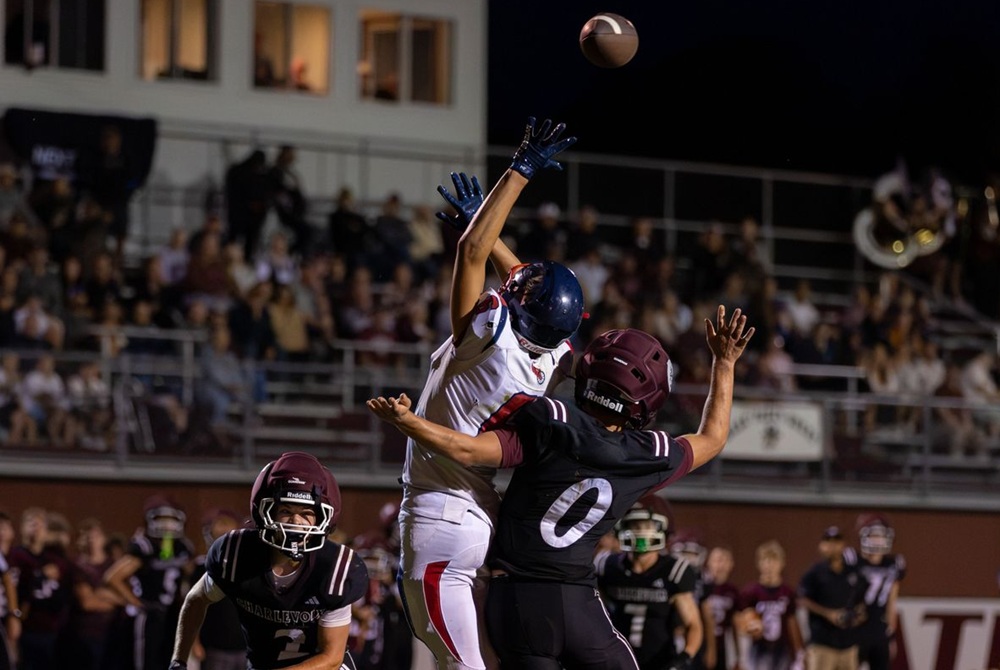
PHOTO A Boyne City receiver attempts to get his hands on a pass over Charlevoix defenders during the Rayders’ 28-12 Week 2 victory. (Photo by kishba media.)