

A Hero Comes Home to Vassar
October 17, 2012
By Alex Leveille and Tyler Langley
Vassar High School seniors
(Editor's note: Nothing short of incredible describes the story of U.S. Army Staff Sergeant Travis Mills. He is continuing a successful recovery from losing all four limbs after stepping on an improvised explosive device while on patrol in April during his third tour of duty in Afghanistan. His story turned a national spotlight on Vassar, a town of 2,700 people located in Michigan's thumb. Mills was an athletic standout for the Vulcans before graduating in 2005, and returned for Homecoming earlier this month. Vassar seniors Alex Leveille and Tyler Langley give us the story and explain its impact from a student point of view.)
Homecoming is about many things to high school students. But this year it got a whole lot bigger when word got out that Travis Mills, paratrooper of the 82nd Airborne, was coming home.
When the students at Vassar learned that Travis was coming back for Homecoming, everyone was excited to see him. A couple of students said they were really happy they would finally be able to meet the hero they heard all about.
“Seeing and meeting Travis was a really neat experience for me personally, so I can only imagine the effect he had on the community," said Vassar football player Brik Rupprecht, one of the team captains this fall. "When Travis showed up, you could really feel the positive energy coming from the crowd, supporting him, and the positive attitude Travis brought with him. When it came to the game, we just gave it our best for him. He told us he wanted to see a win, and that’s what we gave him. (Vassar defeated Unionville-Sebewaing that night 22-16.)”
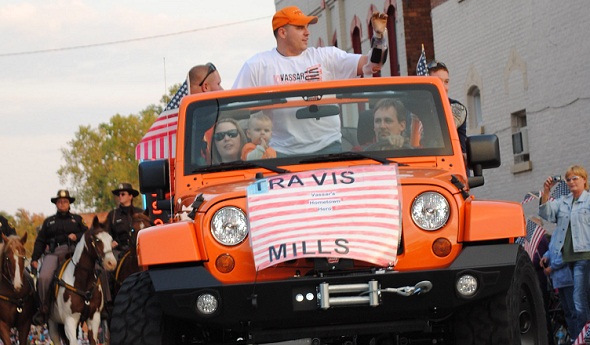
Many things were changed to accommodate Travis’s homecoming. The Homecoming parade, of which Travis was the grand marshal, was moved to Thursday, Oct. 4 instead of Friday before the game. It was followed by a bonfire at which Travis spoke to a crowd of more than 3,000 people, thanking them for everything they have done for him and his family.
On that Friday, the day’s events included a block party sponsored by many local businesses plus Pepsi and Frito-Lay. This was a chance for the community to come together to celebrate Vassar’s Homecoming, as well as welcome Travis home. The pregame festivities included a ceremony to thank all of the area’s veterans, including Travis.
Travis then took center stage before the game to again express his sincere thanks for the community’s love and support throughout his recovery. The community continued that support with various gifts to Travis and his family to further show their love for them.
He then led a special coin toss during which both Vassar and Unionville-Sebewaing players lined up intermixed on both 45 yard-lines to show their united support for Travis. He also spoke to the Vassar team before the game, encouraging them to "play every down like it’s your last, because you never know when it’s going to be your last.”

With Travis coming back to Vassar, our town was put in the spotlight of national news, which was something new to almost all of the students in Vassar. They all had different opinions about it too. Some didn’t like the thought of being in the eye of the country, but others did. Draven Muller, a sophomore and junior varsity football player, said it was a cool thought to be recognized nationally as a town and to be associated with a hero like Travis.
Jim Baker, a former paratrooper himself and teacher at Vassar High School, said, “Travis Mills is a true representative of what a paratrooper is all about. He makes me proud that I was a member of the 82nd Airborne Division.”
Vassar Chief of Police Ben Guile said he remembers Travis when he was in high school. “Only a person like Travis would have been able to survive something like this, and be as positive as he is," Guile said. "He is very charismatic, and him coming back home to thank the community is one of the best things he could have done. This town loves him, and I never have felt any more positive energy at a parade than the one that Travis led.”
Travis came back the following Friday, Oct. 12, to speak to the students at Vassar High School. Travis, being the upbeat guy he is, kept the crowd awake and laughing the entire assembly, cracking jokes and telling the crowd about his experiences in the Afghanistan war.
He also offered advice on high school and college experiences and talked about his plans after getting out of Walter Reed Medical Center, where he's undergoing occupational therapy.
As he put it, “Hopefully the Army will want me back after I’m done at Walter Reed. I might not be able to do all of the physical stuff anymore, but I still have everything they taught me in my head.”
He also plans to go back to college and get a degree in teaching, and hopefully become a teacher and a football coach some day.
Having Travis home was great for the community and the area. He is an all-around great guy and can uplift anyone’s spirits.
Click on links below for Mills' web site and some of the national coverage of his recovery and return home.
TravisMills.org - Fox News - USA Today - Detroit News - Saginaw News
PHOTOS: (Top) Travis Mills served as the grand marshal of Vassar's Homecoming parade Oct. 5. (Middle) Mills returned to his former high school Friday to tell students about his experiences in Afghanistan. (Top photo by Vassar High senior Sarah McKenney; middle photo by English and journalism teacher Jamie Strauss.)
Wassink, Sailors Take Back Championship
November 28, 2014
By Geoff Kimmerly
Second Half editor
DETROIT – The first time Jon Wassink led Grand Rapids South Christian to Ford Field, he spent the 2012 MHSAA Division 4 Final on the sideline with a broken collarbone as his back-up took the team the rest of the way to a title.
Wassink brought the Sailors back to Detroit in 2013 – but they couldn’t keep pace with Marine City despite his three touchdown passes and two scoring runs.
Friday night against Lansing Sexton was Wassink’s last chance to be part of an MHSAA football champion – and play a physical part in a championship game win.
And he didn’t let it slip by. The Sailors' senior quarterback threw for 179 yards and three touchdowns and ran for 122 and another score as South Christian edged Sexton 28-27 for its second Division 4 title in three seasons.
Oh, and Wassink also had four tackles and an interception from his defensive back spot and averaged 39.8 yards on six punts.
“Two years ago when we won it, I was just happy for the team and the community. Part of me obviously wanted to play too, so that was really disappointing but (I was) really happy at the same time,” said Wassink, who was injured in the Semifinal win that season.
“(Last year) was the driving force behind our whole season. We just didn’t want to end our season like we did last year.”
But Sexton came so close to sending Wassink to Western Michigan University with another runner-up finish instead.
The Big Reds (13-1), undefeated on the way to their first MHSAA Final appearance, scored on the game’s opening drive, 2 minutes and 22 seconds into the first quarter.
South Christian (12-2) scored the next two touchdowns, and Sexton then answered. The Sailors took a 21-13 lead into halftime after a Wassink touchdown pass with seven seconds to go before the break and extended the advantage on his 68-yard touchdown run 13 seconds into the third quarter. But the Big Reds battled back with two more scores to pull within a point of the lead with 10:43 to play.
“They’re a scary team. They have all of those great athletes and big bodies,” South Christian coach Mark Tamminga said. “We knew going in they scored a lot of points during the second half and wear you down with all of those big bodies. Our kids just stepped up and made plays when they had to.”
 The first set of offensive plays didn’t result in a score – but burned 5:16 off the clock to give the Big Reds only 5:25 to work with as it drove to take the lead.
The second set of difference-making maneuvers actually came on the same play – and on defense. Sexton had a new set of downs at its 38-yard line when senior linebacker Sam Heyboer burst into the Big Reds' backfield for a 12-year sack. In the process he helped cause a fumble that was recovered by another senior linebacker, Nick Bosch.
But again, South Christian didn’t score – yet took an additional 2:13 off the clock before Wassink was stopped short on a fourth down run by Big Reds senior lineman Isaiah Brown. Only 1:35 remained, and Sexton could advance only 32 yards to its 39-yard-line before the clock ran out.
“Our defense had a heck of a goalline stand down there, and I’m proud of my kids. They fought hard against a really good football team,” Sexton coach Dan Boggan said. “We’re an outstanding football team ourselves, and it could’ve gone either way. I’m disappointed, but I’m not broken.”
Sexton allowed only 63 more second-half yards after Wassink’s long scoring run during the first half-minute of the third quarter. But Sexton also had three turnovers total, while the Sailors never turned over the ball, and missed an extra point after its final touchdown that would’ve tied the score. The Sailors also held a Sexton rushing attack featuring two 1,000-yard rushers to only 101.
Big Reds quarterback Malik Mack finished an outstanding varsity career with 224 yards and two touchdowns passing and another score on the ground. Both of his touchdown passes went to sophomore tight end Kahari Foy-Walton, and senior Rayshawn Wilborn added eight catches for 84 yards and eight tackles at linebacker.
Junior lineman Marshaun Blake had a game-high nine tackles and his teammates combined for six tackles for losses and three sacks. “They were one of the best, if not the best we played all year,” Wassink said. “Fast, physical, just really tough.”
Heyboer finished with two of his team’s three sacks and also caught one of Wassink’s three touchdown passes. Seniors Ryan Veenstra and Eric VanVoorst caught the others, and senior Geff Plasman finished his career with 80 more rushing yards to end up with 1,300 for this fall.
Wassink’s final numbers for his final season set the bar high for those who follow. Adding in his Ford Field heroics, Wassink finished with 1,426 yards and 18 touchdowns rushing and 2,494 yards and 28 touchdowns passing.
And he'll graduate as a two-time MHSAA champion – this time having had something to say about the final result.
“He’s been driven all year. This is what he wanted,” Tamminga said. “He felt he didn’t play the best here last year, and he wanted to go out with a state championship.
“What a tremendous athlete.”
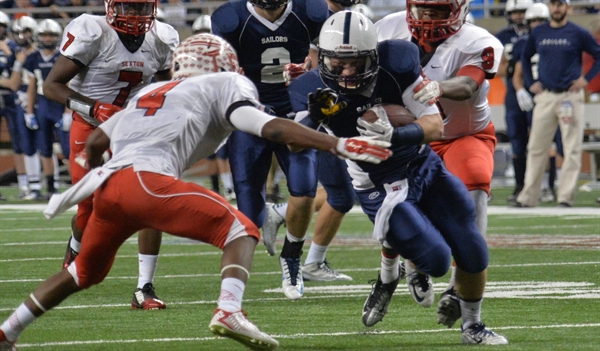
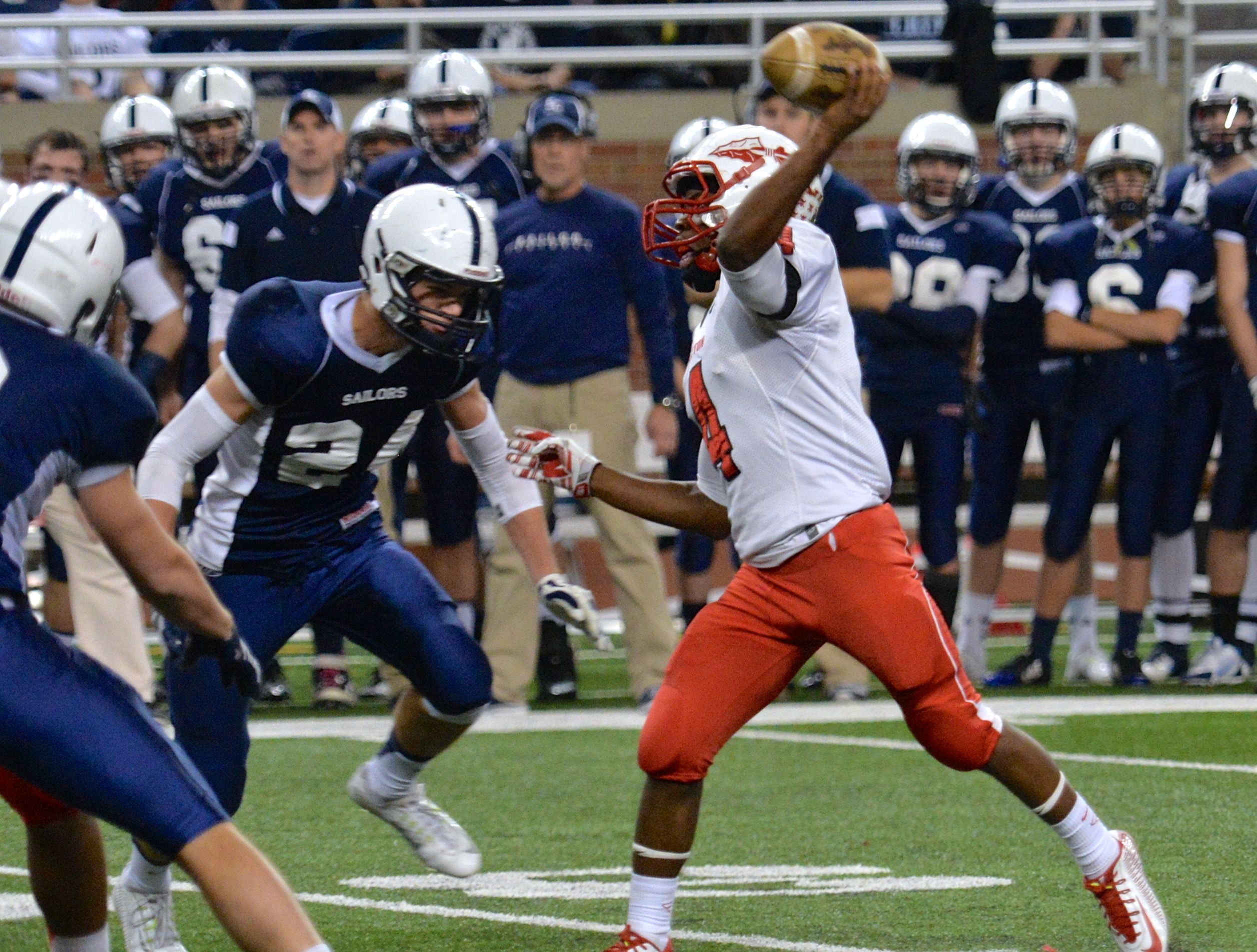
PHOTOS: (Top) Lansing Sexton’s Malik Mack (4) and Ardis Davis (9) work to wrap up a South Christian ball carrier Friday night. (Middle) Mack prepares to unload a pass with the Sailors’ Jake Wierenga applying pressure. (Click for action photos and team photos from Hockey Weekly Action Photos.)
VIDEO HIGHLIGHTS:
WASSINK'S OFF TO THE RACES - Grand Rapids South Christian scored touchdowns on its last possession of the first half and its first of the second half against Lansing Sexton. Here's the second TD, a 68-yard run by quarterback Jon Wassink. The TD and extra point that followed turned out to be the winning scoring sequence in a 28-27 Sailors win.
SEXTON TIGHTENS IT UP - Early in the fourth period, Lansing Sexton pulled within a point of Grand Rapids South Christian on a 29-yard pitch/catch/run play from Malik Mack to Kahari Foy-Walton. It was the second time the duo connected for a score in the game.
Watch the entire game and order DVDs by Clicking Here.