

A Hero Comes Home to Vassar
October 17, 2012
By Alex Leveille and Tyler Langley
Vassar High School seniors
(Editor's note: Nothing short of incredible describes the story of U.S. Army Staff Sergeant Travis Mills. He is continuing a successful recovery from losing all four limbs after stepping on an improvised explosive device while on patrol in April during his third tour of duty in Afghanistan. His story turned a national spotlight on Vassar, a town of 2,700 people located in Michigan's thumb. Mills was an athletic standout for the Vulcans before graduating in 2005, and returned for Homecoming earlier this month. Vassar seniors Alex Leveille and Tyler Langley give us the story and explain its impact from a student point of view.)
Homecoming is about many things to high school students. But this year it got a whole lot bigger when word got out that Travis Mills, paratrooper of the 82nd Airborne, was coming home.
When the students at Vassar learned that Travis was coming back for Homecoming, everyone was excited to see him. A couple of students said they were really happy they would finally be able to meet the hero they heard all about.
“Seeing and meeting Travis was a really neat experience for me personally, so I can only imagine the effect he had on the community," said Vassar football player Brik Rupprecht, one of the team captains this fall. "When Travis showed up, you could really feel the positive energy coming from the crowd, supporting him, and the positive attitude Travis brought with him. When it came to the game, we just gave it our best for him. He told us he wanted to see a win, and that’s what we gave him. (Vassar defeated Unionville-Sebewaing that night 22-16.)”
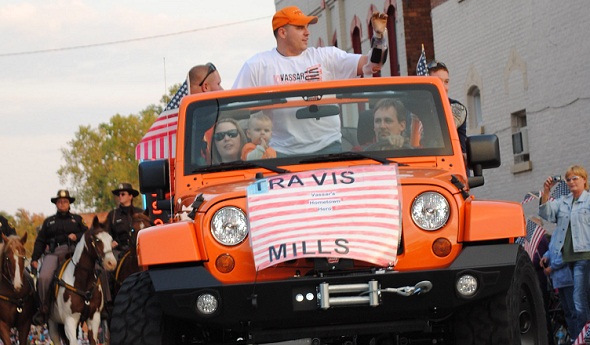
Many things were changed to accommodate Travis’s homecoming. The Homecoming parade, of which Travis was the grand marshal, was moved to Thursday, Oct. 4 instead of Friday before the game. It was followed by a bonfire at which Travis spoke to a crowd of more than 3,000 people, thanking them for everything they have done for him and his family.
On that Friday, the day’s events included a block party sponsored by many local businesses plus Pepsi and Frito-Lay. This was a chance for the community to come together to celebrate Vassar’s Homecoming, as well as welcome Travis home. The pregame festivities included a ceremony to thank all of the area’s veterans, including Travis.
Travis then took center stage before the game to again express his sincere thanks for the community’s love and support throughout his recovery. The community continued that support with various gifts to Travis and his family to further show their love for them.
He then led a special coin toss during which both Vassar and Unionville-Sebewaing players lined up intermixed on both 45 yard-lines to show their united support for Travis. He also spoke to the Vassar team before the game, encouraging them to "play every down like it’s your last, because you never know when it’s going to be your last.”

With Travis coming back to Vassar, our town was put in the spotlight of national news, which was something new to almost all of the students in Vassar. They all had different opinions about it too. Some didn’t like the thought of being in the eye of the country, but others did. Draven Muller, a sophomore and junior varsity football player, said it was a cool thought to be recognized nationally as a town and to be associated with a hero like Travis.
Jim Baker, a former paratrooper himself and teacher at Vassar High School, said, “Travis Mills is a true representative of what a paratrooper is all about. He makes me proud that I was a member of the 82nd Airborne Division.”
Vassar Chief of Police Ben Guile said he remembers Travis when he was in high school. “Only a person like Travis would have been able to survive something like this, and be as positive as he is," Guile said. "He is very charismatic, and him coming back home to thank the community is one of the best things he could have done. This town loves him, and I never have felt any more positive energy at a parade than the one that Travis led.”
Travis came back the following Friday, Oct. 12, to speak to the students at Vassar High School. Travis, being the upbeat guy he is, kept the crowd awake and laughing the entire assembly, cracking jokes and telling the crowd about his experiences in the Afghanistan war.
He also offered advice on high school and college experiences and talked about his plans after getting out of Walter Reed Medical Center, where he's undergoing occupational therapy.
As he put it, “Hopefully the Army will want me back after I’m done at Walter Reed. I might not be able to do all of the physical stuff anymore, but I still have everything they taught me in my head.”
He also plans to go back to college and get a degree in teaching, and hopefully become a teacher and a football coach some day.
Having Travis home was great for the community and the area. He is an all-around great guy and can uplift anyone’s spirits.
Click on links below for Mills' web site and some of the national coverage of his recovery and return home.
TravisMills.org - Fox News - USA Today - Detroit News - Saginaw News
PHOTOS: (Top) Travis Mills served as the grand marshal of Vassar's Homecoming parade Oct. 5. (Middle) Mills returned to his former high school Friday to tell students about his experiences in Afghanistan. (Top photo by Vassar High senior Sarah McKenney; middle photo by English and journalism teacher Jamie Strauss.)
A Game for Every Fan: Week 7
October 9, 2014
By Geoff Kimmerly
Second Half editor
League champions will celebrate this weekend. And 88 teams have the opportunity to clinch playoff berths, joining 54 that already have qualified.
But a similar pressure rests on the 117 teams that enter this weekend 3-3 – and needing to win out to earn automatic tickets to the postseason.
It’s a group that includes Detroit Catholic Central, Lake Orion, Grand Rapids Catholic Central and Saginaw Nouvel – teams which advanced to Ford Field championship games over the last five years.
Keep that in mind when checking out the games to watch in the three weeks to come, including those listed below. As those coaches will tell you, for many the playoff begin now.
Mid-Michigan
Williamston (6-0) at Lansing Catholic (6-0)
Most would bill this as a game between a pair of talented quarterbacks – Lansing Catholic’s 6-foot-6 Tony Poljan vs. Williamston’s speedy pass/run threat Chaz Moore. But the Capital Area Activities Conference White championship could be decided tonight as well by a Cougars defense giving up only 11 points per game or a Williamston defense a smidge better on paper at 9.8 ppg.
Others that caught my eye: Grand Blanc (5-1) at Hartland (5-1), Grand Ledge (4-2) at Lansing Everett (4-2), Laingsburg (4-2) at Pewamo-Westphalia (5-1), Reed City (5-1) at Stanton Central Montcalm (4-2).
West Michigan
Whitehall (6-0) at Muskegon Oakridge (5-1)
After back-to-back losing seasons – including a 1-8 finish in 2013 – there are probably a few people surprised to be talking about Whitehall football this fall. But the Vikings can clinch their best record since 2006 and a share of the West Michigan Conference title with a win tonight. That would be an improvement on 2006, actually – Whitehall finished 9-2 that fall, but lost to Oakridge 14-6 to finish league runner-up.
Others that caught my eye: Cedar Springs (5-1) at Grand Rapids Forest Hills Northern (6-0), Hudsonville (4-2) at East Kentwood (5-1), Muskegon Catholic Central (6-0) at Muskegon Orchard View (4-2), Caledonia (4-2) at East Grand Rapids (4-2).
Greater Detroit
Walled Lake Western (5-1) at Walled Lake Central (5-1)
These two have played each other annually – and a few seasons twice – dating to 1969. But this should be the next in a latest series of high-impact matchups. Walled Lake Central can claim the Kensington Lakes Activities Association North title outright, or share with Western and potentially Waterford Mott if the Warriors win. Western was victorious in 2011, beating Central 18-11 in the league finale to win the North title after Central did the same to Western in 2010.
Others that caught my eye: Plymouth (5-1) at Canton (5-1), Wyandotte Roosevelt (5-1) at Brownstown Woodhaven (6-0), Ida (6-0) at Hudson (5-1), Grosse Pointe Woods University Liggett (5-1) at Lutheran Westland (5-1) on Saturday.
Upper Peninsula
Ishpeming (6-0) at Negaunee (4-2)
These two dominated the Mid-Peninsula Athletic Conference the last two seasons – Negaunee winning the league title in 2012 and Ishpeming last fall – but the Miners are already trailing the Hematites by a win thanks to the re-emergence this fall of Iron Mountain (the Mountaineers beat Negaunee 20-17 in Week 4). Negaunee will have to break Ishpeming’s 27-game winning streak tonight to create a possible three-team shared title.
Others that caught my eye: Munising (5-1) at Bark River-Harris (5-1), Constantine (6-0) at Marquette (5-1) on Saturday, L'Anse (4-2) at Calumet (3-3), Ishpeming Westwood (4-2) at Norway (3-3).
Southwest and Border
Three Rivers (4-2) at Plainwell (5-1)
All three remaining games for Wolverine B Conference teams are league games, and the East race is down to three teams – this pair and Sturgis, with all three opening the league schedule 2-0. Three Rivers and Plainwell didn’t play in the same division of the league the last two seasons, but kept a long-standing rivalry alive with a couple of nonleague tilts won by the Trojans by eight and seven points. Plainwell’s only loss this fall is a two-pointer to Edwardsburg – which also beat Three Rivers by two on opening night.
Others that caught my eye: Saugatuck (4-2) at Fennville (4-2), Edwardsburg (5-1) at Dowagiac (3-3), Battle Creek Harper Creek (4-2) at Coldwater (5-1), Portage Central (4-1) at Portage Northern (4-2).
Lower Up North
Petoskey (5-1) at Gaylord (4-2)
The good news is Petoskey already has Big North Conference leader Cadillac out of the way – the Northmen fell in their Week 3 game, 27-7. The bad news is Petoskey now has to wait and hope either Traverse City West this week or Traverse City Central in Week 9 beats Cadillac so Petoskey can earn a share of the league title. But Petoskey also must be careful – Gaylord lost to Cadillac and Central the last two weeks by a combined 19 points and is seeking its first playoff berth since 2005.
Others that caught my eye: Kingsley (4-2) at Suttons Bay (5-1), Cadillac (6-0) at Traverse City West (3-3), Grayling (3-3) at Elk Rapids (3-3), Indian River Inland Lakes (5-1) at Central Lake (4-2).
Bay and Thumb
Harrison (6-0) at Beaverton (4-2)
Harrison already will post its best finish since 1999 and first winning record since 2000 – and is in best position to end Clare’s seven-season run atop the Jack Pine Conference. But the Hornets must be careful to not look ahead to that Week 8 matchup; Beaverton is one of three teams tied for third place and needs just one more victory to guarantee its first winning season since 2000 as well.
Others that caught my eye: Midland (3-3) at Lapeer (6-0), Romeo (3-3) at Port Huron (5-1), Carrollton (3-3) at Saginaw Michigan Lutheran Seminary (5-1), Flint Powers Catholic (4-2) at Flint Southwestern Academy (3-3).
8-Player
Battle Creek St. Philip (6-0) at Waldron (5-1)
The Southern Central 8-Man Football League championship is on the line. St. Philip outscored Waldron by a combined 110-6 in two games last season and has scored, 55, 56, 89 and 72 points over the last four weeks, respectively. But this is a much better Waldron team than in 2013 – its lone loss is to undefeated Portland St. Patrick, and the Spartans look good to win seven games for the first time since 2007.
Others that caught my eye: Engadine (3-3) at Bellaire (6-0), Owendale-Gagetown (6-0) at Kingston (3-3).
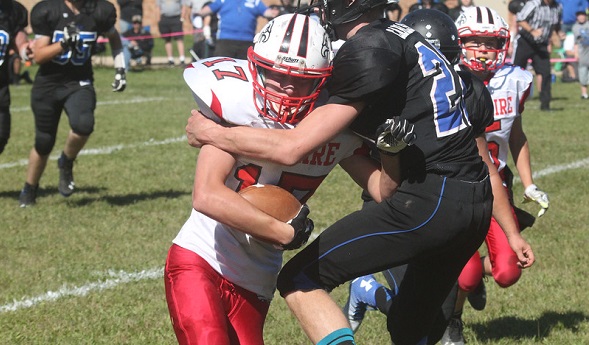
PHOTO: Bellaire, running against Eben Junction Superior Central last week, is one of seven undefeated teams in 8-player football. Superior Central is in a tight race for the final playoff spot and must climb six to make the field of 16. (Photo courtesy of Paul Gerard.)