
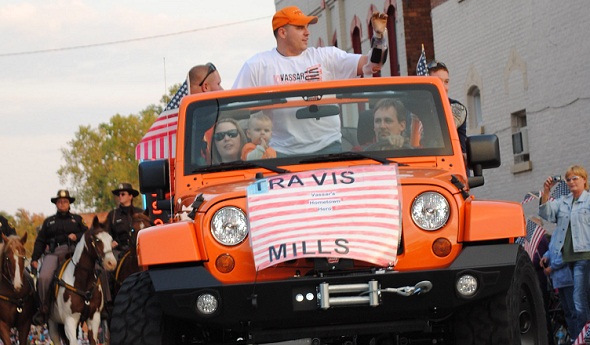
A Hero Comes Home to Vassar
October 17, 2012
By Alex Leveille and Tyler Langley
Vassar High School seniors
(Editor's note: Nothing short of incredible describes the story of U.S. Army Staff Sergeant Travis Mills. He is continuing a successful recovery from losing all four limbs after stepping on an improvised explosive device while on patrol in April during his third tour of duty in Afghanistan. His story turned a national spotlight on Vassar, a town of 2,700 people located in Michigan's thumb. Mills was an athletic standout for the Vulcans before graduating in 2005, and returned for Homecoming earlier this month. Vassar seniors Alex Leveille and Tyler Langley give us the story and explain its impact from a student point of view.)
Homecoming is about many things to high school students. But this year it got a whole lot bigger when word got out that Travis Mills, paratrooper of the 82nd Airborne, was coming home.
When the students at Vassar learned that Travis was coming back for Homecoming, everyone was excited to see him. A couple of students said they were really happy they would finally be able to meet the hero they heard all about.
“Seeing and meeting Travis was a really neat experience for me personally, so I can only imagine the effect he had on the community," said Vassar football player Brik Rupprecht, one of the team captains this fall. "When Travis showed up, you could really feel the positive energy coming from the crowd, supporting him, and the positive attitude Travis brought with him. When it came to the game, we just gave it our best for him. He told us he wanted to see a win, and that’s what we gave him. (Vassar defeated Unionville-Sebewaing that night 22-16.)”
Many things were changed to accommodate Travis’s homecoming. The Homecoming parade, of which Travis was the grand marshal, was moved to Thursday, Oct. 4 instead of Friday before the game. It was followed by a bonfire at which Travis spoke to a crowd of more than 3,000 people, thanking them for everything they have done for him and his family.
On that Friday, the day’s events included a block party sponsored by many local businesses plus Pepsi and Frito-Lay. This was a chance for the community to come together to celebrate Vassar’s Homecoming, as well as welcome Travis home. The pregame festivities included a ceremony to thank all of the area’s veterans, including Travis.
Travis then took center stage before the game to again express his sincere thanks for the community’s love and support throughout his recovery. The community continued that support with various gifts to Travis and his family to further show their love for them.
He then led a special coin toss during which both Vassar and Unionville-Sebewaing players lined up intermixed on both 45 yard-lines to show their united support for Travis. He also spoke to the Vassar team before the game, encouraging them to "play every down like it’s your last, because you never know when it’s going to be your last.”

With Travis coming back to Vassar, our town was put in the spotlight of national news, which was something new to almost all of the students in Vassar. They all had different opinions about it too. Some didn’t like the thought of being in the eye of the country, but others did. Draven Muller, a sophomore and junior varsity football player, said it was a cool thought to be recognized nationally as a town and to be associated with a hero like Travis.
Jim Baker, a former paratrooper himself and teacher at Vassar High School, said, “Travis Mills is a true representative of what a paratrooper is all about. He makes me proud that I was a member of the 82nd Airborne Division.”
Vassar Chief of Police Ben Guile said he remembers Travis when he was in high school. “Only a person like Travis would have been able to survive something like this, and be as positive as he is," Guile said. "He is very charismatic, and him coming back home to thank the community is one of the best things he could have done. This town loves him, and I never have felt any more positive energy at a parade than the one that Travis led.”
Travis came back the following Friday, Oct. 12, to speak to the students at Vassar High School. Travis, being the upbeat guy he is, kept the crowd awake and laughing the entire assembly, cracking jokes and telling the crowd about his experiences in the Afghanistan war.
He also offered advice on high school and college experiences and talked about his plans after getting out of Walter Reed Medical Center, where he's undergoing occupational therapy.
As he put it, “Hopefully the Army will want me back after I’m done at Walter Reed. I might not be able to do all of the physical stuff anymore, but I still have everything they taught me in my head.”
He also plans to go back to college and get a degree in teaching, and hopefully become a teacher and a football coach some day.
Having Travis home was great for the community and the area. He is an all-around great guy and can uplift anyone’s spirits.
Click on links below for Mills' web site and some of the national coverage of his recovery and return home.
TravisMills.org - Fox News - USA Today - Detroit News - Saginaw News
PHOTOS: (Top) Travis Mills served as the grand marshal of Vassar's Homecoming parade Oct. 5. (Middle) Mills returned to his former high school Friday to tell students about his experiences in Afghanistan. (Top photo by Vassar High senior Sarah McKenney; middle photo by English and journalism teacher Jamie Strauss.)

Talking Practice: Texas, Illinois Revise Policies
December 20, 2013
By Rob Kaminski
MHSAA benchmarks editor
Coaches and players in Texas and Illinois adapted to new football practice limitations this fall, with the Texas policy focusing on contact, and the Illinois regulation emphasizing length of preseason practices.
Following are the main changes those states put in place heading into the 2013-14 season:
The University Interscholastic League, which governs school sports in Texas, put into writing that, “During the regular season and postseason, no football player is allowed to participate in more than ninety (90) minutes of full contact practice per week,” effective with the first day of practice this fall.
The complete policy follows:
For the purposes of the of rule, "full contact" is defined as football drills or live game simulations where "live action" occurs. Live action, as defined by USA Football, is contact at game speed where players execute full tackles at a competitive pace taking players to the ground. A team may continue to dress in full pads for practice, but may only participate in live action drills and game time simulations no more than ninety minutes per athlete per week. It is assumed that when players are in shells (shorts, shoulder pads, and helmets) no live action drills or simulations will occur. This rule is intended to limit live action drills and simulations and not the number of practices a team may participate in full pads. A team may participate in "air," "bags," "wrap," and "thud" drills and simulations at any point. These contact levels are defined below:
• Air - Players should run unopposed without bags or any opposition
• Bags - activity is executed against a bag, shield or pad to allow for a soft-contact surface, with or without the resistance of a teammate or coach standing behind the bag.
• Wrap - Drills run at full speed until contact, which is above the waist with the players remaining on their feet.
• Thud - Same as wrap but tempo is competitive with no pre-determined winner and the players are not tackling to the ground.
The rule came to the UIL Legislative Council as a recommendation from the UIL Medical Advisory Committee, a permanent advisory committee to the Legislative Council which meets twice each year to discuss and review safety policies for UIL participants. The committee, which is made up of leading medical professionals in various specialties and includes representatives from the Texas High School Coaches Association, the Texas Girls Coaches Association, and the Texas State Athletic Trainer Association, unanimously recommended this limitation in full-contact football practice.
The rule formulates into a formal policy the existing actions of the majority of coaches across Texas, and most coaches have had to make few adjustments, if any. In fact, according to a story on statesman.com, the proposal caused more of an uproar on social media than from coaches.
“It’s not going to affect us in anyway,” Vandegrift HS coach Drew Sanders said in the story. “Most good coaches were way below that 90-minute amount already. Prior to legislation we still monitored it ourselves – the only change is now we have to keep up a log more publicly.”
Illinois put standards in place for its first 14 days of football practices, known as the state’s Preseason Football Acclimatization Practice Period. At the core of the policy is a three-hour practice limit for the first five days, during which teams can also conduct a one-hour walk-through.
Teams must observe a minimum two hours rest between the practices and walk-throughs. Players may wear helmets only on the first two days, then helmets and shoulder pads for the next three. From days seven through 14 of the acclimatization period, schools may practice for a maximum of five hours per day, as long as that day is followed by a three-hour day, or an off day. During the five-hour days, no session can last more than three hours and must include a two-hour break between practices. Full pads may be worn for the final seven dates leading up to the first contest.
“This policy was the result of a collaborative effort between the IHSA Sports Medicine Advisory Committee and the Football Advisory Committee,” said SMAC committee member and University of Illinois Associate Professor of Orthopedic Surgery Dr. Preston M. Wolin. “The guidelines are based on the most recent scientific evidence, as well as the expertise of the coaches who will help implement them. Both committees believe the guidelines represent a significant positive contribution to the health of our athletes.”
“This new policy undoubtedly changes the way we, as coaches, approach preseason practice,” said Metamora HS coach Pat Ryan, who is a member of the FAC and a past President of the Illinois High School Football Coaches Association. “Coaches have to get more creative with when and how they schedule practices, as well what they do with their time. The proposals were strongly supported by both committees. It is a crucial final step to the process of being able to effectively prepare our teams in a safe manner. Change is always difficult, but the game is changing and we need to adapt to continue to put the safety of our players first.”
The IHSA offered multiple interactive online webinar meetings for high school coaches leading up to the start of practice where questions were answered, along with further clarifications on the policy and the science behind it.
“I think most coaches understood that changes were on the horizon,” said IHSA Executive Director Marty Hickman. “We wanted to be in a position to give our coaches as much information as possible to make sure they are comfortable with the new policy. Their input will be critical moving forward as we develop educational materials, like a best practices presentation. I commend our committees on a policy that is supported by medical experts, football coaches and school administrators.”