

A Hero Comes Home to Vassar
October 17, 2012
By Alex Leveille and Tyler Langley
Vassar High School seniors
(Editor's note: Nothing short of incredible describes the story of U.S. Army Staff Sergeant Travis Mills. He is continuing a successful recovery from losing all four limbs after stepping on an improvised explosive device while on patrol in April during his third tour of duty in Afghanistan. His story turned a national spotlight on Vassar, a town of 2,700 people located in Michigan's thumb. Mills was an athletic standout for the Vulcans before graduating in 2005, and returned for Homecoming earlier this month. Vassar seniors Alex Leveille and Tyler Langley give us the story and explain its impact from a student point of view.)
Homecoming is about many things to high school students. But this year it got a whole lot bigger when word got out that Travis Mills, paratrooper of the 82nd Airborne, was coming home.
When the students at Vassar learned that Travis was coming back for Homecoming, everyone was excited to see him. A couple of students said they were really happy they would finally be able to meet the hero they heard all about.
“Seeing and meeting Travis was a really neat experience for me personally, so I can only imagine the effect he had on the community," said Vassar football player Brik Rupprecht, one of the team captains this fall. "When Travis showed up, you could really feel the positive energy coming from the crowd, supporting him, and the positive attitude Travis brought with him. When it came to the game, we just gave it our best for him. He told us he wanted to see a win, and that’s what we gave him. (Vassar defeated Unionville-Sebewaing that night 22-16.)”
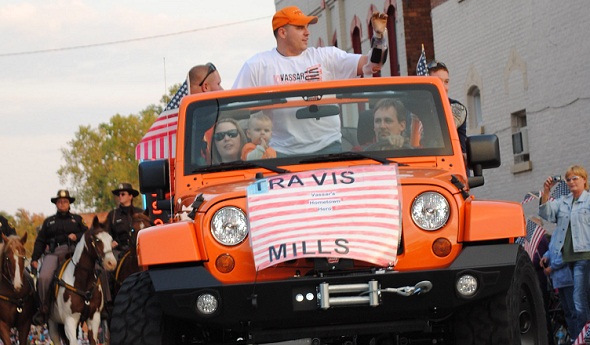
Many things were changed to accommodate Travis’s homecoming. The Homecoming parade, of which Travis was the grand marshal, was moved to Thursday, Oct. 4 instead of Friday before the game. It was followed by a bonfire at which Travis spoke to a crowd of more than 3,000 people, thanking them for everything they have done for him and his family.
On that Friday, the day’s events included a block party sponsored by many local businesses plus Pepsi and Frito-Lay. This was a chance for the community to come together to celebrate Vassar’s Homecoming, as well as welcome Travis home. The pregame festivities included a ceremony to thank all of the area’s veterans, including Travis.
Travis then took center stage before the game to again express his sincere thanks for the community’s love and support throughout his recovery. The community continued that support with various gifts to Travis and his family to further show their love for them.
He then led a special coin toss during which both Vassar and Unionville-Sebewaing players lined up intermixed on both 45 yard-lines to show their united support for Travis. He also spoke to the Vassar team before the game, encouraging them to "play every down like it’s your last, because you never know when it’s going to be your last.”

With Travis coming back to Vassar, our town was put in the spotlight of national news, which was something new to almost all of the students in Vassar. They all had different opinions about it too. Some didn’t like the thought of being in the eye of the country, but others did. Draven Muller, a sophomore and junior varsity football player, said it was a cool thought to be recognized nationally as a town and to be associated with a hero like Travis.
Jim Baker, a former paratrooper himself and teacher at Vassar High School, said, “Travis Mills is a true representative of what a paratrooper is all about. He makes me proud that I was a member of the 82nd Airborne Division.”
Vassar Chief of Police Ben Guile said he remembers Travis when he was in high school. “Only a person like Travis would have been able to survive something like this, and be as positive as he is," Guile said. "He is very charismatic, and him coming back home to thank the community is one of the best things he could have done. This town loves him, and I never have felt any more positive energy at a parade than the one that Travis led.”
Travis came back the following Friday, Oct. 12, to speak to the students at Vassar High School. Travis, being the upbeat guy he is, kept the crowd awake and laughing the entire assembly, cracking jokes and telling the crowd about his experiences in the Afghanistan war.
He also offered advice on high school and college experiences and talked about his plans after getting out of Walter Reed Medical Center, where he's undergoing occupational therapy.
As he put it, “Hopefully the Army will want me back after I’m done at Walter Reed. I might not be able to do all of the physical stuff anymore, but I still have everything they taught me in my head.”
He also plans to go back to college and get a degree in teaching, and hopefully become a teacher and a football coach some day.
Having Travis home was great for the community and the area. He is an all-around great guy and can uplift anyone’s spirits.
Click on links below for Mills' web site and some of the national coverage of his recovery and return home.
TravisMills.org - Fox News - USA Today - Detroit News - Saginaw News
PHOTOS: (Top) Travis Mills served as the grand marshal of Vassar's Homecoming parade Oct. 5. (Middle) Mills returned to his former high school Friday to tell students about his experiences in Afghanistan. (Top photo by Vassar High senior Sarah McKenney; middle photo by English and journalism teacher Jamie Strauss.)
Off to Fast Start, Gunsells Aspiring to Assemble Lasting Ludington Legacy
By
Tom Kendra
Special for MHSAA.com
September 11, 2025
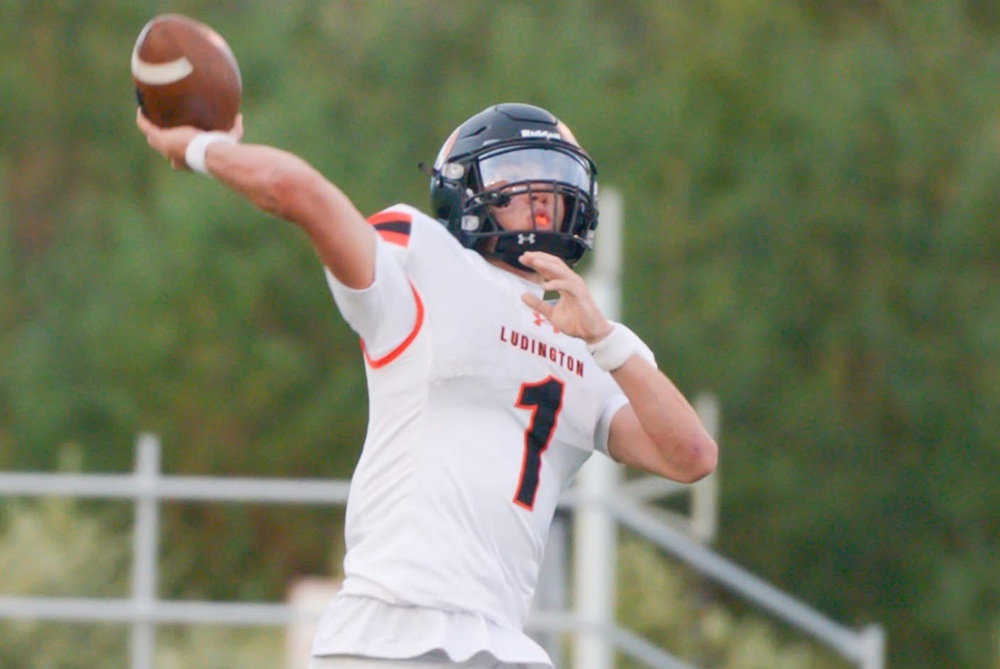
Cameron Gunsell has been building things at Ludington High School his entire life.
 “One of my earliest memories is making forts with the blocking dummies with my older brother during football practices,” recalled Gunsell of his and older brother Wilson’s adventures.
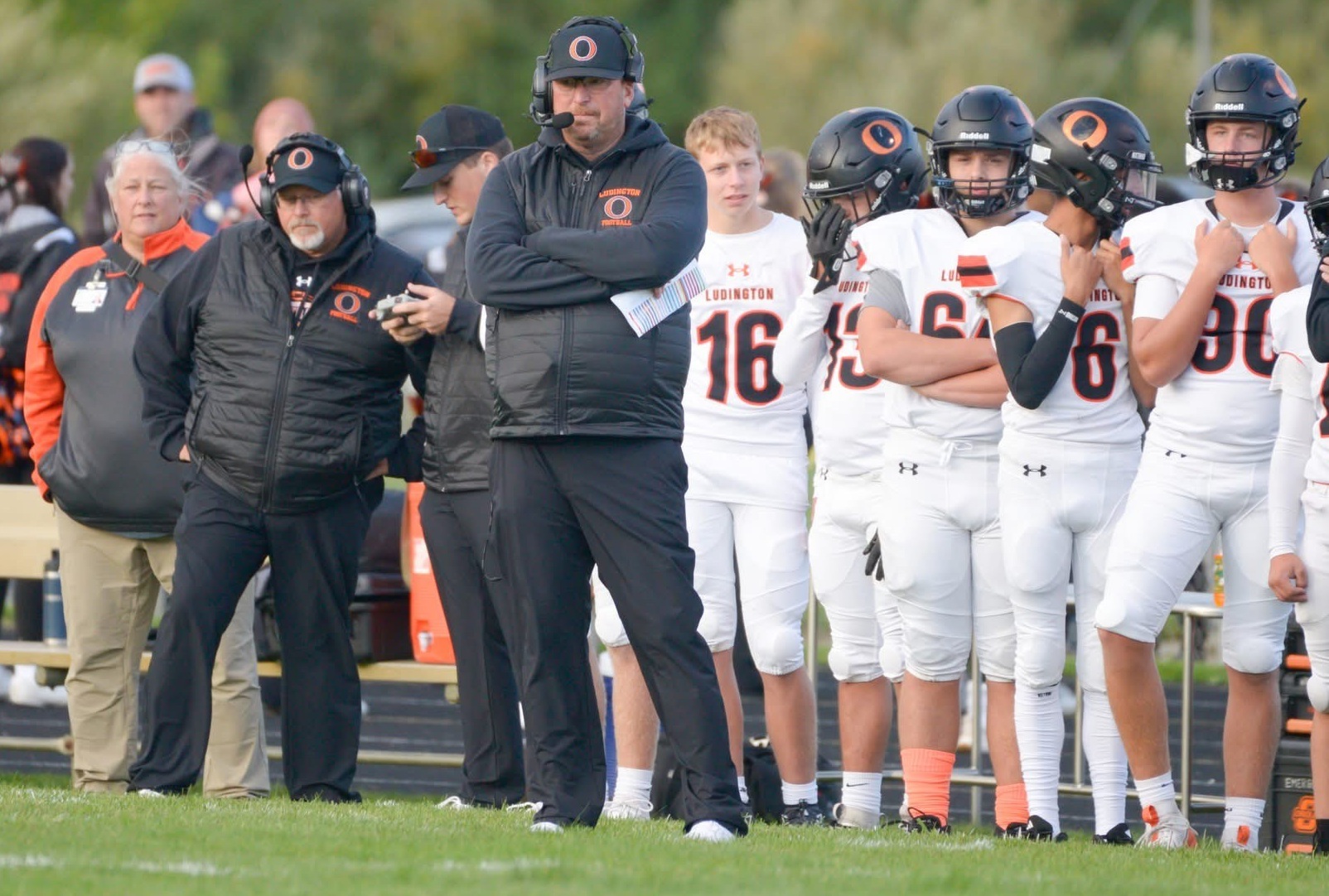
The Gunsells are now building something much bigger and more permanent at Ludington – with dad, Charlie Gunsell, in his 22nd and final year as the Orioles’ head football coach, Wilson an assistant coach and Cameron the team’s unquestioned leader and senior quarterback.
Cameron has rushed for nine touchdowns and thrown for three more over the first two weeks, leading Ludington to lopsided road wins over Coopersville and rival Mason County Central and heading into Friday’s home and West Michigan Conference Lakes opener against Fremont.
There is a buzz in this small town, best known for its Lake Michigan car ferries, which hasn’t won a football conference title since 1999 and has only one playoff victory in school history, which came during the COVID year of 2020.
“We definitely feel like this is our time,” said Cameron, 18, who is three years younger than his only sibling, Wilson. “Our motto this year is ‘Wake People Up.’ We brought back a ton of playmakers and had the best offseason in the weight room getting ready.”
The Orioles started making noise right away at Coopersville, where Cameron carried the ball 34 times for 246 yards and five touchdowns while completing 8-of-11 passes for 116 yards and a TD. He also made a team-high six tackles from his free safety position.
Last week, he was back at it against rival MCC in the Lumberman’s Cup, this time doing more damage through the air completing 8-of-15 passes for 245 yards and two scores while rushing 16 times for 161 yards and four TDs. He again led the team with eight tackles.
“It’s uncomfortable for me as the head coach talking about my son, but he is really good,” said Charlie Gunsell, a Caro native who was the starting quarterback at Ferris State in 1997. “Cam is so stinking competitive, and 80 percent of what we do offensively is a read through him. He is the guy who makes us click on both sides of the ball.”
 Cameron (6-foor-3, 190 pounds), in his third year as the starting quarterback, is closing in on 4,000 passing yards and 3,000 rushing yards for his career. His play caught the attention of college scouts, drawing scholarship offers from Grand Valley State, Davenport and reigning Division II national champion Ferris.
Gunsell announced last month that he would be following in his dad’s footsteps at Ferris, which he said was not an easy decision.
“I honestly was really close to choosing Grand Valley,” said Cameron, who completed 70 percent of his passes last season. “But, in the end, I have always wanted to be a Bulldog. Just like here at Ludington, I grew up going to football games at Ferris.”
With that choice behind him, Cameron is focused on the immediate goal of helping his team unseat Whitehall, which has won three straight WMC Lakes titles, and then making a run in the Division 4 playoffs.
He knows that defenses are going to be keying on him and stacking the box after his fast start.
“If they want to focus on me, that’s great for us,” explained Cameron, who lines up in the shotgun every play and distributes the ball to the Orioles’ four-wide skill players. “We have a lot of other weapons this year.”
The leading receiver is junior Taj Williams with seven catches for 142 yards over two games, while sophomore Kyle Himes has three catches for 122 yards.
Ludington actually features three Himes brothers, with freshman Mikie Himes the team’s second-leading rusher through two games with 88 yards. Junior Messiah Himes is a dangerous running and receiving threat from his slot position.
“We have a lot of kids who deserve touches, and they will get them as we get into our conference games and everyone tries to take Cam away,” said Gunsell, who is assisted by offensive coordinator Brent Gillett and defensive coordinator JP Deines.
Coach Gunsell points to conference foes like Oakridge, Montague, Orchard View and Whitehall as teams that have had the type of playoff success his team wants to emulate.
In order to make a run, he said the team must get the job done up front, where they are led by seniors Walt Autrey (6-4, 298), Colin Shelton and Connor Chaney.
“We have had talented players before, but our biggest thing up here is, are we tough enough?” said Gunsell. “These kids have worked so hard in the weight room to get stronger and to make that toughness our calling card.”
 Tom Kendra worked 23 years at The Muskegon Chronicle, including five as assistant sports editor and the final six as sports editor through 2011. E-mail him at [email protected] with story ideas for Muskegon, Oceana, Mason, Lake, Oceola, Mecosta and Newaygo counties.
PHOTOS (Top) Ludington quarterback Cameron Gunsell launches a pass during his team’s win over Mason County Central last week. (Middle) Gunsell’s father and head coach, Charlie Gunsell (in headset) monitors the action from the sideline. (Photos by Jason Goorman/Local Sports Journal.)