

A Hero Comes Home to Vassar
October 17, 2012
By Alex Leveille and Tyler Langley
Vassar High School seniors
(Editor's note: Nothing short of incredible describes the story of U.S. Army Staff Sergeant Travis Mills. He is continuing a successful recovery from losing all four limbs after stepping on an improvised explosive device while on patrol in April during his third tour of duty in Afghanistan. His story turned a national spotlight on Vassar, a town of 2,700 people located in Michigan's thumb. Mills was an athletic standout for the Vulcans before graduating in 2005, and returned for Homecoming earlier this month. Vassar seniors Alex Leveille and Tyler Langley give us the story and explain its impact from a student point of view.)
Homecoming is about many things to high school students. But this year it got a whole lot bigger when word got out that Travis Mills, paratrooper of the 82nd Airborne, was coming home.
When the students at Vassar learned that Travis was coming back for Homecoming, everyone was excited to see him. A couple of students said they were really happy they would finally be able to meet the hero they heard all about.
“Seeing and meeting Travis was a really neat experience for me personally, so I can only imagine the effect he had on the community," said Vassar football player Brik Rupprecht, one of the team captains this fall. "When Travis showed up, you could really feel the positive energy coming from the crowd, supporting him, and the positive attitude Travis brought with him. When it came to the game, we just gave it our best for him. He told us he wanted to see a win, and that’s what we gave him. (Vassar defeated Unionville-Sebewaing that night 22-16.)”
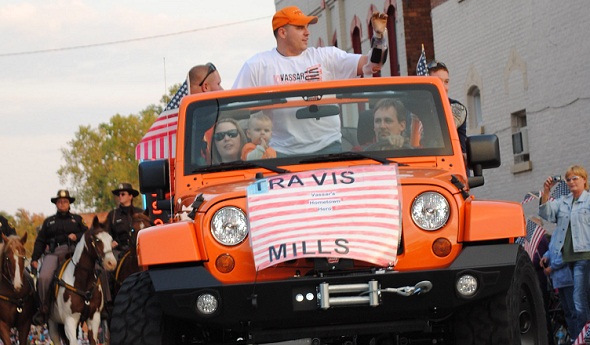
Many things were changed to accommodate Travis’s homecoming. The Homecoming parade, of which Travis was the grand marshal, was moved to Thursday, Oct. 4 instead of Friday before the game. It was followed by a bonfire at which Travis spoke to a crowd of more than 3,000 people, thanking them for everything they have done for him and his family.
On that Friday, the day’s events included a block party sponsored by many local businesses plus Pepsi and Frito-Lay. This was a chance for the community to come together to celebrate Vassar’s Homecoming, as well as welcome Travis home. The pregame festivities included a ceremony to thank all of the area’s veterans, including Travis.
Travis then took center stage before the game to again express his sincere thanks for the community’s love and support throughout his recovery. The community continued that support with various gifts to Travis and his family to further show their love for them.
He then led a special coin toss during which both Vassar and Unionville-Sebewaing players lined up intermixed on both 45 yard-lines to show their united support for Travis. He also spoke to the Vassar team before the game, encouraging them to "play every down like it’s your last, because you never know when it’s going to be your last.”

With Travis coming back to Vassar, our town was put in the spotlight of national news, which was something new to almost all of the students in Vassar. They all had different opinions about it too. Some didn’t like the thought of being in the eye of the country, but others did. Draven Muller, a sophomore and junior varsity football player, said it was a cool thought to be recognized nationally as a town and to be associated with a hero like Travis.
Jim Baker, a former paratrooper himself and teacher at Vassar High School, said, “Travis Mills is a true representative of what a paratrooper is all about. He makes me proud that I was a member of the 82nd Airborne Division.”
Vassar Chief of Police Ben Guile said he remembers Travis when he was in high school. “Only a person like Travis would have been able to survive something like this, and be as positive as he is," Guile said. "He is very charismatic, and him coming back home to thank the community is one of the best things he could have done. This town loves him, and I never have felt any more positive energy at a parade than the one that Travis led.”
Travis came back the following Friday, Oct. 12, to speak to the students at Vassar High School. Travis, being the upbeat guy he is, kept the crowd awake and laughing the entire assembly, cracking jokes and telling the crowd about his experiences in the Afghanistan war.
He also offered advice on high school and college experiences and talked about his plans after getting out of Walter Reed Medical Center, where he's undergoing occupational therapy.
As he put it, “Hopefully the Army will want me back after I’m done at Walter Reed. I might not be able to do all of the physical stuff anymore, but I still have everything they taught me in my head.”
He also plans to go back to college and get a degree in teaching, and hopefully become a teacher and a football coach some day.
Having Travis home was great for the community and the area. He is an all-around great guy and can uplift anyone’s spirits.
Click on links below for Mills' web site and some of the national coverage of his recovery and return home.
TravisMills.org - Fox News - USA Today - Detroit News - Saginaw News
PHOTOS: (Top) Travis Mills served as the grand marshal of Vassar's Homecoming parade Oct. 5. (Middle) Mills returned to his former high school Friday to tell students about his experiences in Afghanistan. (Top photo by Vassar High senior Sarah McKenney; middle photo by English and journalism teacher Jamie Strauss.)
Drive for Detroit: Week 5 Preview
September 22, 2016
By Geoff Kimmerly
Second Half editor
There are 100 undefeated Michigan high school football teams at the midpoint of this season. Another 136 teams have only one loss heading into Week 5, which will be played out in most places tonight.
 Eventually every fall, the elite emerge from all of those with great starts. And this looks like it's going to be that week for the 2015 season.
A number of our undefeated teams take on those from the group with one loss. Many of those matchups are mentioned below in this week’s Drive for Detroit preview, powered by MI Student Aid. Many more may be discussed in Monday's review of the weekend; be sure to tune back in then.
To see the weekend's full schedule, check out the MHSAA Score Center. All games below are Friday unless noted.
Bay & Thumb
Millington (4-0) at Frankenmuth (4-0)
A year doesn’t go by when this isn’t one of the must-see games from the Saginaw Bay area. There’s just too much history between the two; Millington has handed Frankenmuth its only two Tri-Valley Conference East losses over the last five seasons, and three of the Cardinals’ five league losses over the last five seasons came to the Eagles. Frankenmuth owns the most recent victory, 28-7 last year, and has outscored four opponents by a combined 150-20 this fall. Millington’s margin so far is 182-28 – and this one could see more offense than defense with standout quarterbacks Jared Davis and Bryce Bearss leading the Eagles and Cardinals, respectively.
Others that caught my eye: Brighton (3-1) at Grand Blanc (4-0), Croswell-Lexington (3-1) at Algonac (4-0), Montrose (3-1) at Lake Fenton (4-0), Midland Dow (4-0) at Flint Powers Catholic (2-2).
Greater Detroit
Detroit Catholic Central (4-0) at Birmingham Brother Rice (3-1)
What gives this an edge over the many other 4-0 vs. 3-1 matchups in the Detroit area this week is a few-fold. The winner certainly has an upper hand in the Detroit Catholic League Central, annually one of the state’s most competitive leagues. But it’s also intriguing because of Brother Rice’s bounce-back from 2-7 a year ago – its first sub-.500 finish since 1985. The Warriors’ lone loss this fall was to Indiana power Mishawaka Penn; DCC handed previously-undefeated Cleveland St. Ignatius a first loss last week and also owns an always-impressive win over Toledo Whitmer. The Shamrocks’ 35-7 win over Brother Rice in 2015 was their first against the rival after three straight losses; Rice surely will be looking to start a new streak.
Others that caught my eye: Romulus (4-0) at Dearborn (3-1), Detroit East English (3-1) at Detroit Cass Tech (4-0), Romeo (3-1) at Utica Eisenhower (4-0), Dearborn Fordson (4-0) at Redford Thurston (3-1).
Mid-Michigan
Stockbridge (3-1) at Lake Odessa Lakewood (4-0)
These two have combined to score 73 and then 103 points in their most recent meetings, respectively, and Stockbridge quarterback Mason Gee-Montgomery is coming off throwing eight touchdown passes to pass 100 for his career last week. Lakewood hasn’t scored fewer than 37 points this fall, and both teams are giving up their share as well. In addition to the obvious entertainment factor, this is a big one because it could decide the eventual Greater Lansing Athletic Conference champion. The Vikings are reigning champs, and with Stockbridge and Olivet are 2-0 in league play with two more league games left after this weekend.
Others that caught my eye: Laingsburg (4-0) at Fowler (3-1), East Lansing (2-2) at Holt (2-2), Flint Hamady (2-2) at Durand (4-0), New Lothrop (4-0) at Byron (3-1).
Northern Lower Peninsula
Charlevoix (4-0) at Maple City Glen Lake (3-1)
The Northern Michigan Football Conference Leaders division standings could clear up a little bit this week with this result; the winner will join Frankfort (which plays a crossover) as the only undefeated teams left in league play. This isn’t unfamiliar territory for the Rayders; they finished second in the Leaders in 2014. Glen Lake hasn’t been in contention since the formation of the NMFC that fall – but looks early more like the 2012 and 2013 teams that won Northwest Conference titles. The Lakers’ loss this season was by a mere eight points to powerhouse Traverse City St. Francis, and they beat 3-1 Onekama 42-7 a week ago. Charlevoix has an impressive win though too, by eight over NMFC Legends co-leader Boyne City in Week 2.
Others that caught my eye: Johannesburg-Lewiston (2-2) at Frankfort (4-0), Traverse City Central (4-0) at Gaylord (2-2), Houghton Lake (3-1) at Roscommon (4-0), Lincoln Alcona (3-1) at Whittemore-Prescott (3-1).
Southeast & Border
Adrian Madison (3-1) at Sand Creek (4-0)
Six of eight teams in the Tri-County Conference are .500 or better so far, and the league has a couple of significant matchups this week. Sand Creek gets a chance to prove it will stick in contention with also-undefeated Clinton and Ottawa Lake Whiteford. The Aggies have more wins than they’ve totaled in an entire season since 2011, but Madison – which lost to Clinton by only eight in Week 3 – is halfway to earning its first playoff berth since 2009.
Others that caught my eye: Tecumseh (2-2) at Chelsea (4-0), Springport (4-0) at Homer (2-2), Dundee (2-2) at Ida (4-0), Grand Ledge (3-1) at Jackson (2-2).
Southwest Corridor
Lawton (4-0) at Gobles (4-0)
This rivalry has been on, and then off, and now on again a few times over the last 15 years, but this edition might be the most meaningful in a while – and not just because Lawton won a nail-biter 30-27 a year ago. Both are staring down reigning champion Schoolcraft in the Southwestern Athletic Conference Central, with Lawton getting the Eagles next week and Gobles getting them in Week 7. Both are contenders to take the title away; Gobles has scored at least 50 points three weeks in a row, and Lawton has given up 12 – total – in four games.
Others that caught my eye: Battle Creek Lakeview (3-0) at Portage Central (3-1), Edwardsburg (4-0) at Dowagiac (2-2), Parchment (3-1) at St. Joseph Lake Michigan Catholic (4-0), Bark River-Harris (2-2) at Climax-Scotts (4-0) on Saturday.
Upper Peninsula
Lake Linden-Hubbell (4-0) at Newberry (4-0)
The Mid-Eastern Conference has seen the share of top games in the Upper Peninsula so far, and this one could finish the sorting for this season. Newberry, in fact, can clinch a share of the league title, which would its first since 2005 in the Straits Area Conference. The Lakes won the final Great Western Conference title last fall but have played only one Mid-Eastern game so far. They need to win this one to not only take the lead, but keep alive a 13-game regular-season winning streak that this fall included handing Hancock its only loss so far.
Others that caught my eye: Calumet (3-1) at Hancock (3-1), Norway (4-0) at Ishpeming (2-1), Menominee (4-0) at Kingsford (3-1), Gwinn (3-1) at Negaunee (4-0).
West Michigan
Whitehall (4-0) at Montague (4-0)
This is a rematch of one of the classics from the Muskegon area a year ago; Montague won 29-28 in Week 5, which ended up contributing significantly to the Wildcats winning the West Michigan Conference championship. Comparing results against the same first four opponents from a year ago, Montague has been far more dominant this fall, outscoring those teams by a combined 173-24. Whitehall earned an impressive 50-47 win over much-improved Wyoming Kelloggsville in Week 1 and hasn’t slowed, running for 402 yards against Hart last week.
Others that caught my eye: Zeeland West (3-1) at Byron Center (3-1), Grand Rapids Christian (4-0) at Cedar Springs (3-1), Muskegon Reeths-Puffer (3-1) at Muskegon (3-1), Lowell (4-0) at Greenville (3-1).
8-Player
Battle Creek St. Philip (4-0) at Camden-Frontier (3-0), Saturday
Camden-Frontier made its 8-player debut Week 1 by breaking a 19-game losing streak and has absolutely dominated, outscoring its first three opponents by a combined 194-8 – although two of those wins came against the same team. Regardless, the Redskins will find out Saturday where they might sit when it comes to the state’s elite. St. Philip has had a couple of closer-than-usual wins, two by 10 or fewer points. But the reigning MHSAA runner-up has won 16 of its last 17 games.
Others that caught my eye: Deckerville (4-0) at Rudyard (3-1), Pickford (3-1) at Posen (2-2).
Second Half’s weekly “Drive for Detroit” previews are powered by MI Student Aid, a part of the Student Financial Services Bureau located within the Michigan Department of Treasury. MI Student Aid encourages students to pursue postsecondary education by providing access to student financial resources and information, including various student financial assistance programs to help make college more affordable for Michigan students. MI Student Aid administers the state’s 529 savings programs (MET/MESP) and eight additional aid programs within its Student Scholarships and Grants division. Click for more information and connect with MI Student Aid on Facebook and Twitter @mistudentaid.
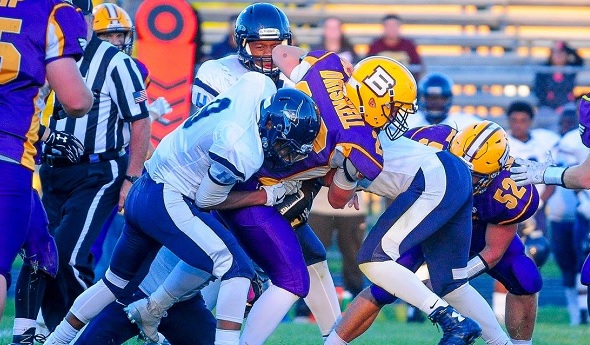
PHOTO: Flint Hamady (blue helmets) downed Byron in Week 2 and takes on Durand this week; Byron takes on New Lothrop, which with Durand is tied for first in the Genesee Area Conference Blue. (Click to see more from Varsity Monthly.)