

Herremans' Focus on 'Dadding,' Giving Kids Similar Small-Town Childhood
By
Tom Kendra
Special for MHSAA.com
August 5, 2021
Todd Herremans played 11 seasons in the NFL, battling big-name defensive linemen every Sunday and ascending to celebrity status in Philadelphia.
 But make no mistake: He’s still a small-town, Ravenna boy at heart.
“We lived in downtown Philly for the last 10 years and then the kids came along,” said Herremans, a 2001 graduate of Ravenna High School. “I tried to make it work, but one day it just hit me that I have no idea how to raise kids in the city.”
So, in a scene straight out of the 1960’s television comedy “Green Acres,” in January he loaded up his wife, Elizabeth, daughter Olivia (5) and son Jaxon (3) and moved to a farm in West Chester, a small town about 50 miles east of Philadelphia.
One of the goals of the move has been to provide his kids with a childhood something like his idyllic upbringing in Ravenna, a rural village in eastern Muskegon County with about 1,200 residents.
Herremans’ father, Paul, is approaching his 31st season as the varsity baseball coach at Ravenna, despite retiring as a math teacher in 2010. He has also coached football and basketball at Ravenna since the 1970s and, as a result, his sons John, Scott and Todd basically grew up under the bleachers.
“I remember being really little and I couldn’t wait to be old enough to be the bat boy,” said Todd Herremans, now 38, whose mother, Marilee, was also a teacher. “Then once I did that, I was itching to put on the pads and the uniforms. Then I couldn’t wait to be on the varsity.”
 He grew up to be a four-sport athlete at Ravenna – starring in football, basketball and baseball (along with helping out the track & field team in his senior year, throwing the discus and shot put) – and he credits playing multiple sports for helping him not only make it to the NFL, but to stay there for 11 years and remain healthy enough to start 126 of 135 career games.
“There’s no doubt playing other sports helped me make it to the NFL – the footwork I developed playing basketball and things like that,” said Herremans. “But it really helped me stay there. When you play different sports you are in different scenarios and fill different roles on each team. I think I was more adaptable than some of the other guys I played with.”
Herremans earned all-West Michigan Conference honors in football, basketball and baseball at Ravenna, but he was a late bloomer in many ways as his skill set grew into his big frame.
He went on to start for four years at Saginaw Valley State, playing in 48 games and starting 40 of them at left or right offensive tackle. During his senior year at Saginaw Valley he earned first-team Little All-America honors from The Associated Press, which put him firmly on the NFL radar.
He was selected in the fourth round of the 2005 NFL Draft, when the Eagles traded up to take him with Green Bay’s pick (126th overall). He started his first NFL game Nov. 27, 2005, and remained a fixture on the Eagles’ offensive front for the next decade.
Herremans, who played at 6-foot-6 and 323 pounds, was known for his consistency and durability, as well as his versatility – playing every interior line position for the Eagles except for center.
The versatility didn’t stop there, however, as he is one of the few interior offensive linemen in NFL history to catch two touchdown passes, one each in 2008 and 2010.
After being released by the Eagles in 2015, he was picked up right away by Indianapolis, where he started two games.
These days, Herremans spends much of his time taking care of his children at the farm in West Chester and also at his cottage on Torch Lake in northern Michigan.
“I do a lot of dadding,” he said with a laugh.
Since his retirement, Herremans and a partner started BodyChek Wellness, a company that makes hemp-based products to help with wellness, balance and recovery. He is also a member of Athletes for Care, a group that advocates for athletes on various issues of health and safety, including the use of cannabis as medicine.
He looks forward to the summer months, when he spends most of his days at his northern Michigan cottage, allowing him a perfect place and opportunity to catch up with his family and friends from both Ravenna and Saginaw Valley.
Even better is having time to watch his kids grow up, which he said would have been nearly impossible during his NFL playing days.
“I have a lot of fun being with them,” Herremans said. “Ever since we moved out to the country, my son has been obsessed with tractors and tools. I love that.”
2020-21 Made in Michigan
July 29: Loy Norrix Career Prepped Crocker for U-M Success, Law Degree Pursuit - Read
July 19: Top PGA Pro Finish Latest Greatest Highlight as Cook Continues Climb - Read
July 16: TC West Standout Renews Ties to Titans, Cheers Past Teammates' Gold Pursuit - Read
July 8: Caro Champs Find Common Ground Again as Mental Health Providers - Read
June 28: Michigan's Minor Leaguers Making Up for Lost Season - Read
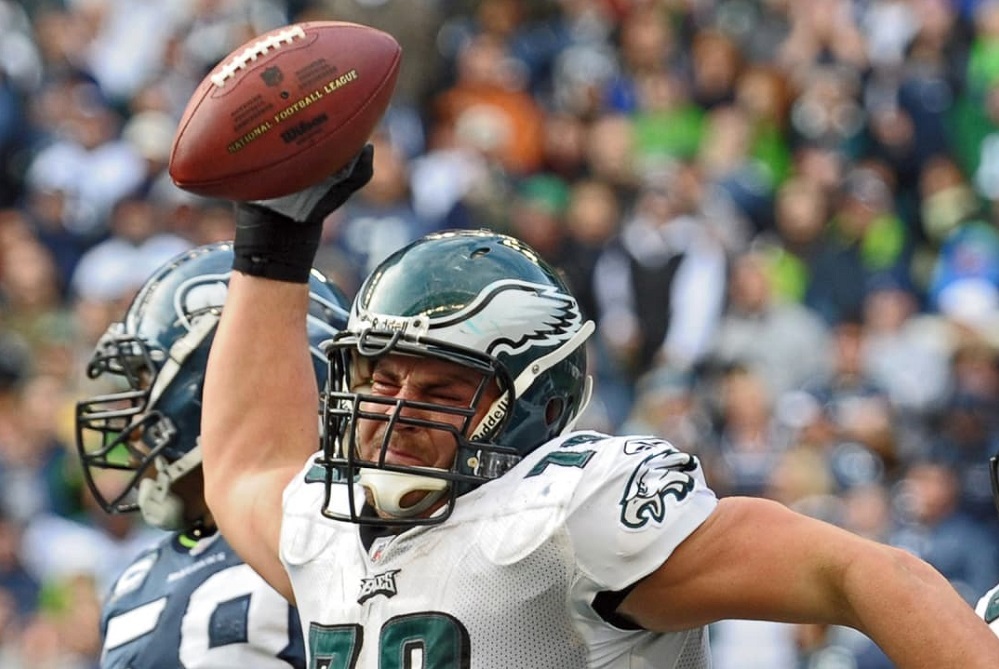
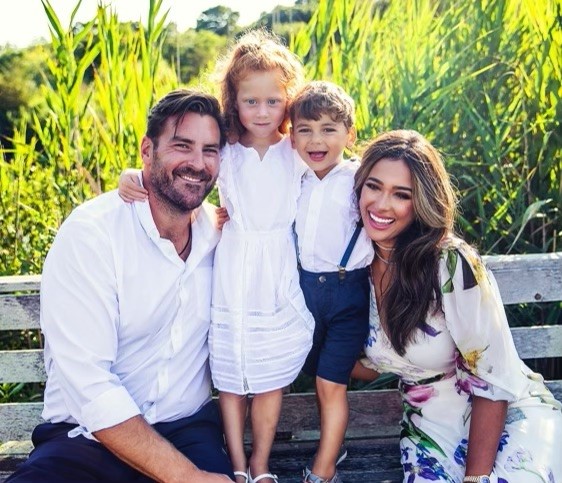
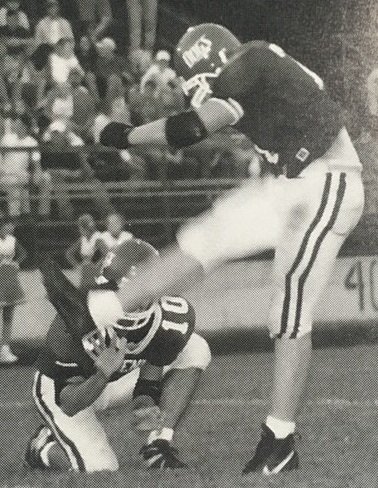
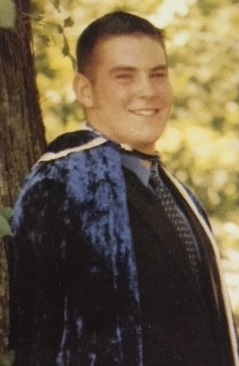
PHOTOS: (Top) Past Ravenna standout Todd Herremans, here with the Philadelphia Eagles, spikes after scoring in 2008. (Middle) Herremans with wife Elizabeth and children Olivia and Jaxon. (Below) Todd’s high school memories include kicking field goals and earning the Homecoming crown. (Top photo courtesy of the Philadelphia Eagles; middle photo courtesy of the Herremans family; below photos courtesy of Ravenna High School.)
1st & Goal: 8-Player Finals Preview
By
Geoff Kimmerly
MHSAA.com senior editor
January 15, 2021
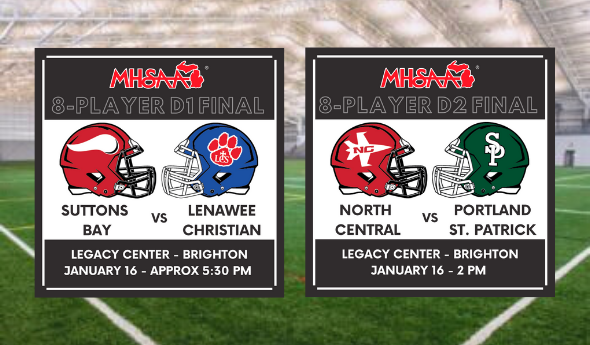
Four undefeated teams will be the first to play for championships to cap the longest football season in MHSAA history.
Adrian Lenawee Christian and Suttons Bay in Division 1 and Portland St. Patrick and Powers North Central in Division 2 will take the field at Brighton’s Legacy Center on Saturday with this season’s two 8-player titles on the line. They returned to action last week after a nearly two-month pause due to COVID-19.
Suttons Bay and Portland St. Patrick are the 2019 runners-up in Divisions 1 and 2, respectively. Adrian Lenawee Christian is new to the format this season and like Suttons Bay is playing for its first football title. North Central, meanwhile, is the only program to win multiple 8-player championships since the format was added in 2011, and the Jets are back at the Finals for the first time since their repeat run in 2016.
Kickoff for the Division 2 game is 2 p.m., with the Division 1 game following approximately 5:30 p.m. Spectators remain limited, but both games will be broadcast live on the FOX Sports Detroit Facebook page, and replayed on FOX Sports Detroit’s primary channel Jan. 21 beginning at 8 p.m. Audio of both games will be streamed live on MHSAANetwork.com.
Below is a look at all four finalists. Team “rankings” are based on their playoff-point averages heading into the postseason.
Division 1
ADRIAN LENAWEE CHRISTIAN
Record/rank: 10-0, No. 3
Coach: Bill Wilharms, eighth season (59-21)
League finish: First in Southern Central Athletic Association A
Championship history: Has never played in an MHSAA Final.
Best wins: 49-0 over No. 1 Morrice in Regional Final, 47-12 over No. 8 Martin in Semifinal, 78-14 over No. 4 Mayville in Regional Semifinal, 24-6 over Division 2 No. 5 Colon.
Players to watch: RB/LB Jameson Chesser, 5-10/170, sr. (1,179 yards/29 TDs rushing, 506 yards/4 TDs receiving); QB/CB Landon Gallant, 5-10/155, sr. (1,331 yards/23 TDs passing, 388 yards/6 TDs rushing); OG/NG Coby Kegerreis, 5-8/185, jr.; C/DE Joey Breckel, 6-1/240, sr.
Outlook: Lenawee Christian’s 8-player debut couldn’t have gone better on the field, as the Cougars have won only one game by fewer than 35 points. That was an 18-point victory over league foe Colon, last season’s Division 1 champion, and Saturday the Cougars can make it a repeat for the SCAA Division A. Chesser – who also has thrown for 178 yards and two touchdowns on 17 attempts – made the all-state first team and scored five times against Martin in the Semifinal. Kegerreis also made the all-state first team, as did junior kicker Clay Ayers (41 of 48 XP), and Breckel earned honorable mention. Those four and Gallant also start on a defense that’s given up only 46 points over 10 games.
SUTTONS BAY
Record/rank: 10-0, No. 1
Coach: Garrick Opie, third season (30-2)
League finish: Does not play in a league.
Championship history: 8-player Division 1 runner-up 2019, 11-player Division 6 runner-up 2004.
Best wins: 38-22 over No. 8 Gaylord St. Mary in Regional Final, 35-0 over Brethren, 39-20 and 44-0 (Regional Semifinal) over Whittemore-Prescott.
Players to watch: RB/DB Hugh Periard, 6-0/175, jr. (799 yards/13 TDs rushing, 217 yards/3 TDs receiving); QB/DB Nate Devol, 6-0/175, sr. (901 yards/15 TDs passing, 301 yards/2 TDs rushing, 4 interceptions on defense); RB/LB Shawn Bramer, 6-2/195, jr. (622 yards/11 TDs rushing, 60 yards/1 TD receiving); OL/LB Michael Wittman, 6-4/230, sr.
Outlook: Suttons Bay is returning to the Division 1 championship game after falling short in a 26-14 defeat to Colon in 2019. The Norsemen have won all of their games by double digits, with a defense giving up only 7.6 points per game and a rushing attack that has piled up 2,506 yards over nine games (last week’s Semifinal win was a forfeit by Indian River Inland Lakes). Wittman made the all-state first team as a linebacker. Starting tight ends Jake Murphy and Brayden Opie add another element to the attack – both have caught 15 passes, with Murphy scoring on five and Opie on six.
Division 2
PORTLAND ST. PATRICK
Record/rank: 10-0, No. 1
Coach: Patrick Russman, 13th season (96-39)
League finish: Does not play in the league.
Championship history: 8-player Division 2 runner-up 2019 and 2017, 11-player Class D champion 1992, runner-up 1997 and 1991.
Best wins: 44-34 over No. 5 Colon in Regional Final, 34-12 over No. 7 Kinde North Huron in Semifinal, 52-19 over No. 4 Burr Oak, 26-22 over Division 1 No. 6 Merrill.
Players to watch: QB/DB Connor Cross, 6-3/190, sr. (1,245 yards/21 TDs passing, 429 yards/9 TDs rushing, 4 interceptions on defense); RB/LB Derec Fedewa, 5-10/185, jr. (1,369 yards/19 TDs, 311 yards/5 TDs receiving); WR/LB Braxton Teachworth, 6-3/190, jr. (193 yards/3 TDs receiving); OL/DL Chase Fitzsimmons, 6-3/240, sr.
Outlook: The Shamrocks have come within a win of the Division 2 championship twice over the last four seasons, and will make a run at it again with an offense featuring all-state first teamers at quarterback and running back. Cross and Fedewa have piled up big numbers this fall, as has leading receiving Shane Cook (502 yards/9 TDs), for a team scoring 43.5 points per game. But the key Saturday could be an opportunistic defense that has taken advantage of 28 turnovers – including 19 fumble recoveries – and allowed conversions on only 19 percent of opponent third downs. Fitzsimmons and Teachworth earned all-state honorable mentions, Teachworth at linebacker.
POWERS NORTH CENTRAL
Record/rank: 10-0, No. 2
Coach: Leo Gorzinski, third season (28-3)
League finish: First in Great Lakes Eight Conference West
Championship history: 8-player champion 2016 and 2015.
Best wins: 55-8 over No. 3 Cedarville in Regional Final, 50-2 over No. 8 Marion in Semifinal, 50-8 over Stephenson, 52-8 over Lake Linden-Hubbell in Regional Semifinal.
Players to watch: QB/LB Luke Gorzinski, 5-9/170, soph. (1,163 yards/18 TDs passing, 909 yards/20 TDs rushing); WR/LB Ian Gorzinski, 5-11/165, sr. (362 yards/5 TDs receiving, 101 yards/3 TDs rushing); RB/LB Alex Naser, 5-8/165, jr. (312 yards/7 TDs rushing, 301 yards/7 TDs receiving, 2 TDs on kickoff returns); OL/DL Carter Eichmeier, 6-2/190, sr.
Outlook: The Jets will match St. Patrick’s all-state quarterback with the other all-state first-team signal-caller this season in Luke Gorzinski, who is coming off four touchdown runs and a scoring pass in the Semifinal. He keys an offense that has outscored opponents 280-8 in the first quarter alone and 539-60 in nine games overall (one win was a forfeit). Eichmeier also made the all-state first team as North Central won all but one of its games by more than 40 points. In addition to the sparse points given up, the Jets are allowing only 114 yards per game.