


Herremans' Focus on 'Dadding,' Giving Kids Similar Small-Town Childhood
By
Tom Kendra
Special for MHSAA.com
August 5, 2021
Todd Herremans played 11 seasons in the NFL, battling big-name defensive linemen every Sunday and ascending to celebrity status in Philadelphia.
 But make no mistake: He’s still a small-town, Ravenna boy at heart.
“We lived in downtown Philly for the last 10 years and then the kids came along,” said Herremans, a 2001 graduate of Ravenna High School. “I tried to make it work, but one day it just hit me that I have no idea how to raise kids in the city.”
So, in a scene straight out of the 1960’s television comedy “Green Acres,” in January he loaded up his wife, Elizabeth, daughter Olivia (5) and son Jaxon (3) and moved to a farm in West Chester, a small town about 50 miles east of Philadelphia.
One of the goals of the move has been to provide his kids with a childhood something like his idyllic upbringing in Ravenna, a rural village in eastern Muskegon County with about 1,200 residents.
Herremans’ father, Paul, is approaching his 31st season as the varsity baseball coach at Ravenna, despite retiring as a math teacher in 2010. He has also coached football and basketball at Ravenna since the 1970s and, as a result, his sons John, Scott and Todd basically grew up under the bleachers.
“I remember being really little and I couldn’t wait to be old enough to be the bat boy,” said Todd Herremans, now 38, whose mother, Marilee, was also a teacher. “Then once I did that, I was itching to put on the pads and the uniforms. Then I couldn’t wait to be on the varsity.”
 He grew up to be a four-sport athlete at Ravenna – starring in football, basketball and baseball (along with helping out the track & field team in his senior year, throwing the discus and shot put) – and he credits playing multiple sports for helping him not only make it to the NFL, but to stay there for 11 years and remain healthy enough to start 126 of 135 career games.
“There’s no doubt playing other sports helped me make it to the NFL – the footwork I developed playing basketball and things like that,” said Herremans. “But it really helped me stay there. When you play different sports you are in different scenarios and fill different roles on each team. I think I was more adaptable than some of the other guys I played with.”
Herremans earned all-West Michigan Conference honors in football, basketball and baseball at Ravenna, but he was a late bloomer in many ways as his skill set grew into his big frame.
He went on to start for four years at Saginaw Valley State, playing in 48 games and starting 40 of them at left or right offensive tackle. During his senior year at Saginaw Valley he earned first-team Little All-America honors from The Associated Press, which put him firmly on the NFL radar.
He was selected in the fourth round of the 2005 NFL Draft, when the Eagles traded up to take him with Green Bay’s pick (126th overall). He started his first NFL game Nov. 27, 2005, and remained a fixture on the Eagles’ offensive front for the next decade.
Herremans, who played at 6-foot-6 and 323 pounds, was known for his consistency and durability, as well as his versatility – playing every interior line position for the Eagles except for center.
The versatility didn’t stop there, however, as he is one of the few interior offensive linemen in NFL history to catch two touchdown passes, one each in 2008 and 2010.
After being released by the Eagles in 2015, he was picked up right away by Indianapolis, where he started two games.
These days, Herremans spends much of his time taking care of his children at the farm in West Chester and also at his cottage on Torch Lake in northern Michigan.
“I do a lot of dadding,” he said with a laugh.
Since his retirement, Herremans and a partner started BodyChek Wellness, a company that makes hemp-based products to help with wellness, balance and recovery. He is also a member of Athletes for Care, a group that advocates for athletes on various issues of health and safety, including the use of cannabis as medicine.
He looks forward to the summer months, when he spends most of his days at his northern Michigan cottage, allowing him a perfect place and opportunity to catch up with his family and friends from both Ravenna and Saginaw Valley.
Even better is having time to watch his kids grow up, which he said would have been nearly impossible during his NFL playing days.
“I have a lot of fun being with them,” Herremans said. “Ever since we moved out to the country, my son has been obsessed with tractors and tools. I love that.”
2020-21 Made in Michigan
July 29: Loy Norrix Career Prepped Crocker for U-M Success, Law Degree Pursuit - Read
July 19: Top PGA Pro Finish Latest Greatest Highlight as Cook Continues Climb - Read
July 16: TC West Standout Renews Ties to Titans, Cheers Past Teammates' Gold Pursuit - Read
July 8: Caro Champs Find Common Ground Again as Mental Health Providers - Read
June 28: Michigan's Minor Leaguers Making Up for Lost Season - Read
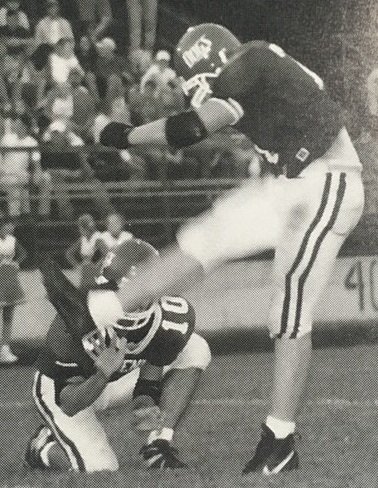
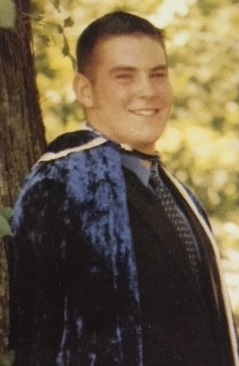
PHOTOS: (Top) Past Ravenna standout Todd Herremans, here with the Philadelphia Eagles, spikes after scoring in 2008. (Middle) Herremans with wife Elizabeth and children Olivia and Jaxon. (Below) Todd’s high school memories include kicking field goals and earning the Homecoming crown. (Top photo courtesy of the Philadelphia Eagles; middle photo courtesy of the Herremans family; below photos courtesy of Ravenna High School.)
Capac Ends 14-Year Postseason Drought, Eager to Begin 8-Player Playoff Run
By
Paul Costanzo
Special for MHSAA.com
October 29, 2025
Not having the option to qualify for the 8-player postseason wasn’t something the Capac football concerned itself with the past three seasons.
 Enrollment was too high at the school to be included in the MHSAA playoff field, and while the 2024 team most certainly would have made it, co-coach Troy Schneider said that since there was nothing that could be done about it, the players weren’t really concerned with it.
But this year, with the opportunity finally there, it lit a fire under the Chiefs.
“It was very motivating for us,” Capac senior quarterback Brody Tesnow said. “All summer, we had decent numbers show up to workouts. Our senior group was really pushing everyone. Our coaches have been on us all year, telling us this is our year that we can do this. I mean, really, we had a decent season last year, and I just feel like that pushed me more to come back this year and be even better.”
Capac is back in the playoffs for the first time since 2011, and at 7-2 is coming off its best regular season since 2001.
That year, the Chiefs advanced to the Division 5 Semifinals. This year’s run will start Friday night with a matchup at Brown City in 8-Player Division 1. A win would be the program’s first in the postseason since 2009.
“I’d love that,” Tesnow said. “That would be a great feeling for us, all the seniors. I remember that win over Deckerville (in Week 8), that was a surreal feeling. I could only imagine what a playoff win would feel like, especially after 14 years of not being in the playoffs.”
It’s been a long road for Capac, which has now had its first back-to-back winning seasons since running off four straight from 2008-11.
Enrollment at the school was near its height back then, peaking at 613 in 2008 before starting a steady decline. It first dipped below 400 in 2015, and by 2020 it was under 300.
That, naturally, led to a decline in football participation as well, and the team was unable to complete the 2020 season, a year where nearly everyone was granted access to the postseason because of the COVID-19 pandemic.
After a 1-8 run in 2021, with a total school enrollment of 211, Capac made the decision to switch from 11-player to 8-player. In each of its first three seasons under the new format, Capac was over the 215-student limit for competing in the postseason. This year, the school is at 203.
 “I didn’t have any decision in that, but our numbers had dropped steadily for a number of years in the school,” said Schneider, who had coached at Capac in 2000s, and took over as varsity coach with Bill Nestle in 2024. “When we came out of the (Blue Water Area Conference), we were a small school, and we were getting pretty well destroyed. Once we moved into the other conference (Greater Thumb), we were with Ubly and Harbor Beach, and I wasn’t coaching at the time, but those are some really good teams, too. There were quite a few people who did not want to make a move to 8-man, but the writing was on the wall with the numbers at the school and the numbers in the football program. It’s been a good move for us. Obviously, a lot of schools have gone to that in the last five years.”
When the program moved to 8-player in 2022, the current senior class was entering high school. Schneider and Nestle had been coaching that group in middle school, and it had shown quite a bit of promise.
There are currently 15 seniors on the varsity team, and while there are only 18 players total on the roster, the junior varsity and middle school programs are thriving, which has people in the high school program optimistic about a future that was pretty uncertain not long ago.
“We’ve got some potential coming up – things are looking pretty good,” Schneider said. “The junior group is small, so they’re going to have small numbers next year as seniors, but the three juniors we have are starters. The next three to four years, it should stay steady and we should be solid.”
But there’s still plenty of work to be done this year, and Capac is confident heading into the postseason despite the fact it lost to Brown City 61-22 in Week 3.
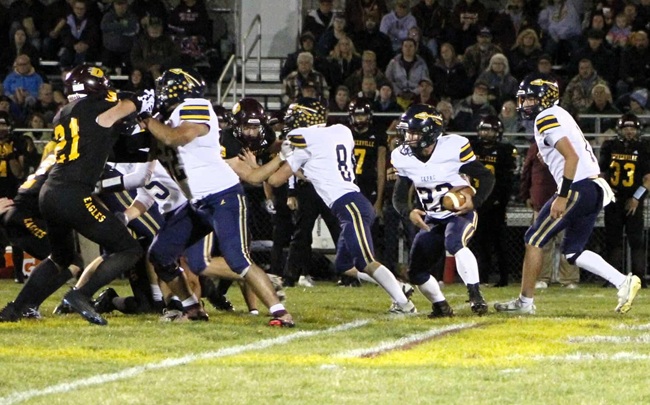
Much of that confidence comes from that Week 8 win against 2024 8-Player Division 1 champion Deckerville. The 28-20 triumph ended Deckerville’s 20-game win streak, as it had not lost since the 2023 Semifinals. It was the first regular-season loss for the Eagles since Sept. 29, 2023.
“Starting the season we went kind of slow, but beating Deckerville told us that we were on that top tier,” senior defensive end and tight end Wiley Roose said. “I mean, after that game, it was crazy. To me, it was definitely the highlight of my sports career in high school. The whole team really came around.”
Beating Deckerville is an accomplishment in its own right, but the fact the Eagles had this season defeated Brown City and Kingston – which delivered Capac’s two losses – was another boost of confidence for the Chiefs, who are ready to show how far they’ve come this fall.
“We watched some film from the game (against Brown City) earlier in the season, and we were just comparing what we were then to how we are now,” Tesnow said. “It’s a huge difference. I’m pumped. We’re proving everyone wrong, and I love that feeling of being the underdog and surprising people.”
Tesnow and his teammates are hoping to continue doing that, but what they’ve done already to get the Capac program back on the right track is a massive accomplishment in itself.
“Coach Nestle and I care about all our players, but seeing these kids develop for five years, go through school, go through some of the losing seasons early in middle school then slowly build and get better – I can think of a number of kids and how they improved with being more aggressive, being tougher and taking the next step,” Schneider said. “It’s really nice to see the kids develop through the program. It’s been sweet. It’s that much better because it’s a great group of kids. They’re wonderful.”
 Paul Costanzo served as a sportswriter at The Port Huron Times Herald from 2006-15, including three years as lead sportswriter, and prior to that as sports editor at the Hillsdale Daily News from 2005-06. He can be reached at [email protected] with story ideas for Genesee, Lapeer, St. Clair, Sanilac, Huron, Tuscola, Saginaw, Bay, Arenac, Midland and Gladwin counties.
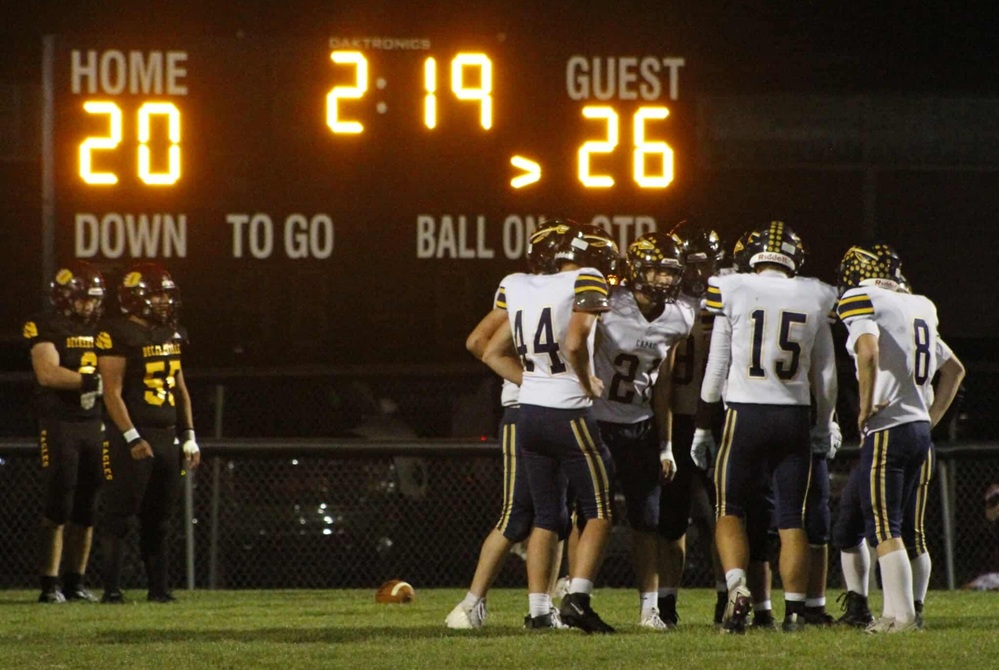
PHOTOS (Top) Capac huddles up during the closing minutes of its Week 8 win over Deckerville. (Middle) Sam Schneider (22) carries the ball and follows his Chiefs blockers as they attempt to create an opening against the Eagles. (Photos courtesy of the Capac football program.)